Skip to product information
1 of 3

Vintage and Antique Gifts

Vintage 1960s Copper Door Wooden Nickel Token Good For 1 Free Drink Springfield Massachusetts Bar Coin Collectible NOS ✨

Vintage 1960s Copper Door Wooden Nickel Token Good For 1 Free Drink Springfield Massachusetts Bar Coin Collectible NOS ✨

Regular price 5.50 USD
Regular price Sale price 5.50 USD
Sale Sold out
Shipping calculated at checkout.
Quantity

What Happened to the Springfield That Knew Your Order Before You Sat Down? 🪙

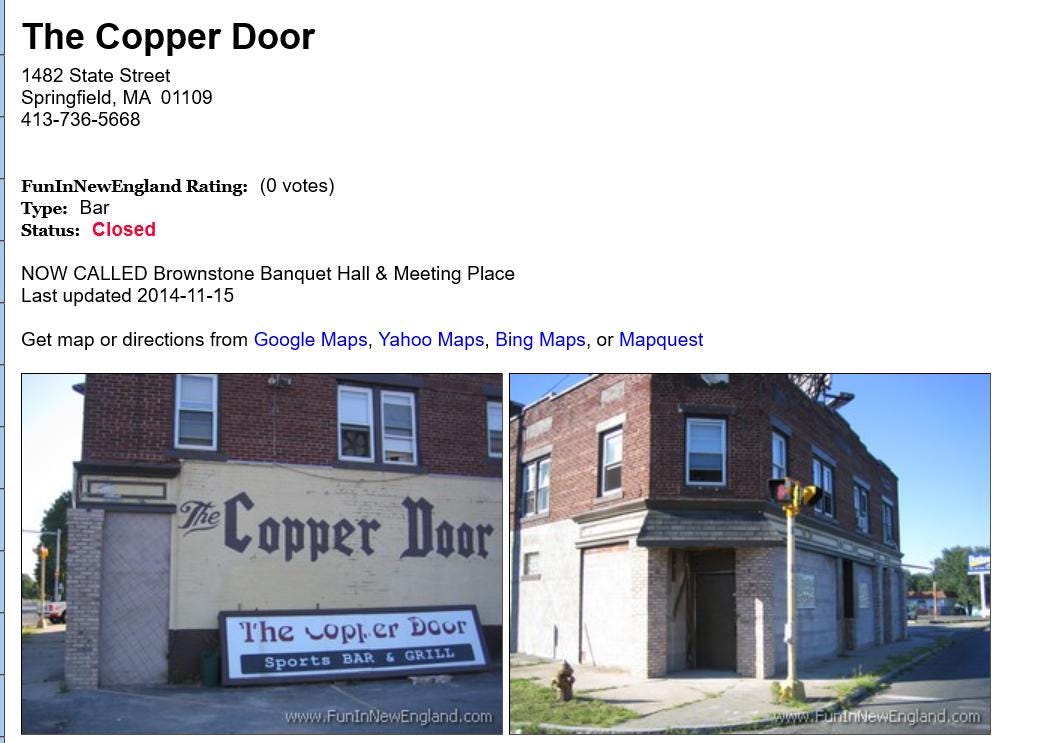
There is a version of Springfield, Massachusetts that lives only in memory now — in the recollections of people who grew up along State Street, who remember the sound of a jukebox warming up at five o'clock, the smell of cigarette smoke and spilled beer and ambition, and the easy comfort of walking into a neighborhood bar where the bartender's hand was already reaching for your glass before you even pulled out a stool. That Springfield was real. It had names and addresses and regulars with opinions. It had the Jilly Jester and the Gaslight Room and the Pesky Sarpent and, at 1482 State Street, it had The Copper Door. Most of what that world left behind is gone — swallowed by time and changing neighborhoods and the long, slow drift of American social life away from the corner tavern and toward somewhere else entirely. But this small copper-colored disc survived. It outlasted the bar that made it, the decade that loved it, and sixty years of attrition. That's not nothing. That's a miracle, quietly shaped like a coin.


🪙 What This Piece Is — The Object Itself

This is a New Old Stock (NOS) vintage wooden nickel promotional drink token from The Copper Door bar and restaurant, located at 1482 State Street in Springfield, Massachusetts, dating to the 1960s. "New Old Stock" means exactly what it sounds like: this token was produced, placed into circulation as a promotional item, and somehow — through a back-room drawer, a forgotten box behind the bar, the careful hands of someone who couldn't bear to throw things away — it survived the decades without being used or significantly handled. It has never been redeemed. The drink it was worth was never poured.

The token measures approximately 1.5 inches in diameter, which places it squarely within the standard format for the American bar token of the era — a size that was deliberately chosen to approximate the feel and heft of a U.S. half dollar coin, making it satisfying to hold and easy to carry in a shirt pocket or a coin purse without getting lost. Both faces carry deep, cleanly struck impressions that have held their legibility beautifully across sixty-plus years. The text arching above reads WOODEN NICKEL, and the legend MADE IN USA sits beneath a central portrait element. A clean incised border circle contains the entire composition with the kind of confident, unfussy design sensibility that characterized the best of American commercial printing in that period. The reverse states the token's purpose in plain, direct type: Good For 1 Free Drink, followed by THE COPPER DOOR, and the address — 1482 State St., Spfld — abbreviated the way only locals would have abbreviated it, the way people write an address when they assume you already know where they mean.

The material and construction reflect the wooden nickel tradition accurately: these tokens were typically produced from compressed fiber or lightweight composite stock and then copper-plated or finished to give them a coin-like appearance and a longer lifespan than raw wood. The result was something that felt substantial without being heavy, decorative without being fussy, and official enough to hand across a bar with confidence. The production of tokens like this one was a cottage industry unto itself in mid-century America, with specialty manufacturers fulfilling small-batch orders for taverns, lodges, promotions, and events from coast to coast.


🍺 The Wooden Nickel Tradition — An American Promotion Born at the Bar

The phrase "don't take any wooden nickels" is older than the tokens themselves — it was already a piece of American folk idiom by the early twentieth century, used as a gentle warning against being swindled. The wooden nickel as a deliberate, tongue-in-cheek promotional artifact turned that warning inside out. By the 1930s and especially through the postwar boom of the 1950s and 1960s, bars, restaurants, lodges, fairs, and civic organizations across the country had discovered that a small, coin-shaped token printed with their name and a specific offer was one of the most cost-effective pieces of advertising they could produce. Customers kept them. They showed them to friends. They carried them home in their pockets and set them on dressers and forgot about them in jacket lining pockets for years — which meant the bar's name and address traveled far beyond the building itself.

For a neighborhood tavern like The Copper Door, a token good for one free drink served multiple purposes simultaneously. It was a reward for loyal customers, a conversation piece at parties, a reason to come back, and a small, durable advertisement for the establishment's address and identity. The "Good For 1 Free Drink" format was the most popular of all the wooden nickel variations — more intimate than a coupon, more tactile than a business card, and carrying just enough monetary implication to feel like a genuine gift. Whether or not The Copper Door used them exactly that way, the practice fits the culture of the era precisely.

The 1960s represented the apex of the wooden nickel moment in American promotional culture. Production quality was high, designs were creative, and the sheer variety of establishments participating in the format — from working-class taverns to supper clubs to resort hotels — meant that a serious collector today can find tokens that read like a complete sociological map of mid-century American leisure. This Springfield example is among the finer surviving specimens of that tradition, not only because of its NOS condition but because of the specificity of its provenance: a named bar, a named street, a named city, and a decade we can date it to with confidence.


🏙️ Springfield, Massachusetts — The City Behind the Token

Springfield sits in the Pioneer Valley of western Massachusetts, along the Connecticut River, and it has always carried a particular kind of urban pride that is distinct from the college-town culture of nearby Northampton or Amherst. This was an industrial city — a city of armories and precision manufacturing, of immigrant neighborhoods that built themselves into something permanent, of working people who clocked in and clocked out and then went somewhere with good lighting and familiar faces at the end of the day. The Springfield Armory produced weapons that shaped American history. The Basketball Hall of Fame calls Springfield home, because Dr. James Naismith invented the game here in 1891. The city contributed to the American story in outsized ways relative to its size.

State Street was one of the primary arteries of Springfield's social geography — a corridor that ran through neighborhoods, past churches and triple-deckers and small commercial strips, connecting communities to each other and to the downtown core. A bar at 1482 State Street would have been embedded in that neighborhood fabric in the way that only corner institutions can be: not just a place to drink, but a place where people processed their weeks, made decisions, celebrated things, argued about the Red Sox, and occasionally said something true that they wouldn't have said anywhere else. Local legend has it that State Street in its mid-century heyday supported more neighborhood taverns per block than almost any comparable corridor in western New England — a density of social spaces that reflected the working-class density of the neighborhoods they served and the deep cultural tradition of the public house as community anchor that many of Springfield's immigrant communities brought with them from Europe.

The Copper Door ran alongside a cluster of Springfield bars that have since passed into local memory — the Jilly Jester, the Gaslight Room, the Pesky Sarpent. These names feel half-invented now, like something from a novel set in the fifties, but they were real places with real regulars and real bartenders who had opinions about things. Almost nothing physical survives from most of them. No menus, no photographs on a publicly accessible archive, no matchbooks in a museum case. The wooden nickel from The Copper Door is the kind of object that occasionally surfaces to remind us that these places existed — that they mattered to real people in a real neighborhood in a real American city — and that the texture of mid-century urban life was richer and more specific than the broad strokes of history usually record.

Springfield has reinvented itself multiple times since the 1960s, as most American industrial cities have, and the neighborhood tavern culture of State Street belongs to an era that the city has largely moved through and beyond. That's not a lament — it's simply the shape of urban time. But for collectors and local historians, objects like this token are primary sources. They tell us something was here. They carry an address. They make a claim on the record.


👤 The People Who Made These Things Matter

Behind every wooden nickel is a small business owner who made a decision — probably not a complicated one, probably not expensive, but a decision nonetheless — to invest in something physical that represented their establishment. The owner of The Copper Door in the 1960s ordered these tokens with an intention: to build loyalty, to reward customers, to put the bar's name in people's pockets. We don't know their name with certainty from what survives. What we know is what the token itself tells us — that they were proud enough of 1482 State Street to put it in print, that they expected the bar to be there long enough for the token to come back, and that they wanted their customers to feel like they had something of value in their hands.

The bartenders who actually distributed these tokens are the invisible figures in this story — the people who handed them across the bar with a wink, or tucked one into a regular's coat pocket at closing time, or kept a small stack near the register for the right moment. Those gestures were the entire point of the wooden nickel promotion. The token was a vehicle for a human transaction: a moment of recognition between the person behind the bar and the person on the other side of it. This particular token, never redeemed, still carries the potential of that moment frozen inside it. The drink was never poured. The gesture was never completed. It's been waiting sixty years.


🖼️ Display Ideas

  • 🗃️ Shadowbox with local ephemera: Mount the token alongside a vintage Springfield city map detail showing State Street, a period postcard of downtown Springfield, and a small printed caption identifying The Copper Door — a micro-exhibit of a lost neighborhood institution.
  • 🍺 Bar cart or home bar vignette: Display in a shallow glass dish or on a small wooden stand as part of a curated grouping of mid-century bar memorabilia — vintage cocktail picks, a period swizzle stick, a matchbook from a contemporary establishment — evoking the atmosphere of the era.
  • 🪙 Coin and token collector's display: Pair with other New England bar tokens, wooden nickels from Massachusetts establishments, or mid-century promotional coin formats in a collector's tray or framed display with archival backing — a regional survey of a specific promotional tradition.
  • 📚 Local history reference shelf: Rest the token in a small acrylic display stand beside books on Springfield history, Pioneer Valley social history, or mid-century American tavern culture — treating it as the primary source artifact it genuinely is.
  • 🎁 Framed gift for the Springfield native: Present in a small frame with a typed card summarizing The Copper Door's address and era — a deeply personal gift for anyone who grew up in or around Springfield in the 1960s, or whose family history connects to State Street.
  • 🏛️ Office or study curiosity cabinet: A small, well-lit shelf or curiosity cabinet grouping of NOS promotional items from American small businesses — tokens, trade cards, celluloid buttons — with this Springfield piece as an anchor object representing the neighborhood tavern category.

🎁 Who Collects These

The audience for a piece like this is genuinely broad, and the reasons people are drawn to it are layered in ways that make it one of the more satisfying categories of small American collectibles to work in.

There are the wooden nickel specialists — and they exist, with real depth of knowledge and carefully organized collections sorted by region, decade, establishment type, and design quality. The wooden nickel and bar token collecting community is well-established, with reference materials, dedicated shows, and a shared vocabulary for grading and categorizing these pieces. An NOS token from a named Springfield bar in this condition is a significant find within that community.

There are the Springfield and western Massachusetts local historians — people who care about the Pioneer Valley's social history the way other collectors care about their great-grandparents' photographs. For someone researching the neighborhood tavern culture of mid-century Springfield, or building an archive of State Street businesses, or writing about the social geography of working-class Massachusetts, this token is a primary source document as much as it is a collectible object.

There are the mid-century Americana enthusiasts — collectors whose interest is the broader texture of postwar American life, the small-business culture, the promotional ephemera, the graphic design sensibilities of the 1950s and 1960s as expressed in everyday commercial objects. A wooden nickel fits that interest perfectly: it's durable, displayable, specific, and charged with the particular optimism of an era when a neighborhood bar could afford to give something away and trust that the gesture would come back to them.

And then there are the personal history seekers — people who had a grandfather who drank at The Copper Door, or who remember their parents talking about State Street, or who grew up in Springfield and find in this token a piece of the city they knew as children that they didn't realize could still be found. For that person, this isn't a collectible at all. It's a recovered fragment of something they thought was gone.


❓ Frequently Asked Questions

What does "New Old Stock" (NOS) mean for a bar token like this one?

New Old Stock means the token was produced during its original era — in this case, the 1960s — and has survived to the present day without being put to its intended use or subjected to significant circulation or handling. This token was never redeemed at The Copper Door for a free drink. It was never worn smooth by years in someone's pocket, never passed across a wet bar top, never bent or scratched in the way that a truly circulated token typically is. It exists in a state that is as close to original production condition as a sixty-plus-year-old object can be, which is exactly what NOS means in the collector's vocabulary. For bar token collectors specifically, NOS condition is the gold standard — it means both faces retain their full impression clarity, the finish reads as intended, and the object carries no post-production damage. The fact that this token remained unused means the drink it represented was never poured — a small, strange preservation miracle that gave us a 1960s Springfield artifact in essentially unplayed condition.

Can I verify that The Copper Door was a real Springfield establishment?

The token itself is the most direct surviving evidence — it names the establishment, provides the street address (1482 State St., Spfld), and is consistent in format, material, and design with authenticated bar tokens from the same period and region. The address places it on State Street, one of Springfield's primary commercial and social corridors, in a neighborhood that was known for exactly this kind of working-class tavern and bar culture throughout the mid-twentieth century. The token also situates The Copper Door within the company of other named Springfield establishments — the Jilly Jester, the Gaslight Room, the Pesky Sarpent — that appear in the oral history and local memory of the city. Many small neighborhood bars of this era left minimal documentary traces in formal archives; the token is precisely the kind of primary source that allows us to confirm an establishment existed, operated at a specific address, and engaged in standard promotional practices of its day.

How do wooden nickel bar tokens like this one differ from actual coins or currency?

Bar tokens were never legal tender and were never intended to be — they were private promotional instruments issued by a specific business and redeemable only at that business for a specific purpose. The "wooden nickel" name, and the deliberate echoing of coin format in size and design, was always part of the joke: the idiom "don't take any wooden nickels" already existed as a warning against worthless imitations, and the promotional token industry cheerfully adopted the phrase and the format as a self-aware, humorous bit of commercial theater. The coin-like diameter (typically matching a half dollar, as this one does at approximately 1.5 inches), the incised border, the portrait-and-text layout — all of these were deliberate design choices that borrowed the visual authority of actual currency while making it clear, through material and marking, that this was something different. Collectors today are drawn to bar tokens precisely because they occupy this interesting liminal space between currency and advertising, between object and gesture.

What should I know about storing or caring for this token?

The token has already demonstrated its durability by surviving sixty-plus years in NOS condition, which suggests it has been kept away from moisture, direct sunlight, and significant temperature swings — the three primary threats to composite and plated promotional items from this era. To maintain its current state, continued storage in a cool, dry environment away from prolonged UV exposure is the main recommendation.

Many collectors store tokens like this in acid-free coin flips or archival sleeves when not on display, particularly if the token is being held as an investment piece rather than a display piece. For display, a small acrylic stand or a shadowbox with UV-filtering glazing will protect the finish from light degradation over time.

An establishment like The Copper Door would have ordered a single-run batch of tokens — all identical, all bearing the same "Good For 1 Free Drink" legend — from a specialty token manufacturer, and that batch would constitute the entire production for that design. There is no known series of Copper Door tokens with different designs or denominations; the single-drink-token format was by far the most common for neighborhood bars of this scale and era.

This means that every surviving Copper Door token from this production run is essentially the same object, but also that the total number of survivors from any given batch is inherently limited — most were redeemed (and thus lost to the bar's till), discarded, or simply worn out through handling. The NOS examples that survive do so precisely because they were kept rather than spent.

Why is the Springfield, Massachusetts geographic specificity significant for collectors?

Geographic specificity is one of the primary value drivers in bar token and promotional ephemera collecting, and for good reason: a token that names a real establishment at a real address in a real city is a document as well as an object. It can be placed in space and time with confidence. For collectors focused on New England memorabilia, Massachusetts social history, or Pioneer Valley regional history specifically, a token from a named State Street Springfield bar is both rarer and more meaningful than a generic promotional piece with no clear provenance. Springfield also has a devoted local history community — the kind of city where people care deeply about what was there before, where neighborhood institutions are remembered and mourned, and where a physical artifact from a lost establishment carries genuine emotional and historical weight. Collectors who specialize in Massachusetts tavern culture, or in the social history of industrial New England cities, will recognize this token immediately for what it is: a direct, physical connection to a specific place and time that no longer exists in any other tangible form.

How does this token relate to the broader history of American bar and tavern culture in the 1960s?

The 1960s were in many ways the last great era of the American neighborhood tavern as a primary social institution, particularly in working-class urban communities like Springfield's State Street corridor. Before the suburban shift fully restructured American social geography, before the rise of the restaurant-bar hybrid and the sports bar and the chain concept, the neighborhood tavern was still doing the work it had always done: providing a consistent, affordable, socially legible space where people from the same few blocks could reliably find each other.

The wooden nickel promotional token is a perfect artifact of that moment because it was cheap to produce, deeply personal in its address (it named a specific bar on a specific street), and entirely dependent on the assumption that the community it was aimed at was stable enough and local enough to return to the same establishment repeatedly.

It is a marketing tool designed for a world with a strong sense of place. That world was already beginning to change when The Copper Door ordered these tokens, and it continued changing until the Copper Door itself, along with the Jilly Jester and the Gaslight Room and the Pesky Sarpent, passed into memory. This token is what that world left behind at 1482 State Street — small, copper-colored, and still good for one free drink that will never now be poured.

Shipping

🚚 Shipping & Handling

  • Shipping costs and timing are calculated at checkout.
  • Items curated and shipped directly by me include U.S. shipping at no additional cost, professionally packed to ensure safe arrival of your artifact.

Items from Vetted Pro Collectors
Shipping for items offered by vetted Pro Collectors is determined at checkout. All Pro Collector listings are reviewed to ensure fair, reasonable shipping practices.

For full details, please refer to our Shipping Policy.

Returns & Exchange

Take your time — you've got a full six months. If a piece isn't right for you, send it back the way it reached you and we're good.

In the first 30 days your money goes straight back the way you paid. After that it's store credit, so you can put it toward something you'd rather have.

Return shipping we sort out between us, case by case. I don't make this difficult.

If something arrives damaged, or it isn't what I said it was, send me a photo within 48 hours and I'll make it right.

Email info@vintageantiquesgifts.com or call 802-356-9872 — that's me answering, not a call center.

The only things I can't take back are custom or special-order pieces and gift cards.

View full details
  • 5 stars: 1 (100%)
  • 4 stars: 0 (0%)
  • 3 stars: 0 (0%)
  • 2 stars: 0 (0%)
  • 1 star: 0 (0%)
m
mrbiercan

good fast transaction, good seller A++

TY!