Skip to product information
1 of 5

Vintage and Antique Gifts

Vintage 1960s Schlitz Malt Liquor Wooden Nickel Don't Take Wooden Nickels Chief Head Breweriana Beer Advertising Token Collectible 🍺

Vintage 1960s Schlitz Malt Liquor Wooden Nickel Don't Take Wooden Nickels Chief Head Breweriana Beer Advertising Token Collectible 🍺

Regular price 5.50 USD
Regular price Sale price 5.50 USD
Sale Sold out
Shipping calculated at checkout.
Quantity

Don't Take Wooden Nickels — But Would You Take THIS One? 🪵

There's a particular kind of American charm packed into a piece of wood no bigger than a silver dollar — small enough to slide across a bar top, light enough to forget in a shirt pocket until laundry day, and clever enough to carry a punchline that's been making people grin for the better part of a century. Old-timers who tended bar or worked the counter at a corner tavern remember these things showing up in cigar boxes, cash drawers, and coat pockets — a little joke from the brewery, handed over with a wink and a "don't spend that anywhere real." This is exactly that kind of piece: a Schlitz Malt Liquor wooden nickel, a genuine slice of American breweriana that has outlived the taverns it was handed out in.

This wooden nickel comes from the Jos. Schlitz Brewing Company of Milwaukee, Wisconsin — one of the true giants of American brewing — and it belongs to that great mid-20th-century tradition of tavern and trade-show giveaways, likely dating to the postwar decades when Schlitz's malt liquor line was competing hard for bar-top attention, somewhere in the broad stretch of the 1950s through the 1970s.

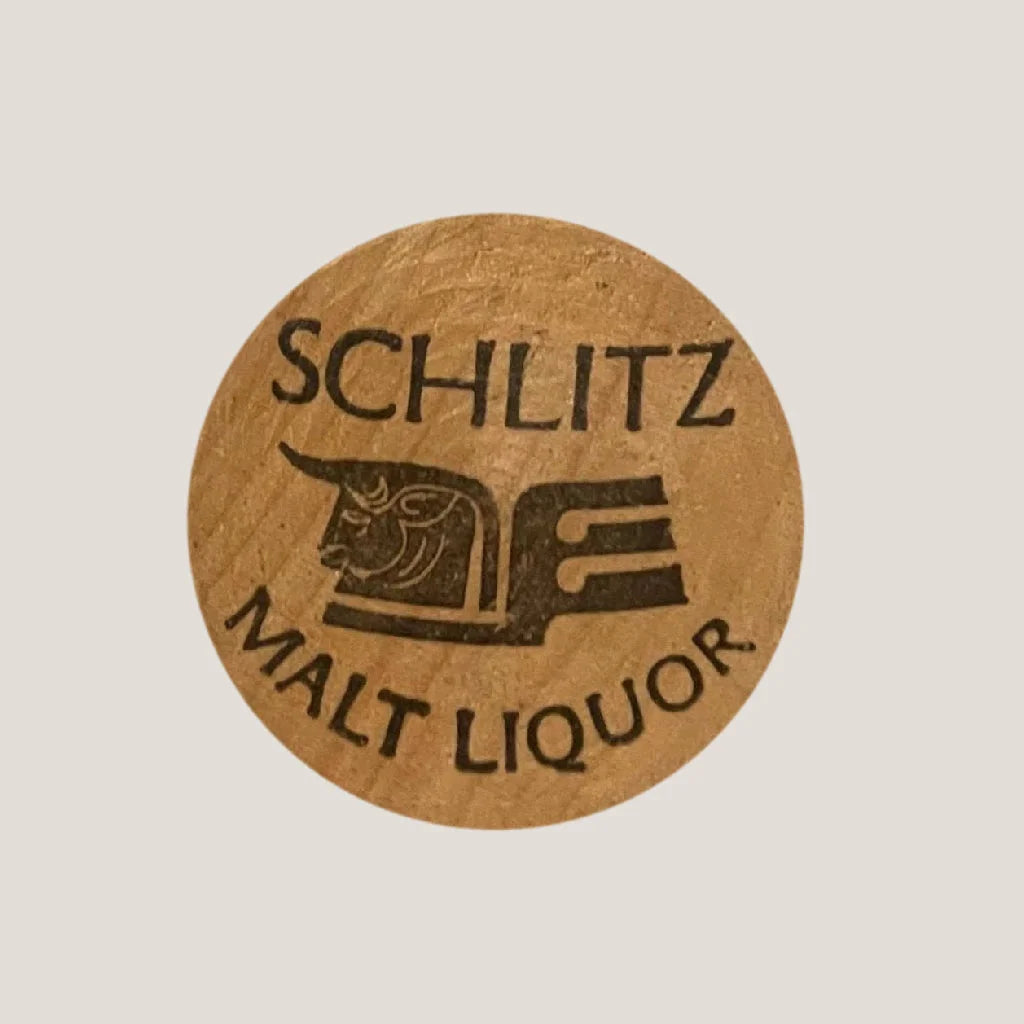
The piece measures 1.5 inches (about 38mm) across — a true pocket-sized disc, right at home rattling around next to a house key or a lucky poker chip. One face carries the brewery's own branding: SCHLITZ arced boldly across the top, MALT LIQUOR arced beneath, and between them the brewery's own emblem — a horned animal head rendered in profile alongside bold, angular linework, the kind of tight, graphic mark that was built to be recognized across a crowded barroom.

The second face of this little coin carries the classic wooden-nickel joke itself: a profile portrait of a Native American chief in a full, radiating feathered headdress, styled deliberately after the beloved Indian Head design that graced the real Buffalo nickel, encircled by the words DON'T TAKE WOODEN NICKELS — FOR THE REAL McCOY SEE OTHER SIDE.

It's a complete little advertising loop — a joke that sends you right back around to the brewery's name, over and over, for as long as you keep the coin in your pocket.

This example is New Old Stock (NOS) — never distributed, never carried in a wallet, never handed across a bar. It stands today as an excellent early example of American tavern advertising: a small, wood-grain artifact of the graphic design, brand marketing, and barroom humor of its era.


🏭 Milwaukee's Beer Barons: The Schlitz Story

The story behind this little wooden coin runs all the way back to 1849, when a German immigrant named August Krug opened a small restaurant and brewery on what was then Chestnut Street — now Juneau Avenue — between Fourth and Fifth Streets in Milwaukee. Milwaukee at that time was filling up fast with German immigrants who brought their brewing traditions with them, and Krug's little operation was one of dozens of small breweries competing for thirsty customers in a city that would, within a generation, become synonymous with beer itself.

In 1850, Krug hired a young bookkeeper freshly arrived from Mainz, Germany — a sharp, determined young man named Joseph Schlitz. When Krug died in 1856, Schlitz didn't just keep the books running; he stepped into the ownership vacuum, and in 1858 he married Krug's widow, formally taking control of the brewery and putting his own name on the label. It was a modest operation compared to what it would become, but Schlitz ran it with an eye toward growth that few of his Milwaukee competitors could match.

The turning point that made the Schlitz name a household word came in 1871, in the aftermath of the Great Chicago Fire. With Chicago's own breweries burned to the ground and the city desperate for supply, Schlitz shipped beer south to fill the gap — a moment of opportunism and generosity rolled into one that cemented the brand's reputation across the region and helped give rise to the slogan that would follow Schlitz for generations: "the beer that made Milwaukee famous." By 1902, Schlitz had grown into the largest beer producer in the United States, a title it would trade back and forth with rival Anheuser-Busch of St. Louis for decades, the two breweries locked in a friendly, very public rivalry that beer drinkers from coast to coast followed with real interest. Schlitz beer traveled by rail and by river, in barrels and bottles, reaching bars from Green Bay to New Orleans to San Francisco — a genuinely national brand at a time when most beer was still a strictly local affair.


🥃 The Malt Liquor Sibling

Schlitz Malt Liquor was the brewery's bolder, brasher sibling to its flagship beer — a higher-alcohol, more assertive brew aimed at a different kind of drinker than the standard lager crowd. Malt liquor as a category came into its own in mid-20th-century America, marketed as a stronger, more potent alternative to ordinary beer, and the major breweries all wanted a foothold in that growing market. Schlitz's malt liquor line carried its own identity, its own advertising push, and — as this little wooden nickel proves — its own giveaway novelties, distinct enough from the main Schlitz beer brand to warrant separate tavern promotions and separate barroom swag.


🪙 "Don't Take Wooden Nickels" — Where the Joke Came From

The phrase itself is older than any brewery giveaway — it's one of those pieces of American slang that outlived whatever originally inspired it. Old-timers and collectors alike will tell you the saying has real roots in hard economic history: during the darkest years of the Great Depression, when local banks failed and small towns found themselves without enough hard currency to keep commerce moving, some communities actually issued their own emergency money made of wood. The most famous case, still told and retold among collectors of American exonumia, is the small town of Tenino, Washington, which in the early 1930s printed wooden scrip to keep its local economy afloat after its bank collapsed. That real wooden money — genuinely usable, genuinely accepted by local merchants — is where the phrase "don't take any wooden nickels" first took on its warning tone: a wooden nickel wasn't backed by anything, and taking one in good faith could leave you holding worthless wood instead of real money.

By the time breweries, taverns, fairs, and five-and-dimes got hold of the idea, the warning had flipped into a joke. Advertisers loved the built-in gag: a promotional token that literally told you, right on its face, not to trust it as money — a wink shared between the brewery and the customer, printed right into the design. The Native American chief portrait wasn't a random choice, either. It was a deliberate visual echo of the Buffalo nickel — officially the Indian Head nickel, minted by the U.S. Treasury from 1913 to 1938 and designed by sculptor James Earle Fraser, one of the most beloved coin designs America ever produced. Advertising novelty makers leaned hard on that familiar profile because everyone in the country recognized it instantly, which made the joke land even harder: here was a coin dressed up exactly like real government money, insisting in the same breath that it absolutely was not.


🎭 The Real McCoy

The other half of the joke — "for the real McCoy, see other side" — carries its own bit of American folklore. Collectors and word-history buffs have long traded competing legends about where "the real McCoy" came from. Some point to a champion boxer of the early 1900s who fought under that name and had to keep proving he was the genuine article and not an imitator trading on his fame. Others — and this version has particular charm on a beer-related token — trace it to Prohibition-era rum-runner Bill McCoy, who reportedly built a reputation for smuggling genuinely undiluted liquor up and down the Atlantic coast at a time when most bootleg spirits were cut and watered down; asking for "the real McCoy" supposedly meant asking for McCoy's unadulterated product rather than some inferior knockoff. Whichever origin story you favor, by the time this wooden nickel was struck, "the real McCoy" had long since settled into the language as shorthand for the genuine, authentic article — which made it the perfect punchline for a brewery telling you, in wood, to go find the real beer instead.


🏙️ Milwaukee, Beer City USA

None of this happens anywhere but Milwaukee. By the turn of the 20th century, Milwaukee had earned its reputation as America's brewing capital, home to a cluster of breweries — Schlitz, Pabst, Miller, and Blatz among them — that together turned the city into a beer town in a way few American cities before or since have matched. The breweries were more than factories; they were civic institutions, major employers, and sources of local pride, their names painted on the sides of buildings, their delivery wagons and later trucks a familiar sight on Milwaukee streets. Local legend around the old brewery district still holds that on a quiet night you could tell which brewery was running its kettles just by the smell carried on the wind — a bit of civic folklore Milwaukee old-timers still swap with a smile.


📦 Why These Little Coins Still Matter Today

Wooden nickels like this one occupy a sweet spot in the collecting world — cheap enough in their day to be handed out by the fistful at taverns, fairs, lodge meetings, and store openings, yet distinctive enough that people held onto them anyway, tucked into cigar boxes and junk drawers where they quietly survived for decades. Breweriana collecting itself has grown into a serious, organized hobby, with dedicated collector groups such as the American Breweriana Association keeping the history of American brewing memorabilia alive — trays, signs, coasters, openers, and yes, wooden nickels, all part of the same story of how breweries built loyalty one small giveaway at a time. A piece like this one connects directly to that larger story: a hands-on, pocket-sized artifact from an era when a brewery's marketing department still thought in terms of jokes you could hold, not just slogans you could read.


🖼️ Display Ideas

  • 🏺 Group it in a small glass dish or shadow box alongside other tavern tokens and bar tools for an instant breweriana corner.
  • 🖼️ Stand it upright in a small coin easel or plate stand on a bar cart or home bar shelf, chief-side facing out.
  • 📌 Pin it inside a display case with vintage beer advertising, coasters, or tap handles for a themed man-cave or den vignette.
  • 🎁 Tuck it into a card as a novelty gift for the beer collector, history buff, or Wisconsin native in your life.
  • 🗄️ Add it to a curated tray of Americana exonumia — wooden nickels, tokens, and trade coins — for a rotating small-object display.
  • 🏷️ Frame it in a shallow shadow box with a printed note on the Schlitz story for a conversation-piece wall hang.

🎁 Who Collects These

Breweriana collectors chase Schlitz pieces specifically because the brand's long, storied run through American brewing history gives every item — from trays to tap knobs to tiny wooden nickels — a real story to hang on. Wisconsin and Milwaukee history buffs seek out anything connected to the city's brewing golden age. Exonumia and token collectors — folks who specialize in coin-like objects that were never official currency — prize wooden nickels as an accessible, affordable corner of that hobby. And plenty of casual gift-givers pick these up simply because they're a genuinely fun, tactile bit of nostalgia: the kind of small object that gets picked up, turned over, read aloud, and laughed at all over again, exactly as it was designed to be a century's worth of bar patrons ago.


❓ FAQ

What brewery issued this wooden nickel?

The Jos. Schlitz Brewing Company of Milwaukee, Wisconsin, for its Malt Liquor brand.

How big is it?

It measures 1.5 inches (about 38mm) across — a true pocket-sized wooden coin.

What condition is it in?

This piece is New Old Stock (NOS) — an excellent early example of mid-century American tavern advertising and breweriana graphic design.

Why does it say "Don't Take Wooden Nickels"?

It's a long-running American joke tied to a genuine bit of Depression-era history, when some towns issued real wooden scrip as emergency currency. Breweries and other advertisers later borrowed the warning as a wink, printing it right onto their promotional tokens.

Why is there a Native American portrait on it?

The image deliberately echoes the Indian Head, or Buffalo, nickel — the well-known U.S. coin minted in the early 20th century — a visual joke that made the "don't take wooden nickels" gag land instantly with anyone who saw it.

What does "the real McCoy" mean?

It's an old American phrase for the genuine, authentic article, with competing legends tracing it to either a champion boxer or a Prohibition-era rum-runner known for selling undiluted liquor. Either way, it made a fitting punchline pointing customers back to the real Schlitz.

Is Schlitz still connected to Milwaukee's brewing history?

Yes — Schlitz stands as one of the defining names of Milwaukee's era as America's brewing capital, alongside fellow local giants like Pabst, Miller, and Blatz.

Shipping

🚚 Shipping & Handling

  • Shipping costs and timing are calculated at checkout.
  • Items curated and shipped directly by me include U.S. shipping at no additional cost, professionally packed to ensure safe arrival of your artifact.

Items from Vetted Pro Collectors
Shipping for items offered by vetted Pro Collectors is determined at checkout. All Pro Collector listings are reviewed to ensure fair, reasonable shipping practices.

For full details, please refer to our Shipping Policy.

Returns & Exchange

Take your time — you've got a full six months. If a piece isn't right for you, send it back the way it reached you and we're good.

In the first 30 days your money goes straight back the way you paid. After that it's store credit, so you can put it toward something you'd rather have.

Return shipping we sort out between us, case by case. I don't make this difficult.

If something arrives damaged, or it isn't what I said it was, send me a photo within 48 hours and I'll make it right.

Email info@vintageantiquesgifts.com or call 802-356-9872 — that's me answering, not a call center.

The only things I can't take back are custom or special-order pieces and gift cards.

View full details
  • 5 stars: 4 (100%)
  • 4 stars: 0 (0%)
  • 3 stars: 0 (0%)
  • 2 stars: 0 (0%)
  • 1 star: 0 (0%)
b
b

The item was in great condition. The seller(s) are very decent and thoughtful. I highly recommend.

a
a***r (1549)

GREAT ITEM-------THANKS

r
ralphie1946
.

Because of mishandling by the post office, my order arrived in pieces. The seller contacted me and replaced the item. This seller went above and beyond when it came to customer satisfaction. They deserve MORE than 5 stars. They deserve 10 GALAXIES

So happy it made it! I can't control some things but I can definitely showcase our customer service. Too bad that only really gets to shine if there is an issue. I am always here to assist with good old-fashioned customer service if one ever arises though. We guarantee your happiness. Thanks for your business, your review and we hope to work with you again soon!

r
ralphie1946

Because of mishandling by the post office, my order arrived in pieces. The seller contacted me and replaced the item. This seller went above and beyond when it came to customer satisfaction. They deserve MORE than 5 stars. They deserve 10 GALAXIES.

So happy it made it! I can't control some things but I can definitely showcase our customer service. Too bad that only really gets to shine if there is an issue. I am always here to assist with good old-fashioned customer service if one ever arises though. We guarantee your happiness. Thanks for your business, your review and we hope to work with you again soon!