
Skip to product information
1 of 6

Vintage and Antique Gifts

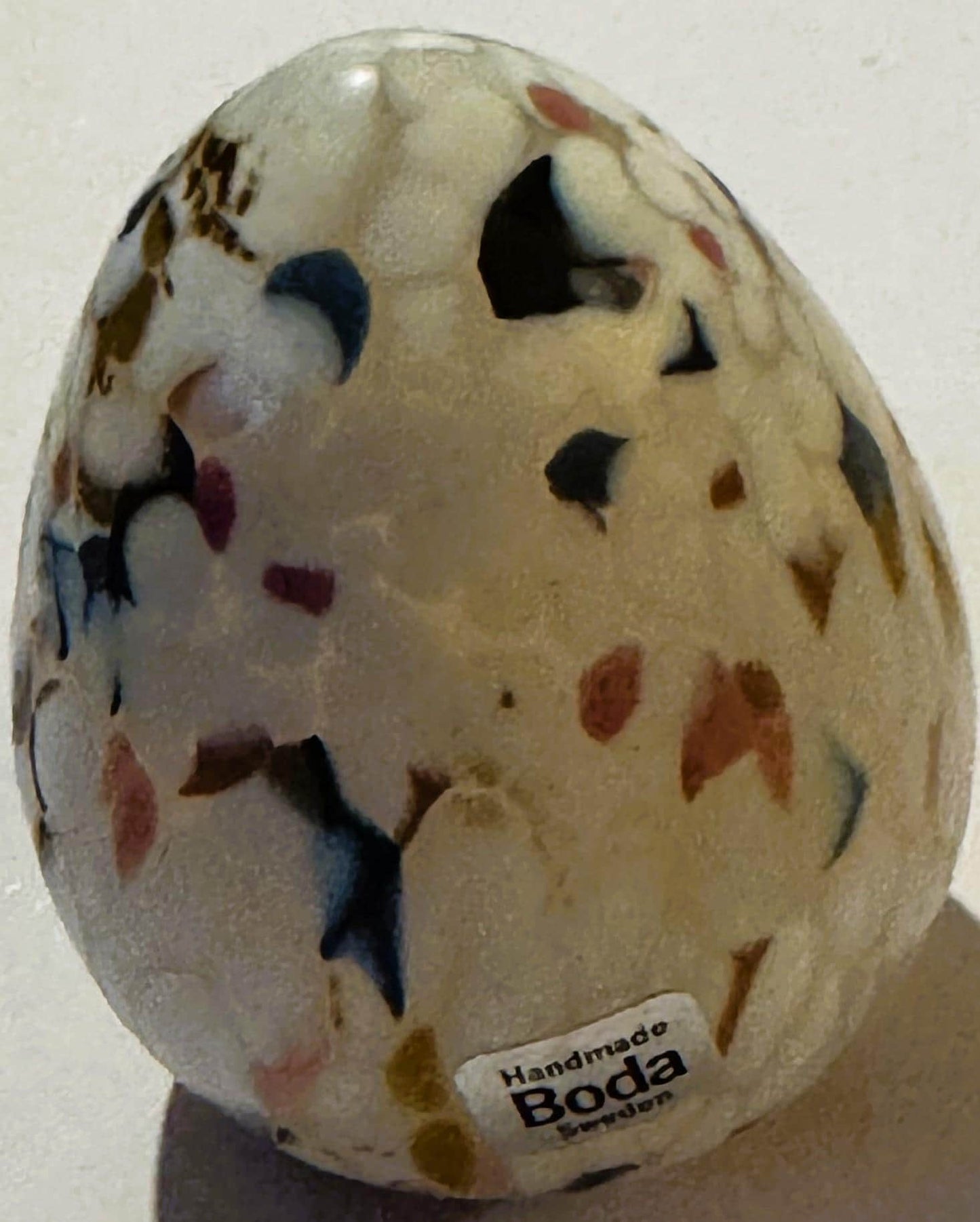
Vintage Boda Sweden Art Glass Egg ✨ Attributed Monica Backstrom, Kosta Boda Confetti Spatter, Hand Blown Swedish Studio Glass, Circa 1970

Regular price 29.00 USD
Regular price Sale price 29.00 USD
Sale Sold out
Shipping calculated at checkout.

Description

🥚 A Small Swedish Egg That Holds a Whole Studio's Worth of Story

Set this little egg in your palm and it changes the light in the room. It is a hand-blown piece of Swedish art glass from Boda, one of the great glassworks of the Småland forest, and it was made to be exactly what it is: a satin-skinned ovoid, ivory-pale, flecked all over with a bright confetti of colored glass that seems to float just beneath a frosted surface. There is rose-pink in there, and a cool slate-blue, and warm amber-ochre, and little sparks of black, with a soft drift of olive-brown speckle gathering toward the base. It is not a big object. It is a petite thing, made to be held and turned and set on a sill where the sun can find it. And it carries, on its underside, a small gold-foil label that tells us a surprising amount about where and roughly when it was born.

What follows is the honest, complete telling of this piece: what it is made of and how it was made, the glassworks it came from, the designer whose name follows it through the market, the little detective story of dating it by its label, the one design feature that surprises people the most, and a plain, unflattering-where-it-needs-to-be account of its condition. Everything here comes from the object itself and its photographs. Nothing is invented, and where the record allows only an attribution rather than a certainty, I say so plainly.


🇸🇪 Boda Glasbruk — A Glassworks in the Kingdom of Crystal

The egg comes from Boda, and the gold label on its base says as much in three plain words: Handmade, Boda, Sweden. Boda Glasbruk was founded in 1864 in the deep pine country of Småland in southern Sweden — the region so thick with historic glass furnaces that the Swedes themselves call it Glasriket, the Kingdom of Crystal. For more than a century this was a landscape organized around fire and sand and the breath of glassblowers, and Boda was one of its most inventive houses. Where some Swedish works built their name on cut crystal and formal elegance, Boda leaned into something looser and more modern through the middle of the twentieth century: bold color, organic form, a sense of play, a willingness to let glass be strange and joyful rather than merely refined.

That instinct is written all over this egg. There is nothing stiff about it. The color is scattered like something happy rather than arranged like something formal, and the whole form has the soft, hand-warmed quality of a thing that was made by a person in a single continuous act of blowing and shaping, not stamped out of a mold. This is exactly the kind of studio-spirited domestic art glass that made the Småland works famous in the postwar decades, and Boda was squarely at the heart of it.


🤝 The Boda–Kosta Story, and Why the Name on the Label Matters

Here is where the history has to be told carefully, because it is easy to get tangled and the live listing that came before this one did get tangled. Boda did not stay a wholly separate company forever. Around 1970 to 1971 it came together with the neighboring works — Kosta, Åfors and others — into a single corporate group in the Småland glass district. But joining a group is not the same thing as changing your name. For several more years the glass kept going out into the world under the individual names of the old houses. It was only in 1976 that the combined company formally unified its branding under the single, now-famous name we all know today: Kosta Boda.

That two-step history — grouped around 1970–71, re-branded as one name in 1976 — is the key that unlocks this piece, and it is why the label reading simply Boda, and not Kosta Boda, is worth pausing on. This egg belongs to the brand family that became Kosta Boda; that is the right shelf to look for it on and the right name to search. But the object itself still speaks in the older voice, labeled Boda alone. That places it before the 1976 unification, in the window when Boda-marked art glass was still leaving the furnace under its own name — comfortably in the circa-1970 range, late 1960s to the middle 1970s.


🔎 The Label as a Little Detective Story

I love this part, because the dating is not guesswork — it is right there on the base if you know how to read it. Collectors of Småland glass have long used the foil labels as a rough calendar. A gold-foil sticker that reads only Boda, Handmade, Sweden belongs to the pre-unification period, before the combined firm put the words Kosta Boda together on its labels in 1976. So the very thing that a careless eye might call just an old sticker is in fact the single most useful dating clue the egg carries. The name it does not say — Kosta — tells you as much as the name it does. A Boda-only foil label is an early label, and it sets this egg down firmly in that circa-1970 window rather than the later, fully-merged era.

None of that requires inventing a precise birth year, and I will not pretend to one. What the evidence honestly supports is a piece of Boda art glass from around 1970 — late 1960s to mid 1970s — identified by its own foil label and placed in time by the well-documented history of when that label style was in use. That is the whole of the dating, told straight.


🎨 Monica Backstrom — The Name This Egg Carries

Ask a collector who made the confetti eggs of this kind and one name comes back: Monica Backstrom. She belongs to the great generation of Swedish glass designers, and her working life is well recorded. Born in 1939 into a design family — her mother was a celebrated textile designer — she trained at Konstfack, Sweden's leading school of arts and crafts, through the early 1960s, and in 1965 she joined Boda, right around the works' own centenary. She stayed with the Boda and Kosta Boda world for roughly four decades, and across that long career she became especially known for exactly this family of objects: eggs, mushrooms and vessels alive with bold, saturated, scattered color. The playful confetti egg is one of her signature ideas.

Now the honest part, because it matters and I would rather you trust me than be won over by adjectives. This particular egg is not signed. It carries its Boda foil label but no engraved artist's signature, and so its maker is an attribution rather than a certainty. What I can tell you truthfully is that the confetti-spatter egg is the style the market consistently attributes to Monica Backstrom, and that the design, the palette and the Boda origin all sit squarely inside her documented body of work. So I attribute it to her in exactly those words — attributed to Monica Backstrom — and I let that stand as the honest description it is. You are buying a labeled Boda art-glass egg in the confetti manner associated with Backstrom, not a signed and certified example, and the price and the plain telling reflect that.


🍳 How It Was Made — Hollow, Blown, and Finished to a Satin Skin

Pick the egg up and the first surprise is the weight, or rather the lack of it. This is a hollow blown form, not a solid paperweight, which is why it feels lighter than it looks and warms so readily in the hand. It began as a gather of molten glass on the end of a blowpipe, inflated and swung and coaxed into its smooth ovoid, with the colored elements introduced into the hot skin as it was worked — the white spatter and the little confetti chips of rose, blue, amber and black rolled and picked up into the surface, then cased under a final clear layer so they read as if suspended just below the surface rather than sitting on top of it.

The surface itself is the second thing to notice. It is not the high, glassy shine of polished crystal; it is a soft, even, satin finish — the muted, silky matte that comes from an acid or abrasive treatment of the outer skin. That satin veil is exactly what gives the piece its dreamy quality. It diffuses the light and pushes the color gently back, so the confetti seems to hover in a soft ivory mist rather than glitter sharply. It is a deliberate, characterful finish, and it is a big part of why these eggs are so pleasant to hold: the surface has a fine, kissable smoothness rather than a slick gloss.


🌊 The Palette — Ivory Ground and Floating Confetti

The color is the whole delight of it, so let me describe it exactly as the photographs show it. The ground is a warm ivory — a soft, milky off-white rather than a stark cold white — and across that ground drifts a fine white spatter that reads almost like frost or scattered snow. Over and through that lie the confetti chips themselves: little irregular flecks and shards of true color. There is a clear rose-pink, a cool slate-blue, a warm amber-ochre that leans toward honey, and scattered points of black that give the whole surface its snap and definition. Toward the base the palette settles and deepens into a drift of olive-brown speckle, as though the color had gently pooled and grown earthier at the bottom of the form. The effect is a small, self-contained galaxy of color, all held in that soft satin ivory — busy up close, calm from across the room. No two of these are ever identical, because the confetti fell where it fell in the moment of making.


🍳 The Open Base — A Feature, Not a Flaw

Now for the thing that most surprises people when they turn the egg over, and the thing I most want to be plain about: the base of this egg is open. The underside is not sealed into a smooth continuous shell; it is a finished, ground opening into the hollow interior. I want to say that clearly and up front, because a photograph of the bottom can startle someone who was expecting a closed egg, and I would always rather tell you than let you discover it. The base is open, on purpose.

Far from being damage, this open ground base is a genuine design feature with a real lineage in Swedish blown glass. Hollow blown ovoids and rounded forms of this kind share their heritage with the shades, stems and bases of blown glass lighting and with stand-mounted display forms — objects that were finished open at one end so they could be seated, mounted or lit. That is the family this shape belongs to, and the open, ground underside is the honest signature of that hand-blown, open-form construction. In practical terms it means the egg is meant to be set upright and displayed with its bright confetti face turned to the light, resting on its base the way it was designed to sit. It is a feature to lean into, not a fault to apologize for — and it is disclosed here plainly so there are no surprises when it arrives.


🔍 An Honest Look at the Condition

I would always rather under-promise and let the object over-deliver, so here is the plain state of the piece, read from the same photographs you can see.

The egg presents beautifully. Going over the images closely, no chips are found and no cracks are found; the profile is smooth and continuous and the satin surface reads clean and even, with its color intact and its foil label still in place on the base. There is one small area on the belly of the egg that catches the light a little more brightly than the surrounding satin — a slightly glossier patch. In all likelihood that is simply a factory gloss window, a spot where the acid or abrasive satin finish sits a touch thinner and the underlying glass shines through, which is a common and completely original characteristic of these frosted-finish pieces rather than any kind of wear or repair. I flag it honestly so you can see it for what it is.

So the honest headline is this: a hand-blown Boda art-glass egg with no chips or cracks found, its color and label intact, and a single small glossier patch on the belly that is most likely part of how it was finished. I am deliberately not calling it flawless or perfect, because those are words that promise more than any photograph can, and because the point of this whole description is that you can trust it. What you see in the pictures is what will arrive.


📏 Size — A Petite Piece (Exact Measurement to Follow)

This is a petite egg — a small, palm-scaled object rather than a large sculptural showpiece, the kind of thing that lives happily on a windowsill, a shelf edge or a writing desk. I would rather give you a measurement I have actually taken than one I have guessed from a photograph, so an exact height and width will be added as soon as the piece is measured by hand. For now, read it as small and holdable: a thing to pick up and turn in the light, not a mantel centerpiece. The precise dimensions will follow.


🏡 Living With It

An object like this asks to be enjoyed in the open, and it slips into a home in several easy ways.

  • 🌞 Set it on a sunlit windowsill where the satin skin can soften the light and the confetti color can wake up — these pieces are at their best with daylight passing across them.
  • 📚 Let it punctuate a shelf of Scandinavian glass or mid-century ceramics, a small bright note of Småland color among taller, quieter pieces.
  • 🖼️ Stand it on a desk or a bedside table as a hand object — something to pick up, turn over and warm in the palm while you think.
  • 🥚 Group it with other eggs or rounded forms for a collected, gathered look, its open base seating it neatly upright.
  • 🎁 Or give it as a piece of genuine Swedish studio glass with a real designer story behind it — a small, meaningful thing rather than a mass-made trinket.

🧵 Who It Is For

This egg will mean the most to a few particular people. The collector of Scandinavian and Swedish art glass, who knows the Småland works and will read the Boda label and the confetti manner at a glance. The admirer of Monica Backstrom's playful, color-scattered world, who will recognize the family this piece belongs to even without a signature. The mid-century modern decorator, who wants a real period object with honest provenance rather than a reproduction. And the person who simply loves a beautiful small thing in glass — something to hold, to catch the light, to keep. For any of them, this is a genuine piece of Boda studio glass, told straight and offered exactly as pictured.


❓ Questions Worth Answering

Is it really Boda / Kosta Boda?

Yes. It carries an original gold-foil label reading Handmade, Boda, Sweden on its base, from the Boda glassworks that became part of the Kosta Boda family. The Boda-only wording places it before the 1976 unification of the Kosta Boda name.

Is it by Monica Backstrom?

It is attributed to her. The piece is unsigned and carries only its Boda foil label, but the confetti-spatter egg is the style the market consistently attributes to Monica Backstrom, and the design, palette and Boda origin all sit within her documented work. I describe it as attributed rather than signed, honestly.

Why is the bottom open?

Because it is a hollow, hand-blown form finished open at the base — a genuine design feature with roots in blown glass lighting and stand-mounted forms, not damage. It is meant to sit upright on that base and be displayed with its confetti face to the light. Disclosed plainly here.

What condition is it in?

No chips or cracks are found in the photographs; the color and the foil label are intact. There is one small glossier patch on the belly, most likely an original factory gloss window in the satin finish rather than wear. Offered exactly as pictured.

How big is it?

Petite — a small, palm-scaled egg. An exact measured height and width will be added once the piece is measured by hand.


✨ Why It Matters

Some objects are worth having because they are loud; this one is worth having because it is real and quietly lovely. It is a genuine hand-blown egg from Boda, one of the historic glassworks of the Swedish Kingdom of Crystal, made around 1970 and identified by its own gold-foil label, in the scattered-confetti manner that collectors attribute to Monica Backstrom. It has a soft satin skin, a whole small galaxy of floating color, and an open, hand-finished base that tells you honestly how it was made. It has no chips or cracks that I can find, and I have described its one small quirk plainly rather than hiding it. What it offers is simply the thing itself: a warm, light, luminous piece of Swedish studio glass, told straight, ready to catch the light on a sill in your home the way it has for the last half-century.

Shipping

🚚 Shipping & Handling

  • Shipping costs and timing are calculated at checkout.
  • Items curated and shipped directly by me include U.S. shipping at no additional cost, professionally packed to ensure safe arrival of your artifact.

Items from Vetted Pro Collectors
Shipping for items offered by vetted Pro Collectors is determined at checkout. All Pro Collector listings are reviewed to ensure fair, reasonable shipping practices.

For full details, please refer to our Shipping Policy.

Returns & Exchange

Take your time — you've got a full six months. If a piece isn't right for you, send it back the way it reached you and we're good.

In the first 30 days your money goes straight back the way you paid. After that it's store credit, so you can put it toward something you'd rather have.

Return shipping we sort out between us, case by case. I don't make this difficult.

If something arrives damaged, or it isn't what I said it was, send me a photo within 48 hours and I'll make it right.

Email [email protected] or call 802-356-9872 — that's me answering, not a call center.

The only things I can't take back are custom or special-order pieces and gift cards.

View full details