


Skip to product information
1 of 4

Vintage and Antique Gifts

Vintage Hand Painted Wooden Egg ✨ Hutsul Style Folk Art, Geometric Pysanka-Style Decoration, Lacquered Wood Egg, Sun Cross on the End

Vintage Hand Painted Wooden Egg ✨ Hutsul Style Folk Art, Geometric Pysanka-Style Decoration, Lacquered Wood Egg, Sun Cross on the End

Regular price $21.00 USD
Regular price Sale price $21.00 USD
Sale Sold out
Shipping calculated at checkout.

Size: palm-sized

🚚 Free US Shipping — ships within one business day. International shipping calculated at checkout.

Quantity

Why Does the Serpent Stay Chained? 🥚 A Hand-Painted Hutsul-Style Wooden Egg

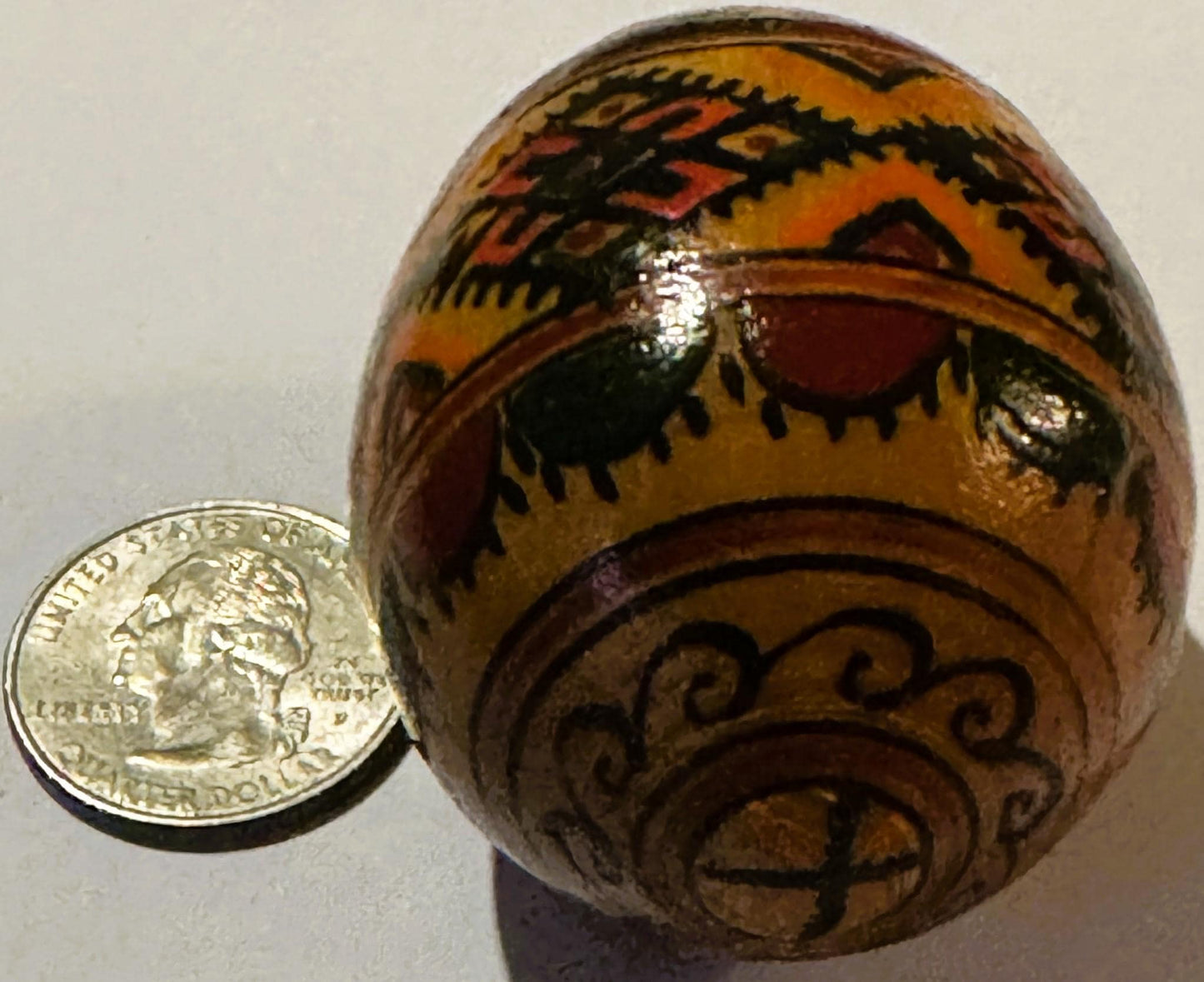
Size: 2 1/2" x 1 3/4" ~ Glossy lacquer, strong color, no chips or dents that I can see.

Here's the legend, the way it's usually told: somewhere in the Carpathian Mountains a terrible serpent lies chained to a cliff, and the only thing holding him there is how many decorated eggs get made each year. Every year his servants go out and count them. A good count and the chains stay tight; a poor one and he starts to work loose. And if people ever quit making them altogether, the story goes, he breaks free for good and overruns the world. I like that a folk art tradition comes with its own doomsday clock built in - keep painting the eggs, keep the world safe.

This little egg is my small contribution to the cause: hand-painted wood, banded in orange, deep red, forest green and black over a warm amber-gold ground, sealed under a glossy lacquer. It's done in the Hutsul geometric style - a Carpathian pysanka pattern, painted onto wood instead of an eggshell.

🎨 What's Painted On It

Every one of these is hand-done, so no two come out quite the same. On this egg, a ring of small black scrolls runs near each end. Just inside that, a band of rounded lobes alternates deep red and forest green, every one fringed in a black saw-tooth edge. The wide center band is the showpiece: bold orange chevrons cross to form X shapes, and between them a black toothed lattice frames hooked, diamond-shaped motifs and small dots. Turn it over to the narrow end and there's a cross set inside a circle, closed in by more of those painted rings - a quiet way to finish a busy design. It's palm-sized, small enough to sit in one hand. The egg you see there is the one that ships.

✍️ Not Wax, but Paint

Pysanka comes from the Ukrainian word pysaty, "to write" - the pattern is written onto the egg, not just colored in. On a true pysanka, that's done with a stylus and melted beeswax: draw a line in wax, dye the egg, add more wax, dye again, and repeat, then melt all the wax away at the end so the pattern shows through underneath. It's a wax-resist method, in the same family as batik, and it belongs to real eggshell pysanky. It's an old, old custom, too - scholars think egg writing in the Slavic lands goes back before Christianity, and over the centuries it got folded into Easter, which is how the decorated egg became an Easter egg. This egg isn't an eggshell - it's turned wood, and every line on it was laid down with a brush.

🪵 From Yavoriv to the Hutsuls

Eggshells crack, so at some point Ukrainian craftsmen started painting wood instead, a sturdier way to keep the tradition going. Makers in Yavoriv, in the Lviv region, got there first. The Hutsuls - highlanders from the Carpathians - picked up the idea later, most likely in the late 1980s, putting their own dense geometric pysanky patterns onto wooden souvenir eggs, in the traditional Hutsul palette of white, yellow, green, red and black. This one leans into orange and amber-gold too, colors the Hutsul painters kept experimenting with as the tradition carried on. Paint is the most common way to dress a wooden egg, but it isn't the only one - you'll also find little lacquer paintings done on a black ground, carved eggs, eggs inlaid with beads, mother-of-pearl, copper wire and colored woods, and some with their decoration glued right on. This one is a painter's egg, start to finish.

📜 What the Patterns Are Said to Mean

Pysanka tradition hangs a meaning on nearly every shape. The endless line - bezkonechnyk - has no start and no finish, and it's read as the sun and time moving on forever; folklore holds that an evil spirit landing on that line gets stuck following it, for good, with no way off. The cross is one of the oldest sun symbols you'll find on a pysanka. And those saw-toothed bands are called wolf's teeth - said to stand guard, for protection and strength. This egg has all three: the running scrolls, the toothed borders around nearly every panel, and the cross set inside a circle on its narrow end.

🏔️ Who the Hutsuls Are

The Hutsuls are highlanders from the southeastern Carpathians, in a region they call Hutsulshchyna, along the Prut and Cheremosh rivers, around towns like Kosiv and Kolomyia. Kuty, Pechenizhyn and Vyzhnytsia are Hutsul country too, all three on record since the mid-1400s, and the homeland doesn't stop at the border - it runs on into northern Romania, into parts of Bukovina and Maramureș. A herding people who built a remarkably intricate art tradition out of mountain life - wood carving, weaving, wooden churches, and pysanky among it. Their carvers are famous for inlaying wood with contrasting woods, brass, silver, bone, mother-of-pearl and glass beads, and the Hutsuls are just as well known for their ceramics, their jewelry and ornaments of brass, leather and bone, and their kilim weaving. Their old songs still remember the outlaw Oleksa Dovbush, a name that turns up again and again in Hutsul folklore. And when the music starts, the favorite dance is the hutsulka - a fast one.

🏛️ A Museum Shaped Like an Egg

In Kolomyia, part of the National Museum of Hutsulshchyna and Pokuttya Folk Art, there's a Pysanka Museum. It opened back in October 1987, and in September 2000, during the 10th International Hutsul Festival, it moved into a purpose-built home shaped like a giant pysanka - 14 meters tall, 10 meters across. Last count, it holds more than 10,000 decorated eggs, with pieces from as far as Romania, Sweden, Canada, the United States, France and India.

🌎 Now It's World Heritage

In December 2024, UNESCO added the Ukrainian pysanka tradition to its Representative List of the Intangible Cultural Heritage of Humanity, a joint listing with Estonia. The road there started back in 2017, with a meeting with Ukrainian tradition bearers in Estonia, and the Hutsul pysanka tradition - the same family of patterns painted on this egg - was named as one of the three parts of the nomination. It finally went through at the 19th session of UNESCO's heritage committee, in Asunción, Paraguay. That happened in the middle of a war - which makes the old legend about the chained serpent land a little differently. Keep making the eggs, the story goes, and the chains hold.

Shipping

🚚 Shipping & Handling

  • Shipping costs and timing are calculated at checkout.
  • Items curated and shipped directly by me include U.S. shipping at no additional cost, professionally packed to ensure safe arrival of your artifact.

Items from Vetted Pro Collectors
Shipping for items offered by vetted Pro Collectors is determined at checkout. All Pro Collector listings are reviewed to ensure fair, reasonable shipping practices.

For full details, please refer to our Shipping Policy.

Returns & Exchange

Take your time — you've got a full six months. If a piece isn't right for you, send it back the way it reached you and we're good.

In the first 30 days your money goes straight back the way you paid. After that it's store credit, so you can put it toward something you'd rather have.

Return shipping we sort out between us, case by case. I don't make this difficult.

If something arrives damaged, or it isn't what I said it was, send me a photo within 48 hours and I'll make it right.

Email info@vintageantiquesgifts.com or call 802-356-9872 — that's me answering, not a call center.

The only things I can't take back are custom or special-order pieces and gift cards.

View full details

Preserving History: Authentic Objects Across Eras

— Curated by Travis Weigel