






Skip to product information
1 of 9

Vintage and Antique Gifts

Vintage Herend Rothschild Bird Hand Painted Porcelain Teacup, Hungary, Form 704, Gilt Rim & Handle 🕊️

Vintage Herend Rothschild Bird Hand Painted Porcelain Teacup, Hungary, Form 704, Gilt Rim & Handle 🕊️

Regular price 62.00 USD
Regular price Sale price 62.00 USD
Sale Sold out
Shipping calculated at checkout.
Quantity

Size: 3.5 inches

🕊️ The Necklace in the Nest

There is a story painted onto this little cup, and it is worth hearing before you look at anything else. As the legend goes, a Baroness of the Rothschild family was walking in her garden one day when she lost a pearl necklace among the trees and hedges. It was given up for gone — until, some time later, it was found again in the most unlikely place: a bird's nest, where a pair of songbirds had carried the shining string off, bead by bead, to line their home. Whether it happened exactly so or grew a little in the telling, the tale so charmed the Rothschilds that Hungary's Herend porcelain manufactory made a pattern of it, and painters have been putting those two thieving little birds and their looped strand of pearls onto fine white porcelain ever since. This teacup is one of them. Turn it in the light and you are holding the whole fairy-tale in your hand: the branch, the birds, and the necklace they were caught with.

That is the romance of it, and it is real romance, because every piece in this pattern is painted entirely by hand. No two are quite identical; each carries the small human variations of the artist who sat with it. What you see below is only ever what these photographs actually show — the mark on its base, the birds on its side, the tiny secret painted inside its bowl. There is no invented maker here, no made-up date, no story the cup itself cannot back up. Just an honest description of a genuinely lovely thing.


📜 What You Are Actually Holding

This is a single Herend porcelain teacup — a lone cup, offered on its own, with no saucer — in the maker's classic Rothschild Bird decoration. It is worked in true hard-paste porcelain, thin and light and faintly translucent, in the clean warm white Herend is known for. The body is not smooth: it carries a gentle molded texture, the woven "osier" basket-weave relief that Herend presses into so many of its forms, and the rim rises and falls in soft scalloped lobes rather than a plain circle, each lobe traced in a fine line of gold. The shape is catalogued by Herend as form number 704 — a number you will find hand-painted in blue on the underside — and it is the comfortable, rounded, slightly bellied cup of a proper tea service.

Set against that quiet white ground, the painting sings. On one side, the two songbirds of the legend perch on a flowering branch above a little mound of grass, the looped swag of the pearl necklace hanging between them like a caught secret. Scattered around the piece are hand-painted flowers, a bright butterfly with pink, gold and blue wings, and — the detail that makes people fall in love — a small colony of insects. The whole thing is finished with gold: a gilt band around the foot, the gilded rim, and a handle striped like a little golden ladder. It is a lot of life for one small cup, which is exactly the point of it.


🎨 A Pattern Born in the 1850s

The Rothschild Bird pattern belongs to the golden age of Herend. The manufactory made its name in the middle of the nineteenth century, when its brilliantly painted porcelain won admirers across Europe and set tables in some of the most storied houses on the continent — the Rothschild family among them. It was in that flush of fame, around the 1850s, that the bird-and-necklace design entered the Herend repertoire, and it never left it: for more than a century and a half it has been one of the house's most beloved and instantly recognizable patterns, still painted the same patient way, freehand, by a trained decorator rather than from any transfer or print.

That continuity is part of what you are buying. This is not a modern impression of an old idea; it is a genuine vintage example of a living tradition, made in Herend, Hungary, and carrying the maker's own blue mark to prove it. The pattern's charm has always been its lightness — a world-class porcelain house choosing to decorate its wares not with heraldry or grandeur but with a pair of mischievous birds and a joke about a stolen necklace. There is real wit in it, and real tenderness both.


🐦 Two Birds and a String of Pearls

Look closely at the main scene, because it repays it. Two small songbirds are perched on the branch of a flowering shrub. One, above, leans down with a rosy-flushed throat and a striped wing; the other, just below and facing away, wears a warm russet-orange breast and a long dark tail. Between and beneath them hangs the pattern's signature: a delicate, doubled loop of tiny painted beads — the pearl necklace of the legend — swagged from the branch as though the birds have just finished arranging it. Springs of white blossom and green foliage frame the pair, and a small tuft of grass anchors them at the base, so the whole vignette reads like a single quiet moment glimpsed in a hedgerow.

Every line of it is drawn by hand. You can see the confidence of the brush in the fine barring of the feathers and the individual dots that make up the necklace. Because this is freehand work, the birds on this cup have their own particular expression — the tilt of a head, the exact set of a wing — that belongs to the one artist who painted it and to no other piece in the world. That is the beauty of collecting hand-painted Herend: you are not acquiring a copy of a design, you are acquiring one artist's single performance of it.


🐞 The Secret Hidden Inside the Bowl

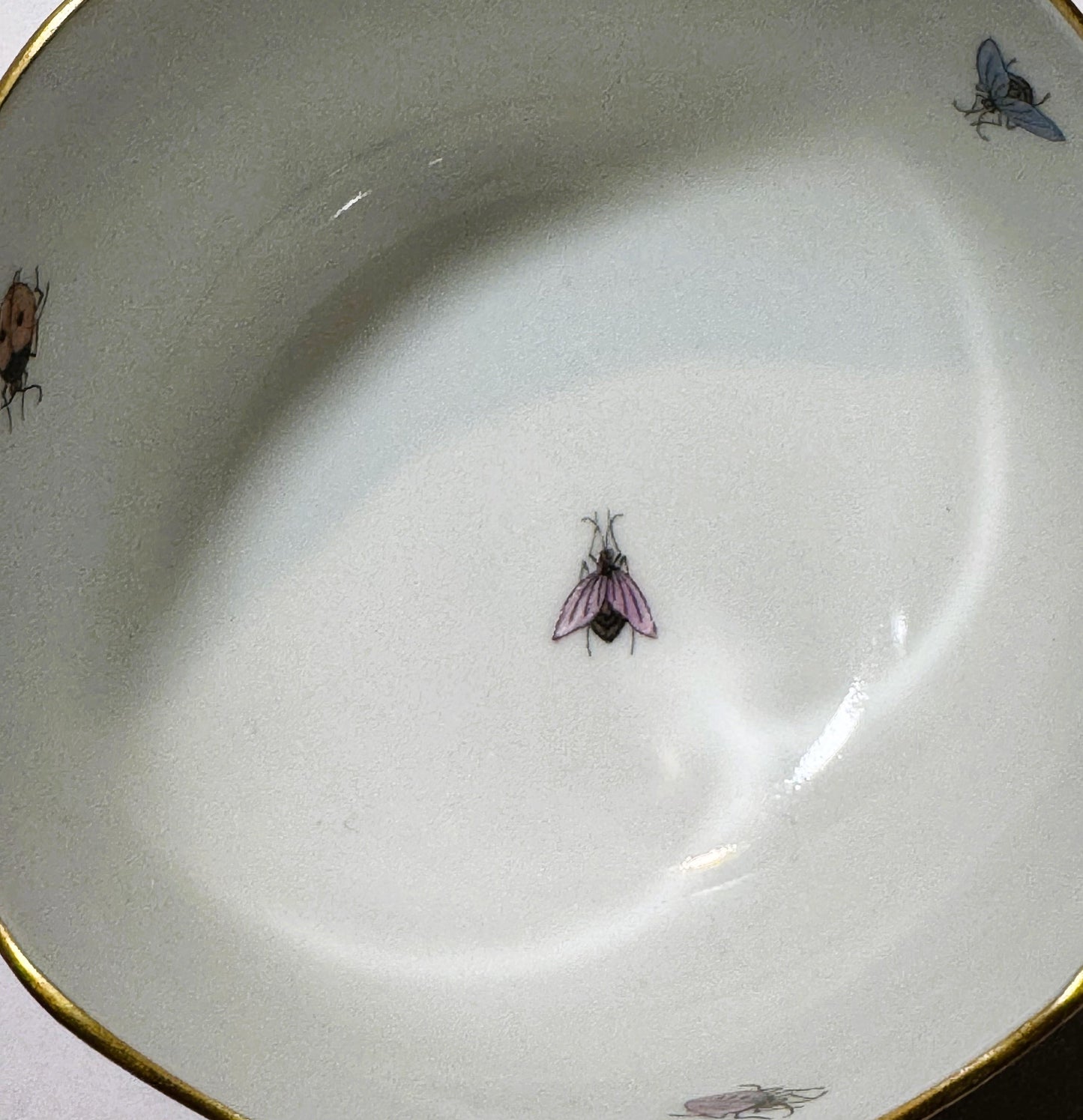
Now lift the cup and look inside, because this is where Herend's Rothschild Bird pattern shows its sense of humor. Scattered across the white interior — where you would least expect them, right where your tea would sit — are tiny hand-painted insects. There is a spotted ladybird near the rim, a little blue-winged fly hovering opposite it, a soft mauve-pink moth resting toward the bottom, and a small dark beetle further round. They are painted with the same delicate care as the birds, in miniature, complete with fine thread-thin legs and antennae.

These bugs are not a flaw and not an accident — they are a beloved, deliberate part of the tradition, the painter's playful signature, the artist's little wink to whoever drinks from the cup. The old conceit is charming: the birds and their flowers have drawn the insects, and the painter simply let a few of them wander in over the gilt rim to keep the tea company. Collectors adore this detail precisely because it is where the hand-painting is most personal; the placement and character of each little creature is the decorator's own choice. On this cup there is also more life on the outside — that vivid butterfly with its pink, yellow and blue wings, and a winged insect near the handle — so that wherever you turn it, something small and living has settled on the porcelain. It is, quietly, one of the most delightful things a teacup can do.


🧺 Basket-Weave, Gold, and the Ladder Handle

The making of the cup is as considered as the painting on it. The body carries Herend's molded osier relief — the subtle woven, basket-like texture pressed into the porcelain before firing — which catches the light in fine vertical ripples and gives the plain white ground a quiet richness even where no color falls. The rim is shaped into soft scalloped lobes rather than a simple round, a small refinement that reads instantly as "better than ordinary," and every edge of it is finished in gold.

And the gold is genuinely lovely here. A bright gilt line follows the whole scalloped rim; a second band rings the foot; and the handle is the little showpiece — a graceful loop striped across its back with short gold bars, like the rungs of a tiny golden ladder, finished at the top with a gilded palmette thumb-rest. It is the kind of detailing that separates a serious porcelain house from a merely pretty one: even the handle, the most functional part of the cup, has been treated as a place for the gilder to do something beautiful. In the photographs the gilding is crisp and well-preserved, with the warm, buttery glow that good hand-applied gold keeps over the years.


🔍 Reading the Base: the Blue Herend Mark

Turn the cup over and the underside tells you exactly what it is. Printed in blue is the traditional Herend backstamp: the word "HANDPAINTED" arched across the top, the crowned Herend shield in the center, and "HEREND HUNGARY" spelled out beneath it. Below the printed mark, added by hand in blue, is the number "704" — Herend's form or shape number for this particular cup — and a second small hand-written number, "62," which is the personal number of the decorator who painted it, not a date. Together they are precisely the kind of mark a collector wants to see: printed maker's stamp, hand-noted shape number, and painter's number, all in the correct blue and all consistent with a genuine, mid-twentieth-century Herend piece made for export.

We describe the mark exactly as it appears in the close-up photographs and no further. The English wording "HANDPAINTED" and the overall style of the stamp are consistent with a mid-20th-century export piece — a true vintage cup, decades old, rather than a modern reissue or a nineteenth-century original. We do not assign it an exact year, because the mark does not give one. What the base does prove, plainly and legibly, is the thing that matters most: this is real Herend, hand painted in Hungary, in the Rothschild Bird pattern, form 704.


✨ Condition, Told Honestly

We would always rather you know exactly what is coming than be flattered by a photograph, so here is the plain condition of the cup, read from the same images you can see. In a word, it is excellent. The gilding is crisp and bright — the rim, the foot band and the ladder handle all read clean and unworn in the photographs, with none of the rubbing or thinning that gold takes on when a cup has been heavily used or run through dishwashers. The painting is fresh and clear, the birds and insects and butterfly all sharp and richly colored, the white ground clean.

Across the photographs there are no visible chips, no cracks and no hairlines, and no sign of any repair or restoration — the cup presents as a sound, intact, well-kept example. What it carries instead is simply its authenticity: the honest surface of a real vintage Herend that has been looked after. It is offered exactly as pictured, with nothing altered, added or hidden. As always, the photographs are the true record of the specific cup you will receive, so please study them closely and judge the surface for yourself.


🥢 One Cup, No Saucer — and Why That Can Be a Gift

Let us be completely clear and completely honest about this, because it matters: what is offered here is the teacup alone. There is no saucer. We are not picturing one, not implying one, and not pretending one is coming — this is a lone cup, and that is exactly how it is sold. Far from being a drawback, for the right person that is precisely the appeal, and it is worth saying why.

A single Herend cup is the perfect cabinet piece. Herend is displayed as much as it is used, and one beautifully painted cup, stood on a shelf or in a glass-front cabinet with its birds turned to the light, is a complete little object in its own right — it needs no saucer to be admired. It is also the answer to a very specific and very real need: the collector or family who has a Rothschild Bird service missing a cup, an orphan looking for its match, someone hunting a single replacement for a set they already love. And it is, quite simply, the gentlest way into Herend there is — a genuine, hand-painted, fully marked piece of one of the world's great porcelain houses, in its most famous pattern, as a first taste rather than a whole service. For a lover of fine china who has never owned a piece of Herend, one perfect cup is a wonderful place to begin.


🖼️ How to Live With It

A cup like this no longer has to hold tea to earn its keep. Here are a few of the ways it settles happily into a modern home.

  • 🍴 Stand it on a shelf or in a cabinet as a small work of art, birds facing out — Herend was always made to be looked at, and one cup displays beautifully on its own.
  • 💍 Let it be a tiny, precious keeper on a dresser: a ring, a pair of earrings or a cufflink tucked into that hand-painted bowl looks like treasure in a treasure-box.
  • 🌿 Float a single short-stemmed bloom in it as a miniature vase, and let the painted flowers answer the real one — or fill it with a candle or a few loose pearls, a nod to the necklace in the legend.
  • 💛 Or give it back its old job now and then for a proper cup of tea — vintage Herend is genuine porcelain built to be enjoyed, and there is a particular pleasure in finding the little painted fly waiting at the bottom.

🎁 Who This Belongs With

This cup will mean the most to a few different kinds of people, each for their own reason. There is the Herend collector, who knows the Rothschild Bird pattern on sight and understands how special a hand-painted, properly marked example is — and who may well be hunting exactly this: a single form-704 cup to fill a gap or grow a collection one careful piece at a time. There is the lover of fine European porcelain and hand-painted china, who simply wants a genuine, beautiful object from one of the great houses without needing a whole service to enjoy it. There is the person who collects teacups — the shelf of mismatched, characterful cups where each one has a story — for whom a real Herend, with birds and a stolen necklace and secret insects inside, is a jewel of a find.

And there is the gift-giver looking for something with genuine craft and genuine charm in it: a present for a tea lover, a porcelain lover, a new collector, a mother or grandmother, anyone who delights in small, finely made things. A lone cup like this makes an especially thoughtful gift precisely because it is complete in itself, meaningful, and full of a story you can tell as you hand it over. However it finds its person, it is a single, individual, one-of-a-kind hand-painted object — there is only this one.


❓ Questions Worth Answering

Is this really Herend?

Yes. The base carries the genuine blue Herend backstamp — "HANDPAINTED," the crowned Herend shield, and "HEREND HUNGARY" — together with the hand-painted form number 704 and the decorator's number. It is a real, hand-painted Herend cup in the Rothschild Bird pattern, shown plainly in the close-up photographs of the mark.

Does it come with a saucer?

No. This is the teacup only — a lone cup, sold on its own, with no saucer. That makes it ideal as a cabinet display piece, as a replacement cup for an existing Rothschild Bird set, or as a first single piece of Herend.

How old is it?

It is a genuine vintage cup. The style of the blue mark, with the English word "HANDPAINTED," is consistent with a mid-20th-century Herend piece made for export — decades old, but not a nineteenth-century original and not a modern reissue. We do not claim an exact year, because the mark does not give one.

What are the little bugs painted inside the cup?

They are a deliberate and beloved part of the Rothschild Bird pattern — the painter's playful touch. Herend decorators traditionally scatter tiny hand-painted insects (here a ladybird, a fly, a moth and a small beetle) inside the bowl as a charming, personal signature. They are meant to be there, and collectors love them.

What is the condition?

Excellent, as pictured: crisp bright gilding, fresh clear painting, a clean white ground, and no visible chips, cracks, hairlines or repairs across the photographs. It presents as a sound, well-kept example, offered exactly as shown.

How big is it?

It is a normal teacup — several of the photographs place a US quarter beside it so you can judge its true scale directly from the images.


💛 Why It Matters

Some things are worth having because they are rare; this one is worth having because it is genuine, and because it is a joy. It is a real, hand-painted Herend teacup in the pattern the world fell in love with — two songbirds and the pearl necklace they were caught with, a scatter of secret insects hidden inside the bowl, a bright butterfly on its flank, all of it drawn freehand by a single artist onto fine Hungarian porcelain and finished with crisp gold and a little ladder of a handle. It carries the maker's own blue mark and form number, and the small, human individuality that only hand-painting gives. It is offered honestly and completely: one lovely cup, no saucer, excellent and exactly as pictured. Bring it home and you are not buying a picture of a fairy-tale — you are keeping the fairy-tale itself, painted onto porcelain, in the hollow of your hand.

Shipping

🚚 Shipping & Handling

  • Shipping costs and timing are calculated at checkout.
  • Items curated and shipped directly by me include U.S. shipping at no additional cost, professionally packed to ensure safe arrival of your artifact.

Items from Vetted Pro Collectors
Shipping for items offered by vetted Pro Collectors is determined at checkout. All Pro Collector listings are reviewed to ensure fair, reasonable shipping practices.

For full details, please refer to our Shipping Policy.

Returns & Exchange

Take your time — you've got a full six months. If a piece isn't right for you, send it back the way it reached you and we're good.

In the first 30 days your money goes straight back the way you paid. After that it's store credit, so you can put it toward something you'd rather have.

Return shipping we sort out between us, case by case. I don't make this difficult.

If something arrives damaged, or it isn't what I said it was, send me a photo within 48 hours and I'll make it right.

Email info@vintageantiquesgifts.com or call 802-356-9872 — that's me answering, not a call center.

The only things I can't take back are custom or special-order pieces and gift cards.

View full details