
Skip to product information
1 of 12

Vintage and Antique Gifts

Vintage 1971 Transocean Gulf Oil Bond Deepwater Horizon Company 8 Percent Debenture with Original Coupons Environmental History 📜

Vintage 1971 Transocean Gulf Oil Bond Deepwater Horizon Company 8 Percent Debenture with Original Coupons Environmental History 📜

Regular price 8.00 USD
Regular price Sale price 8.00 USD
Sale Sold out
Shipping calculated at checkout.
Quantity

🛢️ What Did It Feel Like to Hold a Promise from an Oil Empire?

Picture a walnut-paneled brokerage office in the early 1970s — the smell of fresh newsprint and cigar smoke, a ticker tape clattering somewhere in the back room, a clerk in shirtsleeves clipping coupons from a stack of bearer bonds before locking them back in the vault. Gulf gas stations with their orange disc sign stood on nearly every American corner. Oil was still the fuel of American confidence, and a corporate bond from an oil company felt as solid as the ground the derricks stood on. Somewhere in that world, a Delaware corporation with an ocean-spanning name — Transocean Gulf Oil Company — was quietly borrowing $30 million from investors on two continents, promising to pay it all back, with interest, seventeen years down the road. This certificate is a survivor of that promise.

What you'll receive is an authentic Transocean Gulf Oil Company 8% Guaranteed Debenture — a $1,000 bearer bond certificate from this Delaware corporation's 1971 debenture issue, guaranteed by its parent company, Gulf Oil Corporation, and produced by the venerable American Bank Note Company.

The engraving is unmistakably theirs: a deep forest-green guilloché border framing a cream field, a scalloped wave pattern running like ocean swells across the top edge, and acanthus-leaf scrollwork curling into every corner in the fine, unbroken lines only steel-plate intaglio can produce. Two ornate rosette medallions anchor the upper corners, each centered on an interlocking "1000" and dollar sign rendered in the kind of lathe-cut, spirograph-like patterning that 19th- and 20th-century security printers used specifically because it could not be photographed or hand-copied.

Between them, front and center, an American eagle grips a rocky outcrop, wings thrown open — one raised, one dropped — head turned sharply toward the sky, talons flexed. It's the same muscular, heraldic eagle vignette American Bank Note Company placed on countless bonds, stock certificates, and currency notes across a century of American finance, and it still carries real weight in engraved form.

Below it, bold black display type spells out the company name and terms, and a sheet of interest coupons — dated across the bond's later maturity years — runs down the right-hand side, each one a miniature repeat of the same eagle. The certificate measures a substantial 13.5 × 9.5 inches, the broad, oversized format banks and corporations favored throughout the 20th century so the fine engraving and dense legal text had room to breathe.

It is a genuine issued debenture: executed under the company's seal, authenticated in ink by the trustee, and punch-cancelled through the remaining coupons when it was redeemed.


🦅 The Engraving: American Bank Note Company's Craft

Long before anti-counterfeiting technology meant holograms and microchips, it meant this: hand-cut steel dies, guilloché lathework, and vignettes so finely hatched they couldn't be reproduced by any printing press a forger could get his hands on. American Bank Note Company built its reputation doing exactly this kind of work — the company's engravers spent careers producing currency, postage stamps, and corporate securities for governments and Fortune 500 companies alike, and a bond like this one carries their full house style: the intaglio eagle, the rosette medallions, the dense micro-pattern border. Collectors of scripophily — the hobby of collecting antique stock and bond certificates — often chase American Bank Note Company pieces specifically for this reason. The company name at the bottom of the certificate isn't a footnote; it's a mark of quality that told a 1971 investor this piece of paper had been engraved with the same seriousness as money itself, because in a very real sense, it was meant to function as money's promise.


🛢️ Gulf Oil Corporation: The Guarantor Behind the Promise

The word "Guaranteed" in this debenture's title isn't decoration — it's the whole reason a bond like this could sell across international markets in the first place. Behind Transocean Gulf Oil Company stood its parent, Gulf Oil Corporation, one of the great American oil majors of the 20th century. Gulf traced its roots to the Spindletop gusher in Texas at the turn of the century, grew into one of the industry's celebrated "Seven Sisters" alongside names like Standard Oil and Texaco, and ran its empire out of Pittsburgh, Pennsylvania, where the Gulf Building's stepped pyramid roof and rotating weather beacon towered over the city skyline for generations. Old-timers in western Pennsylvania still talk about the Gulf Building lighting up orange and blue to forecast the next day's weather — a bit of civic folklore tied directly to the company's headquarters. Out on the highway, Gulf's orange-disc logo was as familiar to American drivers as any brand in the country, planted at filling stations from coast to coast.

It was Gulf Oil Corporation's name and credit standing behind this debenture, promising bondholders that if the finance subsidiary ever couldn't pay, the parent company would. That guarantee mattered enormously to the international investors this bond was actually marketed to — and it's a guarantee that, in hindsight, marks a very specific moment in Gulf's corporate life. In 1984, thirteen years after this bond was dated, Gulf Oil Corporation was absorbed into Standard Oil of California in what was, at the time, one of the largest corporate mergers in American history, creating the company known today as Chevron. Every certificate in this debenture series is, in that light, a signed promise from a corporate name that no longer independently exists.


🌊 Transocean Gulf Oil Company: Built for the Eurobond Age

The certificate's own printed text tells a more specific story than its title lets on. This issue was one of a duly authorized series of Transocean Gulf Oil Company debentures, limited to an aggregate principal amount of $30,000,000, issued under an indenture dated March 1, 1971, between the Company, Gulf Oil Corporation as Guarantor, and First National City Bank as Trustee. Payment was structured to be made not just in New York, but through a genuinely international network of paying agencies: the main offices of First National City Bank in Amsterdam, Brussels, Frankfurt am Main, London, Milan, and Paris, plus First National City Bank (Luxembourg) S.A. and Kredietbank S.A. Luxembourgeoise — both in Luxembourg. The fine print even spells out withholding-tax rules for holders who were aliens, non-U.S. residents, or residents of Puerto Rico. In other words, this was never meant to sit quietly in one American investor's safe deposit box. It was designed, printed, and distributed to move across borders and oceans — a fitting fit for a company whose name literally means "across the ocean."

Structurally, this is a bearer debenture — no owner's name is printed anywhere on it, because whoever physically held the certificate was, legally, the creditor entitled to be paid. That's also why the coupon sheet exists at all: rather than mailing a check twice a year, the Company expected bondholders to physically cut off — "clip" — each dated coupon and present it to a paying agent to collect that year's interest, which is where the old phrase "coupon clipper," describing someone living comfortably off investment income, actually comes from. Certificates in this series were issued with coupons running annually from the bond's early maturity years through March 1, 1986, each one worth $80 — 8% of the $1,000 principal, paid once a year rather than the more common semi-annual schedule of many corporate bonds. The indenture also built in a sinking fund, letting the Company redeem debentures early starting March 1, 1976, at increasingly favorable terms through the mid-1980s — a standard mechanism 1970s corporate treasurers used to gradually retire debt ahead of a hard maturity date, giving bondholders more confidence their principal would actually come home.

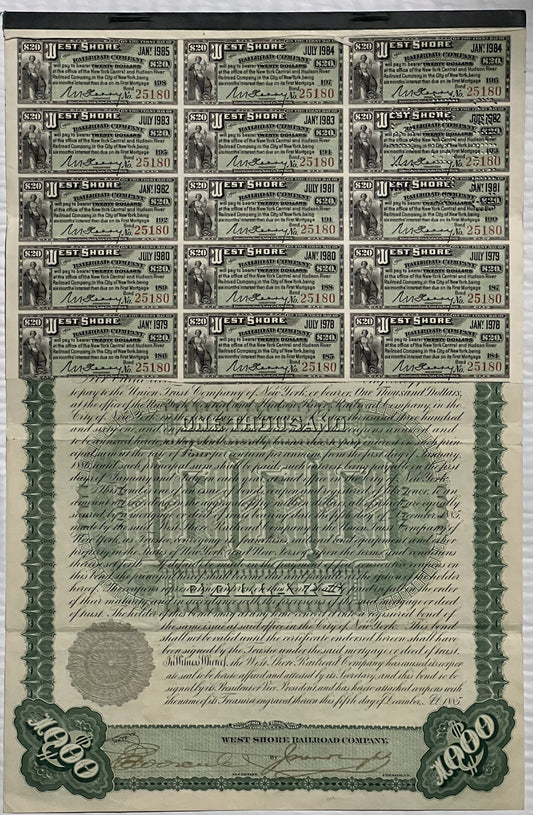
Coupons were made to be clipped away, and most bonds of this age lost theirs one payment at a time until only the certificate was left, so a sheet that came through the decades still attached is the exception rather than the rule. When a road went under, holders commonly taped the last coupon back onto the bond and held on in hope of collecting what they were owed, so a bond that still carries that taped final coupon is the better one to end up with. The coupon count can run a few more or a few fewer than what is pictured.

These are issued instruments rather than blanks. Bonds and debentures of this type were registered to a holder, authenticated by the trustee, and punch- or cut-cancelled when they were finally redeemed. Expect financial writings, markings, stamps, hole punches and staple holes as part of the life of the instrument: endorsements and signatures, trustee and registrar stamps, revenue or documentary tax stamps, cancellation punches, staple holes from being bound into a transfer book, pencil ledger notations. That is the paper trail of a security that actually did its job, and it is what separates a document that lived from a blank that never did. No two are alike: holder details, serial numbers, dates, signatures, stamps and punch patterns vary from example to example, so the photographs show the type rather than the exact sheet that ships. The coupon count can run a few more or a few fewer than pictured.

Shipping

🚚 Shipping & Handling

  • Shipping costs and timing are calculated at checkout.
  • Items curated and shipped directly by me include U.S. shipping at no additional cost, professionally packed to ensure safe arrival of your artifact.

Items from Vetted Pro Collectors
Shipping for items offered by vetted Pro Collectors is determined at checkout. All Pro Collector listings are reviewed to ensure fair, reasonable shipping practices.

For full details, please refer to our Shipping Policy.

Returns & Exchange

Take your time — you've got a full six months. If a piece isn't right for you, send it back the way it reached you and we're good.

In the first 30 days your money goes straight back the way you paid. After that it's store credit, so you can put it toward something you'd rather have.

Return shipping we sort out between us, case by case. I don't make this difficult.

If something arrives damaged, or it isn't what I said it was, send me a photo within 48 hours and I'll make it right.

Email info@vintageantiquesgifts.com or call 802-356-9872 — that's me answering, not a call center.

The only things I can't take back are custom or special-order pieces and gift cards.

View full details