Skip to product information
1 of 10

Vintage and Antique Gifts

Vintage 1974 Pontiac Grand Am Dealer Sales Brochure 🚗 Colonnade Sedan, Pontiac Michigan Muscle Car Advertising, 1970s Auto Showroom Literature, American Icon RIP 2010

Vintage 1974 Pontiac Grand Am Dealer Sales Brochure 🚗 Colonnade Sedan, Pontiac Michigan Muscle Car Advertising, 1970s Auto Showroom Literature, American Icon RIP 2010

Regular price 7.00 USD
Regular price Sale price 7.00 USD
Sale Sold out
Shipping calculated at checkout.
Quantity

Pontiac Is Gone. This Is the Brochure for Its "America's BMW."

The last Pontiac ever built was a G6 sedan that left General Motors' Orion Township plant in January 2010, and the name G6 had been chosen because that car was meant to be the sixth generation of the Grand Am. This brochure goes back to where the Grand Am began. It sells the 1974 model, the second year of Pontiac's attempt to beat the European sport sedans at their own game, and it reached dealers just as the October 1973 oil embargo turned American car buying upside down. Look at the cover. A dark green four-door waits on wet cobblestones under a single spotlight, and in the corner stands a triangular European-style road sign showing a car skidding through an S-curve. Pontiac meant foreign intrigue. The sales figures that followed read more like a forecast.

What You Are Getting

An original Pontiac Motor Division dealer sales brochure for the 1974 Grand Am, new old stock, measuring 12 x 10 1/2 inches (about 30.5 x 26.7 cm). It is printed in full color on glossy coated paper and marked "Litho in U.S.A." at the foot of the back page. The year is Pontiac's own: the sales copy inside says "we call it the 1974 Grand Am," and the maroon hardtop on the back page carries a 1974 license plate.

The cover sets the Grand Am name in white type over a black sky, with the line "The mid-sized Pontiac with foreign intrigue...American ingenuity." Below it sits the green 4-Door Colonnade Hardtop, tan interior showing through the glass and a thin gold stripe running down its flank.

Inside, a Cameo White 2-Door Colonnade Hardtop stretches across both pages, lit on a test pad lined with orange traffic cones, its louvered rear quarter window and honeycomb-pattern wheel catching the light. Fine print at the top of the spread notes that the cars carry some of the options and accessories Pontiac offered at extra cost. The right-hand page shows a burgundy all-Morrokide interior, with white, saddle, green and beige listed as the other choices, above Pontiac's pitch: a mid-sized car with the handling of the finest imports and the ride, styling and performance of a Wide-Track, a "famous squeezable nose," genuine African crossfire mahogany on the console, and a 400 V-8 with Turbo Hydra-matic as standard.

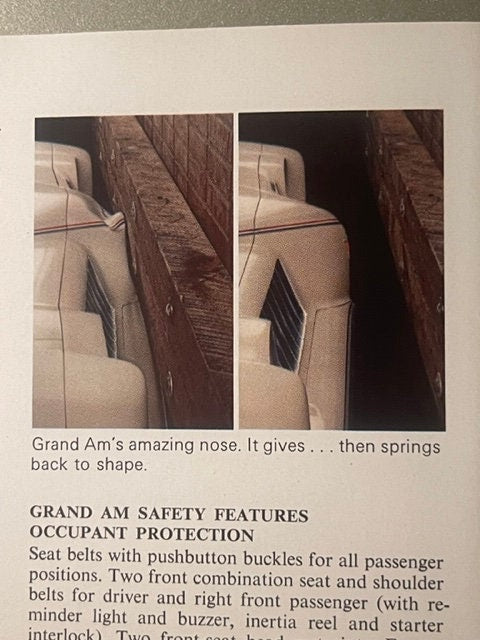
The back page is the spec sheet. It opens with the instrument panel, showing the standard rally gauge cluster and available tachometer, then the Honduras Maroon hardtop from behind, a pair of photos of "Grand Am's amazing nose," and two underside views of the Radial Tuned Suspension. The Facts and Figures cover what a showroom customer wanted to know: a standard 400 2-barrel V-8, with a 400 4-barrel or 455 4-barrel available; a 4-speed manual floor shift offered with the 400 4-barrel only and not in California; a 112.0-inch wheelbase on the 2-door and 116.0 on the 4-door, overall lengths of 210.9 and 214.9 inches, and a width of 77.7; a 25-gallon fuel tank; GR70-15 steel-belted radials on 7-inch-wide wheels. The popular-equipment list reads like the decade in one paragraph: NASA hood, Landau top for the 2-door, 8-track stereo tape player, tilt steering wheel, 6-way power seat and honeycomb wheels. The page signs off with the Pontiac arrowhead and GM logos above the address: Pontiac Motor Division, General Motors Corporation, One Pontiac Plaza, Pontiac, Michigan 48053.

How a Borrowed BMW Became a Pontiac

By the early 1970s Pontiac was watching Mercedes-Benz, BMW, Toyota and Datsun sell Americans something Detroit did not really build: a sedan with balanced handling and a strong engine that still rode like a luxury car. Bill Collins was the Pontiac engineer who decided to answer them. Collins had been assistant chief engineer since 1967, and he had already changed the division once, by suggesting that the big 389 V-8 go into the 1964 Tempest, the idea that became the GTO. On a trip to Opel in Germany he borrowed a BMW to evaluate. He remembered it as a Bavaria; another account of the trip calls it a 3.0S. Either way, in his words, "that's how the Grand Am was born." He came to call the result America's BMW.

Chassis engineer John Seaton and his team turned that conviction into hardware: heavy-duty bushings, thick front and rear anti-roll bars, unique shocks with a little more suspension travel, and radial tires as standard equipment. Pontiac named it Radial Tuned Suspension, and for 1973 the Grand Am was one of only three GM cars on standard radials, alongside the Oldsmobile Cutlass Salon and the Chevrolet Monte Carlo S. The body was GM's new A-body in the form originally intended for the GTO, re-badged and fitted with the top-level Grand Prix interior. Pontiac's design studio under Bill Porter shaped it, GM design chief Bill Mitchell's enthusiasm moved it along, and up front it wore the flexible urethane Endura nose that had first appeared on the 1968 GTO.

The project reportedly ran under the working name "Europa." The name it launched with is usually explained as "Grand" from the luxurious Grand Prix and "Am" from the Trans Am, though one history of the car says it was meant to evoke the Can-Am racing series.

1974: The Year in This Brochure

For 1974 the Grand Am got a redesigned nose and grille, vertical taillights, and a license plate and fuel filler moved up above the rear bumper, which is exactly how the maroon hardtop appears on the back page. The genuine mahogany came off the dashboard after problems but stayed on the center console, and that is why this brochure promises African crossfire mahogany "for the console." The 4-speed manual was no longer offered in California, and the brochure says so in parentheses.

None of it could beat the calendar. The Arab oil embargo began in October 1973, just as 1974 models were reaching showrooms, and buyers who were not chasing pure economy were chasing pure luxury. Pontiac had built 43,137 Grand Ams for 1973. For 1974 it built 17,083, and only 3,122 of those were four-doors like the green car on this cover. The 1975 run fell to 10,679, and the first Grand Am was finished after three model years. One history of the car sums up the trouble: it cost about $1,000 more than a comparable LeMans, and it was a big American car that got 11 mpg.

The Seat Belt That Would Not Let You Start the Car

One line in the back-page safety list ties this brochure to its model year as firmly as the plate does: front seat belts "with reminder light and buzzer, inertia reel and starter interlock." As of August 1973, federal Motor Vehicle Safety Standard No. 208 required new cars to have either automatic crash protection or an ignition interlock, so a 1974 car like this one would not start until the front-seat occupants were buckled. It worked, at first. Belt use rose from about 28 percent in 1973 cars with only a buzzer and light to about 67 percent in 1974 cars with the interlock. It also made drivers furious, and many disabled or bypassed the systems. Members of both houses of Congress took to the floor about the public's anger, and on October 27, 1974, President Gerald Ford signed a law barring any federal safety standard from requiring an interlock. NHTSA deleted the option from Standard No. 208 four days later. The rule lasted barely more than a year, and this brochure advertised it as a safety feature.

Pontiac, Michigan: The Chief, the Town and the Plant

The address on the back page belongs to a town founded on November 9, 1818, by the Pontiac Company, fifteen Detroit investors chaired by lawyer Solomon Sibley, with Stephen Mack and Shubael Conant among the partners. They named it for Pontiac, or Obwandiyag, the Odawa war chief who had occupied the area. By 1820 it was the county seat of Oakland County, about 26 miles northwest of downtown Detroit. Woolen and grist mills ran on the Clinton River, and by the early 1900s wagon and carriage makers such as the O.J. Beaudette Wagon Works were building automobile bodies.

The town's namesake was a real and consequential figure. In May 1763 Pontiac and about 300 followers tried to take Fort Detroit by surprise, then held it under siege until October 31 with more than 900 warriors from half a dozen tribes, defeating a British detachment at the Battle of Bloody Run that July. His war helped move the British Crown to issue the Proclamation of 1763, which barred new settlement west of the Appalachian Mountains. He made peace with Sir William Johnson at Fort Ontario on July 25, 1766, and was killed near Cahokia on April 20, 1769, by a Peoria warrior whose name has not been preserved.

The car that carried his name arrived in 1926 as a companion make for GM's pricier Oakland, quickly overtook it, and had supplanted Oakland entirely by 1933. Pontiac Assembly on Baldwin Avenue, built in 1927, was the division's home factory for decades, and all 1973 through 1975 Grand Ams were built at Pontiac's main assembly plant in the city. Pontiac's population peaked at 85,279 in 1970. The plant built its last full-size Pontiacs for 1980, was idled on August 6, 1982, and closed for good when Fiero production ended on August 16, 1988. The 2020 census counted 61,606 residents.

Pontiac Lore: Sledgehammers, Woodward Avenue and the GTO's Executioner

When the Endura nose debuted on the 1968 GTO, Pontiac's TV commercials and print ads showed the body-colored nose surviving direct blows from crowbars, tire irons, baseball bats and sledgehammers. The story goes that once those ads ran, a mother wrote to Pontiac saying her child had taken a hammer to the family car, so Pontiac was on the hook for the damage. Pontiac, as the tale is told, did not pay. Six model years later this brochure is still bragging, in two photographs, about the nose that "gives... then springs back to shape."

Woodward Avenue, laid over the old Saginaw Trail, runs north out of Detroit toward Pontiac. Through the 1950s and 1960s automobile engineers street-tested their cars along Woodward between 8 Mile and Square Lake roads, and the road became the backbone of Detroit's cruising legend. The Woodward Dream Cruise, founded in 1995 as a fundraiser for a soccer field in Ferndale, drew an estimated one million spectators in 2009.

Then there is Bill Collins himself. The engineer whose 389 Tempest idea started the GTO later proposed canceling the GTO in 1974, and called himself both its father and its executioner, so the last original GTO and this Grand Am share a model year. By 1977 Collins had moved to the DeLorean Motor Company, where he worked with John DeLorean on the DMC-12.

What the Grand Am Left Behind

The idea outlived its first failure. Pontiac brought the Grand Am name back for 1978 through 1980, again from 1985 through 2005, and then replaced it with the G6. In April 2009, in the middle of GM's financial crisis, word came that the Pontiac brand would be dissolved. The final car, that G6, shipped on January 4, 2010, and Pontiac dealer franchise agreements expired on October 31, 2010. The Baldwin Avenue plant that built the cars in this brochure had been closed since 1988. What remains is paper like this: a sedan on cobblestones, a skid sign in the corner, and a promise of foreign intrigue printed the year the gas ran short.

Who This Brochure Is For

Pontiac and GM literature collectors filling in the first-generation Grand Am; anyone who owned, sold or built one of these cars; restorers who want Pontiac's own word on 1974 colors, trims and options; Michigan automotive history buffs; and fans of moody studio car photography, because this cover is a small masterpiece of it. The cobblestone cover and the Cameo White spread both frame well, and it makes a thoughtful gift for the person in the family who still talks about a Pontiac.

Questions People Ask

What year is this Pontiac Grand Am brochure?
1974. Pontiac's inside copy names "the 1974 Grand Am," the back-page hardtop wears a 1974 plate, and the details (mahogany on the console only, no 4-speed in California, a seat-belt starter interlock) all match that model year.

Is it an original or a reprint?
An original piece of Pontiac dealer literature, new old stock, with "Litho in U.S.A." printed on the back page.

How large is it?
Twelve inches wide by 10 1/2 inches tall, about 30.5 by 26.7 cm.

What does "Colonnade" mean?
It was General Motors' name for the pillared body styles with frameless doors and windows used on its 1973 through 1977 mid-size A-body cars, after traditional hardtops and convertibles were dropped in the face of pending federal safety regulations. Pontiac lists the Grand Am as a 2-Door Colonnade Hardtop and a 4-Door Colonnade Hardtop, and this brochure pictures both.

How many 1974 Grand Ams were built?
17,083: 13,961 two-door coupes and 3,122 four-door sedans, every one of them assembled in Pontiac, Michigan.

Who created the Grand Am?
Engineer Bill Collins pushed the idea after evaluating a BMW borrowed from Opel, chassis engineer John Seaton's team developed the Radial Tuned Suspension, and Pontiac's studio under Bill Porter styled it. Martin J. Caserio, Pontiac's general manager from 1973 to 1975, was the first head of the division in over a decade whose focus was marketing and sales rather than performance.

When did the Pontiac brand end?
GM wound Pontiac down in 2010. The final car left the Orion Township line that January, and Pontiac dealers lost their franchises at the end of October.

Shipping

🚚 Shipping & Handling

  • Shipping costs and timing are calculated at checkout.
  • Items curated and shipped directly by me include U.S. shipping at no additional cost, professionally packed to ensure safe arrival of your artifact.

Items from Vetted Pro Collectors
Shipping for items offered by vetted Pro Collectors is determined at checkout. All Pro Collector listings are reviewed to ensure fair, reasonable shipping practices.

For full details, please refer to our Shipping Policy.

Returns & Exchange

Take your time — you've got a full six months. If a piece isn't right for you, send it back the way it reached you and we're good.

In the first 30 days your money goes straight back the way you paid. After that it's store credit, so you can put it toward something you'd rather have.

Return shipping we sort out between us, case by case. I don't make this difficult.

If something arrives damaged, or it isn't what I said it was, send me a photo within 48 hours and I'll make it right.

Email info@vintageantiquesgifts.com or call 802-356-9872 — that's me answering, not a call center.

The only things I can't take back are custom or special-order pieces and gift cards.

View full details
  • 5 stars: 5 (100%)
  • 4 stars: 0 (0%)
  • 3 stars: 0 (0%)
  • 2 stars: 0 (0%)
  • 1 star: 0 (0%)
6
6***a (193)

Excellent seller, item well packaged, very professional

d
d***b (474)

Item like new, excellent packaging, Neat O thank you note from the kids, Thank you!

o
o***o (1150)

Great condition, super packaging. Honest seller, fast shipping.

c
c***3 (1147)

like new brochure, shipped quickly very nice ebay seller.

i
i***b (815)

Thank you so much.