Skip to product information
1 of 7

Vintage and Antique Gifts

Vintage Boeing 737 Enamel Lapel Pin ✈️ Sealed Aviation Souvenir Pinback

Regular price 13.00 USD
Regular price Sale price 13.00 USD
Sale Sold out
Shipping calculated at checkout.

Description

✈️ Remember When a Little Pin on Your Lapel Could Say "I Belong to the Sky"?

There was a time when flying wasn't just a way to get somewhere — it was an event. A stewardess would crouch down and pin a tiny set of wings on a child's shirt just to make the day feel special. A pilot's cap badge meant something when he walked through the terminal. A company lapel pin on a businessman's jacket told you, at a glance, who he flew for and what he believed in. This little enamel piece captures that whole vanished era in miniature: a gold fuselage banking nose-up against an invisible sky, sweeping black wings and tail, a bold red cheatline running the length of the body, and the words BOEING 737 lettered proudly down the side. It's the kind of small, unassuming keepsake a pilot's kid, a frequent flyer, or a lifelong aviation buff would have tucked into a jacket pocket, pinned to a corkboard beside an old boarding pass, or clipped to a flight bag — carried quietly for years without ever quite forgetting where it came from.

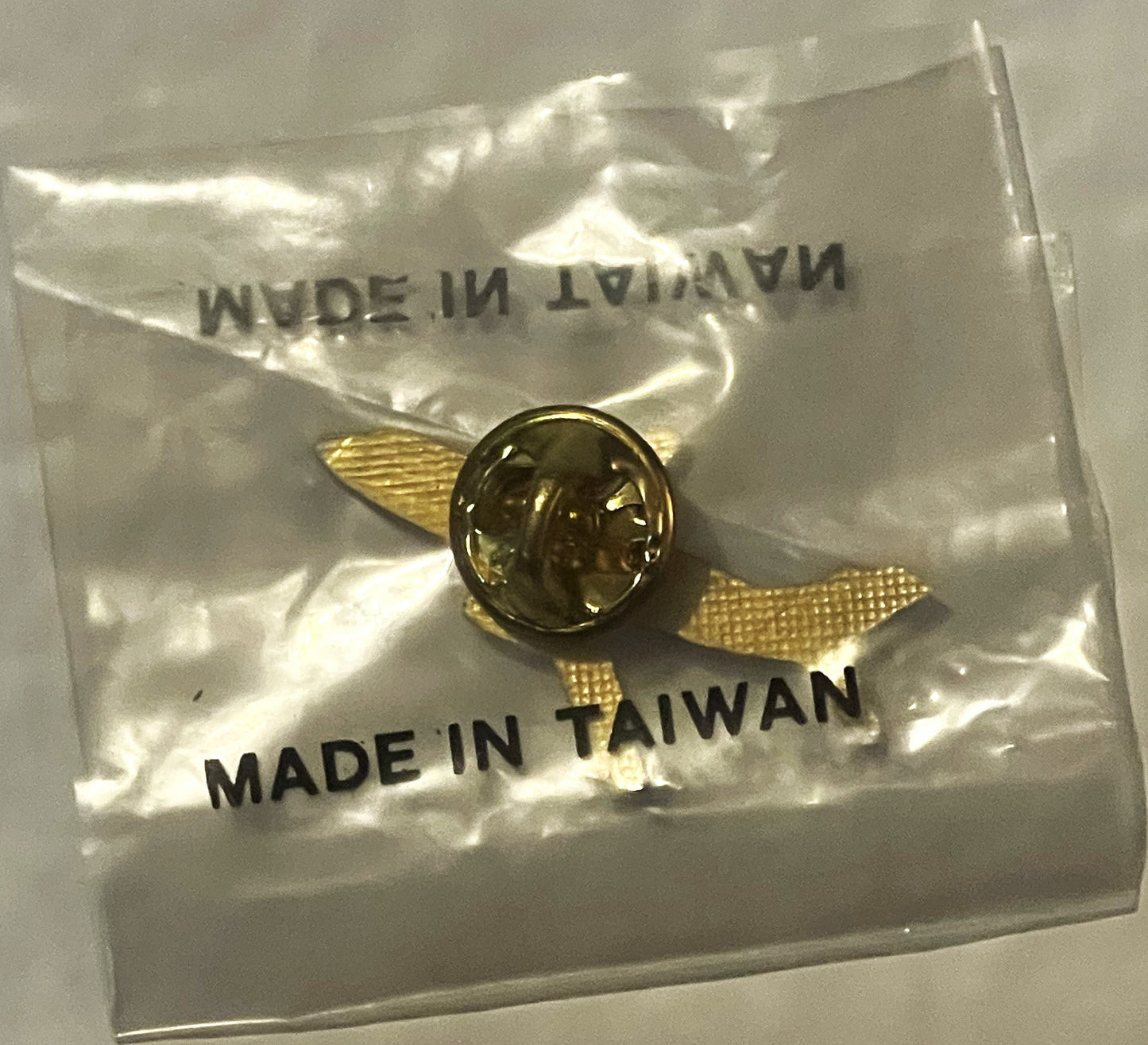
This is a genuine Boeing 737 lapel pin, die-struck in metal and finished in hard enamel across gold, black, and red. The tail is marked simply "737," the fuselage lettered with "BOEING 737," and the aircraft is rendered nose-up and banking in that classic souvenir-pin style — the same visual shorthand used on countless airline wings, plant-tour giveaways, and aerospace gift-counter pins for generations. The piece measures about 1.5 inches (roughly 3.8 cm) across, a genuinely pocket-sized trinket that sits easily on a lapel, a hat brim, or a display board. On the reverse of the packaging, "MADE IN TAIWAN" is printed plainly — a manufacturing mark, not a date stamp, so while it confirms where the pin was produced, it doesn't pin down an exact year. No date appears anywhere on the piece itself, and rather than invent a precise year we don't have, the honest answer is that its styling and packaging place it somewhere across the broad stretch of decades when the Boeing 737 program was hitting its stride and airline promotional pin culture was everywhere — roughly the 1970s through the 1990s. This particular example survives as new old stock (NOS): still sealed in its original factory packaging, never worn, never removed from the sleeve it left the manufacturer in.


🏭 From a Boathouse on the Duwamish to a Global Name

To understand why a little pin like this exists at all, you have to go back to a converted boat house on the Duwamish River near Seattle, Washington, in the summer of 1916. That's where a timber merchant named William E. Boeing incorporated the Pacific Aero Products Company — a modest wooden shed that would, in time, become the cornerstone of the most consequential aircraft manufacturer in the world. Boeing wasn't an engineer by training. He was a Yale graduate who'd made his fortune in lumber, and he'd taken up flying as a hobby back in 1911 under the tutelage of aviation pioneer Glenn Martin. Somewhere along the way, the hobby convinced him that the airplane had a future far bigger than a rich man's amusement.

The following year, the company was renamed Boeing Airplane Company, and with help from an early engineer named Wong Tsu, the "B&W" seaplane took its maiden flight — the literal cornerstone of everything that followed. It's a story local historians and aviation buffs alike still tell with a bit of wonder: a lumberman's hobby, a borrowed boathouse, and a handful of engineers building the future of American air travel by hand on the shores of a Pacific Northwest river.

The company's road wasn't a straight climb. In 1934, federal antitrust action tied to the Air Mail Act forced Boeing out of the airline business entirely, splitting the vertically integrated empire he'd built into separate manufacturing and airline companies. Bill Boeing, embittered by the breakup, sold most of his shares and retired, never again playing a major role in the company that carried his name. It's a quieter chapter than the triumphant jet-age story that came later, but it's part of the real history — a reminder that even legendary companies have hit walls they didn't choose. Boeing's manufacturing side rebounded through military orders in the late 1930s and the massive production demands of World War II, and the company that emerged from that era was the one that would go on to define postwar and jet-age commercial aviation. Decades later, in 1997, Boeing merged with McDonnell Douglas, and in 2001 the company's headquarters left Seattle — the city of its birth — for Chicago, before eventually settling in the Crystal City neighborhood of Arlington County, Virginia. But the airplanes themselves — the ones that made Boeing a household word — were, and largely still are, born in the Pacific Northwest.

✈️ The "Baby Boeing" Takes Its First Flight

By the early 1960s, Boeing's engineers were staring at a gap in their own lineup. The 707 handled long-haul routes and the 727 covered medium-range trips, but neither was quite right for the shorter, thinner routes connecting smaller cities — the fifty-to-sixty-passenger hops of fifty to a thousand miles that airlines were flying with older, less efficient aircraft. Preliminary design work on a new short-haul jet began on May 11, 1964, aimed squarely at filling that gap. What emerged was compact, twin-engine, and nimble enough to earn an affectionate nickname among the people who built it: the "Baby Boeing."

The first 737 was rolled out on January 17, 1967, and on April 9, 1967, it took to the sky for the first time from Boeing Field in Seattle, with test pilots Brien Wygle and Lew Wallick Jr. at the controls. It's easy, looking back, to treat that first flight as inevitable — of course the 737 became what it became — but at the time it was simply a new airplane trying to prove itself against established rivals, competing for a market segment that plenty of people in the industry weren't even sure existed yet. History proved the doubters wrong in spectacular fashion. The 737 didn't just fill the gap Boeing designed it for; it went on to become the backbone of short-and-medium-haul air travel for airlines across the entire world, generation after generation, through multiple redesigns and re-engining programs that kept the airframe modern for decade after decade.

🏘️ Renton, Washington — The Town Built Around a Runway

If Seattle is where Boeing was born, Renton, Washington is where the 737 has spent its entire life. Sitting on the southern shore of Lake Washington just southeast of Seattle, Renton has been home to Boeing's 737 assembly line since that very first rollout in 1967, and it has never stopped since. For generations of Renton families, "working at Boeing" wasn't just a job description — it was a whole identity, a rhythm of shift changes and overtime and layoff scares that shaped the town's schools, its diners, its Little League teams, and its sense of itself. Old-timers around the area still talk about the sound of test flights over the lake, about relatives who spent entire careers on the same assembly line, about the way the town's fortunes rose and fell with Boeing's order books. It's the kind of company-town lore that doesn't always make it into official histories, but that lives on in the stories families pass down — the uncle who worked the riveting line, the neighbor who retired after thirty-five years on 737 final assembly, the sense that this particular jet wasn't just a product, it was practically a member of the community.

That continuity is part of why the 737 holds such a unique place in aviation history. Very few commercial aircraft programs have run, essentially unbroken, out of the same factory town for well over half a century. Whatever era this particular pin was struck in, it was made to commemorate a jet that, by the time collectors were pinning it to their jackets, had already become one of the most recognizable shapes in the sky — and Renton was the town quietly building nearly all of them.

🌍 The Jetliner That Became the World's Workhorse

What started as a modest short-haul jet to plug a gap in Boeing's own product line went on to become, by many measures, the best-selling and most-produced commercial jetliner family in aviation history. Airlines on every continent have flown some version of the 737 — from small regional carriers to the largest global names — and for millions of travelers, "getting on a jet" has quite literally meant getting on a 737. That kind of ubiquity is exactly why a pin like this resonated with the people who collected it: it wasn't a niche or obscure aircraft being commemorated, it was the plane that half the traveling public had probably flown on themselves. Pilots kept these on flight bags. Aviation enthusiasts kept them on corkboards next to ticket stubs. Kids who grew up watching jets climb out of a local airport kept them as tiny proof that the biggest, most exciting machines in the world could still fit in the palm of a hand.

📌 The Golden Age of Aviation Pin Culture

Enamel aircraft pins like this one belong to a whole promotional tradition that flourished alongside commercial aviation's golden decades. Airlines gave junior wings to kids on their first flights. Aerospace companies sold souvenir pins at plant-tour gift counters for visitors who'd just watched a fuselage take shape on the factory floor. Airport gift shops, aviation museum counters, and air-show vendor tables all stocked die-struck enamel pins like this one, shaped after the real aircraft they celebrated, priced cheaply enough that a kid with allowance money or a business traveler killing time before a flight could pick one up without thinking twice. Many of these pins, including this one, were produced overseas — the "MADE IN TAIWAN" mark on this piece places it within that well-established mid-to-late-20th-century tradition of die-struck pin manufacturing that supplied airline gift counters and aerospace souvenir tables around the world for decades. It's a small, easily overlooked detail, but it's part of the honest story of how these pins made their way from a factory into the pockets and lapels of the traveling public.


🖼️ Display Ideas

  • ✈️ Pin it to a corkboard alongside old boarding passes, postcards, or airline timetables for a mini aviation-history corner.
  • 🧷 Clip it to a flight bag, jacket lapel, or pilot's cap the way generations of flyers actually wore pins like this.
  • 🖼️ Mount it in a small shadow box with a photo of a Boeing 737 in flight for an instant conversation piece.
  • 🎓 Give it as a keepsake to a new pilot, flight attendant, or aviation-school graduate stepping into their career.
  • 🗄️ Add it to an existing pin or wings collection alongside other airline and aerospace memorabilia.
  • 🎁 Wrap it up for a lifelong flyer, retired airline employee, or anyone who's ever loved the window seat.

🎁 Who Collects These

Aviation pin collecting draws a genuinely wide crowd — retired pilots and flight attendants who spent careers around aircraft like this one, aerospace employees and their families with a personal connection to Boeing's Pacific Northwest factories, and everyday travelers who simply grew up on 737s and want a small, tangible piece of that memory. It's also a natural gift for the person in your life whose whole world has always revolved around flight: the father who spent decades in a cockpit, the grandmother who worked an airline counter, the teenager who can name every aircraft that flies overhead. Because it arrives as new old stock, still sealed in its original packaging, it appeals just as much to collectors chasing untouched, unworn examples as it does to anyone who just wants a good-looking little pin with real history behind the shape it's cast in.


❓ FAQ

Is this an official Boeing-licensed pin?

It's a Boeing 737-themed souvenir enamel pin bearing the Boeing 737 name and tail marking; it was manufactured overseas, as marked "Made in Taiwan," in the well-documented tradition of die-struck aviation and airline souvenir pins produced for gift counters, plant tours, and airport shops.

How old is this pin exactly?

There's no date stamped anywhere on the piece, so we won't invent one. Based on its styling and packaging, it fits within the broad decades — roughly the 1970s through the 1990s — when the Boeing 737 program was flourishing and aviation pin culture was at its height.

What does "new old stock" mean here?

It means this pin has never been worn or removed from its original sealed packaging. It's been sitting, untouched, since it left the manufacturer.

How big is the pin?

It measures about 1.5 inches (roughly 3.8 cm) from nose to tail — a compact, pocket-sized piece meant to sit easily on a lapel, cap, or flight bag.

What colors and details are on the pin?

The fuselage is gold with a red cheatline running its length, the wings and tail are black, and the tail carries the "737" marking while "BOEING 737" is lettered along the body — all rendered in die-struck metal filled with hard enamel.

Why was the Boeing 737 such a popular subject for souvenir pins?

The 737 became one of the best-selling and most-produced commercial jetliner families in aviation history, flown by airlines around the world — which made it a natural, widely recognized subject for the airline and aerospace souvenir pins collectors sought out for decades.

Is this a good gift for a pilot or aviation enthusiast?

It's exactly the kind of small, meaningful keepsake pilots, flight crew, and aviation buffs have historically kept on flight bags, jackets, and display boards — a fitting gift for anyone whose life has revolved around the sky.

Shipping

🚚 Shipping & Handling

  • Shipping costs and timing are calculated at checkout.
  • Items curated and shipped directly by me include U.S. shipping at no additional cost, professionally packed to ensure safe arrival of your artifact.

Items from Vetted Pro Collectors
Shipping for items offered by vetted Pro Collectors is determined at checkout. All Pro Collector listings are reviewed to ensure fair, reasonable shipping practices.

For full details, please refer to our Shipping Policy.

Returns & Exchange

Product Page Return Policy

  • 60-Day Returns – Items must be in original condition.
  • Refunds – Issued after inspection (excluding shipping costs).
  • Return Shipping – Customer is responsible unless item is damaged or incorrect.
  • Damaged/Incorrect Items – Contact us within 48 hours for a replacement or refund.
  • Easy Returns – Email [email protected] or call 802-356-9872 to initiate a return.

For full details, visit our Refund Policy.

View full details