Skip to product information
1 of 4

Vintage and Antique Gifts

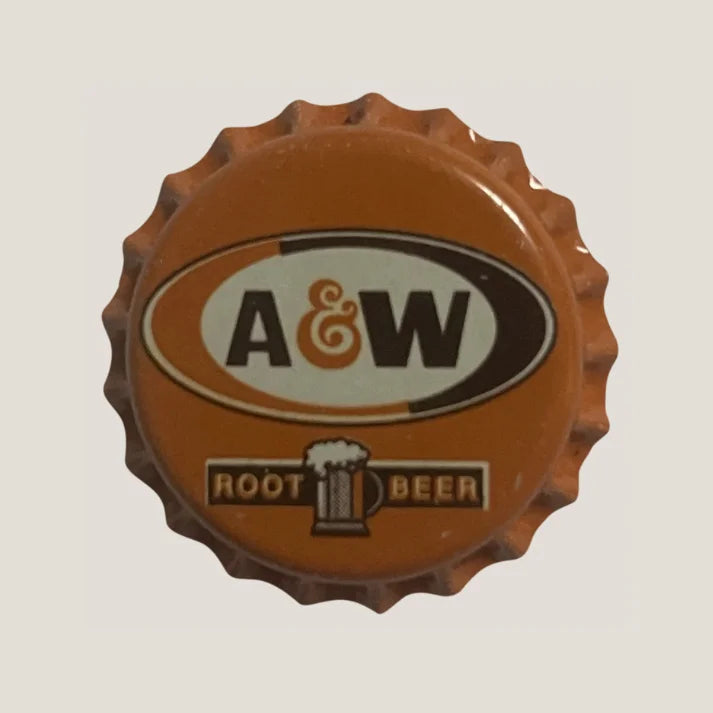
Vintage A&W Root Beer Bottle Cap 🥤 Frothy Mug Logo Crown Cap NOS

Regular price 12.00 USD
Regular price Sale price 12.00 USD
Sale Sold out
Shipping calculated at checkout.

Description

🥤 Remember When a Bottle Cap Meant a Trip to the Corner Store?

There's a particular kind of nostalgia tied up in a bottle cap — not the drink itself, but the little metal disc that sealed it, the one that got pried off with an opener bolted to the porch rail or the edge of a screen door, and then either tossed in a coffee can or, if you were a kid with an eye for color, saved. I still think that's the appeal of a piece like this one. It's small, it's humble, and it's carried the same frothy mug and cursive ampersand for generations of front-porch summers. Holding an unused example of one — never crimped onto a bottle, never popped off with a bang — is about as close as you can get to standing at the counter of an old root beer stand before the first bottle ever left the cooler.

This is a genuine A&W Root Beer crown bottle cap, New Old Stock (NOS) — meaning it was manufactured, never used, and simply sat in inventory ever since rather than sealing an actual bottle. The front carries the instantly recognizable A&W oval logo in warm orange, cream/white, and deep brown, with the bold black lettering "A" and "W" bridged by that distinctive script ampersand — a small flourish of orange curling between the two capital letters that has become one of the most recognized pieces of American beverage branding. Below the oval sits a second panel reading "ROOT BEER" in cream lettering, flanking a simple line-drawn mug topped with a frothy head of foam — the visual signature of the brand distilled down to a couple of square inches of lithographed metal. The scalloped crown edges are crimped in the same orange as the face, and the underside shows plain, unpainted metal — including a small stamped number "22" near the crimped edge, likely a manufacturing or mold reference from the capping plant, the kind of quiet production detail that turns up on caps of this style and adds a little extra texture for anyone who collects them closely.


🏭 A&W and the Birth of American Root Beer Culture

The story behind this little cap goes back to a roadside stand and a homemade batch of root beer. In June of 1919, a man named Roy W. Allen set up a drink stand in Lodi, California, timed to a parade welcoming home the town's World War I veterans. He'd bought a root beer formula from a pharmacist and poured it fresh, cold, and foamy for the returning soldiers and the crowds who came out to greet them. It caught on immediately — enough that Allen kept the stand running, then opened more.

In 1922, an employee named Frank Wright partnered up with him, and the following year the two opened their first true A&W restaurant in Sacramento. The name is exactly what it looks like: Allen and Wright, their initials joined by that same ampersand you see stamped on this cap. The partnership didn't last long in a formal sense — Allen bought out Wright's share in 1924 — but the name, and the "&," stuck for good.

What Allen did next is the part that really built the empire: in 1925 he began franchising the root beer itself, letting local operators run their own stands and add their own menus while he held onto the trademarked name and formula. Historians of franchising point to this as one of the earliest successful food-franchise models in the country — decades before the idea became a fixture of American business. By 1933, there were 170 A&W stands across the country. Even through the Depression and the rationing years of World War II, the brand held its footing, and once the war ended and GI loans put cars and small businesses within reach of a new generation, A&W exploded — by 1950 there were more than 450 stands, many of them drive-ins built for the new automobile culture sweeping postwar America.

One branch of that franchise story deserves its own telling: in 1927, a young businessman named J. Willard Marriott picked up the A&W franchise rights for Washington, D.C., along with Baltimore and Richmond. He opened his root beer stand with a partner, Hugh Colton — and that little stand eventually grew into the Hot Shoppes restaurant chain, which in turn became the foundation of the Marriott hotel empire. It's a genuinely remarkable thread to follow: a root beer stand seeding one of the largest hospitality companies in the world.

Roy Allen sold the business in 1950 to a Nebraska businessman named Gene Hurtz, who formed the A&W Root Beer Company and kept growing it — 2,000 stores by 1960 — while also making the call to let franchisees serve full menus and build out proper drive-in restaurants rather than simple root beer stands. From there, ownership of the brand passed through a long chain of corporate hands: the J. Hungerford Smith Company (which had actually been producing Allen's root beer concentrate since 1921) bought the business in 1963, United Fruit Company took it over in 1966, and by 1971 it sat under a new entity called A&W Distributing Co., part of what eventually became United Brands. Cadbury Schweppes bought the beverage brand in 1993, and it has continued down through corporate mergers since — while the restaurant side of the business split off entirely, eventually landing back in the hands of its own franchisees. It's a genuinely American story: not a company that failed, but one so beloved it kept getting handed from owner to owner, none of them willing to let the root beer itself change.

In 1974, the brand introduced "The Great Root Bear," a costumed mascot that became the friendly face of A&W at drive-ins and county fairs for years afterward — proof that even as ownership shuffled behind the scenes, the company kept investing in the warm, familial feeling that had defined the brand since Roy Allen's parade-day root beer stand.


🏘️ Lodi, California — Where It All Started

Lodi still marks the spot. A historical marker in town reads, in part: "On this site one hot day in June of 1919, Roy Allen served the first frosty mug of creamy A&W Root Beer in Lodi, California." It's a small-town origin story that Lodi has held onto proudly — the idea that a single stand, built for a single day's parade, quietly launched a beverage brand that would spread coast to coast. Local accounts even differ slightly on the exact June date of that first pour, which only adds to the charm — the kind of detail passed down and re-told slightly differently by different old-timers, the way founding stories tend to drift a little with each retelling.


👤 The Men Behind the Mug

Roy W. Allen — born in 1882, died in 1968 — spent his working life before A&W as a hotelier out west, and it was during business travels through Arizona that he crossed paths with the pharmacist whose root beer formula he'd go on to buy and build a company around. He later registered the "A&W Root Beer" name and logo with the U.S. Patent and Trademark Office, protecting the very oval mark you see reproduced on this cap. Accounts note he spent his final eighteen years in comfortable retirement on Balboa Island before his death.

Frank Wright, the "W" in the name, remains something of a mystery beyond his short partnership with Allen — he joined the business in 1922, was bought out just two years later in 1924, and the historical record largely goes quiet on him after that. It's one of those odd footnotes in American brand history: half the name belongs to a man whose own story mostly faded from view.


🌟 Why It Still Matters Today

A&W's frothy mug logo has stayed remarkably consistent for the better part of a century, which is exactly why a small cap like this one still reads instantly to anyone who sees it. It represents an era of American life built around the drive-in, the soda fountain, and the neighborhood stand — a time when a root beer float was an event, not an afterthought. Bottle caps like this survive today mostly by accident: tucked in a drawer, swept into a jar, or in this case, held back in unused inventory and never given the chance to seal a bottle at all. That's part of what makes an NOS example worth pausing over — it skipped the fate of the millions of A&W caps that were popped off and thrown away, and instead sat quietly waiting, decades on, still carrying its factory-crisp color and that little stamped "22" as a small fingerprint of the plant it came from.


🖼️ Display Ideas

  • 🧃 Set it into a shadow box alongside other root beer and soda-fountain advertising pieces for a mini Americana wall
  • 🪙 Mount it in a bottle cap display frame or coin-style shadow case to show off the front artwork
  • 🍺 Pair it with vintage root beer mugs or glassware for a themed kitchen or bar-nook display
  • 🎪 Add it to a broader collection of mid-century drive-in and roadside advertising memorabilia
  • 🎁 Present it as a small, thoughtful gift for anyone with a soft spot for classic American soda brands
  • 📌 Pin it to a corkboard or memory wall of small found treasures alongside other soda-era ephemera

🎁 Who Collects These

Bottle cap collecting is its own quiet corner of the Americana world, and A&W caps are a perennial favorite within it — soda memorabilia collectors, root beer brand loyalists, drive-in and diner nostalgia buffs, and general vintage advertising collectors all tend to overlap here. It's also a natural pickup for anyone building out a broader mid-century Americana shelf, or looking for a small, affordable, genuinely historic gift for a root beer enthusiast or a collector who already has the mugs and the signs but is missing the little details.


❓ FAQ

Is this cap new or used?
It's New Old Stock (NOS) — manufactured but never crimped onto a bottle, so it never went through actual use.

How old is this cap?
There's no legible manufacturer's date stamp on the piece, so an exact year can't be confirmed. Crown caps of this general style were standard for A&W bottling from the mid-20th century into the 1970s, which is the era this piece fits stylistically.

What's the number stamped on the underside?
There's a small "22" stamped into the plain metal underside near the crimped edge — most likely a mold or production reference from the capping plant rather than a date or code tied to the front artwork.

What does the imagery on the cap represent?
The oval A&W logo with its cursive ampersand and the frothy mug graphic below it are the brand's signature marks, used consistently across A&W advertising and packaging for decades.

Would this have actually sealed a bottle?
No — as NOS, this example was held back from that use, which is part of why it survives in the condition it's in today.

Is this a good gift for a collector?
Very much so — it's an easy, meaningful piece for anyone who collects soda advertising, root beer memorabilia, or general mid-century Americana.

Shipping

🚚 Shipping & Handling

  • Shipping costs and timing are calculated at checkout.
  • Items curated and shipped directly by me include U.S. shipping at no additional cost, professionally packed to ensure safe arrival of your artifact.

Items from Vetted Pro Collectors
Shipping for items offered by vetted Pro Collectors is determined at checkout. All Pro Collector listings are reviewed to ensure fair, reasonable shipping practices.

For full details, please refer to our Shipping Policy.

Returns & Exchange

Product Page Return Policy

  • 60-Day Returns – Items must be in original condition.
  • Refunds – Issued after inspection (excluding shipping costs).
  • Return Shipping – Customer is responsible unless item is damaged or incorrect.
  • Damaged/Incorrect Items – Contact us within 48 hours for a replacement or refund.
  • Easy Returns – Email [email protected] or call 802-356-9872 to initiate a return.

For full details, visit our Refund Policy.

View full details