Skip to product information
1 of 6

Vintage and Antique Gifts

Vintage New Kids on the Block Pinback Button 📌 NKOTB Boy Band Group Photo Pin, Button-Up Troy MI, 1980s Pop Music Fan Collectible

Regular price 10.00 USD
Regular price Sale price 10.00 USD
Sale Sold out
Shipping calculated at checkout.

Description

🎤 Do You Remember Which One Was Yours?

Before anyone ever "followed" a favorite, you pinned your loyalty to your jacket. Every kid on the playground had one — a metal circle no bigger than a quarter dollar and a half, clipped to a denim collar or a canvas backpack strap, silently announcing exactly which of the five you'd claim as your own. You didn't need to explain it. Everybody already knew what it meant when a button like this one caught the light. This one has waited a long time to be worn again — a genuine piece of the era, never pinned to anything, held back in old shop stock rather than a teenager's jacket.

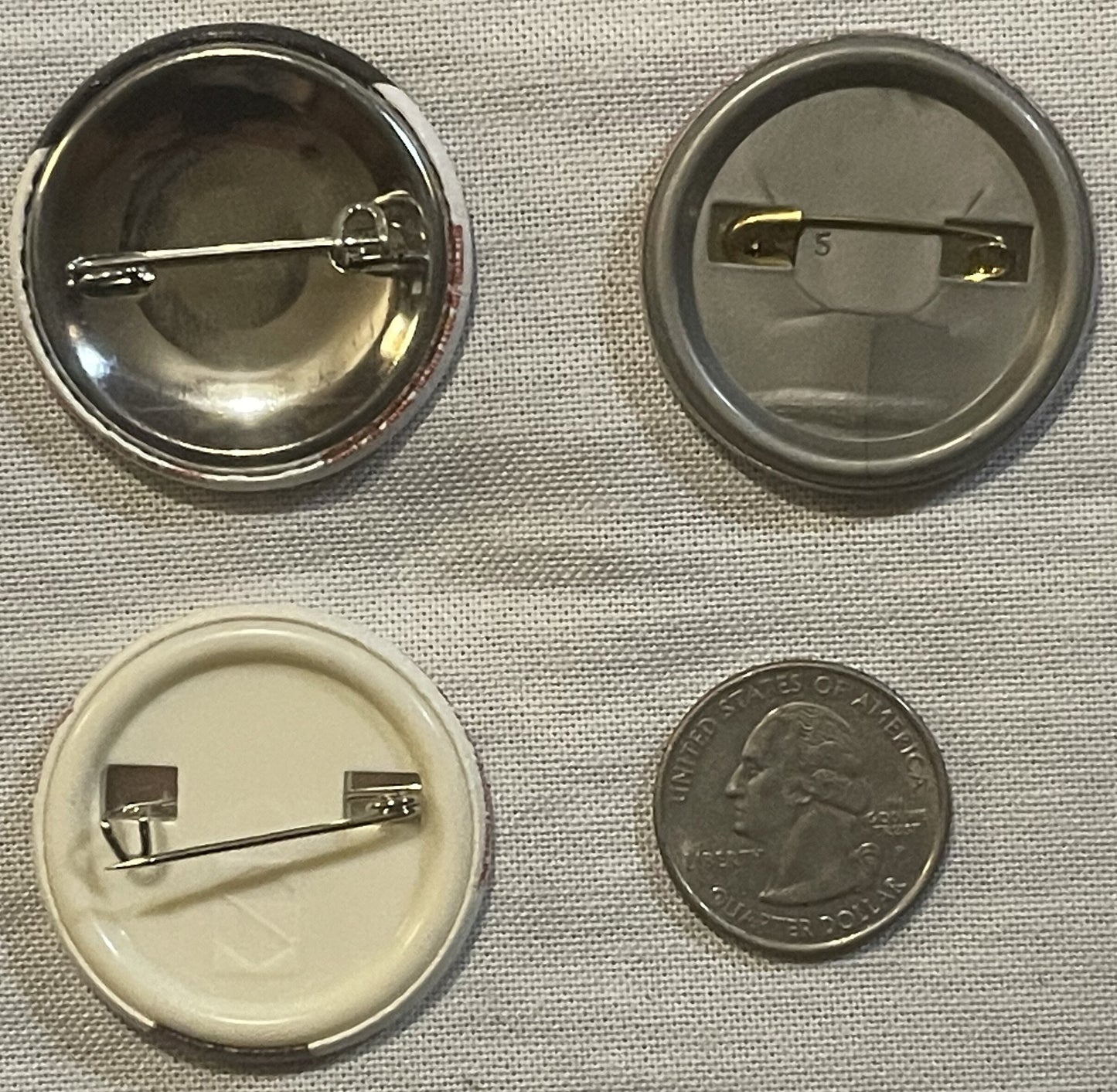
This is a round pinback button, measuring 1.5 inches (about 3.8cm) across, produced by Button-Up, a novelty and licensed-pin maker that operated out of Troy, Michigan. Across its cream-colored face runs a full-color group photograph of the five original members of New Kids on the Block, printed in the layered, dot-screen halftone style of the era's offset presses — you can see the fine mechanical pattern in the color if you look closely, the same printing signature found on the trading cards, magazine inserts, and iron-ons of the same years. Four of the five are gathered close in matching black jackets — one in a red shirt, one in a soft yellow tie, and one stepping forward in a white tank top and a flat cap — while the fifth member kneels in front. Bold, angled red lettering reading NEW KIDS ON THE BLOCK cuts across the bottom third of the design, rendered in that dripping, urban-graffiti-style type the group used across nearly all of its licensed merchandise. This example is New Old Stock (NOS) — inventory that sat unsold and unused rather than one that ever made it onto a real fan's jacket.


🌟 Five Boston Kids and the Man Who Built a Boy-Band Empire

The story of New Kids on the Block doesn't start in a record-label boardroom — it starts on the actual blocks of Dorchester and South Boston, in the neighborhoods where producer Maurice Starr went looking for talent in the mid-1980s. Starr, born Larry Curtis Johnson, had already had one massive success building the R&B group New Edition — a success that ended bitterly, with Starr pushed out of the group's business dealings. His answer was to build something new, on his own terms, and he was blunt about the ambition behind it: he wanted to prove that a white version of New Edition could be twenty times as big.

To find his group, Starr sent talent scout Mary Alford into working-class Boston neighborhoods to find teenagers who could sing, rap, and dance. In Dorchester, she found a fourteen-year-old named Donnie Wahlberg. Jordan Knight, Jonathan Knight, Danny Wood, and eventually Joey McIntyre rounded out the lineup — Joey the last to join, added at just twelve years old after another young singer's parents balked at putting their son in show business, a bit of trivia longtime fans still love to trade, since it means the group's baby-faced breakout star very nearly never made the cut at all.

Here's the piece of neighborhood lore that stops most people cold: before they were New Kids on the Block, the group briefly performed under a different name — "Nynuk," pronounced "na-nook" — and standing in that very first lineup alongside his older brother Donnie was a thirteen-year-old rapper named Mark Wahlberg. He left after only a few months to chase a path of his own, one that eventually ran through "Marky Mark and the Funky Bunch" and on into Hollywood rather than the boy-band circuit his brother helped define. It's the kind of only-in-Boston footnote that turns a manufactured pop act into a genuine neighborhood story that got very, very big.


📀 From "Nynuk" to "Hangin' Tough": The Rise

Columbia Records released the group's self-titled debut in 1986, written and produced almost entirely by Maurice Starr in a bubblegum-pop style. It landed with barely a ripple — the first single, "Be My Girl," got modest airplay around Boston and little else. Then came the second album. Released in the late 1980s, Hangin' Tough rocketed to the top of the Billboard 200 and threw off five top-10 singles, including two chart-topping hits in "Hangin' Tough" and "I'll Be Loving You Forever." Almost overnight, five Boston teenagers went from a stalled bubblegum act to the biggest pop phenomenon in the country.

By the turn of the new decade, the numbers were staggering for any act, let alone a boy band: an estimated 15 million albums, singles, and videocassettes sold, and roughly $400 million a year in related merchandise moving through stores. Their faces were on lunch boxes, notebooks, sleeping bags, trading cards, and — inevitably — pinback buttons just like this one. They packed arenas with screaming fans, took home multiple American Music Awards, and became the standard every teen-pop act that followed would be measured against.


🧷 A Button for Every Backpack: The Late-'80s Pin Boom

It's easy to forget, in an age of profile pictures and social feeds, just how much cultural work a pinback button used to do. In the years New Kids on the Block owned the radio, buttons were the original public declaration of fandom — cheap enough for allowance money, small enough to wear a dozen at once, and easy for a licensor to print by the truckload the moment a band broke big. A jean jacket covered in pins told you everything about a kid before they said a word: which member they'd claim, which concert they'd begged to attend, which side of the playground debate they stood on. Buttons like this one rode alongside the posters torn from teen magazines, the collectible trading cards, and the cassette singles worn thin from replay — all part of the same explosion of merchandise that made NKOTB as much a retail event as a musical one. A pin was small, but at the height of "New Kids Fever," small was exactly what made it perfect: portable, tradeable, and impossible to miss.


🏭 Button-Up of Troy, Michigan

The maker's mark on this piece points to Button-Up, a pinback button shop that operated out of Troy, Michigan. Comparable novelty pins bearing the same Button-Up mark and Troy address are known to collectors from the same general late-1980s period, which places this shop squarely in the same wave of small regional button printers who kept up with pop culture as fast as it moved — a wrestling star one week, a cartoon character the next, a chart-topping boy band the week after that. Companies like Button-Up were the quiet engine room behind teen merchandising: not a household name themselves, but the hands that actually turned a licensed photograph into something a kid could pin to a jacket collar by the following weekend.

Troy itself has long been one of the classic Detroit-area suburbs of Oakland County, Michigan — a township with roots going back to the 1820s that grew explosively through the mid-twentieth century as the automobile industry pulled workers and small manufacturers out from the city core and into the surrounding suburbs, incorporating as its own city by the mid-1950s. That backdrop of small, nimble manufacturing and printing shops serving Detroit's sprawling population is exactly the kind of environment where a novelty pinback outfit like Button-Up would have found steady work — close enough to a major media and retail market to catch every new licensing wave, without ever needing to be a household name outside of it. Old-time button collectors still trade stories about the regional pin shops of this era — Michigan, Chicago, and Pennsylvania all had their own quiet cottage industries turning out licensed buttons — and pieces like this one are often the only surviving record that a shop like Button-Up ever existed at all.


💫 Where the New Kids Are Now

Every teen phenomenon eventually meets its backlash, and New Kids on the Block were no exception — lip-synching accusations chipped at their credibility just as musical tastes were swinging hard toward grunge and gangsta rap. In 1993, the group split from Maurice Starr and shortened its name to the initialism NKOTB, releasing Face the Music the following year before going quiet. But the story didn't end there. The group reunited to sold-out arenas in the years since, proving the fandom that once lived on backpacks and bedroom walls had simply grown up alongside them. In 2014, New Kids on the Block received a star on the Hollywood Walk of Fame, cementing a legacy built on more than 80 million records sold worldwide — and cementing, too, the value of the everyday artifacts, like this button, that fans once wore as proof of belonging. Every boy band that followed, from Backstreet Boys to NSYNC and beyond, owes a debt to the blueprint five Boston teenagers and one relentless Boston producer wrote in the late 1980s.


🖼️ Display Ideas

  • 📌 Pinned to a corkboard or bulletin board alongside other 1980s music memorabilia for an instant teen-bedroom throwback
  • 🖼️ Framed in a small shadow box on its own, matted against a solid color to let the group photo and red lettering pop
  • 🎀 Clustered with other music pinbacks of the same era on a ribbon board or denim jacket for a wall-mounted collage
  • 🎁 Given as a nostalgic gift to a lifelong NKOTB fan who remembers exactly where they stood in the "who's your favorite" debate
  • 📚 Tucked into a display case with cassette singles, ticket stubs, or teen magazines from the same pop-culture moment
  • 🏠 Kept loose in a bowl or tray of vintage pins on a shelf, ready to be picked up and talked about

🎁 Who Collects These

This one draws in a wide range of collectors, and rarely just one type. There are the lifelong NKOTB fans who owned this exact style of button the first time around and are chasing back a piece of their own childhood. There are pinback and button collectors more broadly, for whom a regional maker's mark like Button-Up is its own small research puzzle worth chasing down. There are boy-band and pop-music historians building out a fuller picture of the merchandising machine behind the era's biggest teen idols. And there are gift-givers — buying for a mother, an aunt, a sister who screamed for these five guys decades ago and would light up seeing this show up in a small box today. Across all of them, the pull is the same: a small, honest object that carried real meaning on a real kid's jacket, at the exact moment New Kids on the Block were the biggest thing in music.


❓ FAQ

How big is this button?
It measures 1.5 inches (about 3.8cm) across, the classic size for band and novelty pinbacks of its era — small enough to wear several at once, exactly as fans did.

Is this an original piece from the band's era, or a modern reprint?
This is a genuine period piece, not a modern tribute reprint — produced by Button-Up of Troy, Michigan, during the same general run of licensed New Kids on the Block merchandise that flooded stores at the height of the group's popularity.

What does "New Old Stock" mean for a piece like this?
It means this button was made and set aside as shop inventory rather than ever being sold and worn — it comes from a stash of period stock rather than off of a fan's actual jacket.

Who is pictured on the button?
The full original lineup of New Kids on the Block — Donnie Wahlberg, Jordan Knight, Jonathan Knight, Danny Wood, and Joey McIntyre — shown together in the group photo used across much of the band's licensed merchandise line.

What was Button-Up, exactly?
Button-Up was a regional novelty and licensed pinback button maker based in Troy, Michigan, active in producing pop-culture and novelty pins during the same years New Kids on the Block were at their commercial peak.

Was this button officially licensed by the band?
It's designed and printed in the same style as the officially licensed NKOTB merchandise sold at the height of the group's fame, carrying the band's name and group photograph exactly as fans would have seen it on store-bought pins of the day.

Does the pin still work for wearing today?
Yes — it carries the same style of pin-back fastener fans used at the time, so it can be worn again exactly as it would have been the first time around, or simply kept as a display piece.

Shipping

🚚 Shipping & Handling

  • Shipping costs and timing are calculated at checkout.
  • Items curated and shipped directly by me include U.S. shipping at no additional cost, professionally packed to ensure safe arrival of your artifact.

Items from Vetted Pro Collectors
Shipping for items offered by vetted Pro Collectors is determined at checkout. All Pro Collector listings are reviewed to ensure fair, reasonable shipping practices.

For full details, please refer to our Shipping Policy.

Returns & Exchange

Product Page Return Policy

  • 60-Day Returns – Items must be in original condition.
  • Refunds – Issued after inspection (excluding shipping costs).
  • Return Shipping – Customer is responsible unless item is damaged or incorrect.
  • Damaged/Incorrect Items – Contact us within 48 hours for a replacement or refund.
  • Easy Returns – Email [email protected] or call 802-356-9872 to initiate a return.

For full details, visit our Refund Policy.

View full details