Skip to product information
1 of 4

Vintage and Antique Gifts

Vintage 1992 DC Comics Lobo's Back 🖤 "Bite Me, Fan Boy" Promo Pinback Button

Regular price 12.00 USD
Regular price Sale price 12.00 USD
Sale Sold out
Shipping calculated at checkout.

Description

🤘 Remember When the Rudest Character in Comics Became Everybody's Favorite? 🖤

There was a particular kind of thrill in walking into a comic shop in the early 1990s and seeing a spinner rack loaded with foil covers, holographic variants, and — somewhere in the mix — a snarling, chain-smoking space biker telling you, in dripping horror-movie lettering, to bite him. That was Lobo's whole pitch. He didn't want to save you. He wanted your lunch money and your comic. This little button was part of how DC Comics got that joke in front of fans in the first place — a pocket-sized piece of comic shop counter culture, handed out to hype a book that leaned all the way into its own irreverence. Decades later, it's one of those small, easy-to-lose pieces of 1990s comics ephemera that collectors now hunt down specifically because almost nobody thought to save one at the time.

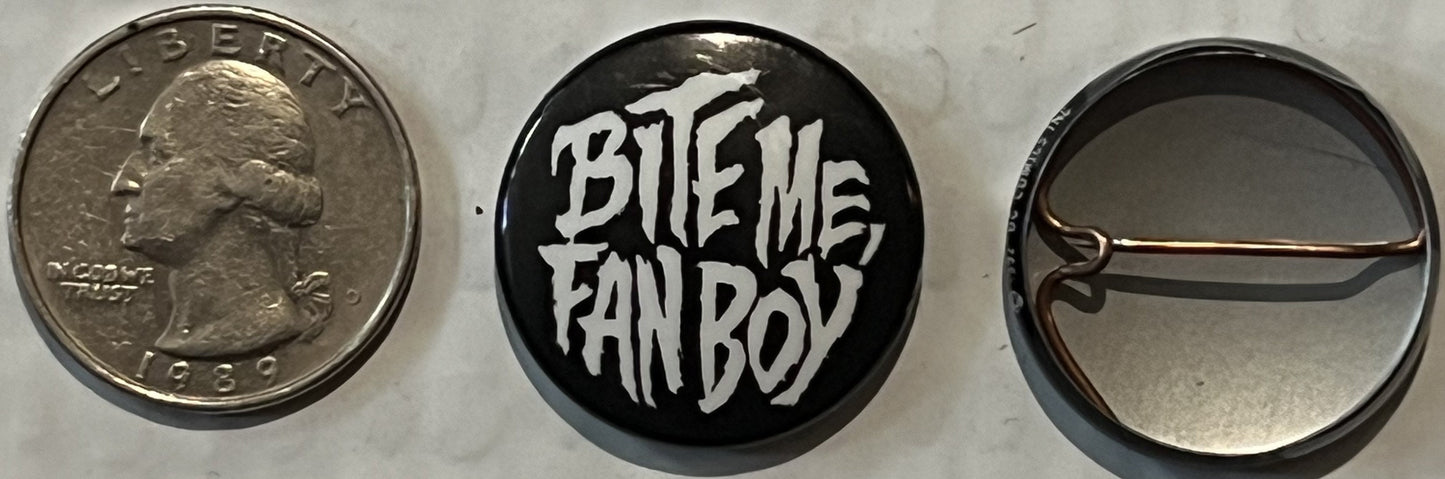
This is a 1-inch pinback button issued by DC Comics, Inc. in 1992 — the copyright line "© 1992 DC Comics Inc." is stamped right on the curled metal edge of the piece, which is how we can date it with confidence rather than guess. It's a litho-printed tin button, black background, white dripping horror-style lettering spelling out "BITE ME, FAN BOY," with a silver metal rim visible at the edge. It's small enough to sit next to a quarter with room to spare, and it was produced as promotional pin-back giveaway merchandise — the kind of thing a comic shop counter or a mail-in fan club offer handed out, not something sold on a shelf with its own price tag. This example is new old stock (NOS): unused promotional stock that never got pinned to a jacket or a corkboard back in 1992, sitting instead in inventory all this time and only now finding its way to a collection.


🏢 DC Comics: From a Basement Pulp Outfit to the House of Superman

To understand why a snarling alien bounty hunter would end up on his own promotional pin in 1992, it helps to know just how far DC Comics had traveled to get there. The company's roots go back to 1935, when a colorful pulp entrepreneur named Major Malcolm Wheeler-Nicholson founded National Allied Publications, hoping to build an American comic book company on original stories rather than newspaper strip reprints. His first release, New Fun: The Big Comic Magazine #1, was a tabloid-sized anthology — a real gamble in an industry that hadn't yet figured out what a comic book even was.

Money trouble followed almost immediately. By 1937, deep in debt to printer and distributor Harry Donenfeld, Wheeler-Nicholson was forced into a partnership to get Detective Comics No. 1 off the ground — the very title that gave us the initials "DC" — and within a year he'd been pushed out of the company he founded entirely. National Allied Publications and the newly formed Detective Comics, Inc. merged into National Comics, which in 1944 absorbed Max Gaines' All-American Publications, and publisher Jack Liebowitz eventually folded everything into National Periodical Publications. It wasn't until 1977 that the company formally adopted the name most fans know it by today: DC Comics.

By the time this button was struck in 1992, DC had grown into the largest comic book publisher in the world, built on the backs of Superman and Batman but increasingly willing to bet on characters who were nothing like either one. DC Comics is today a subsidiary of Warner Bros. Discovery, but in the early '90s it was still very much operating out of its long-time Manhattan offices, a publishing house old enough to remember the Golden Age and hungry enough to chase whatever the next big thing might be — which, for a few wild years, turned out to be a foul-mouthed alien biker nobody at DC originally expected to matter.


👽 Lobo: The Joke Character DC Never Meant to Take Seriously

Lobo first rumbled onto the page in Omega Men #3 in June 1983, created by writer Roger Slifer and artist Keith Giffen. In his earliest appearances he was just another hardened villain-for-hire — a minor menace who came and went without much fanfare and then sat mostly forgotten for the rest of the decade. Comic shop old-timers will tell you Lobo spent years as a footnote, the kind of character back-issue bins were built for.

What changed everything was a deliberate joke that got out of hand. Writer Alan Grant, working with Giffen, retooled Lobo in the 1990 one-shot Lobo: The Last Czarnian as a send-up of the era's grim-and-gritty antihero craze — a parody of exactly the kind of brooding, ultra-violent "hero" that Marvel's Punisher and Wolverine had made so popular. Keith Giffen himself later admitted his surprise at what happened next, saying he'd intended Lobo "as an indictment of the Punisher, Wolverine hero prototype, and somehow he caught on as the high violence poster boy. Go figure." Fans, it turned out, weren't in on the joke — or didn't care that it was one. They just wanted more Lobo.

Among longtime fans, Lobo's own backstory carries its own dark punchline: he's remembered as the last surviving Czarnian, a grim mirror of Superman's own "last son of a dead world" origin — except in Lobo's telling, he's the one who wiped out his home planet himself, and he's not the least bit sorry about it. That kind of gleeful, self-aware nihilism is exactly the tone "Bite Me, Fan Boy" was built to capture — a slogan that manages to insult the very readers buying the comic, and somehow makes them love it more for the nerve.


🎨 Simon Bisley, Todd Klein, and the Look Behind the Attitude

The button's growling, blood-dripped lettering style didn't come out of nowhere — it's a direct echo of the visual world built around Lobo by artist Simon Bisley, who painted the covers and pages for Lobo's Back, the four-issue 1992 miniseries this button was created to promote. Bisley came up through British heavy metal and magazine art, his very first professional gig reportedly a T-shirt design for the metal magazine Kerrang!, before he landed work at the legendary British anthology 2000 AD. That metal-poster pedigree is all over Lobo — the exaggerated musculature, the lurid color, the sense that a comic book page could look and feel like an album cover tacked to a garage wall. It's exactly the aesthetic that made this little "Bite Me" pin feel less like typical superhero merchandise and more like a patch you'd sew onto a denim vest next to your band pins.

Lobo's Back #1 hit shops March 31, 1992, credited to Alan Grant as writer, Simon Bisley on pencils and inks, Lovern Kindzierski on colors, and letterer Todd Klein — whose team is the most likely hand behind the dripping, horror-comic typography that this pin borrows directly from the book's own logo treatment. In the miniseries, Lobo gets himself killed and fights his way back from both Heaven and Hell to return to the land of the living, all delivered with the pitch-black comic tone the character had become known for. It was a story built entirely to be over the top, and the promotional pin was cut from the same cloth.


💥 The Lobo Boom, the Speculator Bust, and Why This Little Pin Survived

Lobo's rise wasn't happening in a vacuum. The early-to-mid 1990s were the height of the comic book speculator boom — a period when foil covers, die-cut variants, and #1 issues were treated less like stories and more like lottery tickets, with fans and dealers alike convinced every new launch might be the next investment windfall. Lobo rode that wave about as far as it could go: by the mid-1990s he'd become one of DC's top-selling characters outside the core Superman and Batman line, spinning off multiple miniseries, an ongoing series, T-shirts, posters, and action figures, all trading on his cult, anti-establishment appeal. Button historians at institutions like the Busy Beaver Button Museum have specifically catalogued pieces like this one — noting that promotional buttons and T-shirts bearing the "Bite Me, Fan Boy" line were given away in connection with the release of Lobo's Back #1, part of the wave of low-cost, high-personality giveaways comic retailers leaned on to move product during that boom.

That boom, of course, didn't last. The speculator bubble that fueled so much of the industry's early-'90s excess collapsed by decade's end, and Lobo's ongoing series was ultimately cancelled in 1999 as part of the broader market correction that swept through comic shops everywhere. Collectors now look back on pieces like this button as small, tangible artifacts of that entire arc — the moment a joke villain became a merchandising phenomenon, and the comic industry's own boom-and-bust cycle playing out in miniature on a one-inch tin pin nobody thought twice about pocketing off a shop counter.


🖼️ Display Ideas

  • 🧥 Pinned front and center on a denim or leather jacket, right where a patch-and-pin collection tells its own story
  • 🎒 Clipped onto a backpack or messenger bag strap for a bit of unapologetic, wear-it-loud attitude
  • 📌 Grouped on a corkboard or pin display alongside other early-1990s DC and Lobo promotional pieces
  • 🗄️ Mounted in a shadow box next to a copy of Lobo's Back #1 or other Simon Bisley artwork
  • 🖤 Set on a small stand or tray on a shelf of comic and pop-culture ephemera
  • 🎸 Displayed alongside band pins and vintage metal memorabilia, honoring the heavy-metal-poster roots of Lobo's original look

🎁 Who Collects These

This pin tends to find its way to a few very specific kinds of collectors: longtime Lobo fans who remember the character from his 1990s peak and want a genuine artifact of that era rather than a modern reprint; comic ephemera collectors who focus specifically on promotional giveaways — buttons, T-shirts, mail-away items — rather than the comics themselves; Simon Bisley fans tracking down anything connected to his DC work; and readers with a soft spot for the entire early-'90s antihero boom, who collect pins, patches, and pieces from that specific window of comic shop culture. It also appeals to anyone building out a jacket, vest, or pin board with a punk or metal edge, since Lobo's whole aesthetic was always closer to a mosh pit than a metropolis skyline.


❓ FAQ

What comic was this button made to promote?

It was a promotional giveaway tied to the release of DC Comics' Lobo's Back #1, a four-issue miniseries that hit shops in 1992, written by Alan Grant with artwork by Simon Bisley.

How do we know this dates to 1992?

The button itself carries the copyright line "© 1992 DC Comics Inc." stamped right on its curled metal edge — the piece dates itself.

Who is Lobo?

Lobo is DC Comics' antihero bounty hunter, created by writer Roger Slifer and artist Keith Giffen, who first appeared in Omega Men #3 in 1983. Originally a minor villain, he was reworked in 1990 as a deliberate parody of the era's ultra-violent antihero trend and unexpectedly became one of DC's most popular characters of the decade.

What does "Bite Me, Fan Boy" mean?

It's Lobo's own brand of dismissive, self-aware humor — a slogan cheekily aimed right at the comic-buying fans themselves, matching the character's irreverent, no-heroes-here personality.

Is this a reproduction?

No — this is genuine new old stock (NOS) promotional stock from the original 1992 release, not a modern reprint or reissue.

How big is the button?

It measures approximately 1 inch across, roughly the size of a US quarter, with a metal pin-back.

Why is this considered collectible today?

Promotional buttons like this were handed out and often lost or worn out rather than saved, making surviving examples from the specific 1992 Lobo's Back promotion genuinely scarce artifacts of a well-documented, closely followed moment in early-1990s comic book history.

Shipping

🚚 Shipping & Handling

  • Shipping costs and timing are calculated at checkout.
  • Items curated and shipped directly by me include U.S. shipping at no additional cost, professionally packed to ensure safe arrival of your artifact.

Items from Vetted Pro Collectors
Shipping for items offered by vetted Pro Collectors is determined at checkout. All Pro Collector listings are reviewed to ensure fair, reasonable shipping practices.

For full details, please refer to our Shipping Policy.

Returns & Exchange

Product Page Return Policy

  • 60-Day Returns – Items must be in original condition.
  • Refunds – Issued after inspection (excluding shipping costs).
  • Return Shipping – Customer is responsible unless item is damaged or incorrect.
  • Damaged/Incorrect Items – Contact us within 48 hours for a replacement or refund.
  • Easy Returns – Email [email protected] or call 802-356-9872 to initiate a return.

For full details, visit our Refund Policy.

View full details