Skip to product information
1 of 7

Vintage and Antique Gifts

Vintage 1975–1976 25 Magic Tricks Kit 🪄 NOS Reiss Games

Vintage 1975–1976 25 Magic Tricks Kit 🪄 NOS Reiss Games

Regular price 12.00 USD
Regular price Sale price 12.00 USD
Sale Sold out
Shipping calculated at checkout.
Quantity

Size: 10 x 6 inches

🪄 Do You Remember the Night Someone in the Living Room Actually Made a Coin Disappear?

There was a specific kind of magic in the 1970s — not the television-special kind, not the Las Vegas kind — but the kind that happened on a Saturday afternoon when a kid cracked open a cardboard-backed bag of tricks and announced to the family that the show was about to begin. That magic lived in kits exactly like this one. This is a sealed, unopened, new old stock (NOS) example of the Reiss Games "Magic Acts — 25 Magic Tricks" kit, copyright 1975 and 1976, straight out of New York, New York, and it has never been opened. The show it was meant to start is still waiting inside.

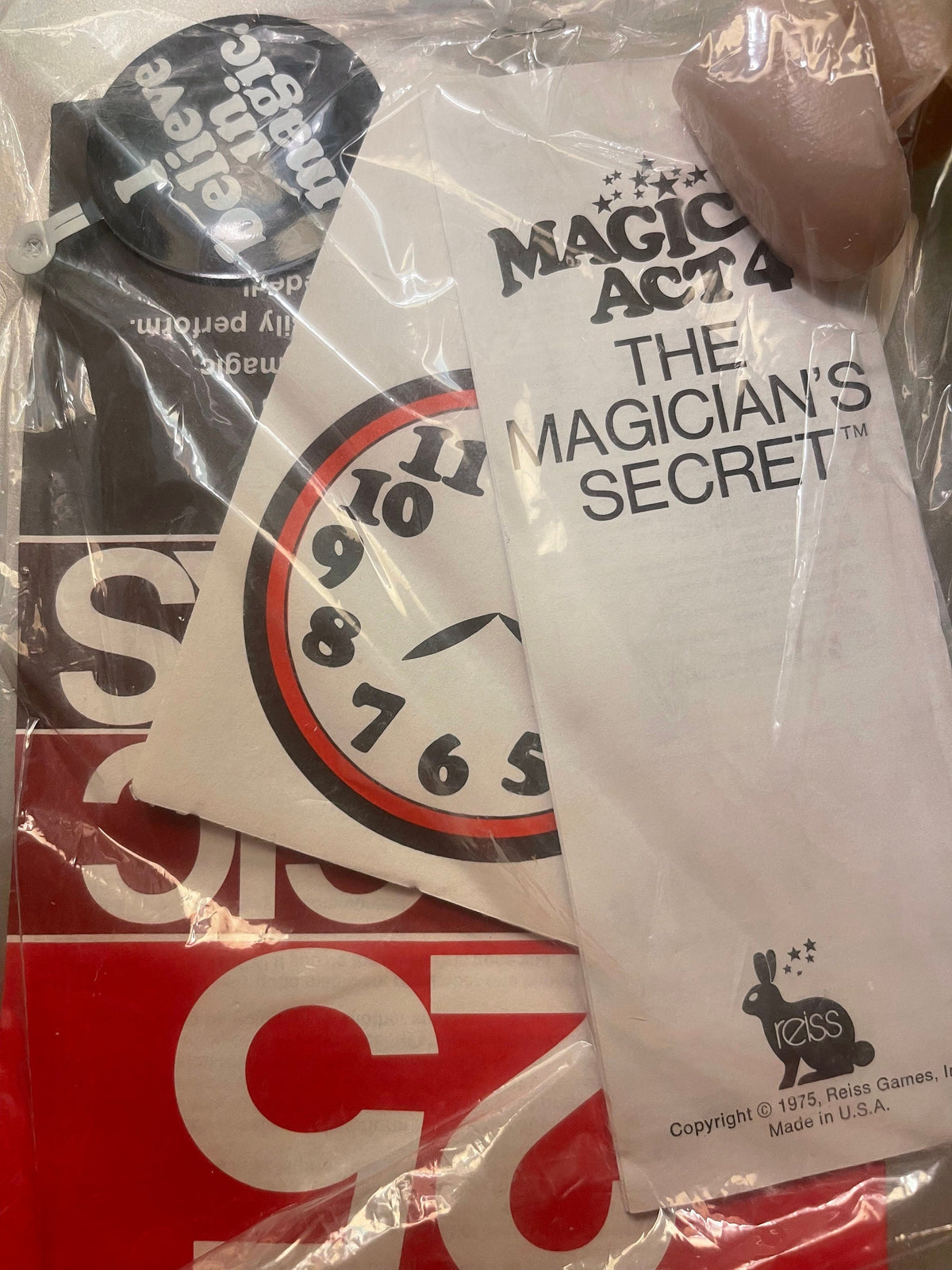
What you are looking at is a complete beginner magic set produced by Reiss Games, Inc. of New York, New York, with booklet content collected and edited by Show-Biz Services of Brooklyn, New York — and an additional production credit running to an Orange, California Reiss address. The kit sits inside its original clear poly bag, still sealed, the red-and-black offset-printed instruction booklets visible through the plastic alongside a rubber thumb tip, an "I believe in magic" pinback button, and the numbered "Magic Act" card inserts that carried each trick's instructions. The front cover promises exactly what it delivers: "A super collection of fun magic you can quickly learn and easily perform. No special props needed!" Printed in bold red, black, and white — the signature color palette of the entire Reiss Magic Acts line — this piece is a direct, tangible artifact of American toy culture at the precise midpoint of the 1970s.

🎲 The Company Behind the Curtain: Reiss Games, Inc.

Reiss Games, Inc. was a genuine New York toy-and-game firm, and by the mid-1970s it had become a notable force in the American boxed-magic-kit category. Toy-history sources record that the company grew into what contemporaneous trade circles described as a world leader in magic kits by the middle of the decade, selling them in both single-trick formats and full magic-show-style sets. Your "25 Magic Tricks" kit belongs to the same numbered-act product architecture as the companion "Great Magic Show" series — kits that were packaged with sequentially numbered "Magic Act" inserts, each carrying its own mini-booklet of instructions. The "Magic Act 4 — The Magician's Secret" card visible right through the plastic of this sealed kit is one of those inserts, part of a clever modular system that let Reiss build out a whole curriculum of beginner magic across multiple price points and package sizes.

The company operated under the umbrella of National Paragon Corporation, and various divisions and related entities — including "Reiss Associates Incorporated," "Gamut of Games," and "Dynamic Games / Dynamic Design Industries" — were part of its broader family of brands. The toy-and-game industry of this era was built on exactly this kind of entrepreneurial layering: a core distribution and creative engine surrounded by specialized imprints that could move product across different retail channels. Reiss was doing it out of New York, which was still, in 1975, the gravitational center of the American toy trade.

The magic line's booklet content came from a separate Brooklyn operation: Show-Biz Services, credited on the label as the entity that collected and edited the tricks. Show-Biz Services left almost no paper trail beyond this credit line — no surviving trade directory entries have surfaced, no independent byline history. What that silence tells experienced collectors is that Show-Biz Services was almost certainly a small specialty shop, a one- or two-person content house that knew the magic world and knew how to write for kids. Brooklyn in the 1970s had no shortage of exactly that kind of quietly expert operation, the kind whose name you only find because it was printed on something that survived.

Local legend in the New York toy trade has it that the numbered Magic Act system was deliberately designed so that a child who received one kit would want the next one — a subscription logic baked into a single-purchase toy, before that kind of thinking had a name in product design.

🗽 New York, Brooklyn, and the Geography of a 1970s Magic Kit

Read the credits on this kit and you are reading a map of mid-1970s New York creative commerce. Reiss Games, Inc. — New York, New York. Show-Biz Services — Brooklyn, New York. And then that secondary address: Orange, California — a detail that turns up on the label and points toward the West Coast distribution infrastructure that a growing toy company needed by the time the mid-seventies boom was in full swing. Three addresses on one small kit. That's the story of how a New York idea got made in Brooklyn and shipped to the country from California.

New York in 1975 was still the city where the American toy and game industry went to think. The Toy Building on Fifth Avenue was still the industry's cathedral. The trade show infrastructure, the buyers, the licensors, the deal-makers — they were all within a cab ride of each other. Reiss Games was native to that world, and this kit carries its DNA: the confident, stripped-down graphic design (red field, white type, black band — no fuss, maximum shelf impact), the no-nonsense copy ("you can quickly learn and easily perform"), the inclusive, democratic magic premise that said you don't need expensive gimmicks. You just need to know the secret.

Brooklyn's contribution through Show-Biz Services adds another layer. Brooklyn in the 1970s was where working creative people lived and operated — writers, designers, content people who did the actual work that got stamped with a Manhattan address on the finished product. The fact that Show-Biz Services got its own credit line on the Reiss booklet is a small act of acknowledgment that the people who actually wrote the tricks down deserved to be named.

👨‍💼 The Man Who Built It: Robert "Bob" Reiss

Behind Reiss Games stood one of the more quietly remarkable entrepreneurs in the American toy-and-game world: Robert "Bob" Reiss, Harvard Business School class of 1956, Brooklyn native, and former basketball standout at Columbia University. Harvard's Baker Library holds an oral history of Reiss, and the picture that emerges is of a man who understood opportunity the way a good magician understands misdirection — which is to say, intuitively and completely.

Reiss started out running the personalized-pencil division of a small New York company after HBS, then built a sales representative operation and recognized the games and magic categories as fertile ground. He moved through the toy world with the instincts of someone who had grown up watching it from the outside and understood what was missing. The magic kits were one expression of that instinct: beginner-friendly, affordable, built around the premise that anyone could learn to astonish people if you gave them the right instructions.

He later became famous — genuinely, business-school-case famous — for a different kind of trick: a cold-call letter, six sentences long, that he sent to the publisher of TV Guide magazine proposing a television-themed trivia game. That letter led to what HBS describes as a $3 million profit venture completed in eight months, during the height of the Trivial Pursuit craze of the 1980s. That case became a landmark teaching document at HBS, and it helped Professor Howard Stevenson formulate his now-classic definition of entrepreneurship as "the pursuit of opportunity beyond resources currently controlled." Over the arc of his career, Reiss founded sixteen companies.

What is worth holding onto, for the collector who picks up this kit, is that Bob Reiss was not a toy conglomerate. He was a Brooklyn kid who went to Columbia on athletic talent, went to Harvard on intellectual talent, and then went into business on sheer entrepreneurial nerve. The magic kits came out of that same nerve — a bet that kids in 1975 wanted to feel powerful and clever, that the right set of instructions in the right package could give a ten-year-old a living room full of genuinely astonished faces. He was right.

Collector lore holds that after National Paragon Corporation ran into financial difficulty and eventually declared bankruptcy in the 1980s, the magic division of the Reiss line was acquired by a Canadian toy company — and that Reiss himself had already moved on, founding his next venture (the games and toy distribution company known as R&R) before the curtain came down on the original enterprise. That narrative traces to forum accounts and fan-compiled histories rather than primary corporate records, and should be understood as the kind of passed-down trade lore that fills the gaps when the paperwork doesn't survive — but it is consistent with everything else known about how Reiss operated: always one step ahead, always onto the next act.

🖼️ Display Ideas

🎩 Frame it flat — the sealed bag with its red-and-black cover makes a striking piece of wall art in a game room, a study, or a kid's bedroom with a vintage theme; the bold offset-printed graphics hold up beautifully at display scale.

🎲 Vintage game shelf grouping — pair it with other 1970s boxed games, card sets, and novelty kits for a curated mid-century shelf display that tells the story of American play in the decade.

🏪 Retail nostalgia vignette — prop it on a small easel inside a display case alongside a vintage spinner rack card or a period toy-store receipt; it reads instantly as a piece of the era's variety-store culture.

🎁 Wrapped and gifted as-is — the sealed, NOS state makes it a ready-made gift for the magic enthusiast, the 1970s toy collector, or anyone who grew up performing living-room tricks; no additional packaging needed.

✨ Magic-themed shelfie centerpiece — anchor a collection of vintage magic ephemera: old Svengali decks, magic wand props, vintage conjuring books. The red-and-black Reiss palette anchors the eye immediately.

📚 Reference library piece — for the serious collector documenting the American toy-and-game industry of the 1970s, this sealed example belongs alongside trade catalogs and period advertisements as a primary source object.

🎁 Who Collects These

This kit draws a specific and passionate collector: the person who grew up in the 1970s and remembers the precise weight and rustle of a bagged toy pulled off a spinner rack, or the person who studies American toy and game history and understands that Reiss Games represents a distinct and underrepresented chapter of it.

Vintage magic collectors prize sealed NOS examples of mid-century beginner kits because they capture the full original experience — booklets, props, button, and all — in a single unopened object. Toy and game historians are drawn to the Reiss line specifically because the company's story intersects with the broader story of New York entrepreneurship in the postwar decades, and because Bob Reiss himself is a documented figure whose career arc illuminates how the industry actually worked.

Nostalgia collectors and 1970s Americana enthusiasts respond to the graphic language — that confident red-black-white palette, the big bold numerals, the copy that assumes you are smart enough to learn this fast. And then there is simply the person who loves magic, who has always loved magic, and who understands that this little sealed bag from 1975 contains twenty-five secrets that have been waiting, intact, for fifty years.

❓ Frequently Asked Questions

Is this kit truly sealed and never opened?

Yes. This is new old stock — NOS — meaning it left the original production and distribution chain without ever being opened. The original clear poly bag remains sealed, the booklets and props are visible through the plastic exactly as they were packed. The copy on the front cover, the button, the Magic Act inserts, the rubber thumb tip — all of it is inside, untouched. What you see in the photographs is precisely what you receive.

What props and materials are actually inside the bag?

Because the kit is sealed and will be sold that way, the interior cannot be inventoried without opening it. However, the contents are clearly visible through the poly bag in the photographs: the main "25 Magic Tricks" booklet with its red-and-black cover; numbered Magic Act instruction inserts including "Magic Act 4 — The Magician's Secret" and booklets titled "Magic Acts with The Magic Cards" and "Magic Acts with The Magician's Secret"; an "I believe in magic" pinback button; and rubber thumb tip props. These are consistent with known examples of the 1975–1976 Reiss Magic Acts line.

What year was this made, and how do you know?

The copyright dates are printed directly on the materials visible through the bag: "Copyright © 1975, Reiss Games, Inc." and a 1976 Reiss Games line also appears on the label. This places the kit firmly in the mid-1970s production run of the Reiss Magic Acts line. Both copyright years are present, which is consistent with a kit whose booklet components were produced across a two-year print run — a common practice for a product selling steadily through the toy trade.

Who was Reiss Games, and why does that matter for a collector?

Reiss Games, Inc. was a New York toy-and-game company that became a notable producer of beginner magic kits in the mid-1970s. It was connected to National Paragon Corporation and was founded and run by Robert "Bob" Reiss — Harvard Business School class of 1956, Brooklyn native, and one of the more documented entrepreneurial figures in the American toy trade. His story is preserved in Harvard's Baker Library oral history collection, and he later became the subject of a landmark HBS teaching case for his TV Guide trivia-game venture. Collecting a Reiss Games piece means collecting something with a real, traceable, human story behind it — not an anonymous mass-market product, but the output of a specific New York entrepreneurial vision at a specific cultural moment.

Is this a common find, or is sealed NOS rare in this category?

Sealed, NOS examples of 1970s beginner magic kits from named American toy companies are genuinely uncommon in the collector market. Most of these kits were opened, used, and scattered — the props lost, the booklets torn, the button detached and pinned to a jacket. A sealed example represents the complete, integrated object as it was originally designed and sold, and for collectors focused on toy history, graphic design history, or the Reiss Games line specifically, that integrity is a meaningful part of the piece's interest.

How does this fit into the broader Reiss Magic Acts product line?

The "25 Magic Tricks" kit is one node in a modular system. The numbered "Magic Act" inserts visible inside this bag — Magic Act 4, the Magic Cards booklet, the Magician's Secret booklet — are the same components that appeared in the companion "Great Magic Show" series and other Reiss magic products of the period. The system was designed so that individual acts could appear across multiple kit configurations, building a curriculum of beginner magic at different price and complexity levels. Collector lore holds that this modular architecture was deliberate — a way to build a return customer into a single purchase, giving a child who received one kit a natural reason to seek out the next one.

Who were Show-Biz Services of Brooklyn, and what did they contribute?

Show-Biz Services is credited on the label as the entity that "collected and edited" the magic content — meaning they selected and wrote up the twenty-five tricks, gave them their names, and structured the instructional booklets. Beyond this credit line, Show-Biz Services left almost no independent documentary trail. No trade directory entries have surfaced, no separate byline history exists. What that tells an experienced collector is that Show-Biz Services was almost certainly a small specialty content operation — exactly the kind of quietly expert Brooklyn shop that did the real creative work behind many branded toy products of the era.

Shipping

🚚 Shipping & Handling

  • Shipping costs and timing are calculated at checkout.
  • Items curated and shipped directly by me include U.S. shipping at no additional cost, professionally packed to ensure safe arrival of your artifact.

Items from Vetted Pro Collectors
Shipping for items offered by vetted Pro Collectors is determined at checkout. All Pro Collector listings are reviewed to ensure fair, reasonable shipping practices.

For full details, please refer to our Shipping Policy.

Returns & Exchange

Take your time — you've got a full six months. If a piece isn't right for you, send it back the way it reached you and we're good.

In the first 30 days your money goes straight back the way you paid. After that it's store credit, so you can put it toward something you'd rather have.

Return shipping we sort out between us, case by case. I don't make this difficult.

If something arrives damaged, or it isn't what I said it was, send me a photo within 48 hours and I'll make it right.

Email info@vintageantiquesgifts.com or call 802-356-9872 — that's me answering, not a call center.

The only things I can't take back are custom or special-order pieces and gift cards.

View full details
  • 5 stars: 2 (100%)
  • 4 stars: 0 (0%)
  • 3 stars: 0 (0%)
  • 2 stars: 0 (0%)
  • 1 star: 0 (0%)
A
Alyson

This item is 51 years old, but it’s like brand new. It was shipped quickly. I am very impressed. Thank you!

J
Jaspers1

Thanks! An asset to eBay. Great service!

Aww, Thank You! We appreciate it and hope to see you again soon.