Skip to product information
1 of 8

Vintage and Antique Gifts

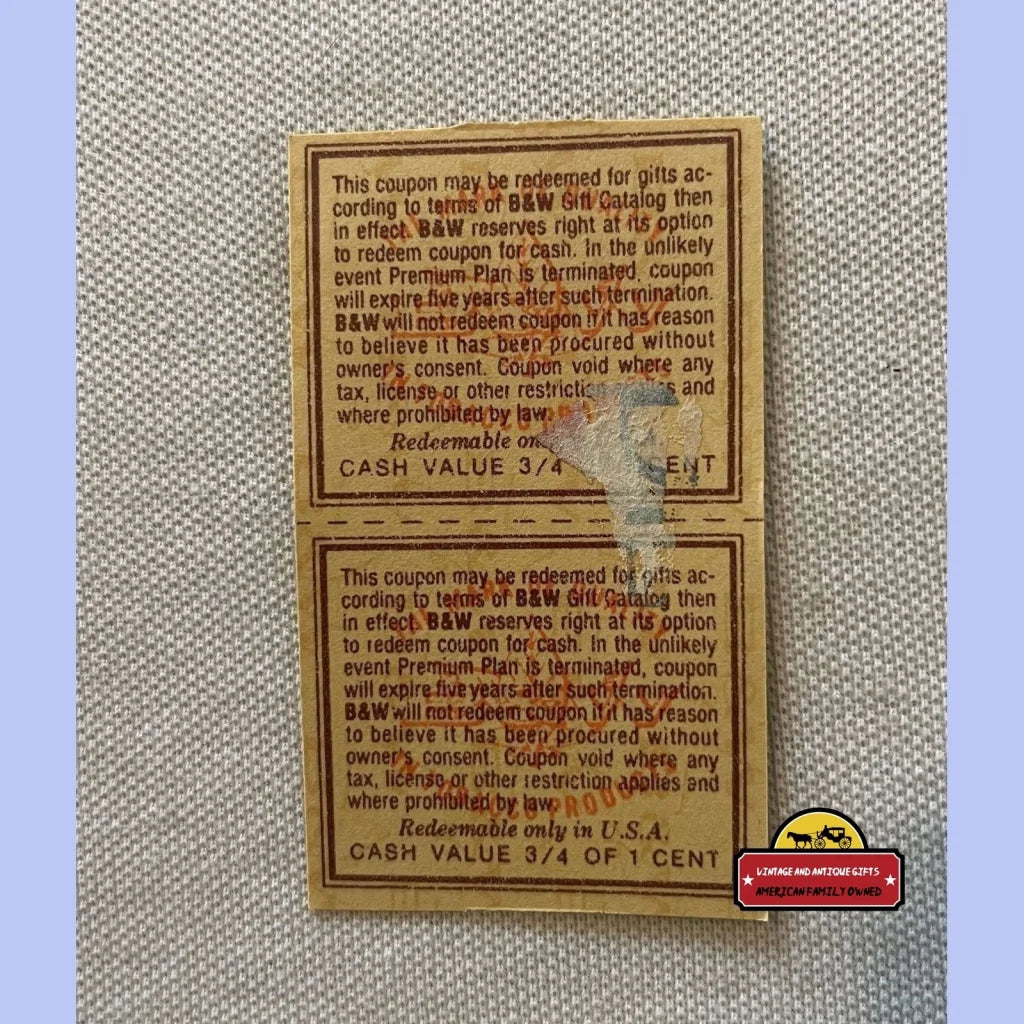
Vintage Raleigh & B&W Tobacco Coupons 🎴 Louisville, KY Brown & Williamson Loyalty Program Ephemera American Made

Vintage Raleigh & B&W Tobacco Coupons 🎴 Louisville, KY Brown & Williamson Loyalty Program Ephemera American Made

Regular price 9.00 USD
Regular price Sale price 9.00 USD
Sale Sold out
Shipping calculated at checkout.

Description

Do You Remember Saving These? 🎴 The Little Paper Coupons That Built One of America's Great Loyalty Empires

There is something quietly remarkable about holding a piece of paper that was once tucked inside a cigarette pack sometime in the 1960s or 1970s — a paper that survived purse pockets and kitchen junk drawers and shoeboxes in closets, decades of American life moving noisily around it, and yet here it is, intact. The ink still sharp. The instructions still readable. The promise of a reward still printed right there in black and white, patient as the day it was pressed. These vintage Raleigh and Brown & Williamson tobacco coupons are exactly that kind of survivor — small, unassuming, and now, all these years later, carrying the full weight of a genuinely fascinating piece of American commercial history on their modest little shoulders.

Long before airline miles rewarded business travelers for flying coast to coast, long before grocery store loyalty cards began tracking every box of cereal and bottle of dish soap, and certainly long before app-based reward programs turned customer behavior into algorithmic data points, Brown and Williamson Tobacco Corporation was already perfecting the art of keeping a customer loyal. The method was almost endearingly simple: tuck a small paper coupon into every pack of Raleigh cigarettes, trust the smoker to save it, and let the accumulated value of those saved coupons turn into something worth having — a toaster, a fishing rod, a set of dishes, something tangible and real. It worked. For decades, it worked beautifully.


🏛️ What You Are Actually Holding — New Old Stock Ephemera from Louisville's Tobacco Era

These are genuine vintage New Old Stock (NOS) Raleigh and B&W tobacco coupons issued by Brown and Williamson Tobacco Corporation during the 1960s and 1970s. "New Old Stock" is a term collectors use with a particular kind of reverence — it means these coupons were never redeemed, never clipped into a catalog order, never worn down by years of handling. They were printed, produced, and then simply... kept. Stored away in the particular American habit of saving things that might one day be useful, and then outlasting the era that gave them meaning in the first place. Each coupon measures approximately 2¼ x 1¾ inches — small enough to slip into a shirt pocket alongside a pack of cigarettes without a second thought, sturdy enough in their printing stock to have endured fifty or sixty years with their original colors and typography completely intact.

The printing itself reflects mid-century commercial printing standards at their most utilitarian and most honest. These were functional objects first — not designed for display or posterity, but for practical exchange. The typography is clean, direct, and purposeful, with the Raleigh brand name and Brown & Williamson identification printed with the confident simplicity of an era that did not need to oversell itself. The coupons were produced in Louisville, Kentucky, which was home to Brown and Williamson's American headquarters and manufacturing operations from 1929 onward — a city that, by the mid-twentieth century, had become as central to the American tobacco industry as any city in the country.


🌿 The Company Behind the Coupon — From Winston-Salem to Louisville and Into American Living Rooms

Brown and Williamson did not begin as a giant. The company's origin story is one of those pleasingly human American business histories — two men, a family connection, a leased facility, and thirty hired workers in a single building. George T. Brown and his brother-in-law Robert Lynn Williamson founded their partnership in Winston, North Carolina — the city that would eventually be known as Winston-Salem — and by February of 1894 they were in the tobacco business. By 1906, the partnership had formalized into the Brown and Williamson Tobacco Company, incorporated and operating in an industry that was, at that moment in American history, expanding in every direction at once.

The decisive turning point came in 1927. The Brown and Williamson families sold the business to the London-based British American Tobacco company, and the reorganized Brown & Williamson Tobacco Corporation — the name that would eventually appear on millions of coupons, packages, and catalog pages — relocated its American headquarters to Louisville, Kentucky. Louisville was not an accidental choice. The city sat at the geographic and cultural crossroads of the American tobacco belt, with established infrastructure, rail connections, a skilled labor force, and a civic identity already deeply intertwined with the industry. Brown and Williamson became part of Louisville's industrial fabric in a way that shaped the city for generations.

The Raleigh brand itself was one of Brown and Williamson's most enduring and beloved product lines — named, as tobacco historians have noted, with that characteristic Southern-inflected nod to colonial American heritage, evoking Sir Walter Raleigh and the romantic mythology of tobacco's earliest presence in English-speaking North America. It was a name that carried weight and familiarity, and the loyalty coupon program attached to it became one of the most recognizable consumer reward programs of the mid-twentieth century. Families saved Raleigh coupons the way later generations would save trading stamps — with genuine purpose, with catalog in hand, with specific items in mind.


🏙️ Louisville, Kentucky — The City That Made These Coupons

To hold these coupons is, in a very real sense, to hold a small piece of Louisville, Kentucky in your hand. The city's relationship with tobacco was never incidental or peripheral — it was foundational. Louisville's tobacco warehouses, auction houses, and manufacturing facilities were economic anchors for the region across much of the twentieth century, and Brown and Williamson's presence there, particularly after the 1929 relocation of its main operations, made the company one of the city's defining employers and institutions. Workers who spent careers in B&W's Louisville facilities raised families, bought homes, and sent children to local schools on wages earned processing, packaging, and printing the products — and the coupons — that would eventually be found in homes across the entire country.

Local legend has it that during the peak years of the Raleigh coupon program, Louisville print workers took a quiet pride in the volume and precision of coupon production — that the presses running coupons were calibrated with the same exacting care as the presses running currency, because in a very real sense, those little paper rectangles were a form of currency in American households. Whether that story is verifiable factory history or the kind of thing that gets passed down in breakrooms and union halls and retirement parties, it captures something true about how seriously the program was taken by the people who made it work from the inside.

Lore passed down among collectors also holds that it was not uncommon, in certain Louisville neighborhoods during the 1960s, to see Brown and Williamson employees arrive home on payday with small quantities of overrun or misprinted coupon stock — items that would never be distributed commercially but that circulated quietly in the community as curiosities and keepsakes. Some collectors believe that a portion of the NOS coupon material that surfaces today traces its origins to exactly that kind of informal preservation, rescued not by design but by the very human instinct to hold onto something interesting simply because it exists. Whether that's provable history or beautiful rumor, it's worth recording so the story isn't lost entirely.


📜 The Loyalty Program — American Consumer Culture in a 2¼ x 1¾ Inch Rectangle

The Raleigh coupon program was one of the most sustained loyalty programs in American consumer product history. Running from the 1930s through the 1990s — a span that astonishes most people when they hear it — the program offered smokers a redemption catalog full of household goods, tools, sporting equipment, and gifts in exchange for accumulated coupons. The model was borrowed and refined from trading stamp programs and earlier premium schemes, but Brown and Williamson executed it with a consistency and a longevity that few comparable programs matched. Families who smoked Raleigh cigarettes didn't just have a brand preference — they had a savings system. They had a drawer or a box or an envelope dedicated to coupons. They had a catalog. They had a plan.

The specific coupons offered here — from the 1960s and 1970s — represent the program at its cultural peak, during the decades when loyalty programs of all kinds were embedded most deeply in everyday American consumer behavior. S&H Green Stamps, Gold Bond Stamps, and the Raleigh coupon program all occupied a similar psychological space in the mid-century American household: the idea that ordinary purchases, made consistently over time, would accumulate into something meaningful. It was a philosophy of patient, incremental reward that resonated enormously with the generation that had grown up during the Depression and the war years, people who understood in their bones what it meant to save carefully toward a specific goal.

That these particular coupons survived unredeemed, in their original NOS condition, gives them an unusual completeness as collectibles. They weren't used. They weren't worn down by circulation. They exist today exactly as they were produced — which means they carry not just historical significance but genuine visual and tactile integrity, the kind of condition that makes ephemera collectors genuinely excited.


🖼️ Display Ideas

  • 🪟 Shadow box framing — arrange a grid of coupons in a deep shadow box alongside a vintage Raleigh cigarette pack, a mid-century catalog page, and a small photograph of a Louisville street scene from the 1960s for a complete tableaux of the era.
  • 📋 Ephemera collector's binder page — sleeve individual coupons in archival-quality currency pages or philatelic stock pages for a flat, museum-quality presentation that protects the surface and allows close examination of the printing.
  • 🖼️ Matted and framed groupings — a set of four or six coupons arranged symmetrically and matted under UV-protective glass makes an unexpectedly striking piece of wall art in a study, home bar, or vintage-themed kitchen, particularly when paired with other mid-century commercial ephemera.
  • 🗂️ Advertising and tobacco memorabilia collection display — these coupons pair naturally with vintage cigarette tins, ashtrays, matchbooks, and tobacco tins in a dedicated display case, anchoring a broader mid-century Americana or tobacco advertising collection.
  • 🎁 Themed gift assembly — tuck a few coupons into a curated gift box alongside other Louisville or Kentucky-made vintage items — a bourbon label, a Derby program, a mid-century Kentucky postcard — for a deeply local, deeply personal historical gift.
  • 📚 Research and reference collection — for historians, graphic designers, and brand scholars studying mid-century commercial printing, loyalty program design, or tobacco industry history, these serve as primary source material in flat archival storage.

🎁 Who Collects These — and Why They Matter

Vintage tobacco ephemera has a devoted and genuinely diverse collector community, and Raleigh coupons occupy a specific and beloved niche within it. Some collectors come at these from the tobacco memorabilia angle — they're building comprehensive collections of Brown and Williamson material, or assembling everything they can find connected to the Raleigh brand specifically, from pack designs to promotional materials to coupon program catalogs. For those collectors, NOS coupon stock in excellent condition is a priority find, the kind of item that rounds out a collection and gives it documentary depth.

Others come from the loyalty program and trading stamp collecting world — a community that is larger and more organized than most people realize, dedicated to preserving the physical artifacts of mid-century consumer reward programs because those programs tell an important and underappreciated story about how American businesses built customer relationships before the digital age. Raleigh coupons sit comfortably alongside S&H Green Stamps, Gold Bond Stamps, and Top Value Stamps in that collecting tradition, representing the tobacco industry's particular contribution to the loyalty program landscape.

Then there are the nostalgia collectors — people who remember, or whose parents or grandparents remember, saving Raleigh coupons. For those collectors, these small paper rectangles are profoundly personal objects, connecting them to specific memories of specific people and specific places. A grandmother's kitchen drawer. A grandfather's shirt pocket. A catalog thumbed through at the kitchen table on a winter evening. That emotional resonance is real and it matters, and it makes these coupons meaningful at a level that purely aesthetic collectibles sometimes can't reach.

Graphic designers and commercial art historians collect mid-century ephemera like this for the printing and typography — the clean, authoritative mid-century commercial lettering, the no-nonsense layout, the particular quality of ink on paper stock from an era before digital design. And finally, Louisville and Kentucky local history collectors seek these out specifically because of the B&W Louisville connection — they represent a tangible artifact of the city's industrial and commercial past, the kind of object that belongs in a local history collection alongside photographs, maps, and industrial records.


❓ Frequently Asked Questions

Are these coupons genuinely from the 1960s and 1970s, and how can I tell?

Yes — these are authentic vintage New Old Stock coupons produced by Brown and Williamson Tobacco Corporation during the 1960s and 1970s. The printing style, typography, paper stock, and ink characteristics are all consistent with commercial coupon printing from that specific era. NOS condition means they were stored away unused rather than circulated through normal consumer use, which is precisely why they've retained their crisp, clean appearance after all these decades. If you're familiar with mid-century commercial printing, you'll recognize immediately that these are period-correct originals — the aesthetic simply cannot be replicated by later reproduction. The quality of the original print stock and the specific typographic conventions are period-authentic markers that experienced ephemera collectors recognize on sight.

Can these coupons still be redeemed for prizes or catalog items?

The Raleigh coupon redemption program ran for an extraordinarily long time — from the 1930s through the 1990s — but it is no longer active. These coupons have long since passed beyond their redemption period. What they represent today is something arguably more interesting than a toaster or a fishing rod: they are primary source artifacts of one of the most sustained consumer loyalty programs in American history, collectible on their own terms as ephemera, as graphic history, and as personal nostalgia objects. Their value now is entirely in what they represent and document, not in any redemption function.

What is the best way to store or preserve these coupons long-term?

For long-term preservation, archival-quality storage is the gold standard. Individual archival polyester or polypropylene sleeves — the kind used for stamps, currency, and small ephemera — will protect the surface from handling oils, humidity, and light exposure without introducing acids that could degrade the paper over time. For display purposes, UV-protective glazing in a frame will prevent fading of the original ink. Keep them away from direct sunlight, fluctuating humidity, and heat sources. Given that these have already survived fifty or more years in remarkably good condition, appropriate archival care will ensure they remain in that condition for another fifty.

Were Raleigh coupons unique to one region, or were they distributed nationally?

The Raleigh coupon program was a national program — Raleigh cigarettes were distributed across the country, and coupons were included in packs sold from coast to coast. However, the coupons themselves were produced in Louisville, Kentucky, which was home to Brown and Williamson's American headquarters and manufacturing operations. That Louisville manufacturing origin gives these coupons a specific geographic provenance that local history collectors particularly value, but the program itself was a genuinely national phenomenon. Families in every state saved Raleigh coupons, which is part of why the program resonates so broadly as a shared piece of mid-century American consumer memory.

How does the Raleigh coupon program compare historically to other loyalty programs of the same era?

The Raleigh coupon program stands out in the history of American loyalty programs primarily for its longevity — running for roughly six decades makes it one of the longest-sustained consumer reward programs in American commercial history. Trading stamp programs like S&H Green Stamps were enormously popular during the same era and covered a wider range of product categories, but they were operated by third-party stamp companies rather than by a single brand. The Raleigh program was brand-specific and brand-controlled from the beginning, which gave it a distinctive identity and a particularly loyal customer base. Collectors who specialize in loyalty program ephemera often describe Raleigh coupons as one of the most collectible and historically significant artifacts from that entire tradition.

Is there value in collecting these coupons as a set versus individually?

Within the ephemera and tobacco memorabilia collecting community, there is genuine appreciation for both approaches. Individual coupons are accessible, displayable, and perfect for collectors who want a single representative piece for a themed display or a specific collection gap. Multiple coupons together — particularly NOS stock in consistent condition — carry additional documentary value as a group, demonstrating print consistency, program design standards, and the visual language of the program across a quantity of surviving examples. For researchers, historians, and serious collectors building reference collections, a group of NOS coupons in original condition is a more complete primary source than a single example. Both approaches are valid and both are genuinely valued in the collecting community.

What makes NOS condition so significant for paper ephemera like these?

For paper ephemera — coupons, trading stamps, tickets, labels, advertising inserts — New Old Stock condition is the condition of choice for serious collectors because it means the piece has never entered the cycle of use and degradation that most paper objects experience. A coupon that was saved, accumulated, bundled with others, handled repeatedly, and eventually submitted for redemption would show every one of those interactions in its condition. A NOS coupon bypassed all of that entirely. It was produced, stored, and preserved without ever fulfilling its intended commercial function — which means its physical integrity is as close to original production quality as it's possible to find after fifty or sixty years. For collectors and display purposes alike, that integrity is irreplaceable. It's the difference between a document and a relic.

Shipping

🚚 Shipping & Handling

  • Shipping costs and timing are calculated at checkout.
  • Items curated and shipped directly by me include U.S. shipping at no additional cost, professionally packed to ensure safe arrival of your artifact.

Items from Vetted Pro Collectors
Shipping for items offered by vetted Pro Collectors is determined at checkout. All Pro Collector listings are reviewed to ensure fair, reasonable shipping practices.

For full details, please refer to our Shipping Policy.

Returns & Exchange

Product Page Return Policy

  • 60-Day Returns – Items must be in original condition.
  • Refunds – Issued after inspection (excluding shipping costs).
  • Return Shipping – Customer is responsible unless item is damaged or incorrect.
  • Damaged/Incorrect Items – Contact us within 48 hours for a replacement or refund.
  • Easy Returns – Email info@vintageantiquesgifts.com or call 802-356-9872 to initiate a return.

For full details, visit our Refund Policy.

View full details