Skip to product information
1 of 6

Vintage and Antique Gifts

Vintage Dominator Crate Labels Two Label NOS Set T.O. Tomasello Watsonville California 1940s 🍅

Vintage Dominator Crate Labels Two Label NOS Set T.O. Tomasello Watsonville California 1940s 🍅

Regular price 17.00 USD
Regular price Sale price 17.00 USD
Sale Sold out
Shipping calculated at checkout.
Quantity

Size: 9 x 7 inches

A silver fighter plane dives out of a navy sky, flame bursting from the center of its propeller, and the word DOMINATOR climbs up to meet it in giant red block letters. On a box of tomatoes. This two-label Dominator Brand set was packed and shipped by T.O. Tomasello Co., Main Office, Watsonville, California, and the stars on that plane give the art away: every blue roundel still carries the red center dot that the U.S. military eliminated from its aircraft insignia in May 1942. These are 1940s new old stock labels, never pasted to a crate.


✈️ What the Two Labels Print

The horizontal tomato label

  • PACKED & SHIPPED BY over a teal triangle, T.O.TOMASELLO CO. in yellow, and MAIN OFFICE WATSONVILLE CALIFORNIA beneath
  • PRODUCE OF U.S.A. at the top right
  • DOMINATOR in tall three-dimensional red and cream letters climbing to the right, with BRAND in orange
  • TOMATOES in cream letters on a field that fades from navy to teal
  • MINIMUM NET WT. 30 LBS. under the spinning propeller

The upright label

  • PACKED AND SHIPPED BY / T.O.TOMASELLO CO. / MAIN OFFICE WATSONVILLE CALIF.
  • DOMINATOR in red and yellow block letters with BRAND in orange
  • PRODUCE OF U.S.A. in yellow at the lower right, over a navy field with a green glow
  • It names no product and no weight

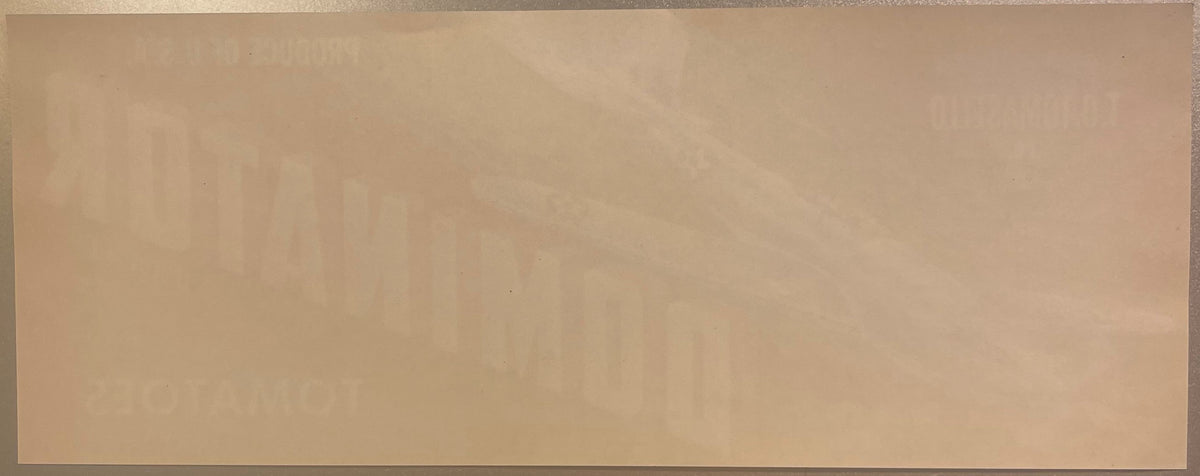
Both labels carry the same painting, redrawn for each shape: a silver single-engine fighter diving from the upper right with a framed cockpit canopy, a green speed trail behind the tail, red tracer streaks beneath the wings, a burst of flame at the propeller hub and a red line firing out of it. Blue roundels with a white star and a red center sit on both wings and the fuselage. Both backs are blank paper, with the front lettering showing through in reverse, and no printer's name appears on either label.


⭐ The Red Dot That Dates the Art

The star insignia is the clue. From 1919 the U.S. national aircraft insignia was a blue circle holding a white five-pointed star with a red disc at its center. From a distance that red center could be mistaken for the red Hinomaru roundel on Japanese aircraft, and in May 1942 it was eliminated. Aircraft already in service had the dot painted over in white. American airmen had their own nickname for that Japanese red disc: the meatball.

The artist who painted the Dominator fighter painted the older star, red dot and all, which places the art in the first years of the 1940s, when patriotic themes had reached even the produce labels of California. Crate label historians point to the Dominator label as the example of that wartime insignia on produce art.


🛩️ Fire Through the Propeller

The label never names its plane. What the artist painted is a sleek silver single-seat fighter firing straight out of the center of its propeller, and that arrangement was the calling card of Bell's P-39 Airacobra. The Airacobra was built around a 37 mm cannon that fired through the propeller hub, with its Allison engine mounted behind the pilot and car-style doors on the cockpit. It first flew on April 6, 1938, entered service in 1941, and 9,588 were built before production ended in May 1944. American pilots first met Japanese Zeros in Airacobras on April 30, 1942, near Lae, New Guinea.


🍅 T.O. Tomasello Co. of Watsonville

T.O. Tomasello Co. was a Watsonville family produce business, and like every packing house in the Pajaro Valley it used its crate labels to make a wholesale buyer remember its name. Dominator was the brand it put on its tomatoes. The family stayed in the valley's produce trade for decades: Joseph Tomasello was born in Watsonville in 1935 to Antonio and Mary Tomasello, came home after his military service to the family farming business, and ran it for the next 40 years. He served on the board of the Western Growers Association and was president of the Salinas Valley Grower-Shipper Association in 1972 and 1973.


🍎 Watsonville, the Apple City

Watsonville was laid out in 1852 by John H. Watson and D. S. Gregory and named for Watson. When the railroad was completed in 1871 the town became an agricultural hub, and Croatian immigrants began their rise to the top of the valley's apple industry. By 1908 one million apple trees stood on 14,000 acres, forty packing houses handled the crop, and Watsonville was known as the Apple City, celebrating with a weeklong festival billed as the "Apple Show Where Apples Grow." Lettuce followed once refrigerated transport could carry it to distant markets, and today the valley is famous for strawberries.

Labels were part of that story from the start. P.N. Lettunich & Co. was the first Watsonville firm to put labels on its apple boxes, and by 1901 it was shipping 100,000 boxes and 110 train cars of fruit. In 1930 T.J. Horgan's packing house in Pajaro shipped more than 3,000 train car loads of produce. The town still honors that trade: fifteen murals in downtown Watsonville reproduce the valley's old crate labels, from Stolich Brothers' California Mission Brand to Zupan and Lucich's Airship Brand, on the walls of cold-storage plants, the Fox Theater and a hardware store.


🪖 The Valley at War

The war reached the Pajaro Valley's fields directly. In 1942 the valley's Japanese residents were sent to internment camps for the rest of World War II, leaving farms nearly empty of workers, and the Bracero Program brought Mexican farm workers north from 1942 to 1964 to replace the workers the war had taken. That is the Watsonville these labels come from: a produce town whose fields the war changed, shipping under a fighter plane.


📦 Why Unused Labels Survive

Crate labels began on the West Coast in the 1880s, when California and Washington growers started shipping east over the new transcontinental rail routes. They were printed by stone lithography until about 1920 and by offset presses after that, at houses such as Schmidt Litho, Louis Roesch and Stecher-Traung. World War II strained the printers' resources and workforces and pushed shippers toward cheaper cardboard boxes with simple printed designs, and pre-printed corrugated boxes went on to replace the wooden crate and its glued label entirely. Many paper labels were destroyed. The ones that survive unused came from stock that a packing house or printer never called on, and as the story goes, collectors began turning up forgotten bundles of them in the corners of farmhouses in the 1960s.


❓ Questions People Ask

How many labels come with this listing? Two: the horizontal Dominator Brand Tomatoes label and the upright Dominator Brand label.

How old are they? They are 1940s crate labels. The roundels on the plane still show the red center dot that was eliminated from U.S. aircraft insignia in May 1942.

What plane is on the label? Neither label names it. It is a silver single-engine fighter firing through its propeller hub, the arrangement Bell's P-39 Airacobra made famous.

What was packed under these labels? The horizontal label names TOMATOES and a minimum net weight of 30 pounds. The upright label names no product.

Have they been used? No. They are new old stock and were never pasted to a crate.

Who printed them? No printer's imprint appears on either label.

Shipping

🚚 Shipping & Handling

  • Shipping costs and timing are calculated at checkout.
  • Items curated and shipped directly by me include U.S. shipping at no additional cost, professionally packed to ensure safe arrival of your artifact.

Items from Vetted Pro Collectors
Shipping for items offered by vetted Pro Collectors is determined at checkout. All Pro Collector listings are reviewed to ensure fair, reasonable shipping practices.

For full details, please refer to our Shipping Policy.

Returns & Exchange

Take your time — you've got a full six months. If a piece isn't right for you, send it back the way it reached you and we're good.

In the first 30 days your money goes straight back the way you paid. After that it's store credit, so you can put it toward something you'd rather have.

Return shipping we sort out between us, case by case. I don't make this difficult.

If something arrives damaged, or it isn't what I said it was, send me a photo within 48 hours and I'll make it right.

Email info@vintageantiquesgifts.com or call 802-356-9872 — that's me answering, not a call center.

The only things I can't take back are custom or special-order pieces and gift cards.

View full details