Skip to product information
1 of 5

Vintage and Antique Gifts

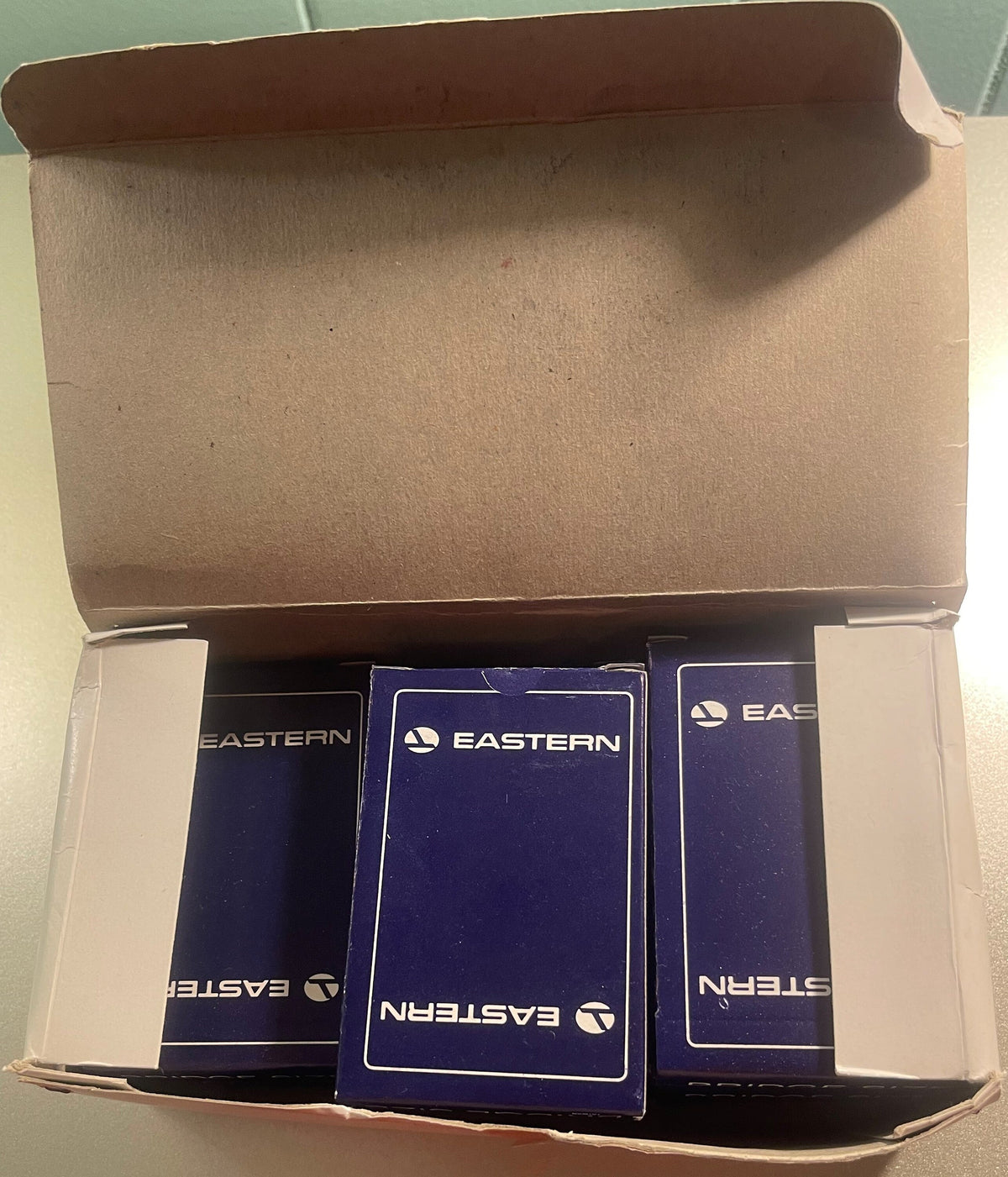
Vintage 1970s Eastern Air Lines Playing Box ✈️ Sealed NOS Deck, Fallen Flag Airline Collectible, Hockey Stick Logo, Clown Joker, Bridge Size

Vintage 1970s Eastern Air Lines Playing Box ✈️ Sealed NOS Deck, Fallen Flag Airline Collectible, Hockey Stick Logo, Clown Joker, Bridge Size

Regular price 10.00 USD
Regular price Sale price 10.00 USD
Sale Sold out
Shipping calculated at checkout.
Quantity

✈️ Do You Remember When Flying Felt Like an Event?

There was a time — not so long ago in the grand sweep of American history, but far enough back that it feels almost mythological now — when boarding an airplane was a genuine occasion. You dressed for it. You arrived early not because security demanded it, but because the terminal itself was worth savoring. The seats had legroom you could actually use. The meals came on real trays with real silverware. And somewhere over the clouds, a flight attendant might press a small navy-blue box into your hands — a deck of playing cards, compliments of the airline, something to pass the hours at altitude in style. I still think that's one of the loveliest small gestures American commercial culture ever offered a passenger: a free deck of cards, printed with the airline's own colors, meant to be pocketed, played, and remembered. This is one of those decks.


🃏 What It Is

This is a bridge-size deck of complimentary Eastern Air Lines playing cards, measuring 3.5 x 2.25 inches (approximately 8.9 x 5.7 cm) — the compact format airlines favored because it slipped neatly into a seat-back pocket, a purse, or a jacket. It's new old stock (NOS), meaning it comes from unused, unsold inventory that sat carefully preserved rather than in circulation.

The box is a deep, confident navy blue, printed by offset lithography with the EASTERN wordmark rendered in clean white block lettering, paired with Eastern's stylized bird-and-wing logo mark — that swooping falcon-like emblem set inside a circle. The design appears twice on the box, once right-side up and once inverted, a classic bit of playing-card-box logic that means whichever way the box lands in your hand, or however it's shelved or displayed, the branding reads correctly.

The side panel simply states PLAYING CARDS, in the same confident white lettering — no elaboration needed, because in the era this was handed out, everyone in America already knew exactly who Eastern was. Open the deck and the real charm reveals itself: the Joker card is a full-color illustration of a grinning clown in a yellow costume dotted with red polka-dots and stamped with all four card suits — spade, heart, diamond, club — down his chest and sleeves, balanced on a unicycle, tossing a fan of aces skyward with one gloved hand while the other trails a curl of ribbon.

It's a wonderfully busy, joyful little piece of commercial art, printed in the same navy-white-yellow-red-black palette that carries through the whole deck.


🦅 Eastern Air Lines — One of the "Big Four"

Eastern Air Lines flew from 1926 to 1991, and for much of that run it stood shoulder to shoulder with United, TWA, and American as one of the "Big Four" domestic carriers created out of the airmail route consolidations of 1930. Its early identity was inseparable from Eddie Rickenbacker, the World War I flying ace who took the controls of the company in 1938 — buying it outright from General Motors with, as the story goes, a personally signed check for $3.5 million — and ran it for the next quarter-century as a lean, famously profitable operation that never leaned on government subsidy the way some rivals did. Under Rickenbacker, Eastern's "Silver Fleet" of Douglas DC-2s and DC-3s modernized air travel for a generation, and the airline built a near-monopoly on the New York-to-Florida corridor that lasted from the 1930s clear through the 1950s.

The look that most collectors associate with navy-blue Eastern ephemera like this arrived in 1964. Floyd Hall took over as president that year with the company deep in the red, and he brought in the design house Lippincott & Margulies to reinvent Eastern's image from the ground up. The result was the "hockey stick" logo — a stylized falcon rendered in two clean white strokes inside a dark blue field, nicknamed by Eastern's own employees for its resemblance to the sporting equipment — paired with the slogan "Wings of Man" and the debut of the Boeing 727 "Whisper Jet" in Eastern colors. It turned Eastern, almost overnight, into the picture of swanky mid-century air travel, and that navy-and-white identity carried the airline's branding — ticket jackets, timetables, playing cards, and all — through the 1970s.

Airlines handing out branded decks like this one to passengers was common practice roughly from the 1950s into the 1970s, a small courtesy that quietly vanished after airline deregulation in 1978 reshaped the industry's economics and airlines largely stopped giving away in-flight extras. That places decks of this design and color scheme somewhere in the window of the 1960s through the 1970s — a wide, honest span, since no printer's date survives legibly on this example to pin it closer.


💔 The Fall — And a Story Worth Telling

Eastern's later years are a harder story. Deregulation squeezed margins across the industry, and under former astronaut Frank Borman's leadership through the late 1970s and early 1980s, labor disputes and mounting debt strained the company even as it relocated its headquarters to Miami. In 1985, Frank Lorenzo's Texas Air Corporation acquired Eastern, and what followed is remembered by aviation historians and former employees alike as one of the harder chapters in American corporate aviation — assets moved, routes shuffled, and a bankruptcy trustee eventually installed in 1990 in a last effort to save the airline. It didn't work. Eastern ceased operations on January 18, 1991, ending a sixty-year run and putting thousands of employees out of work almost overnight.

There's a detail from that final night that's been passed down among aviation buffs and former Eastern people ever since, and it's worth preserving here exactly as it's told: on the evening before the shutdown, reservation agents — completely unaware the decision had already been made above their heads — were reportedly still on the phones, still booking flights, still telling callers no, the airline wasn't closing. Whether you take it as company lore or plain fact, it captures something true about the era: airlines like Eastern were institutions people trusted right up until the very last moment, and a little navy-blue deck of cards from that world carries a bit of that trust in your hand.


🏙️ Miami, Atlanta, and the Rivalry With Delta

Eastern's corporate address moved over the decades — for years it was headquartered in New York City before relocating to Miami-Dade County, Florida, where it became, even after the painful 1988 workforce cuts, the largest corporate employer in the Miami area. But ask old-timers in Georgia and they'll point you to Atlanta just as quickly. Hartsfield became Eastern's busiest hub thanks to its central location, and that put Eastern in direct, decades-long competition with Atlanta's homegrown carrier, Delta Air Lines — a rivalry that shaped air travel across the entire Southeast and one that longtime airline employees still talk about with a certain competitive gleam in their eye. Georgia State University's library today holds archival Eastern Air Lines material, including, notably, a documented collection listing of Eastern playing card decks preserved alongside the company's broader corporate records — a small sign that institutions recognized these giveaway decks as genuine artifacts of the airline's history worth keeping, not just disposable freebies.


👤 The People Behind the Wings

  • ✈️ Eddie Rickenbacker — WWI flying ace who led Eastern from 1938 to 1963, building it into the industry's most profitable postwar carrier without ever taking a government subsidy.
  • 🎨 Floyd D. Hall — Took the helm in 1964 and commissioned the "hockey stick" rebrand that defined Eastern's look for two decades.
  • 🚀 Frank Borman — Former astronaut who steered Eastern through the turbulence of airline deregulation in the late 1970s.
  • 💼 Frank Lorenzo — Acquired Eastern in 1985; his tenure remains one of the most debated chapters in American commercial aviation history.

🖨️ On the Printing

Collectors of airline-issue decks widely associate boxes carrying this style of navy branding with the United States Playing Card Company, the storied Cincinnati, Ohio firm established in 1867 (as Russell, Morgan & Co.) and formally incorporated under its lasting name in 1885 — for generations the dominant American printer of private-label advertising decks for railroads, hotels, and airlines alike. The clean offset lithography, sharp color separation between the navy field and the white lettering, and the detailed, multi-color Joker illustration on this deck are all hallmarks of that tradition of commercial card printing at its finest.


🖼️ Display Ideas

  • ✈️ Prop the box open-faced on a bookshelf or bar cart alongside other aviation memorabilia
  • 🃏 Fan a few cards, Joker included, in a shadow box to show off the artwork
  • 🛄 Pair with a vintage flight bag, ticket jacket, or timetable for a mini Eastern Air Lines vignette
  • 🏠 Set on a desk or side table as a conversation-starting piece of fallen-flag Americana
  • 🎨 Frame the box front alone as a small piece of mid-century commercial graphic design
  • 🎓 Give as a themed gift to anyone with roots in Miami, Atlanta, or a career in aviation

🎁 Who Collects These

Fallen-flag airline collectors chase these decks specifically because Eastern no longer exists to print new ones — every surviving example is a fixed, finite piece of a story that's already been fully told. Aviation historians and former Eastern employees or their families often seek them out for the nostalgia alone, while collectors of advertising ephemera and mid-century graphic design prize the bold navy-and-white branding as a clean example of corporate identity work from a golden age of American travel. Playing card collectors specifically hunt airline-issue decks as a whole subcategory, and Georgia and Florida-based collectors in particular tend to gravitate toward Eastern pieces given the airline's deep roots in both states.


❓ FAQ

Is this deck new old stock or a used deck?
This is new old stock (NOS) — unused inventory that never entered circulation, rather than a deck that was carried and played with on a flight.

What size is the deck?
It measures 3.5 x 2.25 inches (about 8.9 x 5.7 cm), the standard bridge/compact size airlines favored for giveaway decks.

How old is this deck exactly?
No legible manufacturer date survives on the piece, so an exact year can't be confirmed. Based on Eastern's branding history and the era when airlines commonly gave out complimentary decks, this style is best placed broadly within the 1960s to 1970s.

Who printed Eastern's playing cards?
Decks of this style are widely attributed by collectors to the United States Playing Card Company, the long-established Cincinnati, Ohio printer known for advertising and private-label decks, though no surviving corporate contract record ties a specific print run to Eastern by name.

Why does the Eastern logo appear twice on the box, with one upside down?
That's a traditional playing-card-box design convention — printing the mark right-side up on one half and inverted on the other so the branding reads correctly no matter which way the box is picked up or displayed.

Does Eastern Air Lines still exist?
The original Eastern Air Lines ceased operations in January 1991 after sixty-five years of flying, making surviving branded items like this deck genuine relics of a airline that no longer flies.

What does the Joker card look like?
A clown in a yellow, polka-dotted costume decorated with all four card suits, balanced on a unicycle and juggling a fan of aces — a lively, full-color illustration typical of mid-century commercial playing card design.

Shipping

🚚 Shipping & Handling

  • Shipping costs and timing are calculated at checkout.
  • Items curated and shipped directly by me include U.S. shipping at no additional cost, professionally packed to ensure safe arrival of your artifact.

Items from Vetted Pro Collectors
Shipping for items offered by vetted Pro Collectors is determined at checkout. All Pro Collector listings are reviewed to ensure fair, reasonable shipping practices.

For full details, please refer to our Shipping Policy.

Returns & Exchange

Take your time — you've got a full six months. If a piece isn't right for you, send it back the way it reached you and we're good.

In the first 30 days your money goes straight back the way you paid. After that it's store credit, so you can put it toward something you'd rather have.

Return shipping we sort out between us, case by case. I don't make this difficult.

If something arrives damaged, or it isn't what I said it was, send me a photo within 48 hours and I'll make it right.

Email info@vintageantiquesgifts.com or call 802-356-9872 — that's me answering, not a call center.

The only things I can't take back are custom or special-order pieces and gift cards.

View full details
  • 5 stars: 1 (100%)
  • 4 stars: 0 (0%)
  • 3 stars: 0 (0%)
  • 2 stars: 0 (0%)
  • 1 star: 0 (0%)
R
Roger

Nice item, well packaged and seller was great to work with and provided amazing and excellent customer service.