Skip to product information
1 of 4

Vintage and Antique Gifts

Antique Pinex Laxatives Medicine Tin 📌 Fort Wayne Indiana Pharmacy, 36 Tablets 25 Cent Advertising, Early 1900s Patent Medicine Collectible

Antique Pinex Laxatives Medicine Tin 📌 Fort Wayne Indiana Pharmacy, 36 Tablets 25 Cent Advertising, Early 1900s Patent Medicine Collectible

Regular price 16.00 USD
Regular price Sale price 16.00 USD
Sale Sold out
Shipping calculated at checkout.
Quantity

💊 Ever Wonder Why a Medicine Tin Would Warn You to Hide It — Then Tell Children to Eat It Like Candy? 🟡

I've handled a lot of old tins over the years, but this little yellow box from Fort Wayne, Indiana stops people in their tracks every single time. It's the kind of piece that makes a customer read it twice, laugh once, and then ask "wait, they actually printed that?" Yes. They actually printed that. There's something wonderfully honest about an era when a company would put its whole pitch — contradictions and all — right there in black ink on a tin lid, no fine print, no lawyers softening the language. Pick this one up and you're not just holding a container that once sat on a pharmacy counter or a bathroom shelf. You're holding a little chapter of American drugstore life, back when the medicine cabinet and the candy dish weren't always so far apart.

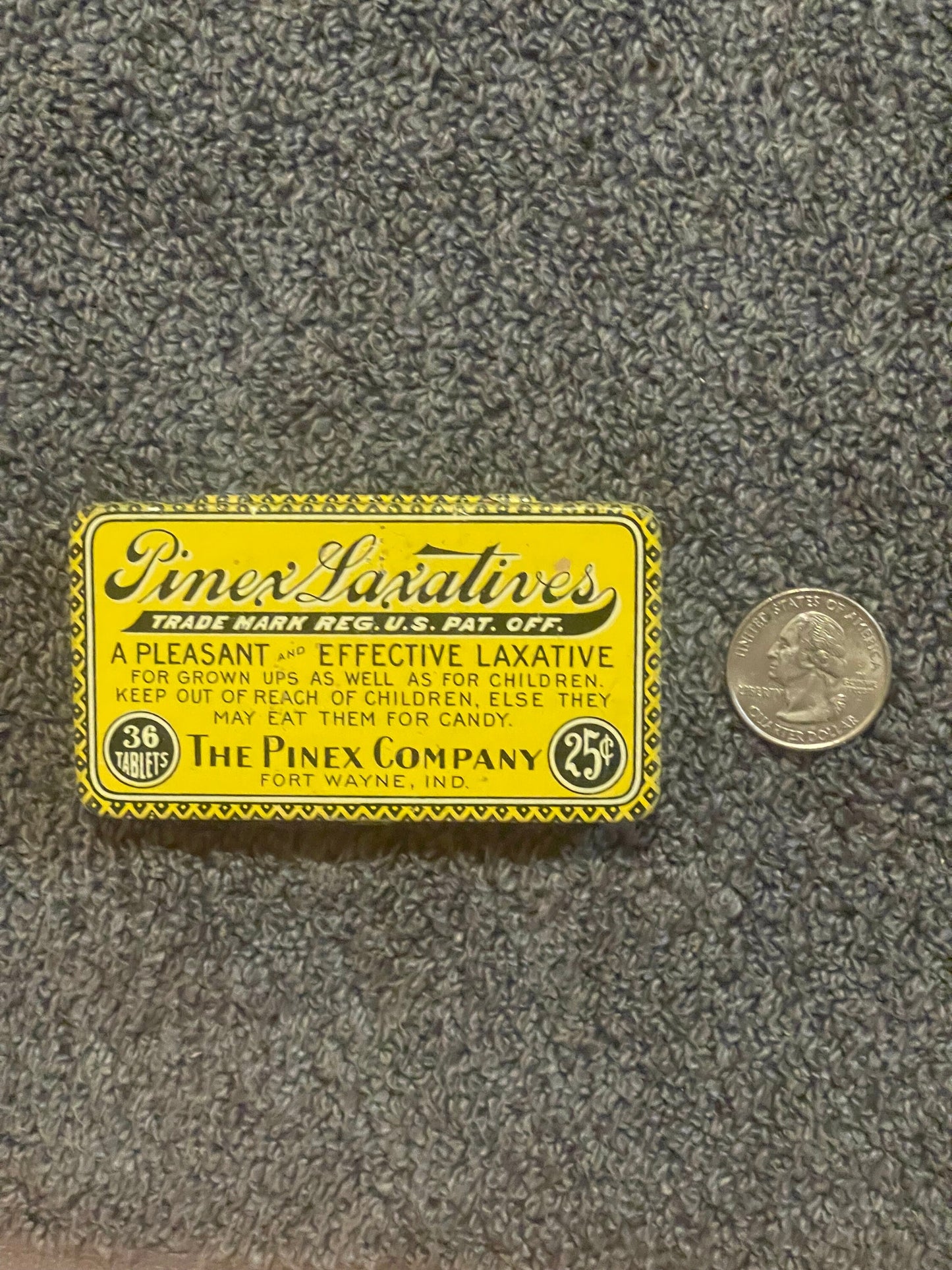
This is an original Pinex Laxatives tablet tin, produced by The Pinex Company of Fort Wayne, Indiana, and it comes to you as New Old Stock (NOS) — meaning this particular tin sat in inventory rather than moving through a working pharmacy, which is exactly why the lithography reads so clean and bright today. The style of the piece — the flowing script logo, the diamond-patterned border, the "Trade Mark Reg. U.S. Pat. Off." banner, and the 25-cent price point — places it comfortably in the early-to-mid twentieth century patent medicine era, the decades when a tin like this would have shared shelf space with tonics, salves, and elixirs at drugstores from coast to coast. It's a compact, pocket-sized piece, measuring 2 inches by 0.5 inches (roughly 5 x 1.3cm) — small enough to have ridden in a coat pocket or a handbag, right alongside a coin purse or a set of keys.

The artwork itself is a small masterclass in early advertising design. The top panel carries "Pinex Laxatives" in bold, sweeping script, banked by a black ribbon reading "Trade Mark Reg. U.S. Pat. Off." Below that, in tidy block lettering, the tin makes its full pitch: "A Pleasant and Effective Laxative for Grown Ups as well as for Children." And then, in the very next line, the now-famous warning: "Keep out of reach of children, else they may eat them for candy." Two black-bordered roundels anchor the bottom corners — one reading "36 Tablets," the other "25¢" — with "The Pinex Company, Fort Wayne, Ind." set in confident serif type between them. The whole face is wrapped in a repeating diamond border that runs the full perimeter, a design touch you'll see again and again on tins of this vintage, meant to catch the eye of a customer scanning a crowded shelf. On the opposite panel, a full set of printed directions lays out dosing for adults and for children by age, right down to the reassurance that "children love the pleasant taste" and a guarantee of satisfaction "without red tape."


🏛️ The Pinex Company: Fort Wayne's Cure for Whatever Ailed You

The Pinex Company built its name on the idea that home remedy and drugstore convenience should meet in the middle. Old-timers and longtime collectors of patent medicine ephemera will tell you that Pinex was best known nationally not for its laxative tablets at all, but for its cough syrup concentrate — a small bottle of Pinex mixed at home with sugar syrup, meant to stretch a little bottle of concentrate into a full pint of cough remedy. That home-mixing trick was practically a household ritual in its day, passed down the way a recipe gets passed down, and it made the Pinex name a familiar one on kitchen shelves well beyond Indiana. This laxative tin represents the company reaching further into that same trusted-name territory — taking the goodwill built by one product and using it to sell another. That's a marketing instinct that never really goes out of style, and it's fascinating to see it playing out in tin and ink more than a century on.

What jumps out reading the tin today is the sheer confidence of the copy. "A Pleasant and Effective Laxative for Grown Ups as well as for Children" is not a claim any company could print without hesitation now, but in the patent medicine trade, bold and universal promises were the whole game. The guarantee language on the reverse — satisfaction or "money promptly refunded without red tape" — was a common device of the era, a way of building trust with a buying public that had every reason to be skeptical of miracle cures, since so many of them were exactly that: miracles that delivered nothing. Companies that wanted to be taken seriously leaned hard into guarantees, trademarks, and official-sounding registration language, and Pinex checked every one of those boxes on this small tin.


🏙️ Fort Wayne, Indiana — A City Built for Making and Shipping Cures

Fort Wayne earned itself the nickname "Summit City" back in the canal era, sitting at the highest point along the old Wabash and Erie Canal route, and that geography kept paying dividends long after the canal boats stopped running. By the time companies like Pinex were bottling and boxing their remedies, Fort Wayne had grown into a genuine rail crossroads, with lines running in every direction to move finished goods out to drugstores across the Midwest and beyond. A patent medicine company didn't need to be based in a big coastal city to build a national customer base — it needed good rail access, a steady labor force, and a postal system willing to carry mail-order pitches into small towns everywhere. Fort Wayne had all three, and it became home to a cluster of manufacturing concerns that shipped their products out by the freight-car load.

Local legend around Fort Wayne's old manufacturing district holds that the city's patent medicine makers kept close company with one another — sharing suppliers, printers, and sometimes even employees, in the way that small industrial cities often did before conglomeration flattened everything into a handful of national names. Whether or not any two rival remedy makers ever crossed paths at the same tin lithographer, it's easy to picture the scene: a city of brick factory buildings, horse-drawn (and later motorized) delivery wagons, and a steady hum of production turning out tins, bottles, and boxes bound for drugstores that most of the workers making them would never see. Fort Wayne's patent medicine chapter isn't as famous today as the city's later reputation for electrical manufacturing, but for collectors who dig into it, it's a rich and rewarding thread of Indiana's industrial story.


👨‍⚕️ Behind the Counter: Drugstores, Home Remedies, and the People Who Sold Them

Picture the drugstore this tin would have called home: a marble-topped soda fountain up front, glass apothecary jars along the back wall, and a pharmacist who compounded as much as he dispensed. Tins like this one lived on open shelving where a customer could pick one up, read the promises printed right on the lid, and decide for themselves whether to try it — no prescription required, no gatekeeping beyond a quarter in hand. That direct, customer-facing style of selling medicine was the whole business model of the era, and it put enormous weight on the artwork and the words a company chose to put on its packaging, because the tin itself was the entire sales pitch.

Families of that generation often kept a rotating cast of these tins and bottles in a kitchen cabinet or a bathroom shelf, trusted the way we might trust a familiar over-the-counter brand today, but with a folksier, more personal relationship to the product. Mothers dosed their own children by the instructions printed right there on the box — no calling a pediatrician, no reading a pharmacist's insert. It's a reminder of just how self-reliant home medicine once was, and how much trust got placed in the printed word of a company a family had never met and would never visit.


🍬 "Eat Them Like Candy": Medicine Before Child-Safety Law

Here's the detail that makes this tin an instant conversation piece: the front panel tells parents to keep it away from children so they don't "eat them for candy" — and the directions panel, without a hint of irony, tells parents to let children "eat like candy or crush to a powder," reassuring them that "children love the pleasant taste." Read back to back, it's a genuinely funny piece of early advertising logic, and it's not a printing error. This was simply the marketing language of an age before child-resistant packaging existed in any form, decades before federal law would require it. The tablets were formulated to taste pleasant enough that a child would take them willingly, and the company treated that as a selling point rather than a hazard to be minimized.

It's a small window into just how differently medicine was packaged and sold before mid-century regulation caught up with the industry. There was no requirement to lock caps, no mandated warning icons, no poison control hotline printed on the label — just plain language, a trademark, and a guarantee. Collectors of patent medicine ephemera prize tins exactly like this one because they capture that particular, unregulated moment so plainly. You could not print copy like this on a medicine package today, which is precisely why finding it preserved on an original tin feels like discovering a fossil of an entirely different regulatory world.


📦 Why a Tin Like This Survives a Century Later

Paper labels tear, fade, and peel. Tin lithography, printed and baked directly onto the metal, holds its color and its crisp lettering in a way paper simply can't match, which is a big part of why advertising tins from this era remain so collectible and so legible generations later. This particular example is offered as New Old Stock — a tin that was manufactured and stocked but never opened and used at a drugstore counter, which is exactly the kind of piece collectors seek out when they want an example that still shows off the full brightness of its original lithographed artwork: the yellow ground, the black diamond border, the crisp script logo. It stands today as a genuinely fine example of early American advertising tin work — the kind of small, everyday object that companies once poured real design effort into, knowing it would sit at eye level on a counter competing for a shopper's attention.


🖼️ Display Ideas

  • 💊 Grouped on an open shelf alongside other vintage medicine tins and apothecary bottles for a full drugstore-counter vignette
  • 🚐 Tucked into a vintage camper or travel trailer medicine cabinet for a period-correct touch of road-trip nostalgia
  • 🏺 Set inside a glass-front curio cabinet where the yellow lithography can catch the light
  • 🖼️ Framed in a shadow box alongside other Fort Wayne or Indiana advertising ephemera for a regional history display
  • 🛁 Displayed on a pedestal tray in a vintage-styled bathroom vanity, echoing its original home
  • 🎁 Given as a nostalgic gift to a pharmacist, nurse, or Indiana native who'll appreciate the local and medical history in one small package

🎁 Who Collects These

This tin sits right at the crossroads of several collecting worlds, which is part of what makes it so satisfying to find a home for. Patent medicine and pharmacy collectors chase it for the Pinex name and the dosage instructions. Advertising tin collectors want it for the lithography and the diamond border work. Indiana and Fort Wayne local history buffs collect it simply because it names their hometown in bold serif type. And then there's a whole crowd of collectors drawn purely to the humor and shock value of that "eat them for candy" line — the kind of piece that gets pulled out at a gathering just to watch someone read it for the first time. Families with a background in pharmacy or medicine often gravitate to pieces like this too, recognizing in it the working world their own relatives once operated in behind a drugstore counter.


❓ FAQ

What exactly is a Pinex Laxatives tin?

It's an original tablet tin produced by The Pinex Company of Fort Wayne, Indiana, designed to hold 36 laxative tablets and retail for 25 cents at a drugstore counter.

How old is this tin?

The script logo, diamond border lithography, trademark language, and price point place it in the early-to-mid twentieth century patent medicine era — the decades when tins like this were common on American drugstore shelves.

Does this tin still contain tablets?

This listing is for the collectible tin itself, valued today for its lithographed artwork and printed history rather than as a working medicine container.

What does "New Old Stock" mean for a piece like this?

It means this tin was manufactured and warehoused as inventory rather than sold and used at a pharmacy counter in its own time, which is why its lithography reads as crisply as it does today.

Why does the tin say to keep it from children, then tell parents to let children eat the tablets?

That's a genuine piece of early advertising language from before child-safety packaging laws existed — the tablets were made to taste pleasant, and the company marketed that pleasant taste directly to parents.

Why is Fort Wayne, Indiana printed on the tin?

The Pinex Company was based in Fort Wayne, a Midwest manufacturing and rail hub that was home to a cluster of patent medicine makers in this era.

What size is the tin?

It measures 2 inches by 0.5 inches — a compact, pocket-sized piece true to the small tablet tins carried at drugstore counters of its day.

Shipping

🚚 Shipping & Handling

  • Shipping costs and timing are calculated at checkout.
  • Items curated and shipped directly by me include U.S. shipping at no additional cost, professionally packed to ensure safe arrival of your artifact.

Items from Vetted Pro Collectors
Shipping for items offered by vetted Pro Collectors is determined at checkout. All Pro Collector listings are reviewed to ensure fair, reasonable shipping practices.

For full details, please refer to our Shipping Policy.

Returns & Exchange

Take your time — you've got a full six months. If a piece isn't right for you, send it back the way it reached you and we're good.

In the first 30 days your money goes straight back the way you paid. After that it's store credit, so you can put it toward something you'd rather have.

Return shipping we sort out between us, case by case. I don't make this difficult.

If something arrives damaged, or it isn't what I said it was, send me a photo within 48 hours and I'll make it right.

Email info@vintageantiquesgifts.com or call 802-356-9872 — that's me answering, not a call center.

The only things I can't take back are custom or special-order pieces and gift cards.

View full details
  • 5 stars: 19 (100%)
  • 4 stars: 0 (0%)
  • 3 stars: 0 (0%)
  • 2 stars: 0 (0%)
  • 1 star: 0 (0%)
y
y***z (1685)

Love this advertising tin, great condition ❗️Shipped securely with quick shipping ❗️ Enjoyed your thank you note with the personalized signatures. Sounds like you have your hands full.

S
Sherry

Great memorabilia! My family pharmacy was around over 100 yrs, but we never thought to keep these

B
Brooke

Fabulous product, and very unique! The item shipped quickly and was packaged well and lived up to the description. Very sweet family business and I will definitely be ordering more in the future from them!

L
Lisa

great addition to our vintage camper medicine cabinet

L
Leah

This item was as described

H
Helen

Just as described package well and clean

K
Keith

Thanks. Excellent service and product

A
April

Great family to work with! Would definitely buy again! Thanks.

l
lor

The item came as described and I got the cutest drawing from the seller’s kids, couldn’t be happier!

r
r***0 (57)

Very well packaged. Received it sooner than I thought I would. Very pleased.

J
Josh

Item packaged carefully and arrived quickly. Exactly as described in the listing. Another one to add to my collection!

Thank you for your kind review! We're so happy to hear that your item arrived safely and met your expectations. ✨ We hope it makes a great addition to your collection. Happy collecting!

E
Elisabeth

Einzigartige alte Dose in gutem Zustand und geeignet verpackt, schnell geliefert - bin sehr zufrieden und sage Dankeschön!

A
Andrew

Excellent quality item matched description a photo with a size reference would have helped my expectations excellent communication all the way through the sale

k
kirklvan.f5siztxy

Great delivery! A nice human touch 💕

Thank you! We need more of it these days. It makes us so happy we accomplished that! ❤️

R
Randy Condiff
Excellent!

This is a very cool antique tin.A must have for anyone who digs these quirky medicinal smalls.it arrived on time and was packaged well.The little bonus gifts and personalized Thank you cards are a unique gesture. I've never gotten that from any other seller I've bought from.Keep up the good work. I'm looking forward to seeing more of your products.Thanks guys.🙂

Thank you! I just saw your new order. I hope we sent you some new bonus labels as I don't have that streamlined yet for repeat customers. The kids were excited to learn about the princess on the matchbook.

B
Becky

Cute tin - arrived in good shape.

Thank you so much for the kind words! We really appreciate it. My dad had to take a break for a bit so I apologize for the delay in responding. We hope to work with you again in the future!

d
ddyk7598

great seller

Thank you, we think you are awesome also!

j
jo-yukyu-acpoilou8d

very happy with the seller and the product

Thank you, Happy Holidays!

b
bmoviecollector4life

NICE item !! AWESOME seller !! GREAT service !! HIGHLY recommended !!

Thank you so much! I hope you love the tins. My family appreciates your business. We got 1000's more items coming as my mother's collection was large so check back often. We hope to help you again in the future! Travis and the Kids