Skip to product information
1 of 3

Vintage and Antique Gifts

Antique 1910s In-Step Foot Remedy Free Sample Tin In-Step Laboratory Wayne NY Small Apothecary Medicine Tin 2.5 Inch 🥫

Antique 1910s In-Step Foot Remedy Free Sample Tin In-Step Laboratory Wayne NY Small Apothecary Medicine Tin 2.5 Inch 🥫

Regular price 16.00 USD
Regular price Sale price 16.00 USD
Sale Sold out
Shipping calculated at checkout.
Quantity

Size: 1 inches

What Fits in the Palm of Your Hand — and Holds a Hundred Years of American Life? 🦶

There is a particular kind of stillness that comes over you when you pick up a tin this small. It weighs almost nothing, and yet it doesn't feel nothing. It feels dense — the way a river stone feels dense after a century of water has worked it smooth. This little round sample tin from the In-Step Laboratory of Wayne, New York is barely an inch across. It sits on a fingertip. A child could close a fist around it and you'd never know it was there. And somehow, impossibly, it has survived the full arc of the twentieth century — the drugstores, the medicine cabinets, the estate sales, the forgetting — and arrived here, in exactly the condition it left the laboratory. Lithographed lid intact. Instructions still perfectly legible. For Ailing Feet — Rub Well Into Skin. That's all it needed to say. That was the language of an era that trusted the straightforward, the practical, the handshake-over-the-counter promise of American proprietary medicine.

Somebody once held this exact tin. Maybe a druggist pressed it into a customer's hand across a glass-topped counter in a Southern Tier general store. Maybe it rode in a coat pocket for a day and was set on a bedside table that same night, forgotten, and never opened. Maybe it sat in a sample case alongside a dozen other little tins, each one a tiny ambassador for a remedy that promised relief to tired, road-worn, working-class American feet. However it got here — here it is. New Old Stock. Untouched. Original. The real thing.


🏺 What It Is — The Object, the Maker, the Moment

This is an authentic antique free-sample tin produced by the In-Step Laboratory of Wayne, New York, in Steuben County in the Southern Tier of New York State. The production window for this piece runs from approximately 1906 through the 1930s — the golden age of the American proprietary remedy trade, when every town of any size had its local laboratory, its druggist who doubled as a chemist, and its shelf of paper-labeled and lithographed tins promising comfort and cure.

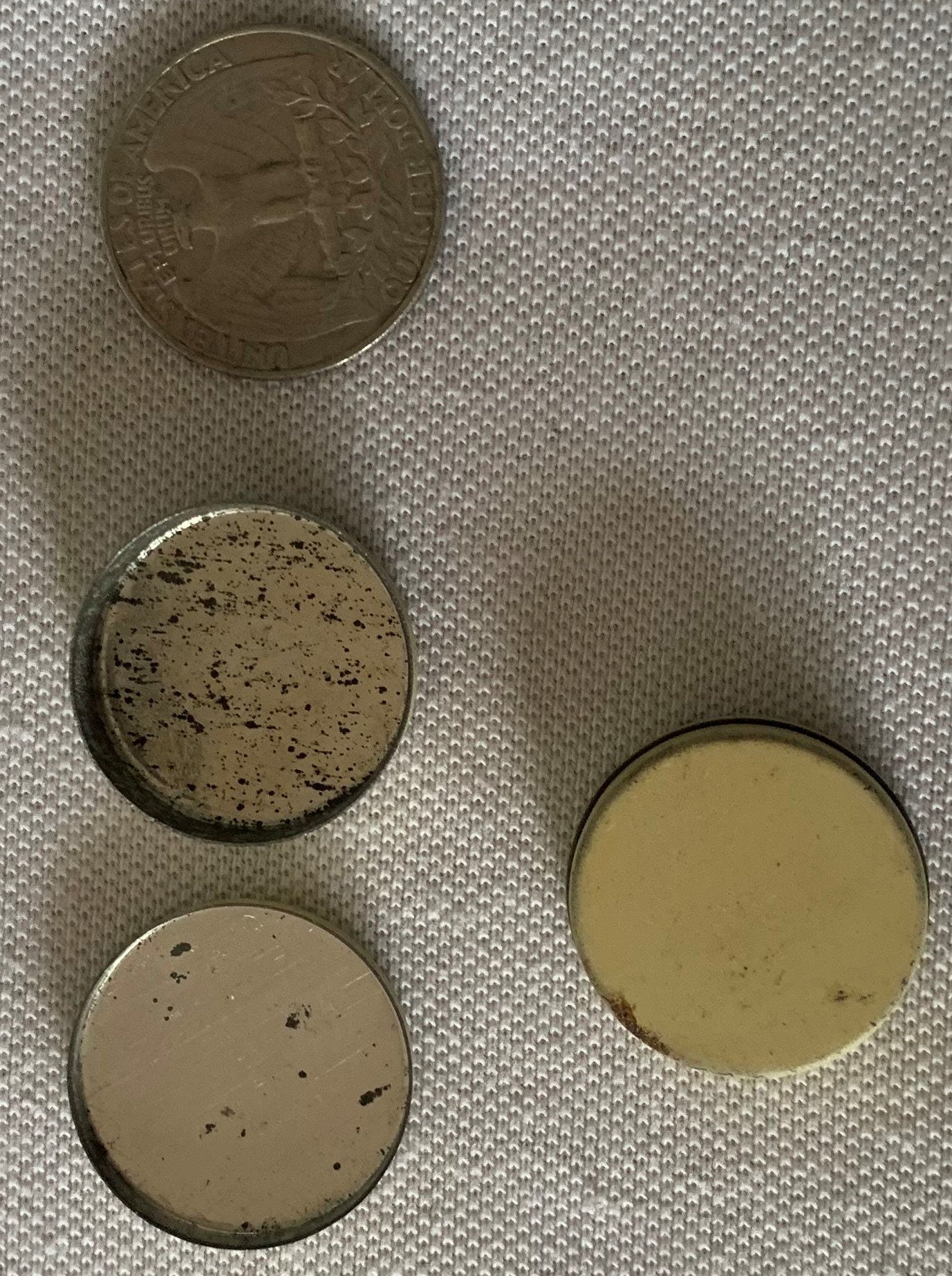
This particular tin is a sample size — the smallest expression of a commercial remedy, produced specifically to be given away, handed out, tucked into paper bags alongside purchases, or left in stacks on druggists' counters as a point-of-sale invitation. Approximately one inch in diameter, it is a round, shallow tin with a lithographed or printed paper label adhered directly to the lid — carrying the brand name, the origin, the instructions, and the quiet graphic confidence of early American commercial printing.

This is New Old Stock (NOS) — meaning it was never used, never emptied, and never made it into the hands of whoever was supposed to rub it into their aching feet. It stayed, somehow, exactly as it was made. That is the rarest kind of survival for objects this ephemeral, this small, and this ordinary in their original moment.


🏛️ Wayne, New York — The Town Behind the Tin

Wayne, New York is a quiet township in Steuben County, tucked into the rolling hills and deep valleys of the Southern Tier — the long belt of upstate New York that stretches westward from the Catskills toward the Pennsylvania border and beyond. It is not a famous place by the standards of New York State geography. No one writes songs about it. The tourist maps don't linger there. But Wayne has a longer and richer history than its modest profile suggests, and it is that history — the history of small American places that did real American work — that makes a tin like this one so worth understanding.

The town was formally organized on May 18, 1796, in the same legislative stroke that carved Steuben County out of Ontario County and set the bones of the Southern Tier into their permanent shape. In those early years it went by the name Frederickstown — a name that belonged to the optimistic, Federalist-era habit of naming places for founding figures and local patrons. It held that name for just over a decade before the New York State Legislature, on April 6, 1808, officially renamed it Wayne, in honor of General Anthony Wayne — the Revolutionary War commander his own soldiers called Mad Anthony, a hard-driving, audacious officer whose victories at Stony Point and Fallen Timbers had made him a household name in the early republic. The renaming was a statement of values. The people of this township wanted to be associated with boldness, with forward motion, with American grit. That spirit — practical, determined, not given to unnecessary flourish — is threaded through every piece of commerce that came out of the Southern Tier in the century that followed.

By the late nineteenth and early twentieth centuries, small-scale manufacturing and proprietary trade had taken root across Steuben County. The railroad lines that stitched the Southern Tier to the broader northeastern economy — freight moving through Corning and Bath and out toward the Erie corridor — meant that even a small operation in a place like Wayne could reach a regional or national market through a network of traveling salesmen, sample cases, and druggist relationships. The In-Step Laboratory was exactly that kind of operation: a local enterprise producing a remedy for a universal human complaint, bottled and tinned and sent out into the world through the channels that connected rural New York to the wider trade.

Local legend has it that the proprietors of small Southern Tier remedy laboratories in this era often doubled as the town druggist, the local physician's informal partner, or both — men and women who understood the practical chemistry of liniments, salves, and foot preparations because they had learned it by doing it, in back rooms that smelled of camphor and lanolin and turpentine, not in any formal school of pharmacy. The line between folk remedy and proprietary medicine was thin in those years, and the best of those laboratories carried knowledge passed down from earlier hands — from the herbal and apothecary traditions of the nineteenth century — and simply gave it a proper label, a confident name, and a tin small enough to slip into a pocket.


👞 The Proprietary Remedy Trade — An American Original

To hold this tin without understanding its industry is to miss half its meaning. The American proprietary remedy trade — sometimes called the patent medicine trade, though true patents were rarer than the name implies — was one of the most vigorous, colorful, and culturally revealing commercial phenomena in the nation's history. From roughly the 1870s through the 1930s, it produced thousands of products: tonics, liniments, salves, powders, lotions, and preparations of every description, sold under confident trade names, wrapped in lithographed paper, sealed in glass bottles and in little tin boxes exactly like this one. The trade was democratic in the best sense. It didn't require a doctor's visit. It didn't require a prescription. It required only a druggist, a counter, and a customer with a complaint — in this case, tired, aching, working-class feet.

Foot remedies held a specific and significant place in the proprietary trade because foot pain was a genuinely universal American experience in the era before modern podiatry, before orthopedic footwear, before the mass-market athletic shoe. Working people — farmers, factory hands, domestic workers, miners, railroad men, shop clerks standing twelve hours on plank floors — lived with foot trouble as a daily fact. Corns, calluses, athlete's foot, cracked heels, plantar pain: these were not minor inconveniences. They were the persistent tax that physical labor levied on the human body from the ankles down. A remedy that promised relief — a salve that could be rubbed into the skin at the end of a long day — was not a luxury. It was a necessity, and the proprietary trade understood that. Foot remedy products proliferated: Dr. Scholl's (founded 1906, almost exactly contemporary with this tin's production window), Zona Salve, Blue Jay corn plasters, and dozens of smaller regional preparations from local laboratories like In-Step. Each one competed for shelf space, for the druggist's recommendation, and for the quarter or dime in a working person's pocket.

The sample tin was the proprietary trade's most elegant sales tool. Too small to use up quickly — just enough to try. If it worked, you came back for the full size. If it worked consistently, you asked your druggist to keep it in stock. The sample was the foot in the door, which makes the foot remedy sample tin a kind of perfect, self-referential artifact of American commercial history: a remedy for feet, delivered as a foot-in-the-door.

Lore passed down among collectors of proprietary medicine tins holds that the survival rate for sample tins is actually lower than for full-size tins — not because they were less carefully made, but because they were considered more disposable in their moment. A full tin on a bathroom shelf had a certain presence. A sample tin could be used up, tossed, lost in a coat pocket, or simply overlooked and thrown out with the week's waste paper. NOS sample tins from this era — particularly from small regional laboratories whose total production runs were modest by the standards of national brands — are genuinely scarce. When they surface, they surface singly, in estate lots, tucked into the corners of old tin boxes or forgotten in general store drawers.


🔬 The In-Step Laboratory — Name, Identity, and the Spirit of an Era

The name In-Step Laboratory is itself a small work of genius. It works on multiple registers at once, the way the best brand names of the early twentieth century always did. It promises relevance — in-step, for the foot and the stride. It promises currency — to be in step was to be modern, current, moving with the times. And it promises the authority of a laboratory — that word doing heavy lifting in the proprietary trade, where it signaled science, precision, and a claim to something beyond the merely homemade. In-Step Laboratory. It would have looked authoritative on a druggist's shelf. It would have sounded persuasive from a traveling salesman's pitch. And it looks, a century later, like exactly what it was: a small American enterprise with a big American confidence in its own product and its own name.

The laboratory operated out of Wayne, New York — a Steuben County address that would have meant something to regional druggists even if it carried no particular national recognition. Regional provenance mattered in the proprietary trade. It was proof that a real person, in a real place, had made this thing and stood behind it. Wayne, New York was that real place. General Anthony Wayne's name was on the town. That was not nothing.


🖼️ Display Ideas

  • 🧲 Apothecary vignette on a floating shelf: Pair this tin with a small amber glass bottle, a vintage mortar, and a folded scrap of period newspaper — the whole assembly fits in six inches of shelf space and reads as an authentic early twentieth-century pharmacy moment.
  • 🗺️ Regional New York history display: Mount alongside a reproduction or original Steuben County map, a period postcard from the Southern Tier, and one or two other Wayne or Bath, NY artifacts — a collector's statement about a specific place and time.
  • 🏺 Tin collection centerpiece: Displayed on a small velvet or linen square inside a shadow box or under a glass dome, this inch-wide tin punches far above its physical weight. Its scale is its drama — surround it with slightly larger tins and let its smallness do the storytelling.
  • 💼 Traveling salesman / sample case theme: Group with other NOS sample tins, a vintage sample case, and a period trade catalog — an exhibition of the American commercial road in the early twentieth century.
  • 🦶 Foot care and podiatry history collection: A natural anchor piece for anyone assembling a focused collection around the history of foot remedies, shoe care, and the early American health product trade. Pairs beautifully with Dr. Scholl period ephemera, shoe horns, and early comfort footwear advertising.
  • 🎁 Display as a gift already curated: Presented in a small wooden box or on a square of aged linen, this tin arrives as a complete object — no additional framing or mounting required. Its age, its graphics, and its narrative do all the work.

🎁 Who Collects These

The people who find their way to a piece like this one tend to arrive from several different directions, and what's wonderful is how different those directions are — and how this single small tin speaks authentically to all of them.

Proprietary medicine and apothecary collectors are the natural heartland audience for this tin. These are serious, often deeply knowledgeable collectors who understand the history of the American patent and proprietary remedy trade the way a book collector understands first editions — by era, by lithography style, by regional origin, by survival condition. For this collector, a NOS sample tin from a small regional laboratory with a confirmed town address is a meaningful find. The In-Step Laboratory of Wayne, New York represents exactly the kind of local enterprise that produced authentic, period-correct graphic design in modest quantities — making survivors rarer than anything from the national brands.

New York State and Southern Tier local history collectors will recognize the Wayne, Steuben County provenance as the primary attraction. There is a passionate community of collectors focused specifically on upstate New York commercial artifacts — drugstore items, general store pieces, local business ephemera — and a piece with a confirmed Wayne, New York address is a direct connection to the lived commercial history of that community.

Tin and lithography enthusiasts collect for the object itself — the printing, the form, the survival. A miniature lithographed sample tin in NOS condition is, for this collector, a triumph of the printer's and tinsmith's art. The graphic language of the early American proprietary trade was among the most distinctive commercial printing produced in this country, and the sample tin — at its smallest scale — is its most concentrated expression.

Nostalgia and everyday life historians — people drawn to the objects that ordinary working people touched and used — will feel the pull of this tin most personally. It's not a presidential memento or a military artifact. It's a foot remedy sample. It's the most ordinary, practical, human thing imaginable. And that ordinariness is precisely its power. This is what history actually felt like from the inside — not grand, not monumental, but small and useful and carried in a coat pocket on a cold day in upstate New York.

Interior stylists and prop collectors have discovered proprietary medicine tins as one of the most versatile and visually rewarding categories of antique object — graphic, scaled, historically resonant, and endlessly arrangeable. A tin this small can anchor a vignette or disappear into one. It is, in the language of display, a perfect accent object.


❓ Collector FAQ — In-Step Laboratory Sample Tin

Is this genuinely New Old Stock, and how can I tell?

Yes — this tin is confirmed New Old Stock (NOS), meaning it was produced in its original era (approximately 1906 through the 1930s) and has never been used or emptied. The indicators of NOS status on a piece like this are consistent across several factors: the lithography and label graphics show no evidence of handling wear consistent with use; the tin retains its original form without the denting, discoloration, or chemical residue that accompany a used and emptied remedy tin; and it presents with the precise, uncompromised graphic quality that only a never-handled original carries. For collectors of the proprietary medicine category, NOS is the benchmark condition — a tin that was used is a tin with a story, but a tin that was never used is a tin that time forgot, and that is its own, rarer kind of story.

What does the approximate 1906–1930s production window mean for dating?

The production window of approximately 1906 through the 1930s reflects the established historical arc of the American proprietary remedy trade as it applies to small regional laboratories. The year 1906 is significant because the Pure Food and Drug Act of 1906 fundamentally changed how proprietary remedies were labeled, marketed, and manufactured — requiring clearer ingredient disclosure and ending some of the more extravagant curative claims of the earlier trade. Products that survived and continued into the 1910s and 1920s did so by adapting to those requirements. The 1930s represent the end of the golden era for most small regional laboratories, as the Depression, changing regulatory requirements, and the consolidation of the pharmacy and drug manufacturing industries put smaller operations out of business or absorbed them. A tin from this window is a product of the mature, regulated, but still vigorously independent American proprietary remedy trade.

Who was the In-Step Laboratory, and is more known about them?

The In-Step Laboratory of Wayne, New York was a small regional proprietary remedy manufacturer operating in Steuben County in the Southern Tier of New York State during the early twentieth century. Like many small laboratories of this era, it operated at a scale that left limited documentary traces in formal historical records — the trade directories, druggist journals, and commercial almanacs of the period captured the largest national players most reliably, while regional and local operations like In-Step are known primarily through their surviving products.

This tin is itself primary evidence of the laboratory's existence and operation — a physical document of a small American enterprise. Local legend in the Southern Tier holds that several of the area's small remedy manufacturers were connected to the region's agricultural and folk medicine traditions, producing preparations based on knowledge accumulated across generations of rural New York practice.

Whether In-Step had such roots is not documented, but the connection to Wayne — a township named for a Revolutionary War hero and organized in the earliest years of Steuben County — places it squarely in the long tradition of small-town American self-sufficiency and enterprise.

How do I display or store this tin safely?

A tin this small benefits from thoughtful display that protects it from two primary enemies: handling and humidity. For display, a small glass dome, a shadow box with UV-filtering glazing, or a sealed vitrine are all excellent choices — they allow full visual appreciation while protecting the lithography and any paper label elements from light degradation and fingerprint oils. For storage between display periods, an acid-free tissue nest inside a small archival box is the collector's standard. Avoid displaying near windows with direct sunlight, near heat sources, or in rooms with high humidity fluctuation — all of which accelerate the aging of both the tin substrate and any printed paper elements. Beyond that, the object requires very little: it has survived a century without intervention, and a careful modern environment will preserve it for another century easily.

Is the condition typical for NOS tins of this age and type?

NOS condition on a piece of this age — a minimum of roughly ninety years, and potentially well over a century — represents the best survivable state for a sample tin of this type. Sample tins were produced with the economics of give-away in mind, which means the tin substrate and printing were not necessarily intended for long-term survival.

The fact that this example has retained its lithography, its form, and its legible text is itself a function of the conditions in which it was preserved — most likely stored away from light, moisture, and handling for the majority of its life. Minor evidence of age is appropriate and expected on any authentic antique tin of this period and is part of the object's honest character as a historical artifact.

First, the category produced an enormous range of regional and local brands — because foot trouble was universal, the market supported dozens of competitors at every scale from national to neighborhood, creating enormous variety for collectors. Second, the graphic design language of foot remedy packaging tended toward the practical and confident rather than the lurid or sensational — these were workaday products, and their tins and labels reflect that honest, direct aesthetic, which ages remarkably well.

Third, the sample tin form — small, round, lithographed — is among the most visually satisfying container forms in the entire proprietary trade, and foot remedy samples were produced in this form more consistently than almost any other remedy category. And finally, there is something genuinely human and relatable about the subject matter.

Foot pain is not a historical complaint. It is a present-tense one. A tin that promises relief for ailing feet speaks across a century without translation.

How does this piece fit into a broader collection of New York State antiques and regional commercial history?

A Wayne, New York commercial artifact of this age and specificity is, for the focused upstate New York collector, a genuine find. Steuben County and the broader Southern Tier are well-represented in the antique and estate sale market through agricultural implements, glass (Corning is just a short distance away, and the region's glassmaking history is rich), and general store dry goods. But proprietary remedy pieces from specific Southern Tier addresses — with the town name, the laboratory name, and the era all confirmable — are considerably rarer. This tin slots naturally into a collection built around the commercial and material culture of rural and small-town New York in the early twentieth century, and it holds its own in that company. General Anthony Wayne's name is on the town that made this tin. That is a thread that runs from the Revolutionary War through the Southern Tier's agricultural and industrial development and arrives, in miniature, in the palm of your hand.

Shipping

🚚 Shipping & Handling

  • Shipping costs and timing are calculated at checkout.
  • Items curated and shipped directly by me include U.S. shipping at no additional cost, professionally packed to ensure safe arrival of your artifact.

Items from Vetted Pro Collectors
Shipping for items offered by vetted Pro Collectors is determined at checkout. All Pro Collector listings are reviewed to ensure fair, reasonable shipping practices.

For full details, please refer to our Shipping Policy.

Returns & Exchange

Take your time — you've got a full six months. If a piece isn't right for you, send it back the way it reached you and we're good.

In the first 30 days your money goes straight back the way you paid. After that it's store credit, so you can put it toward something you'd rather have.

Return shipping we sort out between us, case by case. I don't make this difficult.

If something arrives damaged, or it isn't what I said it was, send me a photo within 48 hours and I'll make it right.

Email info@vintageantiquesgifts.com or call 802-356-9872 — that's me answering, not a call center.

The only things I can't take back are custom or special-order pieces and gift cards.

View full details
  • 5 stars: 2 (100%)
  • 4 stars: 0 (0%)
  • 3 stars: 0 (0%)
  • 2 stars: 0 (0%)
  • 1 star: 0 (0%)
b
boc2001

Very small just what I wanted! In excellent condition, was mailed quickly and was packed very well.

b
bmoviecollector4life

AWESOME item !! HIGHLY recommended seller !! A PLEASURE !!! Thanks !!

Thank you so much for your business! We really appreciate it and hope to work with you again soon.