Skip to product information
1 of 4

Vintage and Antique Gifts

Antique 1930s Schooner Brand Lemons Crate Label ⛵ — Goleta Lemon Association, Santa Barbara County CA

Antique 1930s Schooner Brand Lemons Crate Label ⛵ — Goleta Lemon Association, Santa Barbara County CA

Regular price $9.00 USD
Regular price Sale price $9.00 USD
Sale Sold out
Shipping calculated at checkout.

Size: 10 1/2" x 8 1/2"

🚚 Free US Shipping — ships within one business day. International shipping calculated at checkout.

Quantity

Why a Schooner on a Lemon Label? ⛵ Antique 1930s Crate Label, Goleta Lemon Association, Santa Barbara County

Size: 10 1/2" x 8 1/2" ~ NOS unused stock, little to no storage wear.

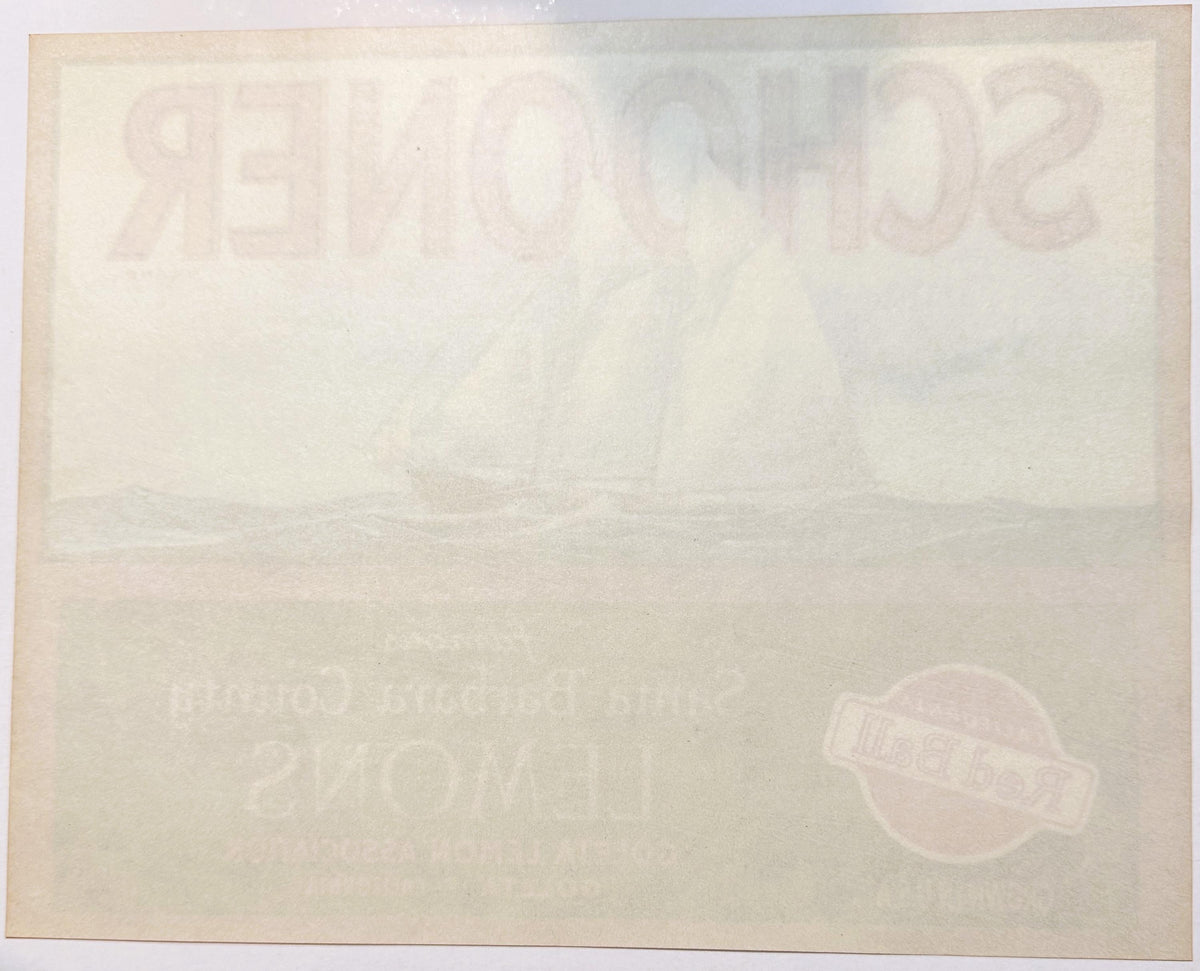
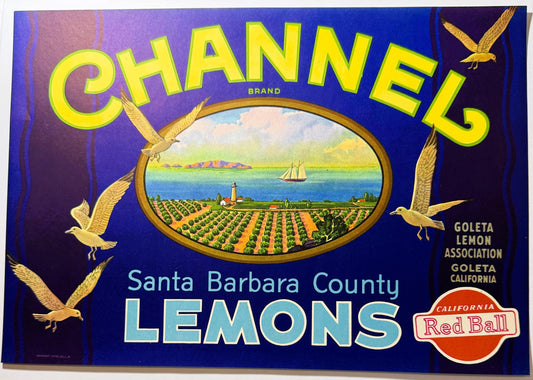
A 1930s Schooner Brand lemon crate label from the Goleta Lemon Association of Goleta, Santa Barbara County, California, never pasted on a crate. A two-masted schooner under full sail, and the best part is why it's there.

Lemons came to this coast with the Spanish missionaries in the late 1700s, and by the late 1800s they were a real industry. Sherman Patterson Stow planted the Goleta Valley's first irrigated lemon orchard in 1875. In 1896 the local growers banded together as the Santa Barbara County Lemon Growers' Exchange, and a year later the Johnston Fruit Company started up with Stow at the helm.

The Goleta association had its own comeback story, too. A fire wrecked its plant in 1950, and in 1951 it opened a 182,000-square-foot packing house, at the time the world's largest single-unit lemon-processing plant, able to handle some 2,000 rail carloads of lemons a year. Now that's making lemonade out of lemons.

⚓ What's Printed on It

  • SCHOONER in outlined red-orange display capitals, with BRAND set small beneath the final R, over the ship
  • famous Santa Barbara County over LEMONS in the black panel
  • GOLETA LEMON ASSOCIATION — GOLETA... CALIFORNIA
  • CALIFORNIA / Red Ball — white script on a plaque over a solid red disc at the lower left, the citrus Exchange's companion mark to Sunkist
  • GROWN IN U.S.A.
  • SCHMIDT LITHO CO. L. A. — the printer's imprint, in dark microtype on the orange border at the bottom left

Goleta is the town, Santa Barbara County the growing district, and Schmidt Litho Co. of Los Angeles did the printing.

⛵ A Schooner for a Schooner Town

This brand name is a little inside joke. Goleta is Spanish for schooner, and the town got its name from ships in the Goleta Slough. In 1819 José de la Guerra's schooner ran aground trying to slip into the slough mouth, and Benjamin Foxen repaired it on the mud flats. In 1828 and 1829 William Dana hired Foxen to build a ship right there in the slough, the only safe harbor on the Central Coast with supplies at hand, using lumber shipped from Monterey. Launched as La Fama and renamed Santa Barbara, it's remembered as the first American ship built in California. Eighteen years later Daniel Hill bought it and renamed it La Goleta, then called his land grant La Goleta too, and Governor Pío Pico approved it in 1846. So a schooner on a Goleta label is the town's own name, in pictures.

There's another story told about the name, and it's a good one. Sometime after the De Anza expeditions, the story goes, a sailing ship, a goleta, was wrecked at the mouth of the lagoon and sat there for years where everybody could see it, and the place took its name from the wreck. Either way you tell it, the town was named for a schooner.

🍋 The Goleta Lemon Association

The association was formed in 1935 by 60 growers with about 600 acres of lemon trees, and in 1936 it opened its packing and storage plant on La Patera Lane beside the Southern Pacific tracks. Its brands told the buyer the grade: Goleta and San Marcos were top quality, La Patera was extra choice, Schooner, Channel and Arboleda were choice, and Estero was standard. After the 1951 rebuild the association ran until 1978, when the packing plant closed. Santa Barbara County lemon acreage peaked at 9,328 acres in 1957; strawberries have taken most of that ground since, and Goleta throws a Lemon Festival every fall to remember the groves.

It was a big operation in its day. By 1936 that first plant on La Patera Lane had as many as 350 people working in it, and by 1947 the association was packing for 220 growers on 2,300 acres and bringing in about $3 million a year.

⚓ The Schooner name is still sailing

Here's something I didn't expect. The Goleta Lemon Association registered SCHOONER as a trademark for fresh citrus fruits, filing on May 8, 1936 and getting it registered on September 22, 1936 as U.S. Reg. No. 339,019. Its own filing says the Schooner name first went on its fruit on February 19, 1936, and its top-grade San Marcos brand was filed the very same day. That registration never died. It has been renewed over and over, in 1976, 1996, 2006 and 2016, most recently in January 2026, and today it belongs to Mission Citrus, a lemon packer in Yuma, Arizona. So the name on this label is still out there on lemons, ninety years after a Goleta packing house first put it on a crate. Mission Citrus, for the record, is a partnership of two packing companies, Curtis Packing and Pericone Packing.

🔴 The Red Ball in the corner

That little CALIFORNIA Red Ball at the lower left is a grade mark. It belonged to the California Fruit Growers Exchange, the growers' cooperative that later took the name Sunkist, and it marked their second grade, the fruit just under Sunkist, with good juice and sugar and very little decay, under two percent. The Exchange said it first used Red Ball on April 3, 1911, and registered it on November 27, 1923. The Exchange itself went back to 1905, grown out of the Southern California Fruit Exchange of 1893, and in 1952 it took the Sunkist name for the whole cooperative; Sunkist Growers registered the Red Ball all over again in 1954. It fits: Schooner was one of the association's choice grades, and the choice fruit went out under the Red Ball.

🖨️ Schmidt Litho of Los Angeles

The printer's line at the bottom belongs to one of the giants of the crate-label business. Max Schmidt incorporated his first label and lithographing company in 1883, it ran as the Mutual Label & Lithographic Company from 1899, and when the new building opened in 1907 the name became Schmidt Lithograph Company and stayed that way for the next six decades. Max Schmidt died in 1936, the same year this association started filling crates. In 1966 the company was bought and became Stecher-Traung-Schmidt, which ran until 1994. The Henry Ford museum holds a Schmidt label printed in the same Los Angeles plant, and the Boston Public Library keeps a Goleta Lemon Association Schooner Brand label in its print collection. The Henry Ford's is Limoneira Company's Santa Brand, copyrighted 1928, with the same "Schmidt Litho. Co. L.A." line at the foot; as Samantha Rhoads tells it in her piece on Max Schmidt for the museum, a signature like that shows a label "was created in Schmidt's Los Angeles factory." The Boston library catalogs its Schooner as a "fruit crate label advertising lemons showing a sailing ship at sea," which is about as plain as you can say it.

Crate labels are a reminder of a bygone era, and the lithography on them is unparalleled even to this day, in my opinion. Museums and art institutes have galleries dedicated to them, and more and more collectors are seeking them out to preserve their history. Every label sold is one fewer left for sale anywhere. Nobody is printing more, and once these are on display with collectors or in galleries, they will be very difficult to acquire.

Neat nautical decor! Hang it in a beach house, a boat-lover's den or a sunny kitchen, and it's a perfect gift for anybody from Goleta or Santa Barbara County.

Shipping

🚚 Shipping & Handling

  • Shipping costs and timing are calculated at checkout.
  • Items curated and shipped directly by me include U.S. shipping at no additional cost, professionally packed to ensure safe arrival of your artifact.

Items from Vetted Pro Collectors
Shipping for items offered by vetted Pro Collectors is determined at checkout. All Pro Collector listings are reviewed to ensure fair, reasonable shipping practices.

For full details, please refer to our Shipping Policy.

Returns & Exchange

Take your time — you've got a full six months. If a piece isn't right for you, send it back the way it reached you and we're good.

In the first 30 days your money goes straight back the way you paid. After that it's store credit, so you can put it toward something you'd rather have.

Return shipping we sort out between us, case by case. I don't make this difficult.

If something arrives damaged, or it isn't what I said it was, send me a photo within 48 hours and I'll make it right.

Email info@vintageantiquesgifts.com or call 802-356-9872 — that's me answering, not a call center.

The only things I can't take back are custom or special-order pieces and gift cards.

View full details

Rescuing American History Since 2007

— Travis & the Kids