Skip to product information
1 of 3

Vintage and Antique Gifts

Antique Embossed Gold Cream Wine Bottle Labels 🥃 Three Stars Crescent Design, Unused Stock Label Set, Early 1900s-1930s Style Ephemera

Antique Embossed Gold Cream Wine Bottle Labels 🥃 Three Stars Crescent Design, Unused Stock Label Set, Early 1900s-1930s Style Ephemera

Regular price $6.00 USD
Regular price Sale price $6.00 USD
Sale Sold out
Shipping calculated at checkout.

Size: 2 1/4" x 1 1/4"

🚚 Free US Shipping — ships within one business day. International shipping calculated at checkout.

Quantity

What Did a Wine Bottle's Collar Look Like? 🥃 Antique Embossed Gold & Cream Three Star Crescent Bottle Labels, Unused

Size: 2 1/4" x 1 1/4"

The collar a wine bottle used to wear: the small gold crescent at the top of the glass, and the one label the bottling machine did away with.

A well-dressed bottle once wore three pieces of paper: the body label on the front, a strip on the back, and a curved collar where the shoulder rises into the neck. The French trade calls that curved piece the collerette, and the Champagne houses describe it as a nod to the scarves, lanyards and neck ornaments their forebears wore. Modern lines label anywhere from 900 to 8,000 bottles an hour, and a line that fast wants one label, not three; the separate collar has become a rarity. This is a pair of them, French or Belgian, from the early 1900s through the 1930s, new old stock that was never dampened and never put on glass.

What You Are Looking At

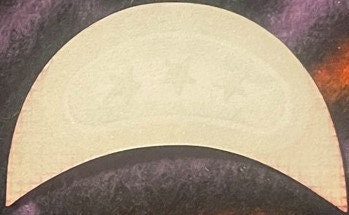
Each label is a die-cut paper crescent measuring 2 1/4 x 1 1/4 inches. On the face, a kidney-shaped border of gold with a fine, glittering grain frames a cream-and-gray oval traced by a thin dark keyline. Three gold stars, each outlined in dark ink, sit in a row across the oval. Behind the gold, a band of red crosshatching flares out to the two lower points, and the bottom edge is cut in a concave sweep so the label follows the round of a bottle's shoulder.

The design is embossed, pressed up into the paper. One of the two labels is photographed turned over, and its plain cream back shows the outline of the oval and the stars coming through from the front. Neither label carries a printed name, maker, town or date.

Three Stars and an Office Window in Cognac

Three stars were a grade before they were an ornament. Richard Hennessy was an Irish officer who had served in the French army under Louis XV, and in 1765 he founded the cognac house that still bears his name. A hundred years later, in 1865, his great-grandson Maurice Hennessy created a classification for the cognacs of the family house, giving each quality its number of stars. The story told at Hennessy is that he took the idea from a star engraved on his office window. Martell took up the system, Otard followed, and the star became the trade's shorthand for quality.

For a while the stars held a real meaning. In 1868 a three-star Hennessy was ten years old; by 1906, when the firm advertised what its stars stood for, three meant at least twelve years, two meant nine and one meant six. Nothing in law held those numbers in place. By the middle of the twentieth century three stars signified about six years, and by the 1970s the grade had been retired in favor of VS, "Very Special." The VS on a cognac bottle today is the legacy of that engraved star.

On this pair the stars are the whole message. A collar with nothing on it but three stars could sit on any merchant's bottle.

A Label With No Name: the Passe-Partout Trade

French printers sold ready-made designs that the trade called passe-partout labels, often an oval medallion inside an ornamental border, which a merchant bought and finished with the name of his own wine, by hand or by overprinting. Printers kept pattern books of borders, frames and ornaments that could be combined in any order, and those books stayed in use from the eighteenth century into the 1930s. They are how a small bottler put a label on the shelf that looked as fine as a château's without paying an artist for an original design.

The Bordeaux Press Behind the Printed Wine Label

French label history credits one man with making the printed wine label commonplace. Cyprien Gaulon, a writing master, set up in Bordeaux in 1815 and took out a patent as a lithographic printer in 1818. His idea was to replace the small handwritten slips glued to bottles with printed labels. In November and December of 1825 he was the master printer at Goya's side, pulling the edition of 100 prints of The Bulls of Bordeaux while the painter lived out his exile in the city.

Gaulon died in Bordeaux in January 1858. His widow carried the press on with the help of her daughter and her son-in-law, Michel Wetterwald, a lithographer born in Guebwiller in Alsace in 1825, whose name the house took. As Imprimerie Wetterwald Frères it was still selling stock labels more than a century after Gaulon opened his doors: its 1937 catalog, Modèles pour vins, offered 456 numbered designs, with blank ornamental borders left open for a merchant's overprint.

French or Belgian: the Northern Road for French Wine

These labels are French or Belgian, and the two answers sit closer together than they sound. After the English, it was the Dutch and the Belgians who built a market for Bordeaux outside France. Belgian buyers dealt through the merchants of Libourne, the river port on the Dordogne, many of them families who had come from the Corrèze; the Moueix family of Pétrus is one, and it still releases its wines in Belgium before any other market. The wines of Pomerol and Saint-Émilion were popular in Belgium long before they caught on in London.

Belgian merchants bottled fine Bordeaux under their own names, and the merchant bottlings of Vandermeulen are still sought by collectors. One Belgian family went further. The Thienponts of Etikhove, in the Flemish Ardennes, had been wine merchants since Camille Thienpont opened his business in 1842. In the spring of 1924 Georges Thienpont and his wife Josephine bought Vieux Château Certan in Pomerol, and the estate is in Thienpont hands still. The story goes that Georges gave his bottles a pink capsule so he could spot his own wine in a client's cellar without having to ask.

Why Unused Collars Survive

Once a collar was glued to a bottle, its fate was the bottle's: soaked off, scraped away, or thrown out with the glass. The ones that last are the ones that were never needed. These two sat out the decades flat, and the gold is still bright and the stars still sharp.

Questions People Ask

What is a crescent-shaped wine label for?

It is a collar, or collerette: the curved label at the top of the bottle where the shoulder meets the neck, above the main label. Its concave lower edge is cut to follow the curve of the glass.

Are these two different labels?

No. They are two of the same design. One is shown face up; the other is shown from the back, so you can see the plain cream reverse with the embossing coming through.

How big are they?

Each is 2 1/4 inches across and 1 1/4 inches high.

Were they ever used?

No. They are new old stock and have never been applied to a bottle.

What do the three stars mean?

Stars were a grade. Hennessy introduced star classification for cognac in 1865, Martell and Otard adopted it, and three stars became the best-known grade mark in the trade until VS replaced it in the 1970s.

Are they French or Belgian?

One or the other. Belgium was one of the great northern markets for French wine, and Belgian merchants bottled wine under their own labels, so a collar like this could come from either side of the border.

How old are they?

They date from the early 1900s to the 1930s.

How should I display them?

Flat and out of direct sun. A shallow frame with a mat lets the gold catch light from the side, and setting the two side by side, one face up and one face down, shows the design and the embossing together.

Shipping

🚚 Shipping & Handling

  • Shipping costs and timing are calculated at checkout.
  • Items curated and shipped directly by me include U.S. shipping at no additional cost, professionally packed to ensure safe arrival of your artifact.

Items from Vetted Pro Collectors
Shipping for items offered by vetted Pro Collectors is determined at checkout. All Pro Collector listings are reviewed to ensure fair, reasonable shipping practices.

For full details, please refer to our Shipping Policy.

Returns & Exchange

Take your time — you've got a full six months. If a piece isn't right for you, send it back the way it reached you and we're good.

In the first 30 days your money goes straight back the way you paid. After that it's store credit, so you can put it toward something you'd rather have.

Return shipping we sort out between us, case by case. I don't make this difficult.

If something arrives damaged, or it isn't what I said it was, send me a photo within 48 hours and I'll make it right.

Email info@vintageantiquesgifts.com or call 802-356-9872 — that's me answering, not a call center.

The only things I can't take back are custom or special-order pieces and gift cards.

View full details

Preserving History: Authentic Objects Across Eras

— Curated by Travis Weigel