Skip to product information
1 of 5

Vintage and Antique Gifts

Antique American Brilliant Cut Glass Creamer 📌 Pinwheel & Hobstar, Unsigned ABP, Choice of Two Silhouettes c 1900-1915

Antique American Brilliant Cut Glass Creamer 📌 Pinwheel & Hobstar, Unsigned ABP, Choice of Two Silhouettes c 1900-1915

Regular price 35.00 USD
Regular price Sale price 35.00 USD
Sale Sold out
Shipping calculated at checkout.
Size
Quantity

✨ Two Silhouettes, One Golden Age of American Glass

This listing offers a genuine survivor of the American Brilliant Period of cut glass — and it lets you choose the exact shape you want. Two unsigned brilliant-cut creamers are on offer here, cut in the same dazzling family of patterns but in two subtly different silhouettes: one that stands a touch taller and more upright, and one that sits a little wider and lower, the shape we simply call the fatter of the pair. You pick the one that speaks to you. Each is a single, individual creamer sold on its own, and there is only one of each, so the silhouette you select is the specific piece that comes home to you.

They are close cousins rather than identical twins. Both throw light the way only deeply hand-cut glass can, both wear the sawtooth rim and notched handle of the period, and both are unsigned — honest, anonymous work from the great age of American cutting. But look closely and they part company in the details, right down to the star cut into the bottom of each one. Everything below describes what the photographs actually show, with no invented maker, no invented pattern name, and no story the glass cannot back up itself.


🏛️ What "American Brilliant" Actually Means

For roughly forty years — opening with the 1876 Philadelphia Centennial Exposition and running until the First World War — the United States made some of the most extravagantly cut glass the world had ever seen. It is remembered now as the American Brilliant Period, and pieces like these two creamers sit squarely at its height, around 1900 to 1915. It was a moment when American glasshouses set out to beat the finest European crystal at its own game, and for a few remarkable decades they did.

The recipe was simple to state and punishing to execute: pour a thick, heavy blank of high-lead glass, then cut it so deeply and so precisely that every facet became a tiny prism. Lead glass is soft enough to cut and brilliant enough to fire the light back in rainbows, and a good cutter used both qualities without mercy — covering nearly the whole surface in miter cuts, stars and crosshatched fields until the object stopped looking like a vessel and started looking like frozen light. That is exactly what you see when either of these creamers catches a lamp: not decoration applied to glass, but glass turned entirely into ornament.


🔨 Cut Entirely by Hand, on a Turning Wheel

There is no shortcut hidden anywhere in a piece like this. Each creamer began as a heavy pressed or blown blank, and every line you can see was ground into it by hand against a spinning wheel fed with wet abrasive. The cutter held the glass up to a rotating stone or iron wheel and pushed the blank into it, judging the depth, the angle and the spacing of each cut by eye and by feel, then rough-cut, smoothed and finally polished the whole surface until the frosted grooves came clear and bright.

That is why the subtle differences between these two creamers are not defects but fingerprints. No two blanks were identical, no two cutters worked exactly alike, and no piece was ever truly repeated. The slight variance in proportion between the taller and the fatter creamer, the small differences in how the pinwheels sweep and where the stars land — all of it is the honest signature of work done by a human hand, over and over, against a wheel, a very long time ago.


🌀 Reading the Cutting: Pinwheels, Hobstars and Crosshatch

Both creamers are cut in the classic brilliant vocabulary, and once you learn to read it the surface comes alive. The dominant motif is the pinwheel, sometimes called a buzzsaw — a whirling star whose feathery, finely notched blades sweep out from a small center as if caught mid-spin. Set among the pinwheels are hobstars: many-pointed cut stars with a faceted hobnail heart, the signature flourish of American Brilliant glass. Between the large motifs, the cutter filled the leftover spaces with tidy triangular panels of fine crosshatching — a dense diamond mesh that catches light in a different, softer register and throws the bold cuts into relief.

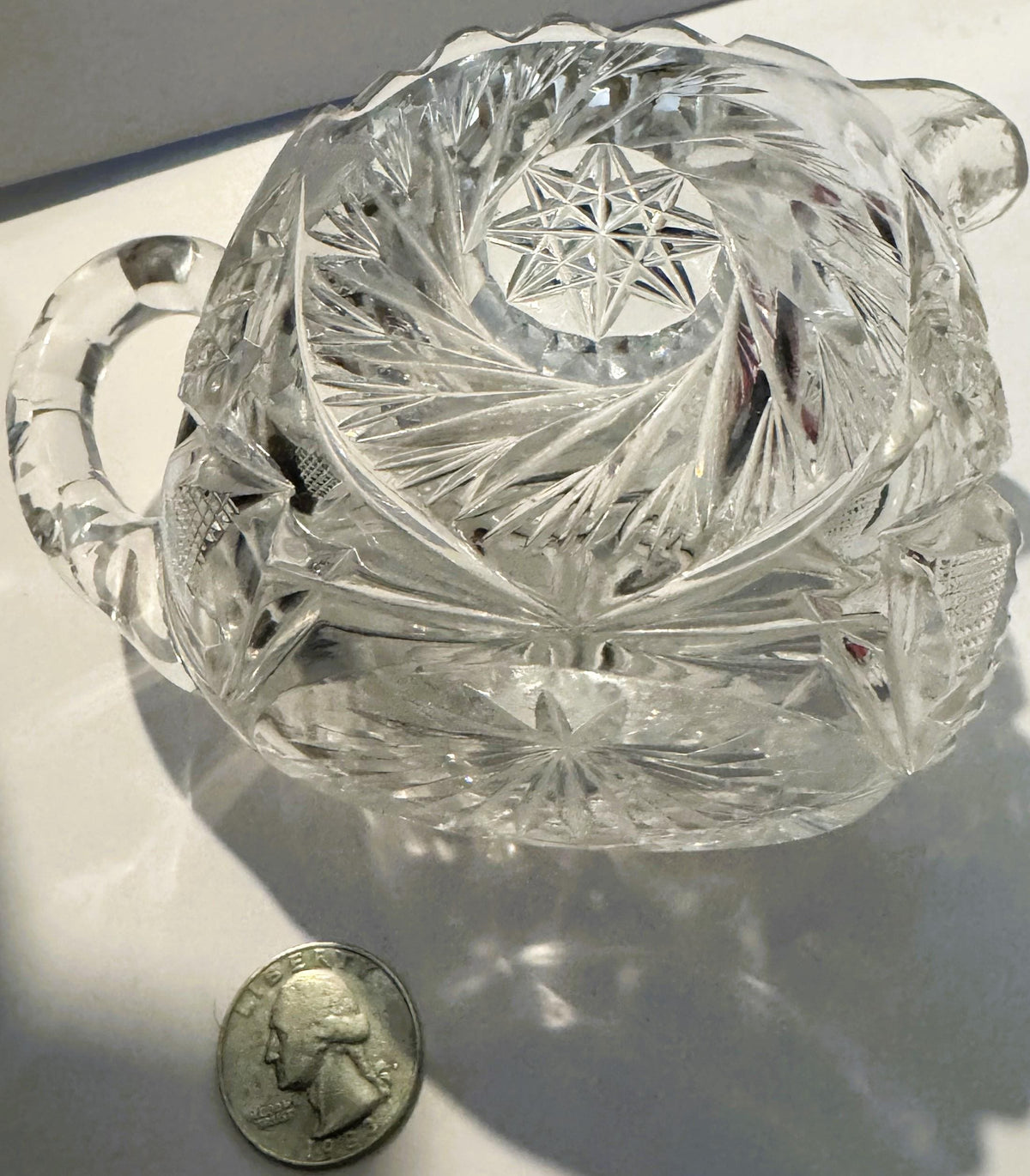
The details carry the same care all the way to the edges. The rim of each creamer is finished as a sawtooth border, a continuous ring of sharp serrations cut right into the lip. The loop handle is notched and faceted rather than left plain, so it sparkles along with the body. There is a pinched pouring spout at the front. And when you look straight down into either creamer, the base is finished with its own cut star radiating across the bottom — the last hidden flourish, meant to flash when the piece was lifted or when light passed through it.


📏 The Choice: Taller or Fatter

Here is the practical heart of the listing — the two shapes, and how to tell them apart, so you can choose with confidence.

  • 🔹 The Taller creamer stands a little more upright and reads as the trimmer of the two: roughly 4½ inches wide including the handle, about 3 inches across the body without it, and about 3 inches tall.
  • 🔸 The Fatter creamer sits lower and broader, with a fuller, more generous body: roughly 5½ inches wide including the handle, about 3½ inches across the body without it, and about 2½ inches tall.

So the two are genuinely different pieces, not two photos of one creamer: the silhouettes differ, and so does the star cut into each base — one bottom is finished with a single many-rayed radiant star, the other with a crisp eight-point hobstar, as the two overhead photographs show. Both are handsome; neither is "better." One simply stands a bit taller and slimmer, the other a bit wider and lower. Choose the proportion you prefer, and that specific creamer — the very one in the photographs — is what you will receive.


🖊️ Unsigned — and Why That's Simply Honest

Neither creamer carries a maker's mark. Some of the celebrated cutting houses of the American Brilliant Period acid-stamped their glass with a tiny signature, and the most famous names of the era — the great shops whose work now anchors museum cases — are part of the world these creamers come from. But these two pieces are unsigned, and we will not borrow a name they do not wear. We attribute them to no maker. What we can tell you is what the glass shows on its own terms: American, brilliant-cut, of the period, and unmistakably hand-worked.

That honesty is worth stating plainly, because unsigned brilliant glass is judged on the only thing that never lies — the quality of the cutting itself. And on that measure these creamers stand on their own feet: deep, confident miters, well-swept pinwheels, clean hobstars, and crisp sawtooth rims. You are buying the cutting and the age, exactly as pictured, with no pedigree invented to inflate them.


🔍 An Honest Look at Condition

We would always rather tell you exactly what you are getting than let a photograph flatter it, so here is the plain state of both creamers, read from the same pictures you can see.

These are genuine, used antiques of well over a century, and they show it honestly. Expect the light interior cloudiness and faint surface haze that a lifetime of use leaves on old glass, and the gentle softening of a few of the sharpest cut points that ordinary handling brings. Across the photographs the bodies read as sound and complete — the sawtooth rims, the notched handles and the pouring spouts all present — with no cracks or losses jumping out. As with any antique cut glass, the sharp sawtooth rim and the spout are the places to study most closely, so please do zoom in on the close-up images and let them be your guide; each creamer is offered exactly as pictured, with nothing added and nothing hidden. A US quarter appears beside the glass in several photographs so you can judge the true scale for yourself directly from the images.


🥂 How to Live With It Now

A brilliant-cut creamer no longer has to serve cream to earn its place. Its second life is as a small, light-catching object with real history in it, and it slips into a modern room in more ways than one.

  • 🌿 Use it exactly as intended — fresh cream at a special breakfast or tea, alongside a matching sugar if you have one, where the cut glass does its old job beautifully.
  • 🌸 Let it be a tiny vase for a few short stems, snips of herbs or a single bloom on a windowsill, where light through the cutting is the whole point.
  • 🪥 Set it on a shelf, vanity or desk as a small catch-all for rings, matches, paper clips, toothpicks or cotton swabs — useful, pretty and endlessly picked up.
  • ✨ Or simply display it as the little sculpture of frozen light it is, where a lamp or a shaft of sun can set the pinwheels and hobstars flashing.

Whichever silhouette you choose, it does the same quiet magic: it takes ordinary daylight and gives it back in sparks.


🎁 Who This Is For

This will mean the most to a few different kinds of people. There is the collector of American Brilliant cut glass, who reads pinwheels, hobstars and a sawtooth rim at a glance and enjoys a good honest unsigned example for what the cutting alone is worth. There is the lover of antique tablewares who wants a real creamer with real age at a welcoming size rather than a modern reproduction. There is the person building a mismatched, magpie collection of small cut-glass pieces, for whom another well-cut creamer is exactly the right kind of find. And there is the gift-giver hunting something with genuine history and sparkle to it. For any of them the choice of silhouette is a small gift in itself — taller or fatter, whichever suits the shelf, the hand or the eye.


❓ Questions Worth Answering

Am I buying one creamer or both?

One. This listing offers a choice of two individual creamers — a taller silhouette and a fatter one — and you select the single piece you want. There is one of each; it is not a pair sold together or a matched set.

What is the difference between the taller and the fatter one?

Proportion, mainly. The taller creamer stands more upright and trim (about 3 inches tall, roughly 4½ inches wide with the handle); the fatter one is broader and lower (about 2½ inches tall, roughly 5½ inches wide with the handle). The two also differ in the star cut into their bases — one a single radiant star, the other an eight-point hobstar — as the overhead photos show.

Is it signed, and who made it?

It is unsigned, and we name no maker. It is genuine American Brilliant-period cut glass, but it carries no acid stamp, so we attribute it to no cutting house and let the quality of the cutting speak for itself.

Is it really cut glass, and really that old?

The deep miter cuts, the pinwheels and hobstars, the crosshatched fields and the sawtooth rim are all consistent with genuine American Brilliant-period hand cutting, c. 1900–1915. Everything stated here comes from the photographs; we invent nothing.

What condition is it in?

Honest and used, exactly as pictured: light interior cloud and surface haze, softening of a few sharp points, no cracks or losses obvious in the images. Please study the close-ups of the sawtooth rim and spout and buy from what you see.

How big is it?

Small — a true creamer, not a pitcher. A US quarter is included in several photographs so you can gauge the exact scale from the images. See the measurements above for each silhouette.


💎 Why It Matters

Some objects are collected because they are rare; these are worth having because they are real — and because you get to choose. Each is a genuine survivor of the American Brilliant Period, hand-cut against a wheel in the golden age of American glass, covered in pinwheels and hobstars and crosshatch and finished with a sawtooth rim, unsigned and honest and asking to be judged on its cutting alone. Pick the taller silhouette or the fatter one, and you are not buying a picture of that vanished age of craftsmanship. You are keeping a small, brilliant piece of it, and setting it where the light can find it again.

🔎 More From The Vintage & Antique Gifts Archive

Shipping

🚚 Shipping & Handling

  • Shipping costs and timing are calculated at checkout.
  • Items curated and shipped directly by me include U.S. shipping at no additional cost, professionally packed to ensure safe arrival of your artifact.

Items from Vetted Pro Collectors
Shipping for items offered by vetted Pro Collectors is determined at checkout. All Pro Collector listings are reviewed to ensure fair, reasonable shipping practices.

For full details, please refer to our Shipping Policy.

Returns & Exchange

Take your time — you've got a full six months. If a piece isn't right for you, send it back the way it reached you and we're good.

In the first 30 days your money goes straight back the way you paid. After that it's store credit, so you can put it toward something you'd rather have.

Return shipping we sort out between us, case by case. I don't make this difficult.

If something arrives damaged, or it isn't what I said it was, send me a photo within 48 hours and I'll make it right.

Email info@vintageantiquesgifts.com or call 802-356-9872 — that's me answering, not a call center.

The only things I can't take back are custom or special-order pieces and gift cards.

View full details