Skip to product information
1 of 9

Vintage and Antique Gifts

Antique 1885 West Shore Railroad $1,000 Gold Bond 🛤️ Certificate with Coupons, Vanderbilt Railway History

Antique 1885 West Shore Railroad $1,000 Gold Bond 🛤️ Certificate with Coupons, Vanderbilt Railway History

Regular price 24.00 USD
Regular price Sale price 24.00 USD
Sale Sold out
Shipping calculated at checkout.
Style
Quantity

What Does a Peace Treaty Between Two Railroad Empires Look Like? 🚂

It looks like this — a hand-engraved sheet of green-inked paper, thick with allegorical figures and locomotive vignettes, promising to pay a thousand dollars in gold more than four centuries from now. Hold one of these bonds and you're holding the paper residue of one of the most audacious — and briefly ruinous — corporate wars of the American Gilded Age. This wasn't a bond issued in quiet confidence. It was issued in the middle of a fight, and it survived to tell you about it.

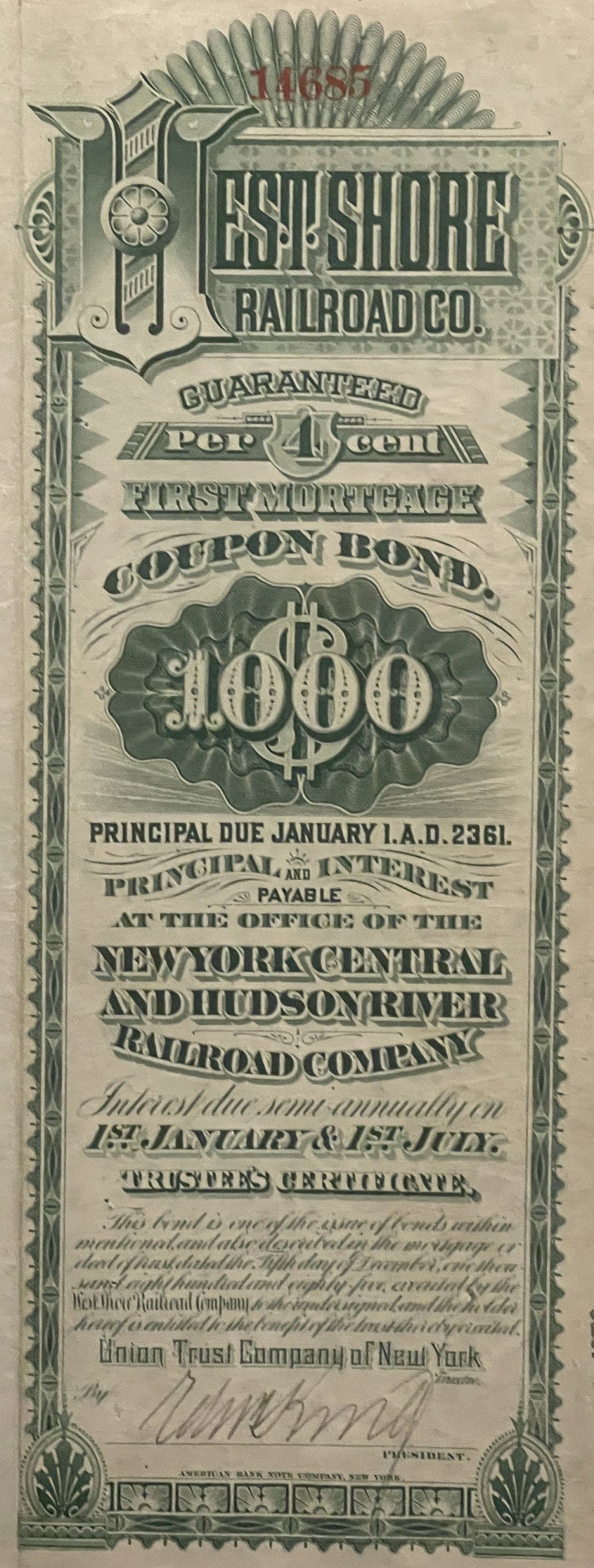
This is an antique 1885 West Shore Railroad Company "First Mortgage Guaranteed Bond," a $1,000 gold coupon bond from the era when American railroads financed their steel and steam with paper like this — part of a total issue limited to $50,000,000, as the certificate itself states. It was engraved and printed by the American Bank Note Company of New York, the same firm entrusted with the security-grade engraving techniques used on U.S. currency, and it shows. The top of the certificate carries a full Gilded Age tableau: a crowned, winged allegorical figure — Liberty or Columbia — rising from a shield bearing the American eagle, flanked by cherubs at their studies, all beneath a banner reading "United States of America." Below that sits a detailed panoramic vignette of the Hudson River itself — steamboats, a paddle-wheeler, a sailing sloop, and a train hugging a rocky, tree-covered shoreline beneath distant highland mountains, exactly the river valley this railroad was built to run alongside. The "West Shore Railroad Company" title is set in bold Victorian lettering over a wheel-and-foliage emblem, and the body of the bond is dense with the formal legal language of 19th-century finance — a promise, in copperplate script, "to pay to the Union Trust Company of New York, or bearer, One Thousand Dollars." A second, separate vignette elsewhere on the certificate shows a steam locomotive at a dock, cowcatcher forward, smoke pouring from its stack, a fireman loading baggage while a steamship waits in the background — commerce and travel, rail and river, side by side. Attached along the top of the full certificate is a sheet of small interest coupons, each engraved for twenty dollars in gold, each bearing its own tiny locomotive and steamboat medallions, meant to be clipped twice a year and presented for payment. This piece is offered as a genuine period example of Gilded Age railroad finance — the engraving, the issuer, and the history behind it are the story here.


🛤️ A Railroad Built to Start a War

The West Shore Railroad — formally organized in the early 1880s as the New York, West Shore and Buffalo Railway before reorganizing under the West Shore Railroad Company name — was never really built to make money on its own. It was built to threaten someone else's money. Its route ran up the west bank of the Hudson River from Weehawken, New Jersey (directly across the river from Manhattan) all the way to Buffalo, tracing almost the exact same corridor already held, jealously and profitably, by William Henry Vanderbilt's New York Central and Hudson River Railroad on the opposite shore. Financiers with grudges against the Vanderbilt rail monopoly — some of them believed to be acting as proxies for the Pennsylvania Railroad — poured capital into the West Shore specifically to give Vanderbilt a rival he couldn't ignore.

It worked, in the sense that it terrified him. It failed, in the sense that it very nearly bankrupted everyone involved. Two full railroads running parallel tracks up the same river valley meant a ruinous rate war almost from the moment the West Shore opened for business in 1883after 1883. Freight and passenger rates on both lines collapsed as each side tried to starve the other out. The West Shore, newer and less capitalized, went into receivership within roughly a year of completion — a spectacular, headline-making collapse for a railroad that had cost tens of millions of dollars to build.


⚓ The Yacht That Ended the War

The story collectors and rail historians still tell about how this fight ended is one of the great set-pieces of Gilded Age business lore: J. Pierpont Morgan, the era's great fixer of broken corporations, invited William Henry Vanderbilt and the financiers behind the West Shore aboard his private yacht, the Corsair, for a cruise up the very river the two railroads had been savaging each other along. Away from lawyers, away from the press, on the water that both companies had built their track beside, Morgan brokered what's remembered among collectors as the "Corsair Agreement" — the New York Central would lease the bankrupt West Shore line, absorb its operations, and end the rate war for good, while the West Shore's bondholders would be protected by a New York Central guarantee on the debt.

That guarantee is written right into the name printed at the top of this bond — "Guaranteed 4 per cent First Mortgage Coupon Bond" — and it's the whole reason paper like this survived to be collected today instead of vanishing into a forgotten bankruptcy file. The very railroad this bond was raised to fight ended up standing behind its repayment.


📜 A Bond Built to Outlive Everyone Who Signed It

Look closely at the fine print and you'll find one of the strangest, most collector-delighting details on the whole certificate: the principal is due "January 1, A.D. 2361." Not 1961. Not even 2061. Twenty-three sixty-one — a maturity date set nearly five centuries beyond the bond's December 1885 issue. This wasn't a printing error or a novelty; it reflects the extraordinary length of the lease arrangement that ended the West Shore war, a lease stretching so far into the future that the bond's own drafters simply wrote out a date almost no one reading it could seriously imagine reaching. Interest was set at 4 percent per annum, payable every January 1st and July 1st at the office of the New York Central and Hudson River Railroad Company in New York City — which is exactly why the coupon sheet attached to certificates in this series is so unusual to hold today. Flip through it and you'll find individual twenty-dollar gold coupons dated for payment dates that, from an 1885 vantage point, sat generations away — a physical, foldable timeline of a debt instrument that its issuers genuinely expected to keep paying out for centuries.


🎩 The Men Behind the Rivalry

Two names loom large over this corner of railroad history. On the West Shore side stood General Horace Porter — a decorated Civil War officer, former aide-de-camp to Ulysses S. Grant, and later a prominent businessman and diplomat — who lent the struggling line his considerable public stature as it fought for survival. On the New York Central side stood Chauncey Depew, the railroad's famed president and legal counsel, an orator so celebrated in his day that he later parlayed his railroad fame into a seat in the United States Senate. Depew and the Vanderbilts were also, at the very same moment, locked in a separate rivalry over luxury railcars — the Pullman Company versus the Vanderbilt-backed Wagner Palace Car Company — a reminder that the Gilded Age's great business feuds rarely stayed confined to just one battlefield.


🏞️ The River the Bond Was Built to Follow

The Hudson River panorama engraved across the top of this certificate isn't generic scenery — it's a advertisement for the route itself, the highlands, river traffic, and shoreline the West Shore's rails actually hugged from Weehawken north through the river towns and up into the Mohawk Valley toward Buffalo. Old-timers along the Albany County stretch of the line — in and around communities like Guilderland and Altamont, where local newspapers once chronicled the railroad's construction crews cutting through the countryside — still pass down stories of the grading gangs, the tunnel work, and the sudden arrival of a second competing railroad through towns that had, until then, known only one. The Weehawken terminal itself required a serious feat of period engineering — a tunnel bored through the Palisades to bring the line down to the riverfront — a detail preserved today in historic engineering surveys of the site.


💰 Why This Kind of Paper Survives at All

Railroad bonds and stock certificates from this era were working financial instruments, not keepsakes — issued, mortgaged, pledged, redeemed, and very often destroyed once their purpose was served. A certificate engraved with this much artistry, carrying its coupon sheet, tied to a corporate drama as colorful as the West Shore–New York Central rate war, is exactly the kind of piece the field of scripophily — the collecting of historic stocks and bonds — was built around. It's a genuine, tangible artifact of how 19th-century America actually financed its railroads: through elaborate engraved promises, backed by mortgages on tracks and rolling stock, guaranteed by rival corporations forced into an uneasy peace, and clipped, coupon by coupon, twice a year at a bank counter in Manhattan.


📜 The Coupon Sheet, and What the Marks Mean

A bond that still has its coupon sheet is the complete instrument rather than the pretty half of it. Most surviving railroad bonds were stripped of their coupons decade by decade, one clipping at a time, until only the certificate was left, so a sheet that came through that attrition is a survivor of a century of small subtractions. The coupon count can be a few more or a few fewer than pictured. When a road went under, holders very often taped the last clipped coupon back onto the sheet and put the bond away, still hoping to collect what they were owed — families had been living on those payments, and a bond that still carries that taped-back coupon is the better one to end up with.

Stock and bond certificates carry financial writings, markings, stamps, hole punches and staples as part of the life of the instrument. Endorsements and signatures, transfer-agent and registrar stamps, revenue or documentary tax stamps, punch or cut cancellations applied at redemption, staple holes from being bound into a transfer book, pencil ledger notations — that is the paper trail of a working financial instrument, not a list of flaws. A clipped coupon run is a positive: it is the proof that the bond paid its holder, year after year, before the road failed.

These are held as a group, and no two are alike. Serial numbers, the exact run of coupon dates, the placement and pattern of punch cancellations and stamps, a clerk's pencil marks, the folds and toning of decades in a bank file — all of it changes from one example to the next. Treat the photographs as an example of the type rather than a portrait of one specific sheet. What ships is its own document, individuated by a century of handling that happened to it and to nothing else. That is the appeal of the class, not a caveat.

🖼️ Display Ideas

  • 🖋️ Framed flat under glass to show off the full Hudson River vignette and the coupon sheet together
  • 📚 Displayed in a home library or study alongside other Gilded Age railroad and finance ephemera
  • 🏛️ Paired with a period map of the Hudson River rail corridor for a small railroad-history vignette
  • 🎓 Used as a genuine teaching artifact for lessons on 19th-century American railroad expansion and finance
  • 🚂 A centerpiece for a train-collector's office wall, alongside model locomotives or vintage rail memorabilia
  • 🎁 Given as a conversation-starting gift for a history buff, financier, or railroad enthusiast

🎁 Who Collects These

Scripophily collectors — those who preserve historic stock and bond certificates as artifacts in their own right — seek out pieces exactly like this one, where the artwork, the issuer, and the underlying corporate story are all equally compelling. Railroad historians and Hudson Valley history buffs prize it for its direct tie to one of the era's most famous corporate rivalries. Collectors of American Bank Note Company engraving work value it for the sheer craftsmanship of the printing. And gift-givers looking for something with genuine historical weight — for a father, a financier, a train enthusiast, or anyone drawn to the Gilded Age — find it a piece that rewards a closer look every time it's taken off the wall.


❓ FAQ

What exactly is a "gold bond" from this era?

A gold bond was a corporate debt instrument that promised repayment of both principal and interest specifically in gold coin, rather than paper currency — a common feature of major railroad financing in the late 19th century, when investors wanted protection against currency fluctuation.

Why does the certificate list a maturity date centuries in the future?

The January 1, A.D. 2361 principal due date reflects the extraordinarily long lease arrangement that settled the rate war between the West Shore Railroad and the New York Central — one of the more remarkable curiosities in American railroad finance.

Who printed this certificate?

The American Bank Note Company of New York, the premier security-engraving firm of the era, whose name appears on the certificate itself and whose techniques were closely related to those used in printing U.S. currency of the period.

Is this bond connected to J.P. Morgan?

Yes — the West Shore Railroad's financial rescue and its guarantee by the New York Central are directly tied to the famous "Corsair Agreement," brokered by J.P. Morgan aboard his yacht of the same name, which ended the destructive rate war between the two railroads.

What route did the West Shore Railroad actually run?

It ran up the west bank of the Hudson River from Weehawken, New Jersey, opposite Manhattan, north through the river valley and on into the Mohawk Valley toward Buffalo — a direct competing route to the New York Central's line on the river's east shore.

Does the coupon sheet have any significance beyond decoration?

Yes — the attached coupons represent the actual semi-annual interest payments investors would have clipped and redeemed at a New York bank, a routine but now largely vanished mechanic of 19th-century bond finance.

Is this a good piece for someone who isn't already a railroad collector?

Absolutely — its combination of fine Gilded Age engraving, a genuinely dramatic corporate history, and ties to figures like J.P. Morgan and Chauncey Depew make it accessible and compelling to general history and Americana collectors, not just railroad specialists.

Shipping

🚚 Shipping & Handling

  • Shipping costs and timing are calculated at checkout.
  • Items curated and shipped directly by me include U.S. shipping at no additional cost, professionally packed to ensure safe arrival of your artifact.

Items from Vetted Pro Collectors
Shipping for items offered by vetted Pro Collectors is determined at checkout. All Pro Collector listings are reviewed to ensure fair, reasonable shipping practices.

For full details, please refer to our Shipping Policy.

Returns & Exchange

Take your time — you've got a full six months. If a piece isn't right for you, send it back the way it reached you and we're good.

In the first 30 days your money goes straight back the way you paid. After that it's store credit, so you can put it toward something you'd rather have.

Return shipping we sort out between us, case by case. I don't make this difficult.

If something arrives damaged, or it isn't what I said it was, send me a photo within 48 hours and I'll make it right.

Email info@vintageantiquesgifts.com or call 802-356-9872 — that's me answering, not a call center.

The only things I can't take back are custom or special-order pieces and gift cards.

View full details
  • 5 stars: 6 (100%)
  • 4 stars: 0 (0%)
  • 3 stars: 0 (0%)
  • 2 stars: 0 (0%)
  • 1 star: 0 (0%)
6
6***6 (181)

Arrived in good condition thank you

V
Velma Jonez
Highly recommended!

Travis brings the highest quality of e-he era with the greatest expertise and professionalism to the game. Literally. Always. It is such a joy to purchase from vintage antiques. Thank you so much for everything!!

Hello Velma! We're popping the champagne at Vintage and Antique Gifts to celebrate your glowing 5-star review! Your kind words about our vintage railroad certificate give us a renewed drive on this journey. Your ongoing support has us whistling a cheerful tune! ✨ We're thrilled to keep bringing you the joys of antiquing!

M
Mark Matyas
Excellent!

The seller was prompt, courteous and responsive, answering all my questions.
Items were exactly as advertised, well packed and it arrived in excellent condition. I have made a purchase once before and I am equally as pleased with what I received today — so I would / will definitely buy from this seller again. Exceptional Customer Service ! The children’s touch also brightened my day :) Thank you

M
Monte Swain (Denver, US)
Fantastic!

What a great business you're running! These certificates are in excellent shape. A 400-year junk bond from a classic R&R for this price. Fantastic! I shopped around afterwards to compare prices on this same product. You're way below. Thanks for a terrific transaction. Tell the kids hello for me!

L
Laura

We got these quickly, they were carefully packaged, and, the SWEETEST letter ever, included. Very happy with this purchase, which was a gift, that made the giftee VERY happy. thank you!

E
Edwin A Skorski Jr (New York, US)
Highly recommended!

Really nice certificates. Fast shipping.could not have been better Thanks.....Ed