Skip to product information
1 of 8

Vintage and Antique Gifts

Antique 1920 Panhandle Route Railroad 1000 Dollar Gold Bond Pittsburgh Cincinnati Chicago St Louis Finance 📜

Antique 1920 Panhandle Route Railroad 1000 Dollar Gold Bond Pittsburgh Cincinnati Chicago St Louis Finance 📜

Regular price 18.95 USD
Regular price Sale price 18.95 USD
Sale Sold out
Shipping calculated at checkout.
Quantity

Size: 15 x 10 inches

🚂 What Did It Take to Bankroll an Iron Empire Stretching From Pittsburgh to St. Louis?

Picture Pittsburgh in the years just after the First World War — the sky stained orange from the steel mills, switch engines clanking in the rail yards at all hours, and somewhere in a paneled downtown office, a stack of freshly engraved bond certificates waiting for the ink of a company seal. This is one of those certificates — a $1,000 General Mortgage Gold Bond issued by the Pittsburgh, Cincinnati, Chicago and St. Louis Railroad Company, the storied line every old railroader simply called the Panhandle Route. It's not a reproduction and it's not a souvenir — it's a genuine piece of the paper machinery that once financed America's railroads, the kind of document that quietly moved millions of dollars between Pittsburgh boardrooms and New York banking houses while steam locomotives did the loud work up top.

It comes from the Pittsburgh, Cincinnati, Chicago and St. Louis Railroad Company — a Pennsylvania Railroad subsidiary headquartered in Pittsburgh, Pennsylvania — and belongs to this company's General Mortgage Five Per Cent Gold Bond, Series A, an issue whose printed terms carry the date of June 1, 1920 and a maturity of June 1, 1970, with interest payable each June 1st and December 1st at the company's office in Pittsburgh or its agency in New York City. Every certificate in this series was engraved and printed by the American Bank Note Company, whose name runs quietly along the bottom border the way it did on so much of America's serious paper — its currency, its railroad bonds, its Treasury notes. The design is a small museum in itself: an arched banner reading "UNITED STATES OF AMERICA" crowns a richly detailed steam-era vignette of a locomotive pulling into a rail yard, smoke rolling skyward while trackmen work the rails in the foreground, captioned with the very states this railroad served — Pennsylvania, Ohio, West Virginia, Indiana, and Illinois. Below it, the company's name unfurls in bold, shadowed 3-D lettering over the ornate "$1000" denomination, framed by fine geometric guilloche borderwork and decorative corner medallions of the kind that made bank-note engraving its own art form — dense enough that no forger of the era could hope to replicate it by hand. The lower panel carries the dense cursive legal language typical of early 20th-century railroad securities, the Trustee's Certificate naming the Union Trust Company of Pittsburgh, and the printed record of the bond's execution and its authorization under the Securities Commission of Illinois in June of 1920.


🛤️ The Panhandle Route: The Pennsylvania Railroad's Gateway West

"Panhandle Route" sounds almost like a nickname somebody dreamed up for a company letterhead, but it was real, working railroad slang, and it described real geography. The name came directly from the line's main stem, which left Pittsburgh, Pennsylvania, and cut straight through the narrow northern panhandle of West Virginia before continuing on to Bradford, Ohio — where the route split, one branch running north toward Chicago and the other running southwest through Indianapolis to East St. Louis, Illinois. Railroad men and the traveling public alike just started calling it the Panhandle, and the name stuck for the better part of a century.

The roots of the company reach back further than most people expect — all the way to 1848, when the Steubenville and Indiana Railroad was chartered in Ohio to push a line west from the Ohio River. That little railroad, along with several sister lines built in the same scramble of mid-19th-century track-laying, eventually found itself tangled in the financial troubles so common to early American railroading. In January of 1868, these struggling lines were consolidated under the banner of the Panhandle Railway Company, and it was around this reorganization that the Pennsylvania Railroad — already the dominant power east of Pittsburgh — moved in to secure its hold on the property. By September of 1890, further mergers with the Cincinnati & Richmond Railroad and the Jeffersonville, Madison & Indianapolis Railroad completed the picture, and the Pittsburgh, Cincinnati, Chicago and St. Louis Railroad Company was born — the name that would appear on certificates like this one for decades afterward.

Under Pennsylvania Railroad control, the Panhandle Route became the company's principal artery west of Pittsburgh, carrying both freight and passengers across four states and tying the industrial might of the Ohio Valley to the grain markets of the Midwest and the rail hub of Chicago. It was never a flashy, independently branded railroad the way some western lines were — it was infrastructure, the kind of steady, workhorse trunk line that made the Pennsylvania Railroad's boast as the "Standard Railroad of the World" possible in the first place.


🏙️ Pittsburgh: Steel, Steam, and the City Behind the Signature

Every line of this bond points back to Pittsburgh. The company's office, where principal and interest were payable, sat in that city; the Trustee named to safeguard the mortgage backing the bond — the Union Trust Company of Pittsburgh — was one of the city's great financial institutions of the era, the kind of bank whose name still marks a landmark office building in the city's downtown to this day. Pittsburgh in this period wasn't just a stop on the map — it was the beating industrial heart that made a railroad like the Panhandle Route necessary in the first place. Steel mills needed coal and ore moved in, finished rail and structural steel moved out, and it was trunk lines just like this one that made Pittsburgh the forge of American industry. A bond like this wasn't financing a rural branch line — it was financing the arteries of a city that was, at the time, one of the most productive industrial centers on earth.


💰 What a "General Mortgage Gold Bond" Actually Promised

To modern eyes, the fine print on a document like this can look like decoration, but it was serious financial machinery. A "general mortgage" bond meant the railroad had pledged its physical property — the rails, the rolling stock, the real estate — as collateral, administered by an independent trustee bank rather than the railroad itself, precisely so bondholders had recourse if the company ever faltered. The "gold bond" designation meant something very specific in 1920: it promised repayment in actual gold coin of the United States, a common and much-trusted feature of railroad securities in the era before the gold clause was set aside by federal action in the 1930s. Investors of the day sought these gold bonds out specifically because they offered a hedge against currency devaluation — a "gilt-edged" security in the truest sense of the phrase.

The five percent coupon, payable each June 1st and December 1st, was a steady, generous return for a conservative investor in that period — banks, insurance companies, trust funds, and individual savers all favored railroad bonds like this one as the bedrock of a portfolio. And the fifty-year span between the 1920 issue and the 1970 maturity reflects just how long-term railroad financing was expected to run — these companies were building for a century, not a decade, and their bondholders were asked to think the same way.


🌆 1920: A Railroad Reborn From Government Hands

The timing stamped into this bond's fine print lands at a genuinely pivotal moment in American railroad history. During the First World War, the federal government had taken direct control of the nation's railroads under the United States Railroad Administration, running them as a single coordinated system for the war effort. That federal control ended with the Transportation Act of 1920, which handed the railroads — including the Pennsylvania Railroad and its Panhandle Route subsidiary — back to private management and set new rules for how they could raise capital and set rates. A bond issue dated June of 1920 sits squarely in that moment of transition, part of the wave of private capital-raising that followed the railroads' return from government hands, as companies rushed to rebuild their finances and their equipment after years of wartime strain.


🖋️ The American Bank Note Company's Craft

The tiny imprint along the border of this certificate — American Bank Note Company — belongs to one of the most storied names in American security printing. For well over a century, this firm produced the engraved vignettes, guilloche borderwork, and micro-fine lettering found on American currency, postage stamps, stock certificates, and railroad bonds alike, all in the service of a single goal: making a document so intricate that no counterfeiter could reasonably reproduce it. The steam locomotive vignette gracing the top of this certificate, the shadowed lettering of the company's name, the lace-like floral border running along the bottom — every element was cut by hand into steel dies by engravers whose entire craft was devoted to trust, permanence, and beauty in equal measure. Collectors of financial ephemera prize American Bank Note Company work precisely because of this — the same engraving houses that made a five-dollar bill or a share of Pennsylvania Railroad stock look unforgeable are the ones who made a railroad bond feel as serious as the promise it carried.


👥 The People Who Signed the Promise

A bond like this passed through many hands before it ever reached an investor's strongbox — a company president or vice president whose office authorized the issue, a secretary or assistant secretary who attested to its execution, a treasurer whose facsimile signature appeared by engraving rather than pen, and finally the trustee bank's own officer, who countersigned to certify that this bond was indeed one of the instruments described in the underlying mortgage. It's easy to forget, looking at the ornate lettering and the formal legal boilerplate, that this was a document meant to be trusted by strangers — an insurance company actuary in Hartford, a private banker in New York, a widow's trust fund in Philadelphia — anyone weighing whether to lend a Pittsburgh railroad a thousand dollars for fifty years. Every signature and countersignature on this bond existed to answer that one question: can this be trusted? For decades, the answer for Pennsylvania Railroad paper was an emphatic yes.


🛤️ From Panhandle Rails to Rail-Trail: The Legacy Today

The Pennsylvania Railroad itself would go on to merge with the New York Central in 1968, forming the short-lived Penn Central, and much of its physical network — including stretches of the old Panhandle corridor — eventually passed through Conrail and into the hands of later freight operators, while other segments were abandoned outright. Today, a stretch of that old Panhandle right-of-way survives in a very different form: as the Panhandle Trail, a public rail-trail that lets modern walkers and cyclists trace part of the very route this bond once helped finance, out through the same Pennsylvania and West Virginia countryside the trains once rolled through. Local rail history buffs and trail walkers alike still point to it as a living reminder of just how much of the region's infrastructure was built on paper exactly like this — bonds, mortgages, and the quiet trust of investors who never once rode the trains their money paid for.


🖼️ Display Ideas

  • 🖋️ Framed alone on a library or study wall, letting the engraved locomotive vignette and the bold company lettering carry the whole composition
  • 🏛️ Grouped on a gallery wall with other railroad or industrial certificates for an Age of Steam display
  • 🎁 Given as a milestone gift to a railfan, historian, or finance collector who has the stock certificates but not the bonds

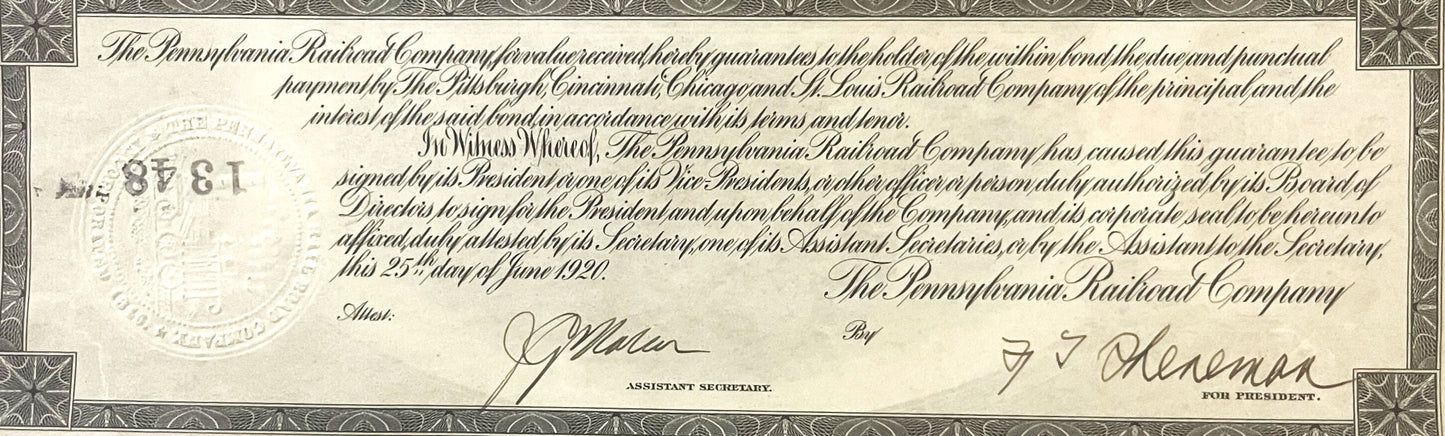
Condition, told straight: this bond was issued, executed in wet ink, guaranteed on its reverse by the Pennsylvania Railroad on June 25, 1920, and — when its work was done — formally cancelled with the red stamp you can see on its face. It lived out its financial life and was preserved rather than pulped. That working history, not an empty archive, is what you are holding. Each of these is an authentic, period-issued example, so the serial number and small hand-completed details vary from one certificate to the next; you will receive an original comparable to the one photographed.

An issued certificate picks up the marks of its working life: endorsements and signatures on the reverse, transfer-agent and registrar stamps, revenue or documentary tax stamps, punch or cut cancellations at redemption, staple holes from being bound into a transfer book, and pencil ledger notations. Those marks are the paper trail of a financial instrument that actually did its job.

Shipping

🚚 Shipping & Handling

  • Shipping costs and timing are calculated at checkout.
  • Items curated and shipped directly by me include U.S. shipping at no additional cost, professionally packed to ensure safe arrival of your artifact.

Items from Vetted Pro Collectors
Shipping for items offered by vetted Pro Collectors is determined at checkout. All Pro Collector listings are reviewed to ensure fair, reasonable shipping practices.

For full details, please refer to our Shipping Policy.

Returns & Exchange

Take your time — you've got a full six months. If a piece isn't right for you, send it back the way it reached you and we're good.

In the first 30 days your money goes straight back the way you paid. After that it's store credit, so you can put it toward something you'd rather have.

Return shipping we sort out between us, case by case. I don't make this difficult.

If something arrives damaged, or it isn't what I said it was, send me a photo within 48 hours and I'll make it right.

Email info@vintageantiquesgifts.com or call 802-356-9872 — that's me answering, not a call center.

The only things I can't take back are custom or special-order pieces and gift cards.

View full details