
Skip to product information
1 of 4

Vintage and Antique Gifts

Antique Embossed Cigar Band 🍂 1900s - 1920s Manila Stubs Collector Tobacco Label

Antique Embossed Cigar Band 🍂 1900s - 1920s Manila Stubs Collector Tobacco Label

Regular price $5.95 USD
Regular price Sale price $5.95 USD
Sale Sold out
Shipping calculated at checkout.

Size: 2 3/4" x 1/2"

🚚 Free US Shipping — ships within one business day. International shipping calculated at checkout.

Quantity

What Did a Manila Cigar Band Look Like? 🍂 Antique Embossed Gold Cigar Band, 1900s-1920s

Size: 2 3/4" x 1/2"

🎩 A little gold cigar band that never made it onto a cigar. It says MANILA on the front and MADE IN U.S.A. twice, and that little contradiction is the whole story of it.

🏷️ What's on it

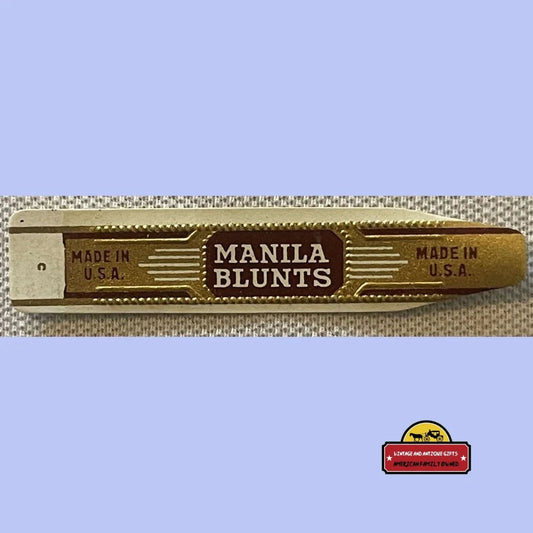
An antique embossed paper cigar band, 2 3/4" x 1/2", New Old Stock and never wrapped around a cigar. In the middle, MANILA STUBS in white on a deep burgundy-red panel ringed with raised gold dots. Gold fields run out to either side, edged top and bottom in red, with a few fine white lines running out from the center panel, and each one carries MADE IN U.S.A. in red. One end is cut square with a little slit, the other angled to a point, the way a band tucks around a cigar. Turn it over and the back is plain cream paper with the embossing pressed through. It's from the 1900s to the 1920s, the heyday of the embossed cigar band.

🌴 "Manila," made in the U.S.A.

After the Spanish-American War of 1898 the Philippines became an American possession, and "Manila" became a word with some real pull on a cigar. The Manila cigar already had a big reputation around the world by the late 1800s. A good Manila got talked about in the same breath as a Havana, and sometimes it cost more: in London in 1844, cheroots from the Philippines were selling for about 20% more than cigars from Havana. Rudyard Kipling even tucked "a mild Manila" into the cigar box in his poem "The Betrothed," right in with his Havanas. In 1881 the Spaniard Antonio López y López, the first Marquis of Comillas, founded the Compañía General de Tabacos de Filipinas, La Tabacalera, and in 1887 it opened La Flor de la Isabela, at the time the largest cigar factory in the world. The name means the Flower of Isabela, after the tobacco leaf that still grows way up in the Cagayan Valley of northern Luzon, where the friars found the crop did best, in a climate a lot like Cuba's Vuelta Abajo. Then in 1909 the Payne-Aldrich Tariff opened free trade between the Philippines and the United States, with limits on how much Philippine tobacco and how many cigars could come in duty-free. Manila cigars were in American shops, and plenty of American cigar makers borrowed the name.

That's where this band gets fun. Manila Stubs' own box label shows two men in Philippine dress standing in a tobacco field between palm trees, and then says MADE IN U.S.A. five separate times, with the price in a big red band: 2 for 5¢, Very Mild, 10 for 25¢. Same red and gold as this band. My read is that they wanted the romance of Manila and wanted you to know the cigar was American all the same, which is why even this skinny little band says it twice. And two for a nickel tells you who they were for: the working man's smoke, the stub you lit on your lunch break or on the porch after supper, dressed up in gold like a banker's cigar.

🔖 Cigar bands, then and now

American factories turned out billions of cigars a year in the first decades of the 1900s, and by then nearly every brand wore a band, printed in bright colors and gold and often embossed like this one, so it would catch the eye in the box. Kids collected them by the hundreds, trading them and pasting them into albums, and the hobby even has its own name, brandophily. The used ones got torn off and burned, so the ones that survive clean and flat like this are the ones nobody ever put on a cigar.

The story goes that some of the cleanest bands and labels that turn up today came out of the lithography shops themselves: that master pressmen kept a few perfect impressions of every job they printed, tucked away in a drawer or a portfolio the way a painter keeps his studies, because they knew the work was good. Nobody wrote that down, but it's the kind of story that follows these little pieces of paper around.

🖼️ Display

Great in a small shadow box with a matchbook or an old cigar box label, slipped into an album with other bands, or framed with the MADE IN U.S.A. facing out as a conversation piece. A fun little gift for anyone who likes cigars, tobacco history or a good bit of advertising.

Shipping

🚚 Shipping & Handling

  • Shipping costs and timing are calculated at checkout.
  • Items curated and shipped directly by me include U.S. shipping at no additional cost, professionally packed to ensure safe arrival of your artifact.

Items from Vetted Pro Collectors
Shipping for items offered by vetted Pro Collectors is determined at checkout. All Pro Collector listings are reviewed to ensure fair, reasonable shipping practices.

For full details, please refer to our Shipping Policy.

Returns & Exchange

Take your time — you've got a full six months. If a piece isn't right for you, send it back the way it reached you and we're good.

In the first 30 days your money goes straight back the way you paid. After that it's store credit, so you can put it toward something you'd rather have.

Return shipping we sort out between us, case by case. I don't make this difficult.

If something arrives damaged, or it isn't what I said it was, send me a photo within 48 hours and I'll make it right.

Email info@vintageantiquesgifts.com or call 802-356-9872 — that's me answering, not a call center.

The only things I can't take back are custom or special-order pieces and gift cards.

View full details

Preserving History: Authentic Objects Across Eras

— Curated by Travis Weigel