
Skip to product information
1 of 4

Vintage and Antique Gifts

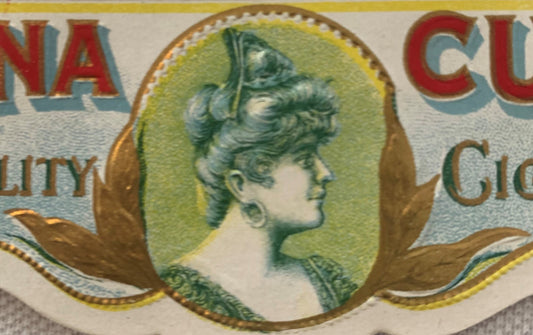
Antique 1900s Cleola Cigar Box Nail Tag Label 🌹 Victorian Portrait Beauty Embossed Gold Scrollwork Roses

Antique 1900s Cleola Cigar Box Nail Tag Label 🌹 Victorian Portrait Beauty Embossed Gold Scrollwork Roses

Regular price $6.00 USD
Regular price Sale price $6.00 USD
Sale Sold out
Shipping calculated at checkout.

Size: 4" x 2 1/4"

🚚 Free US Shipping — ships within one business day. International shipping calculated at checkout.

Quantity

What Does It Feel Like to Hold Something That Was Never Meant to Survive? 🌹

Size: 4" x 2 1/4"

A cigar box label had one job: make a buyer reach for that box instead of the one beside it, and then get torn up when the lid came off. Nobody framed them and almost nobody kept them. So I never tire of a CLEOLA nail tag that was never pasted to anything. Embossed gold scrollwork, a woman with a rose at her ear, and a back that still holds the design as a raised mirror image, pressed clean through the paper. These are New Old Stock, unused and never applied to a box. 🌹

🌹 A Nail Tag, Not an Outer

The label is a cigar box nail tag. Nail tags were glued over the nail that closed the box, to keep anyone from tampering with the cigars inside, and that is the name the dealers who handle this exact design file it under. It is the smaller cousin of the big outer label that faced the room. CLEOLA had one of those too: a square portrait outer showing the same woman, which the collector price guides list as "CLEOLA - OUTER - PORTRAIT." That square outer is a different label from this tag, though the two are plainly family.

In fact CLEOLA was a whole set of labels built around her. Besides the nail tag and the square outer there is an inner lid label, a top label, and an edge strip with two small portraits. One complete CLEOLA box that has come up for sale even wears a red "Now 2 for 5c" sticker, which is a two-for-a-nickel cigar. And do not mix it up with CLEORA, one letter different. That is a separate brand, with its own Havana and Tampa labels in the guides.

🏭 Who Made CLEOLA? Fritz Bros. of Cincinnati Is the Best Lead

Nothing printed on the tag names a maker, a printer or a town, so here is where the paper trail leads. The one documented launch of a cigar called Cleola comes in the summer of 1900. Tobacco, the New York trade weekly, ran a letter from Cincinnati dated July 3, 1900, reporting that some "velvety advertising" had been prepared for the new Fritz Bros. cigar, Cleola, which was to be launched in the near future. A complete CLEOLA box from Ohio carries this same portrait, plus a factory stamp whose date line is pre-printed "190_" and left blank for the year. Cincinnati in 1900, Ohio again on the box, the 1900s on the stamp: that makes Fritz Bros. the best-supported link between this tag and a maker. No document names the two together, so I call it a link and not a signature.

The Fritz name is worth a few minutes of your time. Four brothers, Otto H., Richard, Emil and Theodore Fritz, started the firm in July 1874 at 125 Main Street in Cincinnati. Emil and Theodore retired on New Year's Day 1882, and Otto and Richard carried on. By 1883 a book on the industries of Cincinnati counted factories at 125 and 147 Main Street and a second plant out at Eaton, Ohio, which handled the lower grades. About 325 people worked for them, 225 in Cincinnati and 100 in Eaton, turning out better than half a million dollars' worth of cigars a year from Havana and Sumatra leaf they imported themselves. Their leading brands then were Henry Clay, Richard Third, Joe Jr., Planters' Pride, Stocks and North Carolina. Seventeen years after that list was written, they were the ones announcing Cleola.

The company kept going well into the new century. A 1914 Cincinnati reference book lists The Fritz Bros. Co. as makers of "strictly high grade cigars," and a 1918 Ohio state report counts 257 people on its payroll at 903 Broadway, 230 of them women. Where the story goes after that is still an open thread.

The name turns up once more in 1945. A wartime price-control order issued that June lists "Cleola" and "Cleola - De Luxe" among the domestic cigars that Harry R. Becker of Dallastown, Pennsylvania, was authorized to sell. Whether his Cleola had any connection to the Cincinnati brand, or ever wore this label, is an open question.

🕰️ Dating the Tag

July 1900 is the earliest anchor, and the "190_" on the Ohio box keeps the label's life inside the 1900s. Embossed gilt chromolithography of this kind fits that decade, so I call it an antique from the 1900s. It is a nice historical footnote, too: Cleola was announced in the last summer of Queen Victoria's reign. She died in January 1901, so the brand began right at the tail end of the Victorian era. It is also a scarce tag. Only one other seller has this exact nail tag right now.

👩 The Woman With the Rose

There is a reason the portrait is a woman. The California State Archives' exhibit on cigar box trademarks says portraits of beautiful women were the most popular choice of all for box labels, with idealized women, romantic scenes, flowers and gold accents flourishing everywhere. The CLEOLA woman fits right in: hair swept up, a rose at her ear, set in an oval of embossed rococo scrollwork between pink roses and fern fronds. Nothing I know of names her, or the artist who painted her, so she stays Cleola. Collector lore says the portrait labels worth chasing are the ones where the woman looks like a particular person and not a type. I think she passes that test, and I notice it every time I pick her up.

🎨 How It Was Made

These came out of the chromolithography shops, where one hand-drawn limestone went down for each color and the sheet passed through the press again and again. The gold was embossed last, pressed in with a die so the scrollwork stands up off the paper. Run a fingertip over it and you can feel the relief. It is an original, not a reproduction, and the mirror-image impression on the back is part of how you can tell. Labels like this survive unused when a maker ordered more than it needed, or a brand ended before its print run was used up.

The big names in cigar-label lithography in those years included George Schlegel, George Schmidt, Heywood Strasser and Voigt, O.L. Schwencke, Heppenheimer and Maurer, the American Lithographic Company and George Harris and Sons. Nothing on the tag names its printer.

🖼️ Display Ideas

  • 🖼️ Float-mount it in a shallow shadow box over linen or velvet, so the embossing catches the light the way it was meant to.
  • 🌹 Group it with other portrait ephemera such as trade cards, calling cards and scraps, for a wall that reads as one era.
  • 🗂️ Keep it in an archival sleeve in a flat file or portfolio if you would rather study it than hang it.
  • 🕰️ Put it on a dressing table beside perfume bottles and hair combs, where a woman with a rose belongs.
  • 📚 Build a study collection around it with a cigar label price guide and Tony Hyman's Handbook of American Cigar Boxes.

🎁 Who Collects These

  • 🚬 Tobacciana collectors who like to complete a brand, from the nail tag and outer to the inner and edge labels.
  • 🎨 Chromolithography and paper ephemera fans who already hold trade cards, seed packets and sheet music covers.
  • 👩 Collectors of turn-of-the-century portraits, who will recognize a cameo-sized woman from another time.
  • 🏠 Decorators after real period printing for a gallery wall.

To keep it looking this way, store it flat in an acid-free polyester sleeve, and if you frame it, use UV-filtering glass and float-mount it. Dry-mounting is permanent and would squash the embossing.

Shipping

🚚 Shipping & Handling

  • Shipping costs and timing are calculated at checkout.
  • Items curated and shipped directly by me include U.S. shipping at no additional cost, professionally packed to ensure safe arrival of your artifact.

Items from Vetted Pro Collectors
Shipping for items offered by vetted Pro Collectors is determined at checkout. All Pro Collector listings are reviewed to ensure fair, reasonable shipping practices.

For full details, please refer to our Shipping Policy.

Returns & Exchange

Take your time — you've got a full six months. If a piece isn't right for you, send it back the way it reached you and we're good.

In the first 30 days your money goes straight back the way you paid. After that it's store credit, so you can put it toward something you'd rather have.

Return shipping we sort out between us, case by case. I don't make this difficult.

If something arrives damaged, or it isn't what I said it was, send me a photo within 48 hours and I'll make it right.

Email info@vintageantiquesgifts.com or call 802-356-9872 — that's me answering, not a call center.

The only things I can't take back are custom or special-order pieces and gift cards.

View full details

Preserving History: Authentic Objects Across Eras

— Curated by Travis Weigel