
Skip to product information
1 of 3

Vintage and Antique Gifts

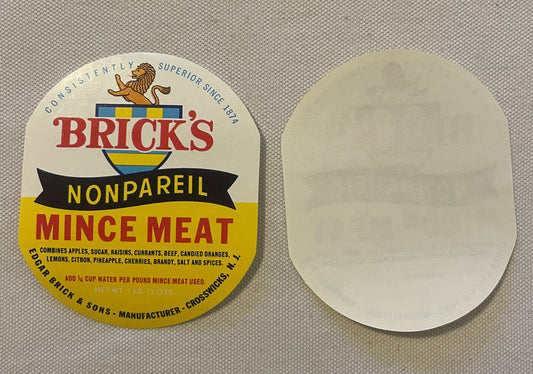
Antique Brick's Old Homestead Mince Meat Label 🏡 NOS 1910s - 1930s Oval Farm Scene, Edgar Brick & Sons, Crosswicks NJ

Antique Brick's Old Homestead Mince Meat Label 🏡 NOS 1910s - 1930s Oval Farm Scene, Edgar Brick & Sons, Crosswicks NJ

Regular price $9.00 USD
Regular price Sale price $9.00 USD
Sale Sold out
Shipping calculated at checkout.

Size: 3 1/2" x 3"

🚚 Free US Shipping — ships within one business day. International shipping calculated at checkout.

Quantity

How Did a Little General Store in Crosswicks, NJ Become America's Biggest Mince Meat Maker? 🏡

Size: 3 1/2" x 3"

Another amazing find, and the artwork on these little ovals is just wonderful. This is a New Old Stock label for Brick's Old Homestead Mince Meat, made for Edgar Brick & Sons of Crosswicks, New Jersey, and never put on a jar. There's no date printed anywhere on it. It comes from the 1910s to the 1930s, the stretch when old Edgar was finishing out his years and his sons were taking the reins. Pour yourself a coffee, because the family behind this little oval has a better story than most.

🫙 Read the Fine Print

Everything the shopper needed to know is printed right on it. The recipe runs apples, sugar, raisins and currants, then beef, candied orange and lemon peel, then cane syrup, salt and spices, and last of all, brandy. It tells the cook to stir a quarter cup of water into the jar, gives the net weight as one pound one ounce, and signs off as Edgar Brick & Sons, the manufacturer, of Crosswicks, N.J.

🏪 Edgar Brick's Better Idea

Edgar Brick and his wife Susan moved to Crosswicks in the 1850s, where they ran a general store on Main Street. Like plenty of country stores, theirs sold mince meat made over in Philadelphia, and Edgar wasn't impressed with it. So in 1874 he cooked up his own. First-year total: 76 pounds. Hang on to that number.

People came back for more, and inside five years he'd outgrown the store. In 1879 he bought two local farmhouses, had them moved onto one lot and joined them together into a factory. I like to think that's where "Old Homestead" came from, a mince meat made inside two old farmhouses. By the turn of the century Edgar Brick & Sons was the biggest mince meat maker in New Jersey, and Brick's was on grocers' Christmas lists well past the state line. Washington, D.C. stores were advertising "Bricks Mince Meat" for the holidays in 1902 and 1903, and a 1905 ad in the Five Mile Beach Journal, down at the Jersey shore, was selling the Nonpareil brand, "made by Brick at Crosswicks," for 12 cents a pound.

👨‍👦‍👦 Edgar and His Boys

Edgar was a pillar of that town, not just its mince meat man. He joined the Crosswicks fire company in 1864, and when it adopted a new constitution in 1882 he was appointed its first chief. He died in 1920, and his three sons, Arthur R., Josiah E. and Charles W. Brick, took over the business. Two years later the three of them gave the fire company its first firehouse and a motorized chemical fire engine in their father's memory, and the building was dedicated on November 25, 1922.

The sons kept busy. Josiah was the first president of the Crosswicks Community Association, organized in 1919, and one of its big backers when the Community House went up and opened in 1923; he died suddenly in 1927, at 61. Charles owned the old mill on Crosswicks Creek in the 1920s; new ice-making machinery went into it in 1920, and its ice was sold all around the area, including to the Hildebrecht Ice Cream Company over in Trenton. All told, the Brick family helped bring electricity to Crosswicks, set up a mill and an ice plant on the creek, and helped found the Chesterfield Township Historical Society.

Brick family members ran the company for another 48 years after Edgar was gone, and they took it a long way. At the World War II peak they had forty people working and turned out about three million pounds of mince meat a year, more than any other mince meat maker in the United States. From 76 pounds in year one to three million pounds a year, all from a village that has about 850 people living in it today.

🥃 About That Brandy

Real brandy went into this old recipe, and I doubt that hurt repeat business one bit. The way the story gets told, mince meat got extra popular during Prohibition for pretty much that reason. Here's what's on paper. Prohibition and the Volstead Act took effect in 1920, and people started lobbying almost at once to keep popular foods made with liquor legal. A 1922 court ruling said culinary products could contain liquor, mince meat included. Brick's went and got the paperwork, too: a Brick's Banquet Hall label of the 1920s reads "PROOF ALCOHOL BY VOLUME 14 PER CENT" and carries Federal Prohibition Permit N.J. H-926. Collectors love to tell it as legal liquor sitting on the grocery shelf in plain sight, between the canned peaches and the soup. I won't argue with them.

🌾 Crosswicks, Then and Now

Crosswicks is the oldest of Chesterfield Township's three villages, settled by Quakers in 1677, and the name is Lenape, from Crossweeksung, which is said to mean "house of separation." The Quakers put up their big brick meeting house in 1773, and during the Revolution soldiers from both sides were quartered in it. On June 23, 1778, five days before the Battle of Monmouth, the fighting came right through town over the creek bridge, and the meeting house took three cannonballs. One is still mortared into the north wall, and nobody has ever settled which side fired it. Local lore says a caretaker once pried that ball out of the wall and kept it at his house for safekeeping, and after he died, early in the twentieth century, it was brought back and plastered right back into place.

The heart of the village, 95 old buildings on about 50 acres, made the National Register of Historic Places back in 1976 as the Crosswicks Village historic district, honored for its architecture, its military history, its religion and its transportation. And for a good long stretch the big local industry was Brick's. One Princeton antiquarian dealer called Brick's mince meat "one of the major industries of Crosswicks" in the late nineteenth and early twentieth centuries.

🏚️ What Happened to the Factory

By the 1960s America just wasn't eating mince meat like it used to. In 1968 the company quit making it altogether and switched to alcoholic beverages, and in 1979, 105 years after that first 76 pounds, it closed for good and much of the old equipment and furnishings were sold at auction. The Hamilton Uniform Company bought the building in 1980 and worked out of it for years before it shut down too. The old factory, those two 1879 farmhouses with years of additions grown onto them, was still standing in the historic district in 2017, empty, with parts of its roof fallen in, when Preservation New Jersey put it on its list of the state's most endangered historic places.

The recipe outlived the factory, though. The Chesterfield Township Historical Society, the same one the Brick family helped start, was sampling and selling mince meat made from a recipe based on Brick's at its 2014 Heritage Day in Crosswicks, and its holiday mince meat pie sales have leaned on that same Brick's recipe. I'd call that a happy ending.

🍎 So What Was Mince Meat?

If you've only ever seen it in a modern jar, old-time mince meat was how a household put up food for winter: chopped cooked beef or venison and suet mixed with apples, raisins and currants, citrus peel, sugar and warm spices, with brandy, rum or cider to help it keep. It waited in the pantry until Thanksgiving and Christmas and then went into pies. The British had mostly taken the meat out of their mince pies by the early twentieth century, but Americans kept the beef in for decades longer, and you can see it right there in Brick's recipe.

🎨 The Artist Nobody Remembers

There's no artist's name anywhere on this label, and that's typical. The people who drew farm scenes for the label trade were talented folks who got paid very little and never got credit, and most of them we'll never know. Keeping a label like this around, instead of letting it end up in the trash, is one small way to keep their art alive forever.

📦 Condition

New Old Stock: unused, never applied to a jar.

🎁 Good For

  • 🖼️ A farmhouse kitchen wall. The oval looks great centered on a rectangular mat behind UV glass.
  • 🗺️ Anybody with Crosswicks, Chesterfield Township or Burlington County roots
  • 🥧 The one in your family who still bakes a mince meat pie every Christmas
  • 🥃 Prohibition and food history collectors. That brandy line starts conversations.
  • 🧱 Anyone whose last name is Brick. Hard to top that as a gift.

Shipping

🚚 Shipping & Handling

  • Shipping costs and timing are calculated at checkout.
  • Items curated and shipped directly by me include U.S. shipping at no additional cost, professionally packed to ensure safe arrival of your artifact.

Items from Vetted Pro Collectors
Shipping for items offered by vetted Pro Collectors is determined at checkout. All Pro Collector listings are reviewed to ensure fair, reasonable shipping practices.

For full details, please refer to our Shipping Policy.

Returns & Exchange

Take your time — you've got a full six months. If a piece isn't right for you, send it back the way it reached you and we're good.

In the first 30 days your money goes straight back the way you paid. After that it's store credit, so you can put it toward something you'd rather have.

Return shipping we sort out between us, case by case. I don't make this difficult.

If something arrives damaged, or it isn't what I said it was, send me a photo within 48 hours and I'll make it right.

Email info@vintageantiquesgifts.com or call 802-356-9872 — that's me answering, not a call center.

The only things I can't take back are custom or special-order pieces and gift cards.

View full details
  • 5 stars: 1 (100%)
  • 4 stars: 0 (0%)
  • 3 stars: 0 (0%)
  • 2 stars: 0 (0%)
  • 1 star: 0 (0%)
t
timbeggs

Great item! Wonderful seller! Thanks!!!

Pleasure is all ours!

Preserving History: Authentic Objects Across Eras

— Curated by Travis Weigel