

Skip to product information
1 of 3

Vintage and Antique Gifts

Antique Brick's Beechwood Mince Meat Label 🥧 Edgar Brick & Sons Crosswicks NJ NOS Pie Litho 1920s–1930s

Antique Brick's Beechwood Mince Meat Label 🥧 Edgar Brick & Sons Crosswicks NJ NOS Pie Litho 1920s–1930s

Regular price $6.00 USD
Regular price Sale price $6.00 USD
Sale Sold out
Shipping calculated at checkout.

Size: 3" x 2 1/4"

🚚 Free US Shipping — ships within one business day. International shipping calculated at checkout.

Quantity

What Went Into Old-Time Mince Meat? 🥧 Antique Brick's Beechwood Mince Meat Label, Edgar Brick & Sons, Crosswicks NJ

Size: 3" x 2 1/4"

🥧 Read the small print and there it is: beef and rum, printed right on the jar. This unused Beechwood Mince Meat label comes from Edgar Brick & Sons of Crosswicks, New Jersey, a business that began when a village storekeeper sold 76 pounds of his own mincemeat in 1874 and grew into the largest mincemeat maker in the United States, in a Quaker village where a Revolutionary War cannonball is still lodged in the meeting house wall.

The Label

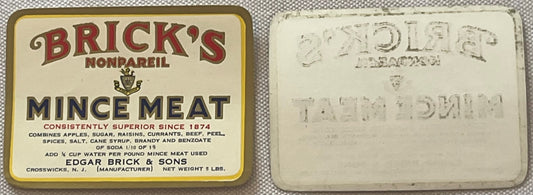
The label measures 3 x 2.25 inches, a small cream rectangle with rounded corners inside a thin navy border. BEECHWOOD runs across the top in tall navy outlined capitals, and beneath it sits a golden mince pie with a crimped crust in a blue-rimmed dish. MINCE MEAT follows in bold red capitals, with CONSISTENTLY SUPERIOR SINCE 1874 in red below. A line of small navy type lists the ingredients, "Combines Apples, Raisins, Cane Syrup, Dextrose, Beef, Spices, Salt, Starch and Rum," and a red line gives the directions: TO THE CONTENTS OF THIS JAR ADD ONE HALF CUP OF WATER. At the bottom it reads MAN'F'D BY EDGAR BRICK & SONS, CROSSWICKS, N. J., and NET WEIGHT 1¾ LBS. The back is plain. It is new old stock, never pasted onto a jar.

Edgar Brick's Mincemeat

Edgar Brick started making mincemeat in 1874 because he was not satisfied with the Philadelphia-made mincemeat he had been selling in his Crosswicks store. In that first year he sold 76 pounds. Demand grew fast enough that within five years he needed more room, and in 1879 he made a factory by moving two local farmhouses onto the property and joining them together. Additions followed over the years until the plant became a sprawling structure of wood and concrete. By the turn of the twentieth century Edgar Brick & Sons was the largest mincemeat manufacturer in New Jersey.

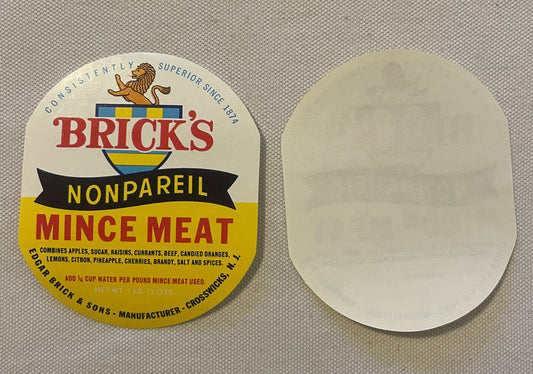
Edgar Brick died in 1920, and his three sons, Arthur, Josiah and Charles, took over the business. Under the family the company reached its peak during World War II, when 40 workers produced three million pounds of mincemeat a year and Edgar Brick & Sons stood as the largest mincemeat manufacturer in the United States. Beechwood was one of several names Edgar Brick & Sons printed on its mincemeat labels, alongside Old Homestead, Banquet Hall, Nonpareil and Buyers Special. A Brick's Banquet Hall Mince Meat label carrying the same "Consistently Superior Since 1874" line has been dated to about 1920, an Old Homestead Mince Meat label also names Crosswicks, and wooden firkin buckets painted with the Edgar Brick & Sons name still turn up.

What Was in the Jar

Mincemeat is far older than the Brick family. Its roots in English cooking go back to the twelfth century and the Crusades, when returning Europeans met Middle Eastern cooking that mixed meat, fruit and spices into dishes both sweet and savory. One of England's oldest cookbooks, The Forme of Cury from the fourteenth century, gives a recipe for "tarts of flesh" filled with pork, stewed bird and rabbit, eggs, cheese, sugar, saffron and spices. Rich, expensive and spiced, the pies became a Christmas dish, and by the Victorian age many cooks were leaving the meat out altogether. The Beechwood recipe kept the old way: beef among the apples and raisins, and rum to finish it.

The Legend of the Mince Pie Ban

Mince pies carry one of England's favorite legends: that Oliver Cromwell banned them. The truth behind the story is real enough. Parliament's June 1647 ordinance tried to abolish Christmas and other holidays, the Puritan-led government cracked down on Christmas feasting, mince pies included, and the move was so unpopular that it sparked riots. The bans ended when Charles II took the throne. But Cromwell himself left no record of any opinion about pies, and the idea that he personally outlawed them is a tale that grew in the retelling, with the mince pie standing in for the whole Puritan war on Christmas.

Crosswicks, New Jersey

Crosswicks takes its name from the Lenape word Crossweeksung, usually translated as "house of separation." Quakers settled there in 1677, the Chesterfield Friends Meeting was established in 1684, and its Provincial Georgian brick meeting house went up in 1773. In June 1745 the missionary David Brainerd recorded arriving among the Lenape at Crossweeksung.

On June 23, 1778, the Revolutionary War came straight through the village. New Jersey militia under Philemon Dickinson and troops under William Maxwell skirmished with British forces under General Henry Clinton, slowing their march five days before the Battle of Monmouth. The meeting house, built for a congregation of pacifists, was hit by three cannonballs, and one is still embedded in its north wall between the second-story windows. Nobody knows whether the British or the Continentals fired it. The story goes that a caretaker once dug the ball out and kept it at his house for safekeeping, and after his death in the early twentieth century it was returned and a mason plastered it back into the wall, where visitors can still see it.

What Changed

Mincemeat fell out of fashion in the second half of the twentieth century. As consumption declined, Edgar Brick & Sons turned in 1968 to producing alcoholic beverages and stopped making mincemeat entirely, and the company closed in 1979. Its original equipment was sold off, but the old factory building, born of two farmhouses pushed together in 1879, remains a landmark of Crosswicks' industrial past, and unused labels like this one keep the Beechwood name alive.

Good For

  • A small frame for a kitchen, pantry or coffee bar
  • New Jersey and Burlington County history collections
  • Food label and holiday baking collectors
  • A gift for anyone who still makes mince pie at Christmas

Questions People Ask

What was in Beechwood Mince Meat?

Fruit and meat together, as mincemeat always was: the printed recipe starts with apples and raisins and ends with beef, spices and a finish of rum.

Who made it?

Edgar Brick & Sons of Crosswicks, New Jersey, a family firm founded in 1874 that became the largest mincemeat maker in the United States.

How big is the label?

3 x 2.25 inches, with rounded corners.

How old is it?

It dates from the 1920s–1930s and is new old stock, never used. The ingredient line settles the early end: it prints Dextrose, and pure dextrose was not a commercial product until W. B. Newkirk worked out how to crystallize it in 1922. Corn Products standardized the process in 1923, and output went from about eight million pounds that first year to forty million by 1924 — which is when "dextrose" starts turning up on ingredient panels at all.

Did mincemeat really contain meat?

Yes. Medieval recipes were built on meat, and this Beechwood label still lists beef among its ingredients.

Did Oliver Cromwell ban mince pies?

That is a legend. Parliament did try to abolish Christmas in 1647, feasting included, but there is no record of Cromwell personally banning pies.

Shipping

🚚 Shipping & Handling

  • Shipping costs and timing are calculated at checkout.
  • Items curated and shipped directly by me include U.S. shipping at no additional cost, professionally packed to ensure safe arrival of your artifact.

Items from Vetted Pro Collectors
Shipping for items offered by vetted Pro Collectors is determined at checkout. All Pro Collector listings are reviewed to ensure fair, reasonable shipping practices.

For full details, please refer to our Shipping Policy.

Returns & Exchange

Take your time — you've got a full six months. If a piece isn't right for you, send it back the way it reached you and we're good.

In the first 30 days your money goes straight back the way you paid. After that it's store credit, so you can put it toward something you'd rather have.

Return shipping we sort out between us, case by case. I don't make this difficult.

If something arrives damaged, or it isn't what I said it was, send me a photo within 48 hours and I'll make it right.

Email info@vintageantiquesgifts.com or call 802-356-9872 — that's me answering, not a call center.

The only things I can't take back are custom or special-order pieces and gift cards.

View full details
  • 5 stars: 1 (100%)
  • 4 stars: 0 (0%)
  • 3 stars: 0 (0%)
  • 2 stars: 0 (0%)
  • 1 star: 0 (0%)
c
crabbycrow

Shipped promptly and securely

Thank you!

Preserving History: Authentic Objects Across Eras

— Curated by Travis Weigel