Nice shirt!
Very nice nickel. Charming vender. Fast service. He has other very cool stuff on sale as well.
Very nice labels in excellent condition. Well packaged and arrived timely.
The Cadillac poster was great, very well made and great graphics.
Everything authentic. Nothing reproduced. 🏛️ Vintage and Antique Gifts is a multi-channel...
$0.00 USD
Vintage and Antique Gifts
Size: 14" x 4 1/2"
🚚 Free US Shipping — ships within one business day. International shipping calculated at checkout.
Couldn't load pickup availability
Size: 14" x 4 1/2"
Long before supermarket shelves were lined with shrink-wrapped sameness, a can of tomatoes had to earn its place in a shopper's basket with nothing but a strip of paper wrapped around a tin. That paper had one job: stop a busy hand mid-reach in a country grocery in upstate New York and say this can is worth carrying home. Labels like this were never meant to last - they were pasted on, the tomatoes were eaten, and the tin went to the scrap pile.
An unused antique can label, made to wrap a big 2 lb. 1 oz. tin of tomatoes from a little canning factory in Fabius, New York. OG-NA in raised gold letters, a fat red tomato on one end and a chief in a feathered war bonnet on the other. A small-town packer ordered these so his tomatoes could hold their own on any grocer's shelf, and this one never made it around a can. In metric it's about 35.5 x 11.4 cm. The chief is a Native American chief in profile, in a full feathered war bonnet of white, navy and red feathers over a beaded red, white and blue headband, a gold disc earring and a red blanket at his shoulders. OG-NA BRAND is stamped twice in raised, gold-edged letters - red over the tomato, navy over the chief - and the EHR shield shows up twice too, so the brand faced outward however the tin sat on the shelf. It's a stunning piece of Americana and great Native American Indian decor, and a perfect reminder of the lost art of embossing that was popular in the 1920s.
Edward Hibberd Rowley was born in 1873 at Three Mile Bay, up in Jefferson County, and was farming in Fabius by 1900. The 1910 census has him down as a manager and treasurer. By 1917 he owned a vegetable canning factory in town, and the 1920 census finds him on North Main Street, listed simply as a canner. He put his tomatoes up under two names, Rowley's Fancy Quality and OG-NA, and his family's own history puts the OG-NA labels around the 1920s. The EHR monogram on the little shields at either side is his. He stayed in Fabius the rest of his life, died there in 1946, and he's buried in Fabius's Evergreen Cemetery.
Fabius sits up in the hills south of Syracuse, in Onondaga County. After the Revolutionary War, New York laid out the Military Tract across the middle of the state to pay its soldiers in land, and when its townships were named on July 3, 1790, the surveyor general's office went a little wild with classical names - Pompey, Manlius, Cicero, Marcellus, Cato - and Fabius, for the Roman general Quintus Fabius Maximus. The names are credited to Robert Harpur, a clerk in that office. Fabius became a town of its own in 1798, split off from Pompey. It's high hill country - the town counts as part of New York's Finger Lakes region, and its Highland Forest is Onondaga County's oldest county park - and the classical names handed out across the Military Tract came from the Greek and Roman worlds alike. That naming wave of the 1790s gave a quiet farming town a name older and grander than its population ever quite matched.
Fabius is in Onondaga County, named for the Onondaga Nation, the firekeepers of the Haudenosaunee, the Iroquois Confederacy, whose council fire still burns just south of Syracuse. Rowley's OG-NA tomatoes, chief and all, were packed right there in Onondaga County. The Onondaga were one of the five founding nations of the Confederacy - the Six Nations once the Tuscarora joined in the 1700s.
Rowley's was the kind of small-town cannery Central New York was full of - taking in the local crop in the few short weeks the tomatoes were ripe and putting it up in tins under a brand of its own. He didn't need to compete on a national stage; he needed the grocer down the road to reach for his cans. That he dressed OG-NA in raised gold and a chief's portrait tells you he wanted his tomatoes to look every bit as important as anything shipped in from a big-city cannery. The chief himself follows a visual language that was everywhere in American food and tobacco advertising in those years - in the early decades of the twentieth century advertisers reached again and again for a dignified Native American profile in a feathered headdress to sell everything from cigars to butter to canned vegetables, as shorthand for strength and for American soil.
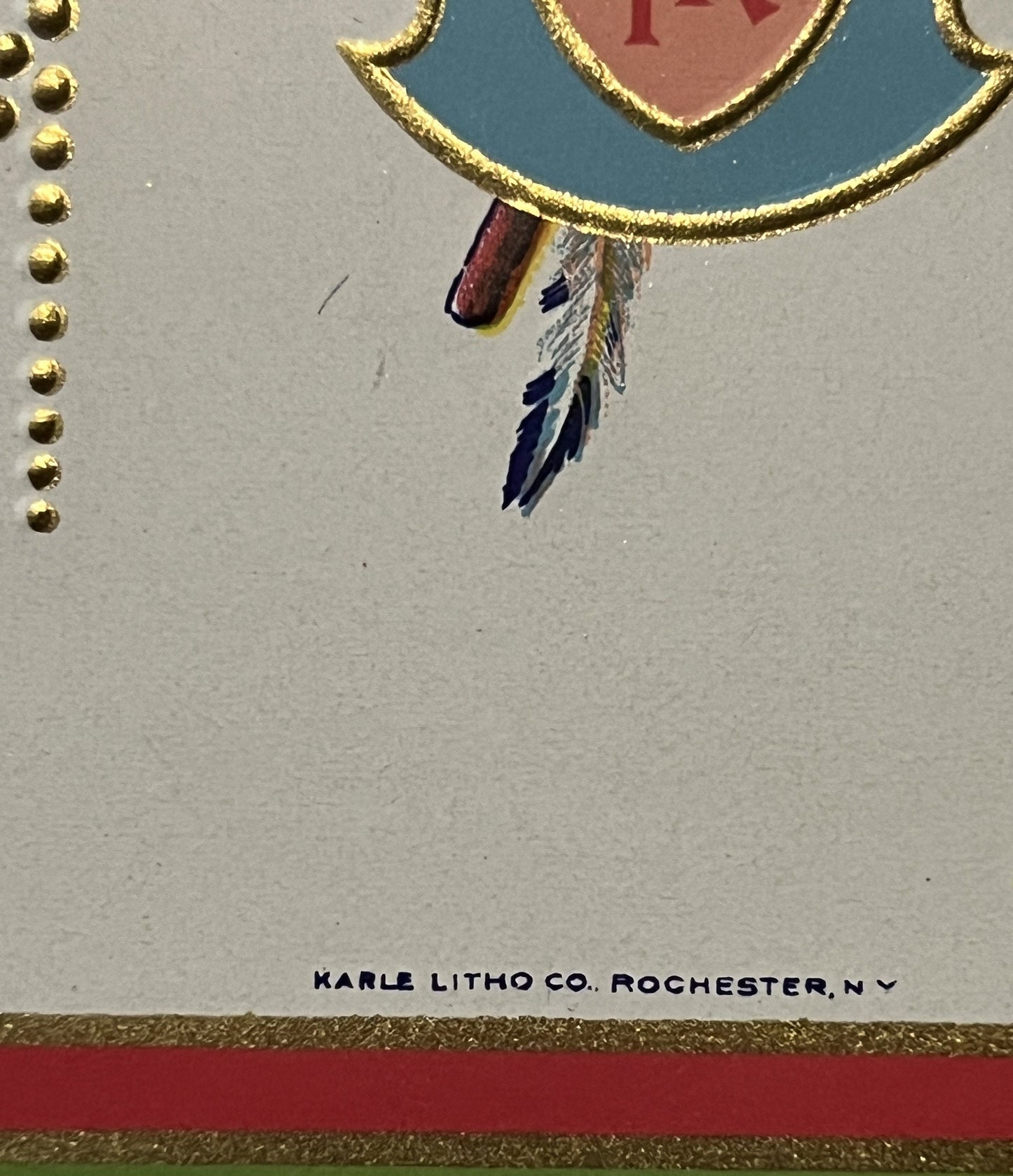
Down in the corner it reads KARLE LITHO CO. ROCHESTER, N.Y., and a little R-118-30 LG runs up the left edge. Karle Lithographic was printing in Rochester by 1912 - a company letterhead from that year still turns up - in a city that had gone from the Flour City of the Genesee River mills to the Flower City of nurseries and seed houses, and kept a lot of lithographers busy doing it.
The firm goes back a lot further than that letterhead. William Karle, born in Rochester in 1854, started his own lithographic company there in 1879, with Anton Rahn as his first partner - Rahn did the art and Karle did the engraving. That same year Rahn & Karle printed a hand-colored plate of everlasting flowers for Vick's Monthly, put out by James Vick, the Rochester seed seller; The Henry Ford museum has one. In 1918 Karle Lithographic printed a big "For Victory, Buy More Bonds" poster for the war effort, and Dartmouth's Hood Museum of Art keeps one. William Karle's company carried on until 1932, when it merged with Stecher Lithographic, another Rochester label printer.
Rochester had a way of reinventing itself - from the Flour City to the Flower City and then into a center of optics and photography, the town where Eastman Kodak was founded in 1888 - and every one of those trades drew skilled engravers, colorists and lithographers who knew how to make a flat sheet of paper look alive.
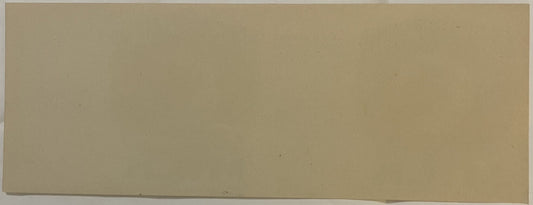
That plain cream strip in the pictures is the back of a label: the gold embossing presses so deep you can read OG-NA backwards from behind.
Long and narrow, it looks great framed over a kitchen doorway or in a farmhouse pantry. You'll get one like the one shown, never used. The supply is finite - nobody's printing OG-NA tomato labels again, and once these last unused ones are gone, they'll be very difficult to acquire.
Frame it on its own under glass as a long horizontal piece over a sideboard or buffet, so the full 14-inch length and the gold embossing catch the light; hang it in a farmhouse kitchen or dining nook with other old food advertising; give it a place in a Native American imagery or Americana collection as a colorful centerpiece; or set it in a home office or study as a conversation piece of regional New York history. It makes a fine gift for a collector of vintage advertising, canning history or Central New York memorabilia, too.
Can and crate label collectors come to it for the gold embossing, Americana and folk-art collectors for the bold, dignified chief portrait and the color, and anyone building around Native American imagery in American advertising, or around Onondaga County and Central New York history, for its ties to Fabius and the Onondaga name. Fans of early advertising lithography and printing history like it as a hands-on example of how Rochester's print houses turned a can label into commercial art.
Can labels like this one are more than a piece of art - they're a tangible link to a bygone era, and the lithography and embossing that went into them is unparalleled even to this day in my opinion. Museums and Art Institutes have galleries dedicated to them, and collectors are actively seeking them out to preserve their history.
Items from Vetted Pro Collectors
Shipping for items offered by vetted Pro Collectors is determined at checkout. All Pro Collector listings are reviewed to ensure fair, reasonable shipping practices.
For full details, please refer to our Shipping Policy.
Take your time — you've got a full six months. If a piece isn't right for you, send it back the way it reached you and we're good.
In the first 30 days your money goes straight back the way you paid. After that it's store credit, so you can put it toward something you'd rather have.
Return shipping we sort out between us, case by case. I don't make this difficult.
If something arrives damaged, or it isn't what I said it was, send me a photo within 48 hours and I'll make it right.
Email info@vintageantiquesgifts.com or call 802-356-9872 — that's me answering, not a call center.
The only things I can't take back are custom or special-order pieces and gift cards.

Awesome seller! Package arrived in great shape!! Timely and excellent communication!
Hi. Sorry 4 the delay. Honorable dealer*Fast delivery*No surprises*WDBA*. Thank you & God bless you.
USPS lost first one, not his fault, he replaced it. Good job. Would buy from again
Nice piece for my Indian collection
The item met my expectations. The seller was very helpful.

Preserving History: Authentic Objects Across Eras
Nice shirt!
Looks great !
Very nice nickel. Charming vender. Fast service. He has other very cool stuff on sale as well.
Very nice labels in excellent condition. Well packaged and arrived timely.
The Cadillac poster was great, very well made and great graphics.
Nice shirt!
Looks great !
Very nice nickel. Charming vender. Fast service. He has other very cool stuff on sale as well.
Very nice labels in excellent condition. Well packaged and arrived timely.
The Cadillac poster was great, very well made and great graphics.