
Skip to product information
1 of 3

Vintage and Antique Gifts

Antique 1920s Wayne Brand Cut Refugee Beans Can Label 🫘 General Anthony Wayne, Edgett-Burnham Company, Newark NY, Gold Embossed

Antique 1920s Wayne Brand Cut Refugee Beans Can Label 🫘 General Anthony Wayne, Edgett-Burnham Company, Newark NY, Gold Embossed

Regular price $6.00 USD
Regular price Sale price $6.00 USD
Sale Sold out
Shipping calculated at checkout.

Size: 11" x 4 1/4"

🚚 Free US Shipping — ships within one business day. International shipping calculated at checkout.

Quantity

What Were Cut Refugee Beans? 🫘 Wayne Brand Cut Refugee Beans, Packed by the Edgett-Burnham Company of Newark, New York

Size: 11" x 4 1/4" ~ NOS unused stock, little to no storage wear.

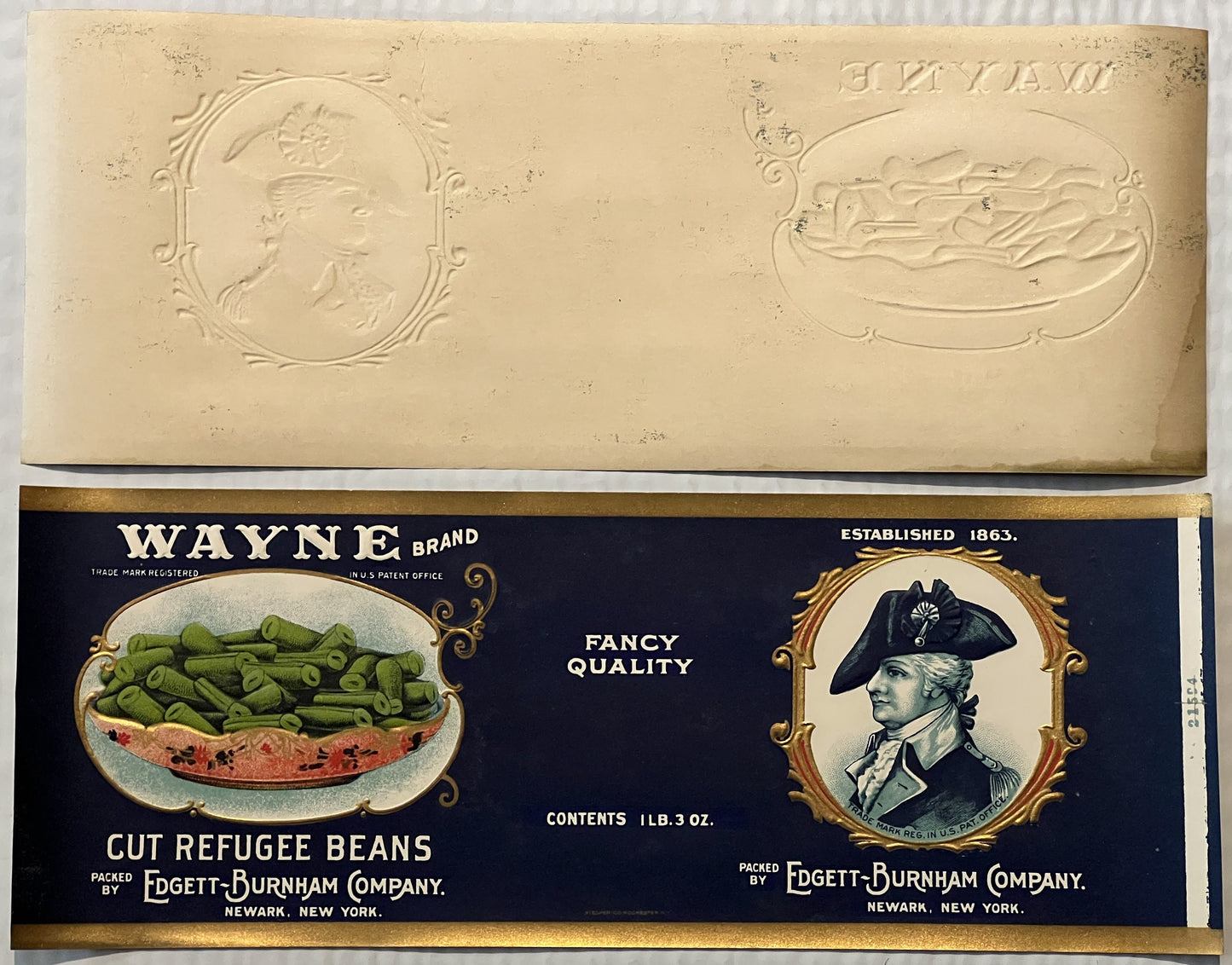
A general in a cocked hat looks out from a gold frame on this can label, under the words ESTABLISHED 1863. He is Anthony Wayne, the Revolutionary War commander Wayne County, New York is named for, and the Newark cannery that packed these beans made his portrait the registered trademark of its WAYNE BRAND. On the other end of the label a decorated dish is heaped with cut green beans, above CUT REFUGEE BEANS and PACKED BY EDGETT-BURNHAM COMPANY, NEWARK, NEW YORK.

It is gold embossed: turn it over and the general's profile and the bowl of beans are pressed through the paper in relief. It's a flat label that never went around a can, and every label in the stack is the same printing.

Like everything I keep, these live in the dark at under 40% relative humidity and a steady 72°F, climate controlled, so any age they show, they had before they came to me.

📜 What the Label Says

  • Brand: WAYNE BRAND, "Trade Mark Registered in U.S. Patent Office"
  • Product: Cut Refugee Beans, Fancy Quality, contents 1 lb. 3 oz.
  • Packer: Edgett-Burnham Company, Newark, New York, "Established 1863" (printed twice)
  • Portrait: General Anthony Wayne in a cocked hat with a cockade, marked "Trade Mark Reg. in U.S. Pat. Office"
  • Size: 11 x 4 1/4 inches
  • Era: 1920s; the firm took the Edgett-Burnham Company name in 1908

🏭 A Cannery on the Erie Canal

The business began in 1863 as the Wayne County Preserving Company, started by Ezra Edgett of Camden, New York, with an earlier partnership, Edgett & Totten, among its predecessors. It settled on the west side of the village of Newark, on the Erie Canal and later the enlarged Barge Canal, with the West Shore Railroad running alongside, so its cases could leave by water or by rail. The company is said to have canned turkey and geese for Union troops during the Civil War.

After Ezra Edgett's death, attorney Edwin K. Burnham joined the firm in 1889, and in 1908 it was incorporated as the Edgett-Burnham Company. It packed under a family of names, Faultless, Wayne, Winsom, West Shore, Burnham and Newark, and later canned corn, peas, beans and beets on contract. Perfection Foods bought the company and ran the plant until 1973, and the old cannery ground became Cannery Row Plaza.

The company's own papers survive. Cornell University's library holds 80 cubic feet of Edgett-Burnham records dated 1854 to 1930, among them daily reports from the packing and canning departments, farm and corn accounts, and photographs of the people who worked there.

🌹 Newark, New York

Newark grew up along the old Erie Canal out of two little settlements, Miller's Basin and Lockville, which took its name from the three canal locks beside it, locks 57, 58 and 59, and the village was incorporated in 1853, on July 21. Jackson & Perkins got its start there in 1872, founded by Albert Jackson, a fruit grower and amateur gardener, and his son-in-law Charles H. Perkins, and in time its roses made Newark the Rose Capital of America.

And just outside the village, in the hamlet of Hydesville in the town of Arcadia, the Fox sisters' mysterious rappings of March 1848 set off the whole Spiritualist movement. The knocking started on the night of Friday, March 31, and the house never lived it down; the newspapers later called it the spook house. In 1904 the Boston Journal ran the story "Bones in 'Old Spook House'" after a false wall in the cellar fell in and bones turned up behind it. A doctor who looked them over found odd fragments, chicken bones among them, and decided somebody had planted them as a practical joke, so the police never opened a case. Those bones, and a peddler's tin box said to have been found with them, ended up in the museum at Lily Dale, the Spiritualist camp in western New York. A canal town with roses and ghosts is a pretty good home for a cannery with a general on its label.

⚔️ Why a General Is Selling Beans

Wayne County, New York was formed on April 11, 1823 and named for General Anthony Wayne, so a Wayne County cannery calling its line WAYNE BRAND and putting the general on the can was hometown pride and patriotism in one picture. Wayne was born near Paoli, Pennsylvania on January 1, 1745, became a brigadier general in 1777, and fought at Brandywine, Germantown, Monmouth and Stony Point. In 1794 he won the Battle of Fallen Timbers, which led to the removal of Native American claims to Ohio. He died at Presque Isle, Pennsylvania on December 15, 1796.

His nickname has a legend of its own. The story goes that in the winter of 1781, with his Pennsylvania division in quarters at Morristown, New Jersey, an eccentric soldier called Jemmy the Drover, or "the Commodore", landed in trouble, and Wayne would not spare him a flogging. "Anthony is mad!" the man is supposed to have shouted, and Wayne's Pennsylvanians decided the name fit. Historians tracing the tale back through print have found its earliest version in 1829, in a Philadelphia magazine called The Casket.

🌱 The Refugee Bean

Refugee is an old green snap bean, named for the French Huguenots who brought it into general cultivation. American seedsmen were selling it by 1822, and it stayed one of the most widely grown green-podded beans well into the twentieth century, which is why "Cut Refugee Beans" needed no explaining to a grocery shopper.

⚖️ One Pound, Three Ounces

The CONTENTS 1 LB. 3 OZ. line is the kind of statement the Gould Net Weight Amendment made law. Signed by President William Howard Taft on March 3, 1913, it required food packages to be plainly marked with their weight, measure or count, after federal inspectors found short-weighted and under-filled packages on a large scale.

🎁 Good For

  • Framing for a kitchen, pantry or farmhouse wall
  • Can label and grocery advertising collections
  • Wayne County, Newark and Erie Canal history
  • Anyone with a Revolutionary War or Anthony Wayne connection

🫘 About these

The supply is finite - nobody's packing Wayne Brand refugee beans on the Erie Canal again, and once these last unused labels are gone, they'll be very difficult to acquire.

Shipping

🚚 Shipping & Handling

  • Shipping costs and timing are calculated at checkout.
  • Items curated and shipped directly by me include U.S. shipping at no additional cost, professionally packed to ensure safe arrival of your artifact.

Items from Vetted Pro Collectors
Shipping for items offered by vetted Pro Collectors is determined at checkout. All Pro Collector listings are reviewed to ensure fair, reasonable shipping practices.

For full details, please refer to our Shipping Policy.

Returns & Exchange

Take your time — you've got a full six months. If a piece isn't right for you, send it back the way it reached you and we're good.

In the first 30 days your money goes straight back the way you paid. After that it's store credit, so you can put it toward something you'd rather have.

Return shipping we sort out between us, case by case. I don't make this difficult.

If something arrives damaged, or it isn't what I said it was, send me a photo within 48 hours and I'll make it right.

Email info@vintageantiquesgifts.com or call 802-356-9872 — that's me answering, not a call center.

The only things I can't take back are custom or special-order pieces and gift cards.

View full details

Rescuing American History Since 2007

— Travis & the Kids