
Skip to product information
1 of 3

Vintage and Antique Gifts

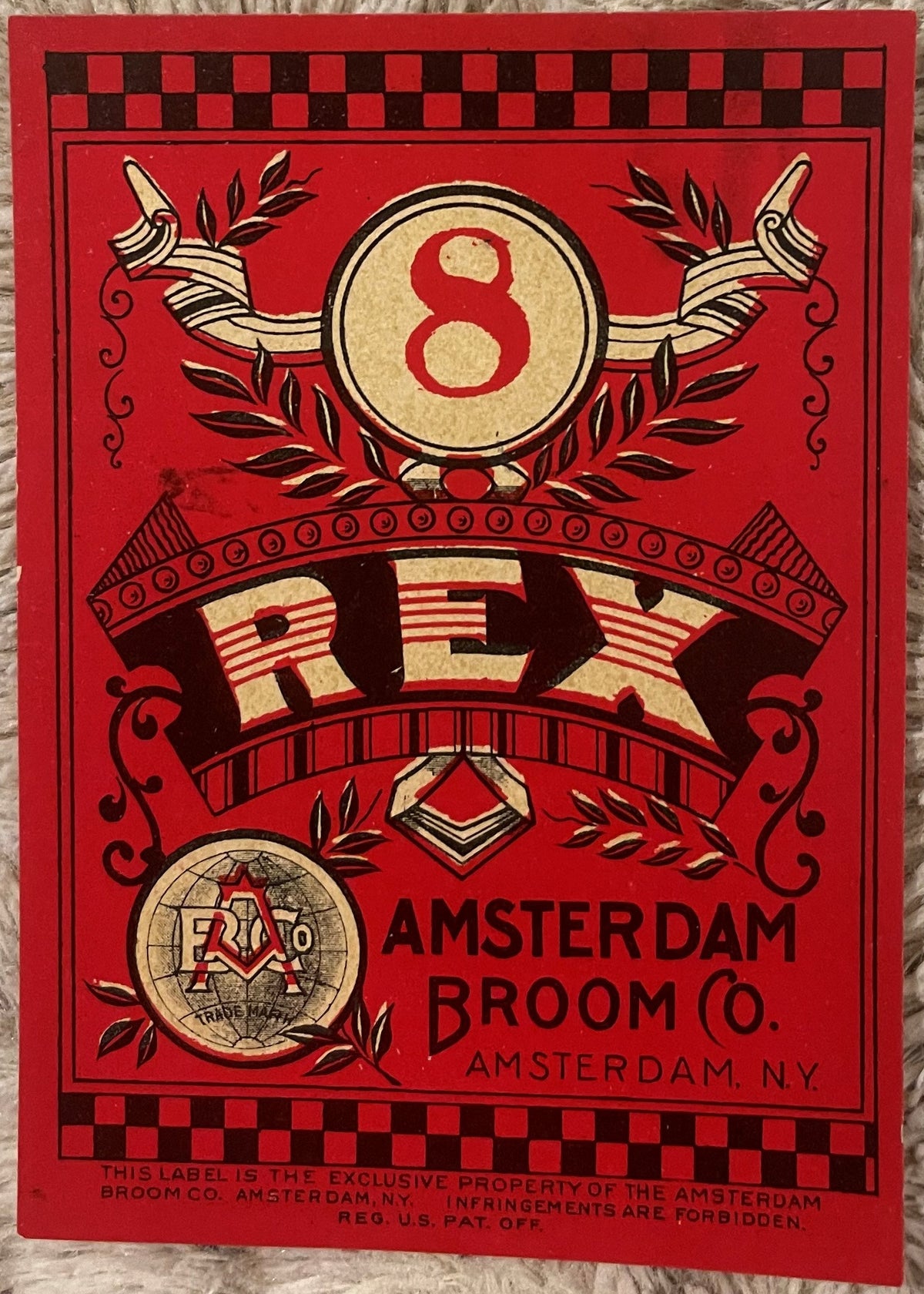
Antique Rex #8 Broom Label 🧹 Amsterdam Broom Co New York NOS Chromolithography Advertising Ephemera

Antique Rex #8 Broom Label 🧹 Amsterdam Broom Co New York NOS Chromolithography Advertising Ephemera

Regular price $8.00 USD
Regular price Sale price $8.00 USD
Sale Sold out
Shipping calculated at checkout.

Size: 4 1/2" x 3 1/2"

🚚 Free US Shipping — ships within one business day. International shipping calculated at checkout.

Quantity

Who Was Julius Wasserman of the Amsterdam Broom Co.? 🧹 Rex No. 8 Broom Label, Amsterdam Broom Co., Amsterdam, New York

Size: 4 1/2" x 3 1/2" ~ NOS unused stock, little to no storage wear.

🧹 What Does It Feel Like to Hold a Century of American Commerce in the Palm of Your Hand?

This one never made it onto a broom handle. No warehouse shelf, no hardware-store peg, no farmhouse closet - just a small rectangle of paper that outlasted the trade it was made for, the factory it was meant for, and very nearly the memory of the company whose name it carries in big bold type. It was printed, put away with the rest of its run, and never glued to anything.

A Rex broom label from the Amsterdam Broom Co. of Amsterdam, N.Y. - a big 8 in a laurel-crowned medallion, REX in bold letters, the company's globe trademark with its A and B, and along the foot the fine print: "This label is the exclusive property of the Amsterdam Broom Co., Amsterdam, N.Y. Infringements are forbidden," with TRADE MARK and REG. U.S. PAT. OFF. They meant it. Yours will look just like this one.

That REG. U.S. PAT. OFF. is the notice the federal trademark law of February 1905 brought in - registered marks were to carry "Registered in U.S. Patent Office" or "Reg. U.S. Pat. Off." - so this label was printed after that, in the early 1900s. REX is Latin for king, and whoever picked the name at Amsterdam Broom wasn't being subtle: a banner across the middle like a royal proclamation, and laurel sprays reaching out both sides of the medallion, the old victory-wreath look borrowed from Roman triumphs, all of it on a household broom. Brooms went out to the trade by number, and collectors read that big 8 as the broom's size or grade in the Rex line. Whoever drew this wasn't just labeling a broom; they were making the case, at a glance across a hardware-store counter, that this was the one to ask for by name. More than a century later, that argument still lands.

🏭 Julius Wasserman's Broom Company

Julius Wasserman started the Amsterdam Broom Company in a three-story building on lower Brookside Avenue in 1884, and his son David came in as a partner in 1889. A 1930s Community Magazine piece says the business grew fast with the work split between them: Julius ran the manufacturing, and David ran the office, bought the raw materials and handled the sales.

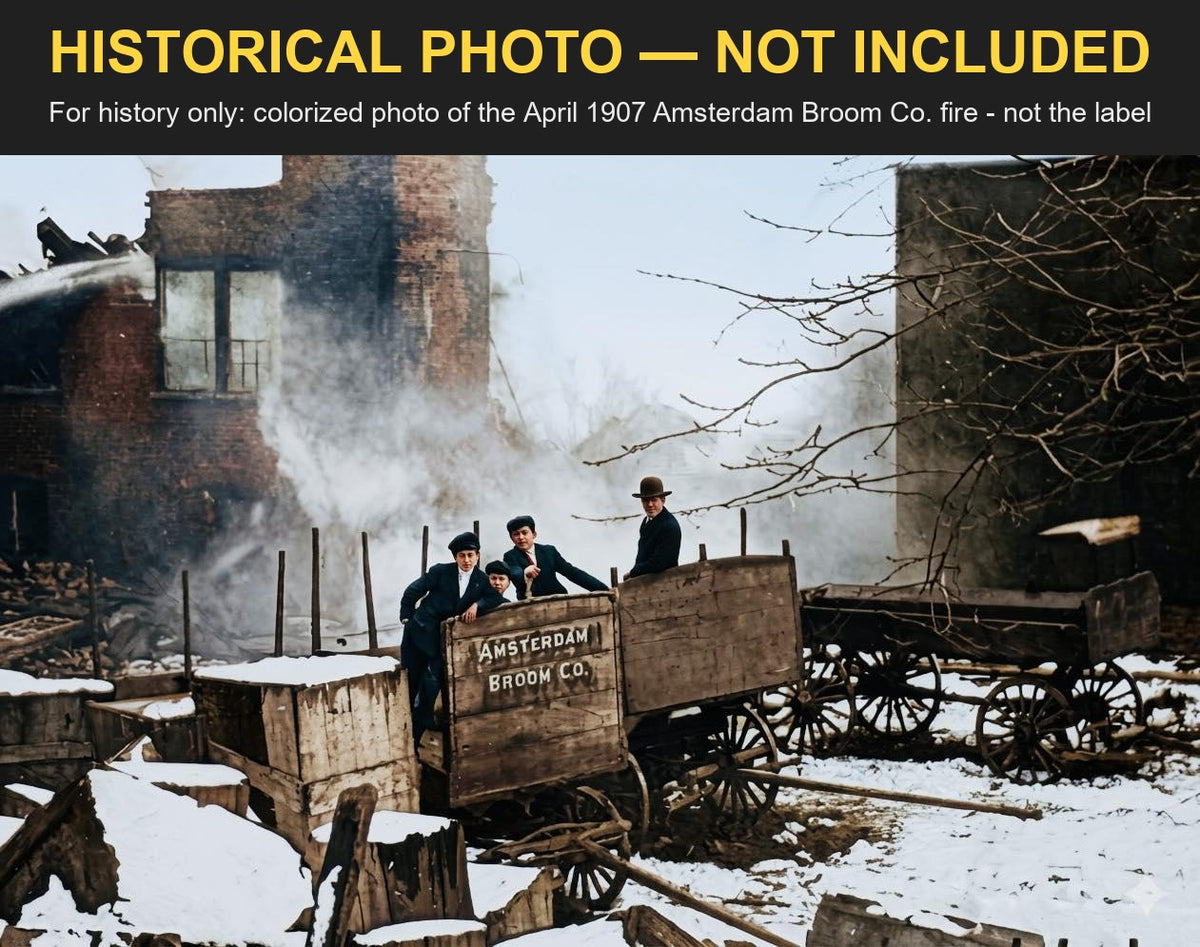
By 1907 they had 169 men working a sixty-hour week, and the Amsterdam Broom name had traveled well beyond the Mohawk Valley - and on April 9, 1907, the plant burned, a loss of around $100,000, the kind of number that put companies under for good in 1907. A Brookside Avenue neighbor spotted the fire and turned in the alarm. William Sullivan of the 8th Ward Fire Company was killed when a wall came down on him, and the main building couldn't be saved, though the firemen got $70,000 worth of broom corn out. The Wassermans kept coffee and sandwiches coming all night. They didn't quit: they moved the office to Main Street, made brooms in the old Globe Mill on Chuctanunda Hill to keep everybody working, and rebuilt bigger on Brookside Avenue - a four-story factory with a sprinkler system, open by that fall, with a brick warehouse next door for the broom corn and room to turn out four million brooms a year. That decision to rebuild rather than retreat tells you about all you need to know about the family. The local history society calls it the largest independent broom concern in the world. Julius, who also served as the city's postmaster, died in 1916; David ran the company through the decades when the vacuum cleaner was shrinking the whole trade - it was the 1930s that really cut into brooms - and he stayed with it until he died in 1957. That's David at the helm through the First World War, the twenties and the Depression.

After David's death the factory went up for sale, and the family sold out in 1957 to the Edy Brush Co. of New York City. Brooms stopped in 1966 - the last broom factory in Amsterdam - and Edy kept making paint brushes, rollers and trays there until Edy Brush closed in the early 1980s. An Amsterdam Brush Corp. was still filing broom trademarks in 1964. The same Amsterdam Brush Corp. filed the EDY mark for paint brushes and rollers in June 1977. The old mill was lost to a fire set by vandals in 2010. A label like this one outlasted the building, the company and everybody who ever worked there. The colorized photo of the 1907 fire, with an Amsterdam Broom Co. wagon out front, is there for the history - it doesn't come with the label.

🏙️ Amsterdam on the Mohawk

Amsterdam sits in Montgomery County on the Mohawk River, about 17 miles northwest of Schenectady and 32 miles northwest of Albany, and brooms were in its bones long before Wasserman. Blood's broom factory, the first big one in town, opened in 1868, and the county gazetteer for 1869-70 already lists the Bronson broom factories - one of them turning out 20,000 dozen brooms a year. By 1912 Amsterdam was the center of broom making for the whole Mohawk Valley, with more than 800 hands at it. Amsterdam made its name as the Carpet City, but brooms were right there beside the carpets - the old city seal, before it was redrawn in 1965, showed carpets, underwear, buttons and brooms, with broomcorn grown up and down the Mohawk River flats. That broomcorn is why the trade took hold here in the first place, though valley farmers had quit growing it by around 1905. New York's broom story actually starts a little east of here: the Shakers at Watervliet were making brooms by 1798.

Hugh Donlon, the Amsterdam Recorder columnist who wrote the city's story down in his book Annals of a Mill Town, claimed the honor for Amsterdam anyway. He said his town had a right to be called New York's first broom-making place, thanks to the broomcorn growing on the islands and flats of the Mohawk right at its door - early on it came from Fort Johnson, Fort Hunter, Fultonville and Amsterdam itself, and only in later years from the western states. He also passed along the trade's own way of talking, which I love: a broom factory was a "shop" no matter how big it got, and the people working in it were "hands." James H. Bronson's shop on Cedar Street had about 175 of them in 1856, a dozen years before Blood's got going, and E. D. Bronson ran another shop on West Main Street. The private shops got a break in 1894, when New York stopped having state prison inmates make brooms, and the trade outlived the Wassermans' fire by decades: Donlon counted 250 hands at the Gardner Broom Company in 1941, turning out 9,000 long-handled sweepers a day. No wonder the old Rug City is also remembered as Broom City.

Broom corn - Sorghum vulgare var. technicum to the botanists - made the plain flat broom that every American home owned around 1900, and every hotel owned a dozen of. The broom makers here were their own trade, not a sideline of the carpet mills: Blood's, Bronson's and the Wassermans' were broom businesses through and through, and they competed on the brand as much as on the broom, which is exactly why a label like this mattered. Amsterdam's mills thinned out through the middle of the century, the same as up and down the Mohawk Valley, and the paper that went with them is a lot of what's left.

🧹 The Brands

Rex, Brookside and Gold Bond were all Amsterdam Broom brands. City historian Robert von Hasseln counted Gold Bond and Brookside among the company's best-regarded brooms. Brookside, you'd have to think, was named for the street the factory stood on.

🖨️ How Labels Like This Were Printed

Labels like this came out of the age of color lithography. From about the 1860s into the early 1900s, chromolithography - a separate stone or plate for each color, laid down one pass at a time in careful register - was how America printed in color, and big shops in New York, Chicago and Cincinnati turned out trade cards, cigar box labels, seed packets and, yes, broom labels. There's no printer's name anywhere on this one, so who ran it off is anybody's guess. The deep red ground, the shadowed REX letters, the checkerboard bands top and bottom - that's the trade's look at full confidence, from the years when American makers figured out that the label was the advertisement.

🖼️ Framing It, Keeping It

At 4 1/2 by 3 1/2 inches (about 11.4 x 8.9 cm), it sits nicely in a standard 5x7 frame with a mat cut to the label, or float-mounted with no mat over the edges so the checkerboard bands show all the way around. Use archival corners or a foam mount rather than glue. If you'd rather keep it in a collection than on the wall, an acid-free polyester (Mylar) sleeve in a 4x6 or 5x7 size and a flat acid-free box, out of direct light and damp, will hold it just as it is.

  • 🍳 A kitchen or mudroom gallery wall with other old household labels - seed packets, soap wrappers, trade cards
  • 📚 Leaning in a small easel on a library or study shelf, where it reads as exactly what it is: a piece of printed Americana with a story behind it
  • 🖼️ Framed beside a period photograph of a broom factory or a Mohawk Valley street scene, or next to an old Amsterdam or Montgomery County map
  • 🧺 With a vintage hardware catalog open to the broom pages and a little antique broom, for a tabletop display that tells the whole story of the trade
  • 🏡 A farmhouse sideboard with ironstone and old wood, where that red holds its own without shouting

It goes to the advertising-ephemera crowd, the New York State and Mohawk Valley history folks, printing-history people, and kitchen-antiques collectors building a room around household life before plastic packaging - for them a broom label from the days of the coal-fired kitchen stove is exactly the right note. It makes a good gift for anyone who collects New York history: specific enough that it never feels like a generic antique.

Wonderful framed for anyone with Mohawk Valley roots. The supply is finite - nobody's printing Rex No. 8 broom labels again, and once these last unused ones are gone, they'll be very difficult to acquire.

Shipping

🚚 Shipping & Handling

  • Shipping costs and timing are calculated at checkout.
  • Items curated and shipped directly by me include U.S. shipping at no additional cost, professionally packed to ensure safe arrival of your artifact.

Items from Vetted Pro Collectors
Shipping for items offered by vetted Pro Collectors is determined at checkout. All Pro Collector listings are reviewed to ensure fair, reasonable shipping practices.

For full details, please refer to our Shipping Policy.

Returns & Exchange

Take your time — you've got a full six months. If a piece isn't right for you, send it back the way it reached you and we're good.

In the first 30 days your money goes straight back the way you paid. After that it's store credit, so you can put it toward something you'd rather have.

Return shipping we sort out between us, case by case. I don't make this difficult.

If something arrives damaged, or it isn't what I said it was, send me a photo within 48 hours and I'll make it right.

Email info@vintageantiquesgifts.com or call 802-356-9872 — that's me answering, not a call center.

The only things I can't take back are custom or special-order pieces and gift cards.

View full details
  • 5 stars: 2 (100%)
  • 4 stars: 0 (0%)
  • 3 stars: 0 (0%)
  • 2 stars: 0 (0%)
  • 1 star: 0 (0%)
a
annmarie2390

Label is beautiful and just as described ! Very quick shipping and great care taken with packaging !!! I loved the letter and bonus items and I feel like I'm part of the family !!! Extremely happy with purchase !! A+++++++++

Of course, you are part of the family! We love making new friends and family all over and the connections we make are very special and each one is unique to us. We really appreciate your kind words and support!

g
gbrex

Great Transaction,Thanks

Thank you so much for the kind words! We really appreciate it. My dad had to take a break for a bit so I apologize for the delay in responding. We hope to work with you again in the future!

Rescuing American History Since 2007

— Travis & the Kids