Skip to product information
1 of 1

Vintage and Antique Gifts

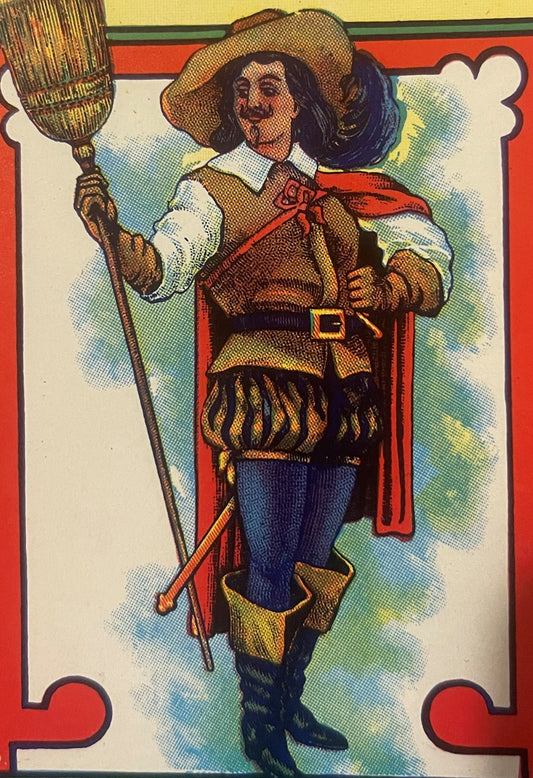
Vintage 1950s-60s Our Leader Toy Soldier Broom Label 🧹 Art Deco Marching Band Litho NOS Advertising Art #49

Vintage 1950s-60s Our Leader Toy Soldier Broom Label 🧹 Art Deco Marching Band Litho NOS Advertising Art #49

Regular price $7.00 USD
Regular price Sale price $7.00 USD
Sale Sold out
Shipping calculated at checkout.

Size: 6" x 3 1/2"

🚚 Free US Shipping — ships within one business day. International shipping calculated at checkout.

Quantity

What Survives When Everything Was Made to Be Thrown Away? 🎖️

Size: 6" x 3 1/2"

There is a particular kind of wonder that comes over you when you hold something that was never supposed to last. Not a portrait painted for posterity, not a commemorative medallion struck for a veteran's mantelpiece, but a broom label: a rectangle of printed paper meant to be pasted onto a wooden handle, sold to a housewife or a janitor, and swept into oblivion one kitchen floor at a time. The printer who ran it through the press knew it would be destroyed. The shopkeeper who stacked a gross of them in the back knew it too. And yet here it is, crisp and vivid, never having touched a single broom handle in its entire existence.

That is the quiet miracle of New Old Stock ephemera. This is the "Our Leader" broom label, NOS, a lithographed piece of American commercial art, and I think it deserves a frame.


🎨 What This Is

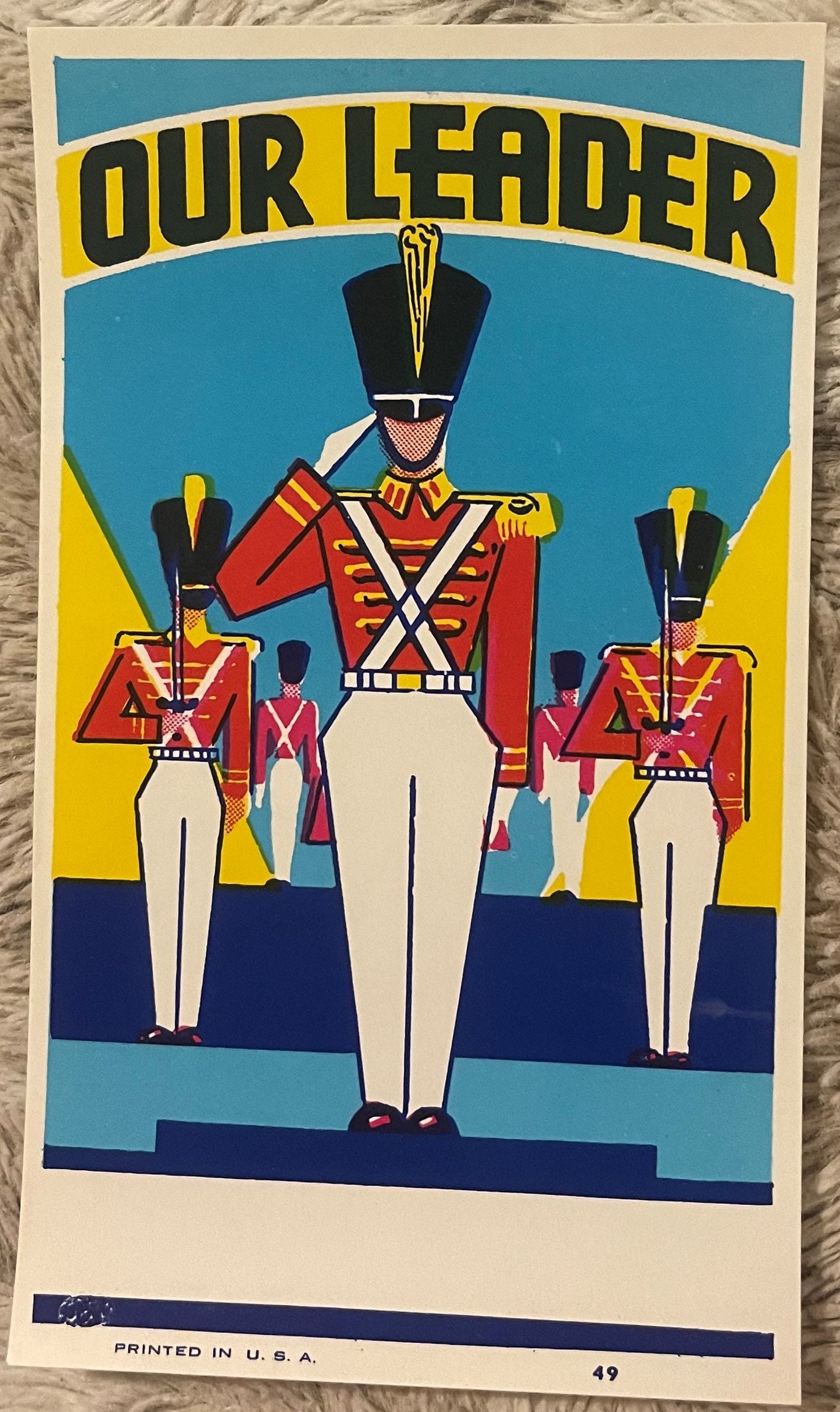
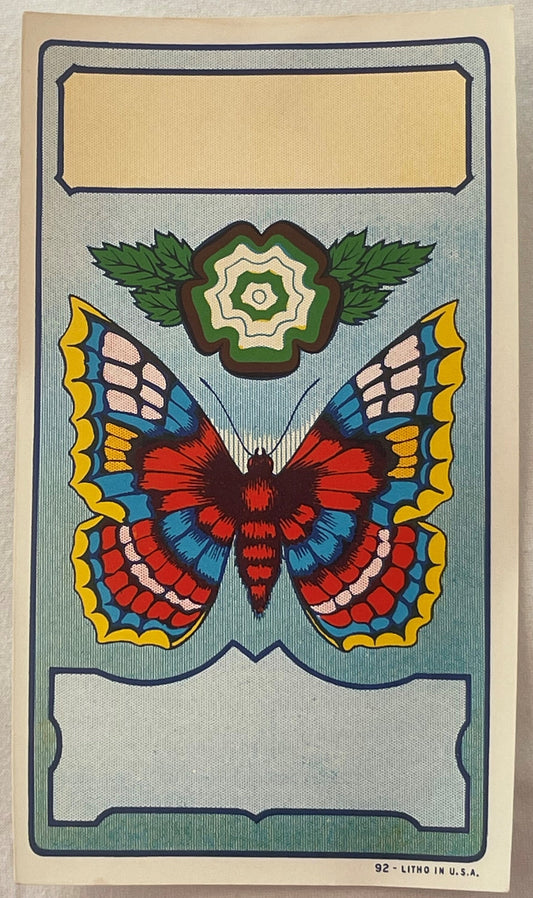
The label is a tall, narrow 6 x 3.5 inches, sized to wrap neatly around a broom's handle. It was printed in the United States, as its own foot line says, and it is a stock label: the name OUR LEADER is part of the artwork, and the open cream panel near the bottom was left for a broom maker to add a company name, a town or a grade. It never got one.

The condition is New Old Stock (NOS): it was printed, bundled and never used. It never went to a broom factory, never got trimmed or pasted. Whatever storage kept it safe, the result is a label that presents the way it left the press, with clean margins and no creases. Most broom labels that turn up are used, trimmed or adhesive-backed remnants pulled off old brooms during estate cleanouts. An unused one is a different category of find.


🔢 Ordered by Number, Printed in the 1950s-60s

That small "49" at the foot is how a broom maker ordered it. Numbered stock labels like this were sold by John L. Denning & Company of Wichita, Kansas, a broom-corn house that began in 1924 and grew to fourteen branches in different states. Denning's sample booklet said "Order by Number Only" on the cover and wouldn't take an order for fewer than 1,000 of any design, and these same toy soldiers, with this same "PRINTED IN U.S.A." foot line and number, turn up among the loose labels in a collector's lot of Denning material.

The wording is what dates the printing. The booklet's own pages read "NN LITHO IN U.S.A.," and because the booklet carries a "Wichita 1" postal-zone address, it was printed between 1943, when zones began, and 1963, when ZIP codes replaced them. "PRINTED IN U.S.A." is the later wording in the series, the one that turns up on imprints carrying ZIP codes, and that puts this printing in the 1950s-60s. The look of the art doesn't date it: the same booklet sold an Edwardian lady and a Victorian-style peacock right beside a cartoon bird in 1950s style, so a streamlined Art Deco design was simply stock art that stayed on the shelf.


🥁 The Design: Military Illustration at Its Most Commanding

The central figure is a lead marching soldier in full dress uniform, a toy-soldier officer in a tall plumed shako with white cross-straps over his tunic, his hand raised in a salute that is not the casual acknowledgment of a parade-route soldier but the stiff, deliberate, eyes-forward salute of someone who knows he is being watched. Two more soldiers flank him at a reduced scale, with others marching away behind, and rays fan out behind the group as if the central figure were lit from within, the source of the light rather than merely standing in it. The composition is bilateral and perfectly balanced, the way a military review is, by design and by discipline.

Across the top, arching in heavy black letters, are the two words OUR LEADER. It is not "Our Broom" or "Our Brand" or any of the literal, product-forward names that lesser broom labels carried. It is a claim, a declaration that whatever you are about to sweep your kitchen floor with is led by someone worth following. Whoever chose it understood that aspiration sells harder than description, and that a household product named after a heroic abstraction will outlast one named after its function.


🏭 The Broom Label Industry: A Lost American Commercial Art Form

American broom manufacturing was a genuinely significant domestic industry, centered heavily in the Midwest, particularly in Illinois, where Arcola earned the informal designation "Broom Corn Capital of the World," but with production facilities and regional jobbers scattered across the country from New England mill towns to the Great Plains communities where broomcorn was grown as a cash crop. The trade supported an entire ecosystem: broomcorn brokers, wire and twine manufacturers, wooden handle mills and, critically for our purposes, the commercial lithography shops that produced the labels, hangtags and wrappers that gave each manufacturer's product its shelf identity.

Broom labels occupy a fascinating niche as a collecting category precisely because they were produced with such consistent graphic ambition for a product so aggressively utilitarian. The competition on a hardware store shelf full of nearly identical brooms was entirely visual, and the people who designed these labels knew it. The result was an arms race of color, imagery and naming that produced some of the most vivid small-format commercial art in the store. Military themes were especially popular, because martial imagery carried connotations of discipline, reliability and authority that translated well to a domestic cleaning product. A broom that marched, that saluted, that led: that was a broom you could trust.

The economics of the stock label made all of this possible. A printer ran a strong central design in bulk and left room for each customer's name, and a small broom company could order the design by number and have its own name added, getting professional lithography without commissioning custom artwork. No printer's name appears on the label or on Denning's booklet, so the press and the artist stay anonymous, and the surviving labels are their work.


🖼️ Display Ideas

  • 🪖 Frame it solo in a deep shadowbox with a navy or gold mat. The tall 6 x 3.5 inch format sits comfortably in a 5 x 7 opening with a generous border, and the rays fan outward into the negative space.
  • 🥁 Group it with other American military ephemera, such as patriotic trade cards or marching band sheet music covers, in a gallery wall arrangement organized around a red, white and blue palette.
  • 🏛️ Lean into the Art Deco look by pairing it with other geometric, sunburst-motif pieces, a Deco tin or a period magazine cover, letting "Our Leader" anchor the display as its smallest and most concentrated example of the style.
  • 🎨 Use it as part of a commercial art study display alongside other NOS labels, such as fruit crate labels, cigar bands and seed packets, to show the range of the lithographer's art across product categories.
  • 📚 Archive it in a Mylar sleeve in a flat file if display isn't your immediate plan. NOS paper this clean deserves acid-free storage and a stable environment.
  • 🏠 Display it in a vintage-themed kitchen, mudroom or entryway, where its original domestic context resonates. There is something deeply right about a broom label displayed near the space it was designed for, elevated now to wall art rather than discarded as packaging.

🎁 Who Collects These

The collector universe for a piece like this is wider than you might expect. At the center are paper ephemera specialists, people who understand lithography as a fine art medium and collect advertising labels across all categories with the rigor a fine art collector brings to prints. For them NOS condition is the decisive factor, and a broom label is valued on the same terms as a cigar label or a seed packet: as an example of the printer's art in its ideal state.

Alongside them are Art Deco collectors, who recognize in the sunburst and bold letterforms the same visual grammar they find in Deco poster art and streamlined industrial design. For them the label's scale is part of its appeal, a concentrated, affordable, displayable piece of a visual style that is otherwise represented by large and expensive objects.

Military and patriotic Americana collectors are a third community, particularly those who focus on marching band and dress uniform imagery and on the way American commercial culture absorbed military iconography in peacetime. The "Our Leader" soldier is not a combat figure. He is a parade figure, a figure of national pride rather than national crisis, and that places him in a specific and beloved niche.

Finally there are decorator-collectors, people who want a piece of vivid, authentic American commercial art for a wall without paying fine art prices, and who will frame it, hang it, and answer "where did you get that?" with a story worth telling. Those are the people this label was always going to end up with.


❓ Frequently Asked Questions

What exactly does "NOS" mean, and how does it affect the value of this label?

NOS stands for New Old Stock, meaning the item was manufactured but never used for its intended purpose. In the case of this broom label, it was printed, warehoused and never applied to a broom handle. It has not been trimmed, pasted, soaked off or handled commercially. A NOS example represents the item as the printer intended it to look, on paper that hasn't been compromised by adhesive or humidity.

How was it printed?

By lithography, which prints from a flat surface that holds ink only where the image was drawn. This is ordinary commercial lithography: a handful of flat inks, with the pink of the faces and the soft tones built from fine dot screens. The "LITHO" and "PRINTED" wording in the foot lines of this numbered series describes exactly that.

How should I store or display this label to preserve it long-term?

If you're framing it for display, the most important considerations are UV-filtering glazing, acid-free matting and backing, and keeping it out of direct sunlight and away from humidity fluctuations. A deep shadowbox gives the best presentation while keeping the label from touching the glazing. If you're archiving, a Mylar (polyester) sleeve, not a PVC sleeve, which off-gasses over time, in a flat file or archival box with acid-free tissue is the preferred method.

What is the significance of the "Our Leader" name, and was it a regional brand or a national one?

The name is part of the stock art, so any broom maker who ordered design 49 got a label reading OUR LEADER, with room to add their own name in the open panel. That fits the naming habits of the broom trade, where regional and national makers competed with aspirational, patriotic and character-driven brand names such as "Old Reliable" and "Eagle Brand" rather than company names, sometimes regionally and sometimes by several makers at once. What is certain is that the name was chosen for its authority and its implied promise: this broom leads, this broom is the one worth following.

What is the size, and how does it fit into standard framing options?

The label measures 6 x 3.5 inches, a tall, narrow vertical format. A 5 x 7 inch frame with a mat opening slightly smaller than the label gives a clean, gallery-style presentation with good border space, and an 8 x 10 frame with an adjustable mat gives even more breathing room, which suits the design. For a shadowbox, standard 5 x 7 or 4 x 6 shadowbox frames will accommodate the label comfortably, and a navy or gold mat is particularly effective.

What do the "PRINTED IN U.S.A." line and the number 49 mean?

The "49" is the design number a broom maker ordered by, and the "PRINTED IN U.S.A." is the foot-line wording of the later printings of that numbered series, where earlier pages read "LITHO IN U.S.A." Together they tie the label to the numbered stock series sold by John L. Denning & Company of Wichita, Kansas, and they are why it dates to the 1950s-60s.

What other types of collectors or collections does this label complement?

The crossover appeal is broad. For Art Deco collectors, the sunburst geometry and bold typography fit alongside period posters and streamlined objects. For military and patriotic Americana collectors, the dress uniform imagery, the saluting figure and the name connect to a rich tradition of martial iconography in peacetime commercial art. For advertising and trade card collectors, it is lithography at full commercial confidence. For broom and domestic tool collectors, a specialized but devoted community, it is NOS, unused and beautifully designed. And for anyone who loves a vivid, authentic American object with a story attached, it is something made to be thrown away that chose, stubbornly and magnificently, not to be.

Shipping

🚚 Shipping & Handling

  • Shipping costs and timing are calculated at checkout.
  • Items curated and shipped directly by me include U.S. shipping at no additional cost, professionally packed to ensure safe arrival of your artifact.

Items from Vetted Pro Collectors
Shipping for items offered by vetted Pro Collectors is determined at checkout. All Pro Collector listings are reviewed to ensure fair, reasonable shipping practices.

For full details, please refer to our Shipping Policy.

Returns & Exchange

Take your time — you've got a full six months. If a piece isn't right for you, send it back the way it reached you and we're good.

In the first 30 days your money goes straight back the way you paid. After that it's store credit, so you can put it toward something you'd rather have.

Return shipping we sort out between us, case by case. I don't make this difficult.

If something arrives damaged, or it isn't what I said it was, send me a photo within 48 hours and I'll make it right.

Email info@vintageantiquesgifts.com or call 802-356-9872 — that's me answering, not a call center.

The only things I can't take back are custom or special-order pieces and gift cards.

View full details

Preserving History: Authentic Objects Across Eras

— Curated by Travis Weigel