Skip to product information
1 of 5

Vintage and Antique Gifts

Antique Hamburg Broom Works No. 10 Warehouse Corn Round Rattan Broom Label 🧹 Cavalier Lithograph Hamburg PA 1910s

Antique Hamburg Broom Works No. 10 Warehouse Corn Round Rattan Broom Label 🧹 Cavalier Lithograph Hamburg PA 1910s

Regular price $7.00 USD
Regular price Sale price $7.00 USD
Sale Sold out
Shipping calculated at checkout.

Size: 5 1/2" x 4"

🚚 Free US Shipping — ships within one business day. International shipping calculated at checkout.

Quantity

What Was the Hamburg Broom Works? 🧹 The "Most Modern Broom Plant in the World" Is a Parking Lot Now. The Cavalier Survived.

Size: 5 1/2" x 4"

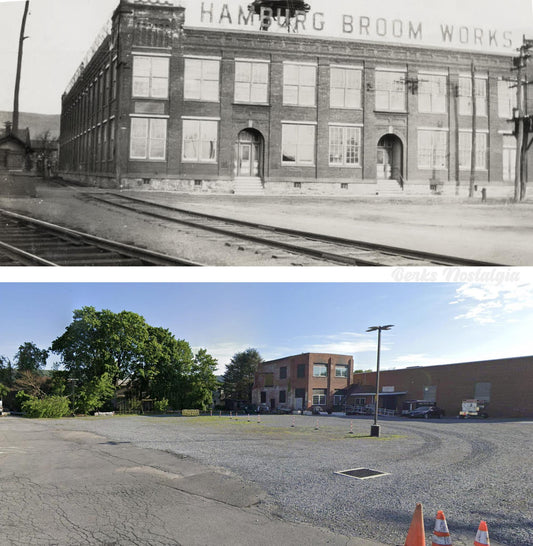
In 1912, Hamburg Broom Works of Hamburg, Pennsylvania, published a catalog whose title did not believe in modesty: Brooms: The Most Modern Broom Manufacturing Plant in the World. At the time it was turning out 6,000 corn brooms a day. The brick plant Wilson E. Schmick built for it has since been torn down, and its ground serves as a downtown parking lot. What remains are small paper survivors like this one: a No. 10 WAREHOUSE, Corn & Round Rattan label starring a swaggering cavalier who holds a broom like a battle standard. It was printed to be pasted on a broom handle. It never was.


🔍 What You're Looking At

A 1910s Hamburg Broom Works broom label, New Old Stock, measuring 5.5 x 4 inches and taller than it is wide.

  • Header: a yellow panel printed No. 10 WAREHOUSE over Corn & Round Rattan.
  • The figure: a cavalier in a broad tan hat with a dark blue plume, long dark hair, a mustache and small pointed beard, a white falling collar and full white sleeves, a brown jerkin, a red cape tied at the chest with a red bow, a black belt with a gold buckle, striped puffed breeches, blue hose and tall black boots with wide tan cuffs. A sword hangs at his hip. One gloved hand rests on his belt; the other holds a corn broom upright by its long handle.
  • Frame: a bold red border outlined in green and black, around a white panel with scrolled corners and a soft blue-green cloud behind the figure.
  • Footer: a blue panel reading Hamburg Broom Works over HAMBURG, PA.
  • Small print: the imprint R.J.K & Co. in the lower left corner of the red frame and the number 934 in the lower right.
  • Margin: a printer's registration crosshair in the unprinted strip along the left edge, the kind of target used to line up each color pass on the press.
  • Printing: up close, the cavalier's face, clothes and shading are built from a fine halftone dot screen.
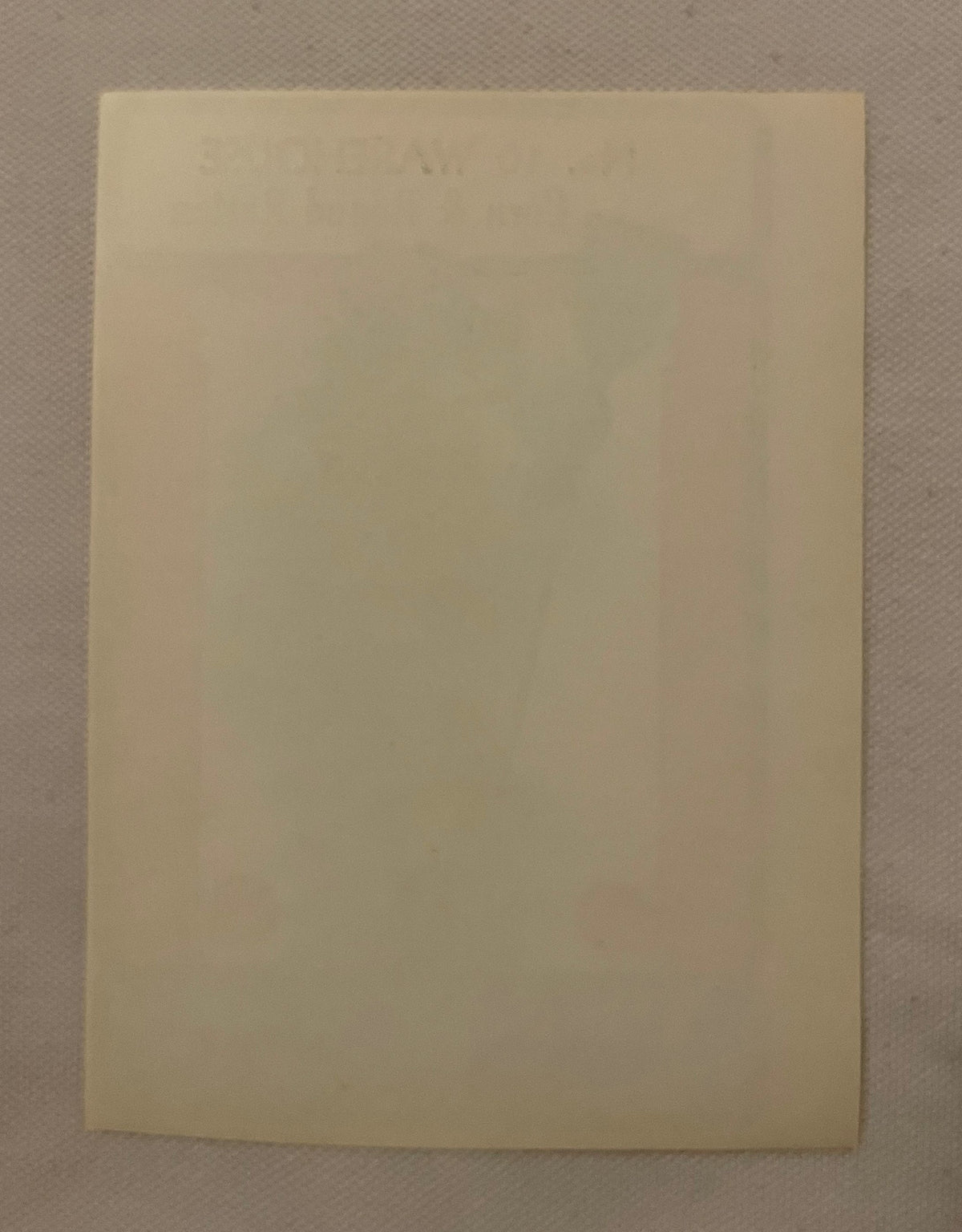
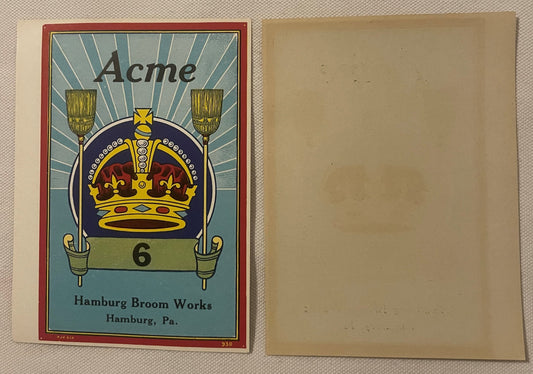
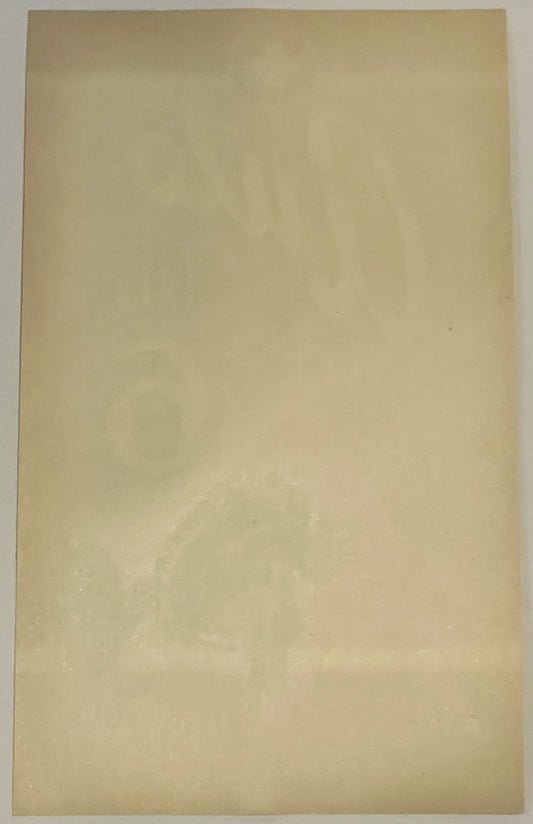
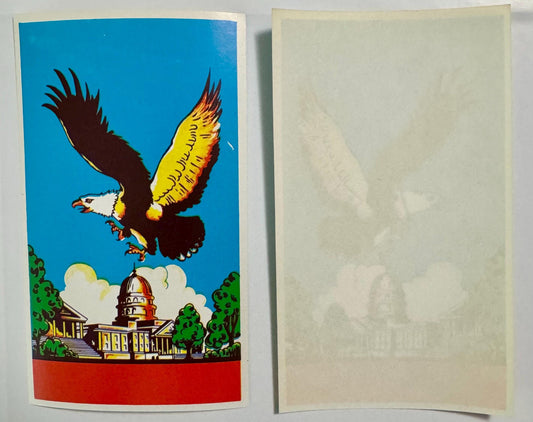
  • Back: blank cream stock, with the front printing showing faintly through in reverse.

🏭 Wilson E. Schmick's Hamburg Broom Works

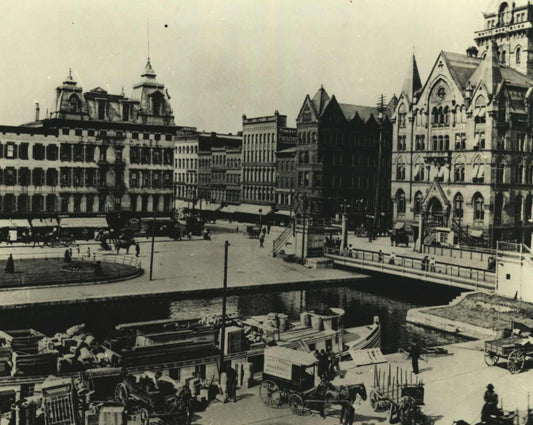
Wilson Schmick established Hamburg Broom Works in 1894. Its first home was in West Hamburg, just south of the Philadelphia & Reading railroad station, and the business grew until it had no room left there. In 1911 Schmick spent $25,000 on a new plant at 2nd and Pine Street, a brick building of modern design meant to let in an abundance of light. An old photograph shows it with HAMBURG BROOM WORKS spelled across the roofline in giant letters and railroad tracks running along the front.

The 1912 catalog that called it the most modern broom plant in the world was an illustrated trade book, showing the line with notes on each broom's specifications and proper use. At the top sat the Eclipse, billed as "The Finest of the 'Silk Ribbon Brooms'". The Model Garage was made for all kinds of cement floors. Whisks and toy brooms rounded it out. The same 1912 catalog also listed two brooms whose names speak to America's racist past: "Topsy" and "Uncle Tom."

In 1921 Schmick decided to downsize and sold the 2nd and Pine building to the Burkey Underwear and Hosiery Company, which expanded it in 1927 and again in 1931. Wright's bought the buildings in 1974 and ran them until they finally closed. The company was a public entity from 1923 to 1999, then went private, and in later years it became one of the assets of Hamburg Industries, Inc. Under that name the broom business itself carried on, making mops, brushes and upright brooms. EPA's Superfund records list a site named Hamburg - Broom Works, Inc. at 2nd and Walnut Streets in Hamburg, a removal-only site that is not on the National Priorities List.


🌾 What "Warehouse, Corn & Round Rattan" Means

Corn is broomcorn, a sorghum grown not for grain but for its long, stiff tassel fibers. Round rattan is cane from the rattan palm, blended in with the broomcorn. Warehouse names the job: a big upright broom for hard work on wide floors.

The name outlived the company. Broom makers still sell the "warehouse corn and rattan broom" today, one current version mixing 65% broomcorn, 20% rattan and 15% sotol fiber, sold for sweeping up heavy and medium debris. The grade printed across the top of this label is a product a buyer can still order by the same words.


📜 How America Learned to Make a Broom

Benjamin Franklin grew French broom, and Thomas Jefferson took up the practice and had broomsticks made from the plant. The real turning point came in 1797 in Hadley, Massachusetts. The story goes that a farmer named Levi Dickenson made a broom for his wife from the tassels of the sorghum he was growing for seed, and it swept so well that his neighbors wanted one too.

In 1798 the Shaker Theodore Bates invented the flat broom. In 1810 came the foot-treadle broom machine, which played an integral part in turning broom making into an industry. The United States had 303 broom factories by 1839. The count peaked at 1,039 in 1919, then fell to 320 by 1939 as the Great Depression thinned the trade. Hamburg Broom Works rose and sold its big plant inside that arc.


🚂 Hamburg, Pennsylvania: Canal Boats, Railroads and King Frost

In 1772 Martin Kearcher received a patent for 250 acres along the Schuylkill River, a tract already named Hamburg. His son laid out the town in 1779, and for years locals called it Kearchertown. Hamburg became a borough by Act of Assembly on April 3, 1837.

Transportation made the town. A canal was built along the east bank of the Schuylkill from 1815 to 1822 and opened to traffic in 1824, and for forty years Hamburg was a great boat-building borough, until the canal was leased to the Philadelphia & Reading and the demand for boats was gone for good. The railroad reached Hamburg in 1842, linking it with Philadelphia and Pottsville. Over the years Hamburg's industries turned out canal boats, carriages, furniture, trucks and fire engines, iron stoves, bricks, brooms, silk goods, knitted garments, ice cream, iron and steel castings and boilers. A few square blocks in the southwest part of town held more than a dozen substantial foundries, plants and mills that employed thousands of people, and Hamburg was once reputed to have more jobs per capita than any other town in the country.

The town also knew how to throw a party. In 1910 Jack Walker came up with the idea of a King Frost Carnival, a Halloween and harvest parade with horse-drawn floats along a route lit by torches, and the Hamburg Item estimated early crowds at 15,000. The Hamburg Area Historical Society has a photograph of a Hamburg Broom Works float in one of the earliest King Frost Parades. In 1916 there was no parade at all, called off over the threat of war, a polio epidemic and the rebuilding of the State Street bridge over the Schuylkill Canal. By 1924 King Frost had a queen, Elda Dietrich, and 50,000 people lined the streets. Highway traffic and World War II ended the tradition, until the Hamburg Jaycees revived it in 1964. It has been held on the last Saturday evening of October ever since, except in 2020, and today the parade runs more than three hours. Go some October and picture a Hamburg Broom Works float rolling through town in one of those early parades, from a company that was turning out 6,000 brooms a day by 1912.


⚔️ The Cavalier

He is dressed for a duel, not a warehouse floor: plumed hat, white falling collar, cape, sword and cuffed boots, the romantic look of a 17th-century cavalier. He does not sweep. He poses, broom raised like a standard, hand on his belt, and lets the label do the selling. Set against the plain words No. 10 WAREHOUSE, the effect is half heroic and half funny, and he still stops people today.

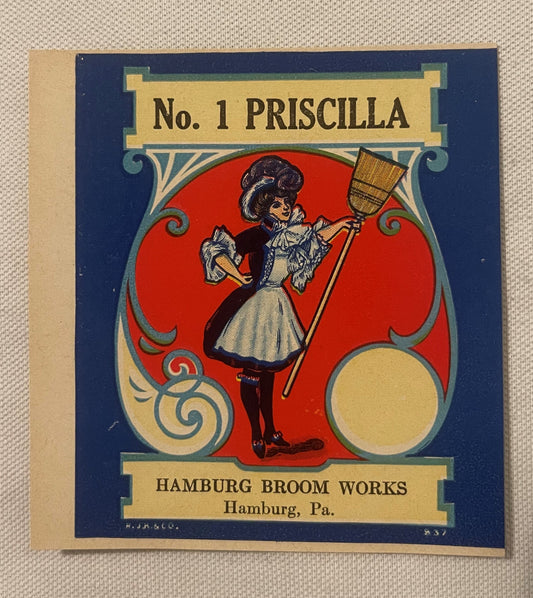
Hamburg Broom Works put other pictures on its labels too, among them a locomotive and an Indian Queen brand showing a Native American woman before a camp of tepees. Local collector lore holds that Hamburg Broom Works took the locomotive into its advertising as a nod to the railroad that made the factory possible. Hamburg had another broom maker with labels of its own, the Windsor Broom Co., whose brands included Auto and Winner.


🎁 Good For

  • 🖼️ Framing — a portrait-shaped label with a bold red frame and a figure that reads from across the room.
  • 🏡 Berks County and Pennsylvania history collections — the maker and the town are printed right on the face.
  • 🧹 Broom, brush and household-tool collectors — a named maker and a named grade.
  • 🚂 Hamburg family history — for anyone whose people worked the town's plants, mills and rail yards.
  • ⚔️ Cavalier and swashbuckler art — a paper hero who sold brooms.

❓ Questions People Ask

Was this label ever put on a broom?

No. It is New Old Stock. The back is blank paper with no glue marks, only the front design showing faintly through the sheet.

How old is it?

It is a 1910s label from a company Wilson Schmick started in 1894. Nothing on the sheet is dated, but the tiny imprint in the lower left reads R.J.K & Co. — read as R. J. Kittredge & Co., the Chicago label house documented printing labels from 1911 through 1920 — and Schmick had just put up his new plant at Second and Pine in 1911.

What is the little target in the left margin?

A registration mark, the crosshair printers used to line up each color on the sheet. It sits in the unprinted strip along the label's left edge.

Where was Hamburg Broom Works?

In Hamburg, Berks County, Pennsylvania, on the Schuylkill River. Its 1911 plant stood at 2nd and Pine Street; after Burkey Underwear and then Wright's, the building came down and the lot is now parking.

What is round rattan doing in a broom?

It is blended with the broomcorn fibers. Heavy-duty warehouse brooms are still made from that corn-and-rattan mix today.

Shipping

🚚 Shipping & Handling

  • Shipping costs and timing are calculated at checkout.
  • Items curated and shipped directly by me include U.S. shipping at no additional cost, professionally packed to ensure safe arrival of your artifact.

Items from Vetted Pro Collectors
Shipping for items offered by vetted Pro Collectors is determined at checkout. All Pro Collector listings are reviewed to ensure fair, reasonable shipping practices.

For full details, please refer to our Shipping Policy.

Returns & Exchange

Take your time — you've got a full six months. If a piece isn't right for you, send it back the way it reached you and we're good.

In the first 30 days your money goes straight back the way you paid. After that it's store credit, so you can put it toward something you'd rather have.

Return shipping we sort out between us, case by case. I don't make this difficult.

If something arrives damaged, or it isn't what I said it was, send me a photo within 48 hours and I'll make it right.

Email info@vintageantiquesgifts.com or call 802-356-9872 — that's me answering, not a call center.

The only things I can't take back are custom or special-order pieces and gift cards.

View full details

Preserving History: Authentic Objects Across Eras

— Curated by Travis Weigel