Skip to product information
1 of 1

Vintage and Antique Gifts

Vintage 1940s Rose Broom Label 🌹 New Old Stock No. 7 | Yellow & Blue Floral Litho Art

Vintage 1940s Rose Broom Label 🌹 New Old Stock No. 7 | Yellow & Blue Floral Litho Art

Regular price $5.50 USD
Regular price Sale price $5.50 USD
Sale Sold out
Shipping calculated at checkout.

Size: 6" x 3 1/2"

🚚 Free US Shipping — ships within one business day. International shipping calculated at checkout.

Quantity

Why Did a Broom Need a Rose? 🌹 Vintage 1940s Rose Broom Label, New Old Stock

Size: 6" x 3 1/2"

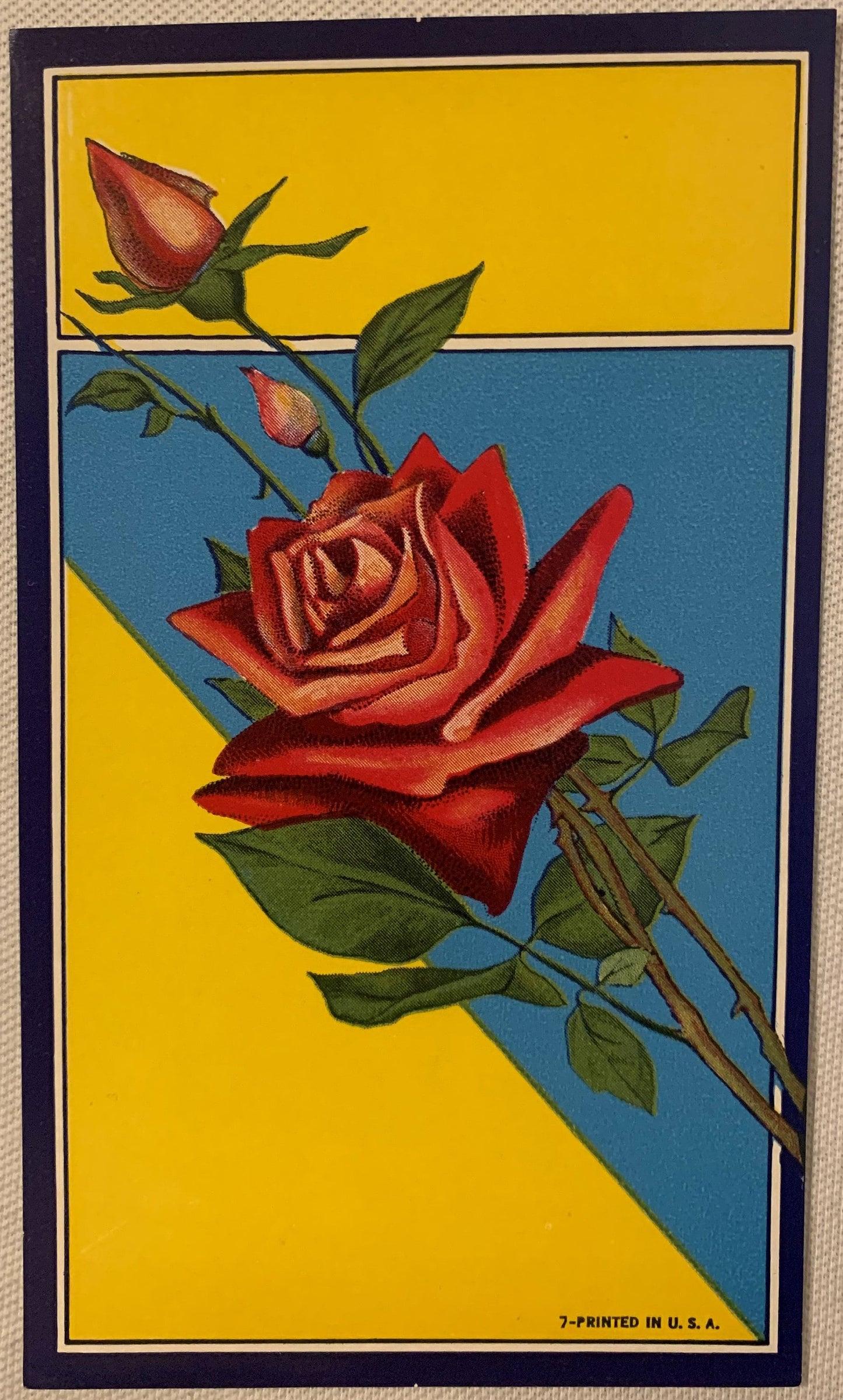
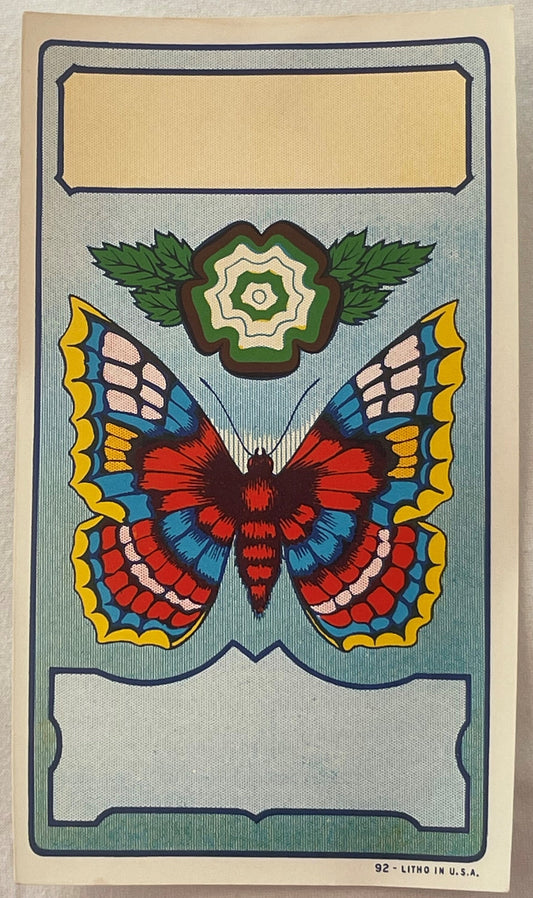
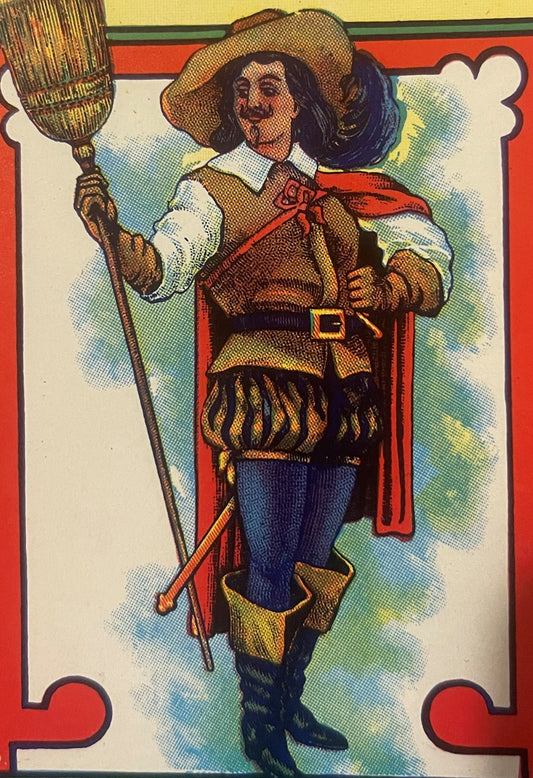
🌹 Nobody frames a broom. But Americans once bought them by the tens of millions, and to make one broom stand out from the next, its maker pasted on a label like this: a big red rose in full bloom, a bud reaching up into an empty yellow panel, all on a sky-blue and yellow field inside a navy border. This vintage 1940s rose broom label was never used, and it comes out of an industry that once ran more than a thousand broom factories and has all but vanished from the United States, with a history that runs through a Ben Franklin legend, a Massachusetts farmer's wife, the Shakers, and a New Deal law that sent federal broom orders to blind workers.

The Label

The label is 6 x 3.5 inches, one red rose in full bloom with a bud climbing above it, and in tiny capitals in the corner it reads 7-PRINTED IN U.S.A. It is new old stock, never pasted onto a broom.

Broomcorn and the Legend of Ben Franklin's Seed

The American corn broom begins with a plant and a story. Broomcorn is a sorghum grown for its long, stiff seed heads rather than for grain. The legend, as an 1899 Idaho Statesman story told it, is that Benjamin Franklin found a single seed on a whisk broom brought from England, planted it, and started every broomcorn crop in America; other tellings bring the broom from France. The documents tell it differently. On February 21, 1757, Franklin wrote from Philadelphia to his sister Jane Mecom, sending her some "whisk-seed" he had picked up in Virginia the spring before. Arcola, Illinois kept the legend anyway. The self-proclaimed Broomcorn Capital of the World commissioned sculptor Jerry McKenna to make a statue of Franklin leaning on a broom, and Arcola is also home to the Thomas Monahan Company, founded there in 1922, which grew into the world's largest maker of broom and mop handles.

Levi Dickinson, the Shakers and the Flat Broom

The first broomcorn broom made for sale in America is credited to Levi Dickinson, a farmer in Hadley, Massachusetts, who in 1797 made one for his wife and began selling extras to his neighbors. By 1800 he and his sons were making several hundred brooms a year for customers across the Northeast, and by around 1850 Massachusetts alone turned out more than a million brooms a year, some sold as far away as South America. The Shakers gave the broom its modern shape. Brother Theodore Bates of the Watervliet Shaker community near Albany, New York is credited with a vise, in use by about 1800, that held the broomcorn flat so it could be stitched tight, and the flat broom swept a broader path with far better control than the old round bundle.

Broom Factory Country

By the time labels like this one were printed, broom making was a national industry. The United States counted 1,034 broom factories in 1919. American farms grew 52,242 tons of raw broomcorn in 1915, the earliest year on record, and averaged 41,000 tons a year over the next half century. Illinois, Kansas, Colorado and Oklahoma were the great broomcorn states, and Oklahoma led the nation in production from 1915 to 1946. Arcola was not the only town to call itself the Broomcorn Capital of the World: Lindsay, Oklahoma took up broomcorn in 1906 and claimed the title too, growing 20,000 to 30,000 acres a year. Oklahoma alone had 31 broom factories in 1930, most of them small shops; one in Davis ran with six workers in 1915.

A New Deal Law and the Blind Broom Makers

Brooms carry a quieter piece of American history too. In sheltered workshops across the country, blind workers made brooms, brushes and mops, and on June 25, 1938 President Franklin D. Roosevelt signed the Wagner-O'Day Act, which required federal agencies to buy certain products made by people who are blind. National Industries for the Blind was incorporated in New York that August 10 to allocate the government orders, and the first approved schedule was for brooms and mops. In the early years, 36 associated agencies employed about 150 blind workers, who made mops, brooms and pillowcases for the military during World War II. In 1971 legislation sponsored by Senator Jacob K. Javits expanded the program to services and to people with other severe disabilities.

Broom Lore

No household tool carries more superstition. American folk belief, gathered in collections such as Harry M. Hyatt's Folklore of Adams County, Illinois and Kentucky Superstitions, runs to hundreds of broom sayings. Carry a broom and a loaf of bread into a new house before anything else. Never sweep after dark. Sweep under someone's feet and they will marry within the year, but sweep around a person's chair and they will stay single for seven years. A broom that falls across the doorway means company is coming, and a broom stood upside down behind the door will send guests home. And witches, the story goes, will not cross over a broom.

What Changed

The broom trade shrank in stages. The count of broom factories fell from 1,034 in 1919 to 320 by 1939. The electric vacuum cleaner had been around since early in the century, but it stayed mostly a luxury for decades. After World War II it turned into an everyday household appliance, and by the middle of the century vacuums had pushed a good many brooms off the store shelves. Mexico began exporting broomcorn in 1965, plastic brooms arrived around 1967, and wall-to-wall carpeting cut demand further. After NAFTA took effect in 1994, tariff protection for American broomcorn brooms was phased out, and by 2006 broomcorn growing in the United States had essentially stopped. The small broom shops that ordered printed labels by the thousand disappeared along the way, which is why an unused label like this one is now kept as a piece of everyday commercial art.

Good For

  • A small frame in a kitchen, laundry room or mudroom
  • Rose and botanical ephemera collections
  • Broom, hardware store and advertising label collectors
  • Scrapbooks and junk journals that call for real period paper

Questions People Ask

How old is this rose broom label?

It's a 1940s printing and has never been used.

How big is it?

Six inches tall and three and a half inches wide.

What is broomcorn?

A sorghum raised for its long, stiff seed-head fibers, the bristles of a traditional corn broom.

Did Ben Franklin really bring broomcorn to America?

That is the legend. His own 1757 letter shows him sending his sister broomcorn seed he got in Virginia.

Who made the first American broomcorn broom?

Levi Dickinson of Hadley is credited with it, a broom made for his wife in 1797.

Shipping

🚚 Shipping & Handling

  • Shipping costs and timing are calculated at checkout.
  • Items curated and shipped directly by me include U.S. shipping at no additional cost, professionally packed to ensure safe arrival of your artifact.

Items from Vetted Pro Collectors
Shipping for items offered by vetted Pro Collectors is determined at checkout. All Pro Collector listings are reviewed to ensure fair, reasonable shipping practices.

For full details, please refer to our Shipping Policy.

Returns & Exchange

Take your time — you've got a full six months. If a piece isn't right for you, send it back the way it reached you and we're good.

In the first 30 days your money goes straight back the way you paid. After that it's store credit, so you can put it toward something you'd rather have.

Return shipping we sort out between us, case by case. I don't make this difficult.

If something arrives damaged, or it isn't what I said it was, send me a photo within 48 hours and I'll make it right.

Email info@vintageantiquesgifts.com or call 802-356-9872 — that's me answering, not a call center.

The only things I can't take back are custom or special-order pieces and gift cards.

View full details
  • 5 stars: 1 (100%)
  • 4 stars: 0 (0%)
  • 3 stars: 0 (0%)
  • 2 stars: 0 (0%)
  • 1 star: 0 (0%)
h
hhil

This Ebay seller goes absolutely FAR ABOVE the norm in guaranteeing customer satisfaction.... Thank you

Thank you so much for your business and kind words! Happy Holidays to you and your family. We hope to see you again soon!

Preserving History: Authentic Objects Across Eras

— Curated by Travis Weigel