Skip to product information
1 of 2

Vintage and Antique Gifts

Vintage 1940s Peacock Broom Label 🦚 Art Nouveau Peacock Litho USA #94 Advertising Ephemera

Vintage 1940s Peacock Broom Label 🦚 Art Nouveau Peacock Litho USA #94 Advertising Ephemera

Regular price $7.00 USD
Regular price Sale price $7.00 USD
Sale Sold out
Shipping calculated at checkout.

Size: 6" x 3 1/2"

🚚 Free US Shipping — ships within one business day. International shipping calculated at checkout.

Quantity

What Does an Old Peacock Look Like When It's Never Been Used? 🦚

Size: 6" x 3 1/2"

Commercial lithography occupies a strange and beautiful place in American art history. It was made to sell things, designed by craftsmen who were paid by the job and never celebrated by name, printed in runs of thousands and destined to be glued, handled, torn and forgotten. Except when it wasn't. Except when a stock room closed, a warehouse went quiet, and a bundle of labels sat undisturbed in a wooden crate while the rest of the century happened without them. That's the story behind this peacock, and it's why I still stop and look every time I pick one up.


🦚 What This Piece Actually Is

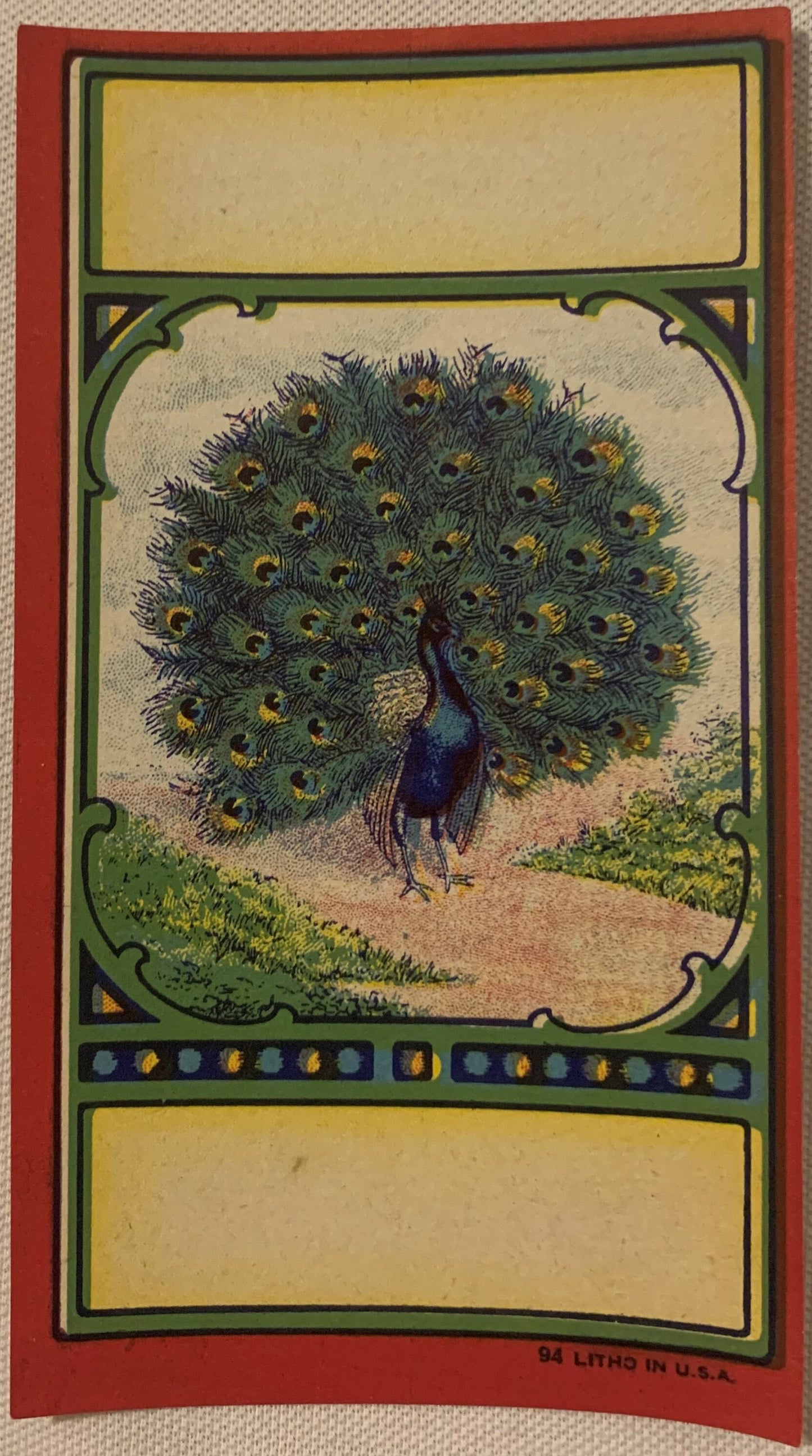
This is an original vintage 1940s peacock broom label, a genuine artifact of the American commercial lithography trade, measuring 6 inches tall by 3½ inches wide. At that size it reads, once framed, not as ephemera but as portraiture. It is New Old Stock (NOS): unused, unglued and pulled from old inventory rather than salvaged from a broom handle. The only printing besides the picture is a small 94 LITHO IN U.S.A. along the bottom edge, and two blank panels, one above the peacock and one below, were left open for a broom maker's name, town or grade.

The subject is a peacock in full display, the tail thrown open into a near-perfect fan with every "eye" marking articulated, set in an Art Nouveau frame. It isn't a rushed trade illustration. It's commercial art from a time when the line between commercial and fine barely existed.


🔢 Ordered by Number, Printed in the 1940s

That little "94" is how a broom maker ordered it. Numbered stock labels like this were sold by John L. Denning & Company of Wichita, Kansas, a broom-corn house that began in 1924 and grew to fourteen branches in different states. Denning's sample booklet carried one instruction on the cover, "Order by Number Only," and the company wouldn't take an order for fewer than 1,000 of any design. This peacock is one of the booklet's own pages: the same art, the same frame and the same "94 LITHO IN U.S.A." line in the same place.

That foot line is what dates the printing. The booklet carries a "Wichita 1" postal-zone address, so it had to be printed between 1943, when zones began, and 1963, when ZIP codes replaced them, and that puts this printing in the 1940s.

📜 The Picture Is Older Than the Printing

The peacock itself had a life before the number. The same art, without a "94," was printed for Albert Mackie Co., Ltd., wholesale grocers of New Orleans, a firm already in the New Orleans papers by 1893, and another copy was printed for the Concordia Mercantile Co. of Concordia, Kansas, under the single word PEACOCK. A stock design could travel from broom maker to broom maker, the same bird under different names, and in this printing it travels under a number. So the picture has a longer history than this particular printing, and that's part of the charm of stock art.


🏭 The American Broom Label Industry

The broom industry in America was far larger, more competitive and more regionally concentrated than most people realize. At its peak, hundreds of independent broom factories operated across the Midwest and South, clustered especially in Illinois, Kansas and parts of the mid-Atlantic, where broomcorn (the sorghum-family plant whose stiff fibrous stalks form the business end of a traditional broom) grew in reliable supply and where rail freight could move finished goods cheaply to regional and national markets.

What moved those brooms off the shelves was not quality claims or price. It was the label. Before broadcast advertising, the paper label wrapped around a broom handle was the entire marketing budget of a small manufacturer. It was the face of the company, the thing a housewife or a hardware store owner remembered when they placed their next order, and broom makers spent real money on label design and printing.

The peacock was not a random choice. In the decorative vocabulary of the Edwardian and Arts and Crafts years that shaped this picture, the peacock was a symbol of pride, beauty and quality, and it appeared in tile work, wallpapers, jewelry and theater curtains. Putting one on a broom label was a statement: this product is not ordinary.


🎨 Craftsmen Without Credit

One of the quiet heartbreaks of ephemera collecting is that the artists who designed labels like this are almost never identified. Here there's no signature and no printer's name on the label, and none on Denning's booklet either, so both the artist and the press stay anonymous. Trade lithography houses in cities like Chicago, Cincinnati, New York and St. Louis employed formally trained staff artists, often schooled in European printmaking and illustration, who brought real sophistication to even the most utilitarian assignments. A broom label commission was not beneath them. It was simply Tuesday, and on that Tuesday someone drew a peacock that still commands a room.

Local legend among Midwest broom trade historians has it that certain regional printing houses kept a standing "show piece" policy: they would print one label design to an extremely high standard as a calling card, a proof of capability for prospective manufacturers, and the overruns sometimes ended up with stationers, framing shops, or in storage, never attached to a product at all. Collectors add that NOS broom labels of this artistic quality tend to appear in small, cohesive batches, not as single orphaned survivors, which suggests they were kept together rather than separated from a used run.


🖼️ Display Ideas

  • 🖼️ Float-mount it in a deep shadowbox frame with a linen or kraft paper mat. The neutral ground lets the peacock dominate without competition, and the depth gives the label a jewel-box presence on the wall.
  • 🌿 Group it in a botanical or bird art gallery wall alongside vintage Audubon prints, pressed fern specimens or other peacock imagery.
  • 🏡 Use it as a focal point in a study, library or reading nook, where guests have time to look closely. The fine detail in the feathers rewards sustained attention.
  • 🎨 Pair it with Arts and Crafts or Art Nouveau objects. The peacock motif was central to both movements, and this label reads as a cousin to Tiffany glass, William Morris wallpaper and Rookwood pottery in its visual vocabulary.
  • 🎁 Frame it as a collected gift with a handwritten note about the story behind it. Framing the story alongside the piece is half the gift.

🎁 Who Collects These

The community around advertising labels and commercial ephemera is one of the warmest and most knowledgeable in the world of antiques and vintage collecting, and it spans a wide range of motivations. Paper ephemera collectors pursue this category for its direct connection to everyday American life. Broom labels are a niche within a niche: produced in large numbers originally, but surviving in NOS condition only when entire stocks were never used. Serious collectors understand that a crisp, unglued example is genuinely harder to find than a used label in good condition, because most of what was printed was used.

Folk art and Americana enthusiasts are drawn to the meeting of craft and commerce that trade lithography represents. These pieces were made by skilled hands for functional purposes and were never intended to be art, which is part of what makes them art. Bird art and natural history print collectors, the people who collect Audubon and Gould, find broom labels like this a natural adjacent category. Interior designers and stylists working with American antiques or pattern-forward interiors are strong buyers of framed ephemera, and gift buyers looking for something different for the person who has everything, who collects, or who simply loves birds will find it here.


❓ Frequently Asked Questions

How do I know this is a vintage original and not a later reproduction?

The printing is a match for Denning's own sample booklet, with the same art, frame and "94 LITHO IN U.S.A." foot line in the same place, and that booklet is addressed to Wichita with a postal zone, so it predates ZIP codes. Reproductions of this category of American trade label are not commercially produced in any meaningful way; there is no market incentive to fake a broom label.

What exactly does "New Old Stock" (NOS) mean for this label?

New Old Stock means this label was part of a commercial printing run that was never used for its intended purpose. It was never glued to a broom handle, never handled by a consumer, and never exposed to the wear that used labels experienced. It survived in storage in the condition it left the press and has come to market from that original inventory.

Is the color really as vivid as it appears in photographs?

The color is genuinely striking in hand, rich and saturated in the way lithography achieves better than modern reproduction. Every screen renders color differently, so the warmth or coolness of the teal will look a little different in natural light than on your display. What the photographs cannot fully convey is the slight surface texture and the way the ink catches directional light.

What is the best way to preserve and display this piece long-term?

The primary enemies of paper ephemera are UV light, humidity swings and acid migration. If you are storing rather than displaying, acid-free sleeves or folders in a stable-temperature environment are appropriate, and thoughtful framing with UV-protective glazing will protect it for as long as it has already waited.

How large will this look framed on a wall?

The label is 6 inches by 3½ inches, about the size of an index card, but framed it reads substantially larger. With a standard mat border of 2-3 inches on each side, you're looking at a finished piece of about 10-12 inches tall by 9-10 inches wide, which holds its own as a standalone piece on a shelf or in a gallery arrangement.

Can this be given as a gift without additional framing?

Absolutely. Many buyers of paper ephemera prefer to present the piece unframed, so the recipient can choose their own frame and mat. The label itself is the artifact, and the framing is the setting.

Where do unused broom labels like this come from?

Most broom labels were pasted on and used up with the broom, so the unused ones that turn up today came out of old printer's or factory stock. The peacock has consistent appeal across several collecting categories (advertising, bird art, Arts and Crafts motifs, Americana), so when examples do appear, they tend to find homes quickly.

Offered from a collection built over decades, with care for the history these pieces carry and respect for the craftsmen who made them. Every piece in our shop is described to the best of our knowledge and offered in the spirit of connecting the right collector with the right artifact.

Shipping

🚚 Shipping & Handling

  • Shipping costs and timing are calculated at checkout.
  • Items curated and shipped directly by me include U.S. shipping at no additional cost, professionally packed to ensure safe arrival of your artifact.

Items from Vetted Pro Collectors
Shipping for items offered by vetted Pro Collectors is determined at checkout. All Pro Collector listings are reviewed to ensure fair, reasonable shipping practices.

For full details, please refer to our Shipping Policy.

Returns & Exchange

Take your time — you've got a full six months. If a piece isn't right for you, send it back the way it reached you and we're good.

In the first 30 days your money goes straight back the way you paid. After that it's store credit, so you can put it toward something you'd rather have.

Return shipping we sort out between us, case by case. I don't make this difficult.

If something arrives damaged, or it isn't what I said it was, send me a photo within 48 hours and I'll make it right.

Email info@vintageantiquesgifts.com or call 802-356-9872 — that's me answering, not a call center.

The only things I can't take back are custom or special-order pieces and gift cards.

View full details
  • 5 stars: 1 (100%)
  • 4 stars: 0 (0%)
  • 3 stars: 0 (0%)
  • 2 stars: 0 (0%)
  • 1 star: 0 (0%)
M
Marlene Hrivnak

Vibrant. Not damaged in any way.

Preserving History: Authentic Objects Across Eras

— Curated by Travis Weigel