Skip to product information
1 of 2

Vintage and Antique Gifts

Antique 1920s Gladiola Brand Oranges 🌸 Crate Label — Covina Orange Growers Ass'n, Los Angeles Co., California — Schmidt Litho

Antique 1920s Gladiola Brand Oranges 🌸 Crate Label — Covina Orange Growers Ass'n, Los Angeles Co., California — Schmidt Litho

Regular price $7.00 USD
Regular price Sale price $7.00 USD
Sale Sold out
Shipping calculated at checkout.

Size: 11" x 10"

🚚 Free US Shipping — ships within one business day. International shipping calculated at checkout.

Quantity

Why Is There No Orange on This Orange Label? 🌸 An Antique 1920s Gladiola Brand Crate Label From Covina, California

Size: 11" x 10" ~ NOS unused stock, little to slight storage wear. It has minor corner wear, I doubt you would notice on display, see pictures and video and judge for yourself, please.

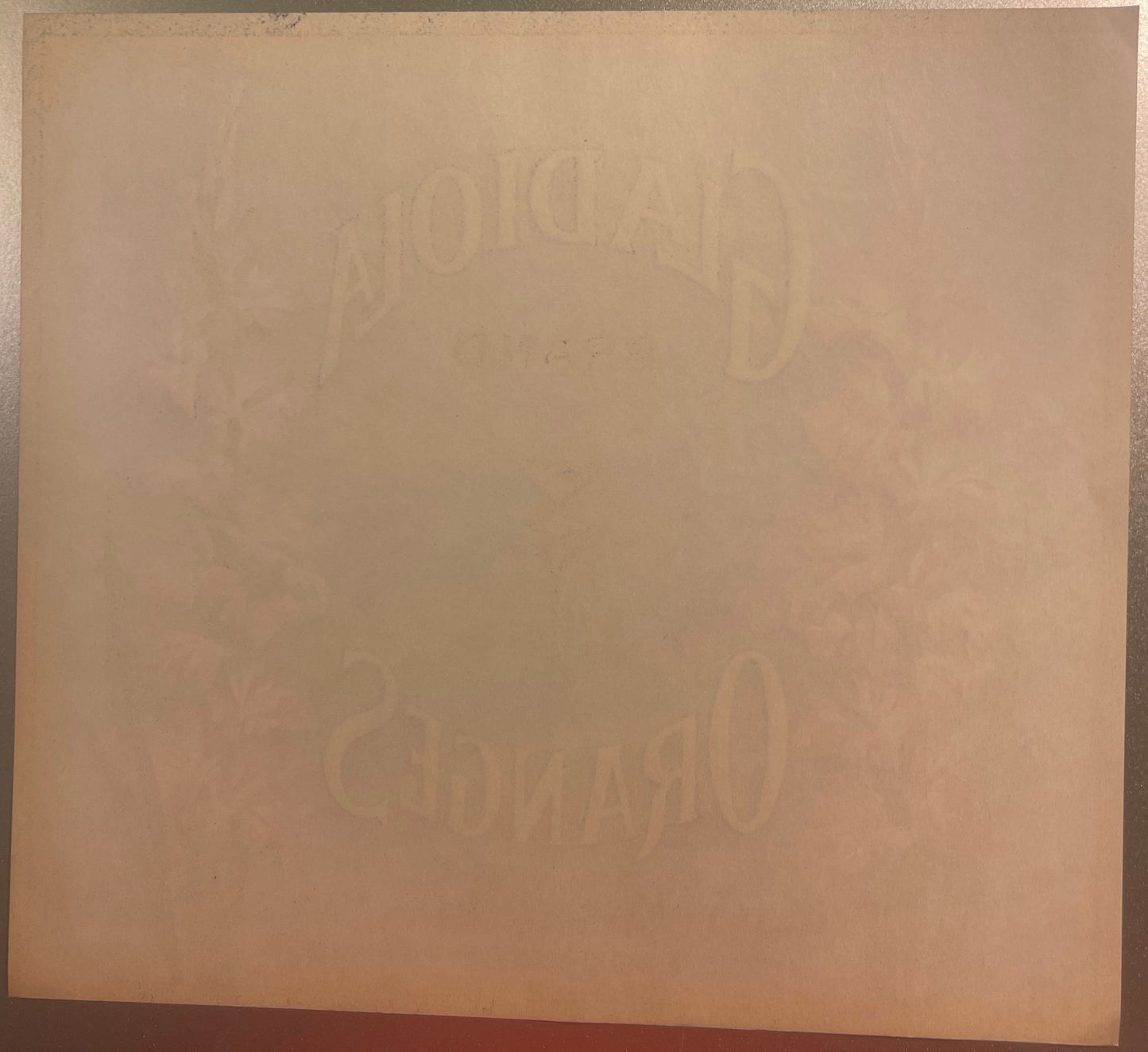
Two tall spikes of gladiolus, coral and pink with long green leaves, stand up either side of this label like a pair of columns. Between them GLADIOLA arches across in big yellow letters, BRAND sits under it, a little red, blue and green ornament hangs on a long stem in the middle, and ORANGES runs across the bottom. Not one orange anywhere on it. Along the foot it reads GROWN & PACKED BY COVINA ORANGE GROWERS ASS'N., COVINA, LOS ANGELES CO., CALIFORNIA, and tucked into the lower left corner in tiny type is the printer, SCHMIDT LITHO. CO. L.A. It was made to be glued on the end of a wooden orange crate, and it never was.

Crate labels are a reminder of a bygone era, and the amazing lithography process is unparalleled even to this day in my opinion. Museums and art institutes have given them gallery space, and more and more collectors are seeking them out to preserve their history. My pictures seriously don't do this one justice.

🌸 A flower named for a sword

Gladiolus comes from the Latin gladius, a sword, for the shape of those long leaves running up both sides. A packing house could put anything on its label that would make a buyer at the wholesale market back East pick its crates out of a carload, and the Covina growers handed this one over entirely to a flower. Pretty confident move for an orange.

🍊 Covina, "One Mile Square and All There"

Covina sits in the San Gabriel Valley east of Los Angeles, and for better than half a century it was one of the orange towns of the Southern California Citrus Belt. In 1881 Joseph Swift Phillips contracted for 2,000 acres of the old Badilla lands there, and Frederick Eaton - later the mayor of Los Angeles - surveyed the tract and wrote the name "Covina" on the 120-acre town site on his plat map in December 1884. Lots went on sale in January 1885, a couple of years ahead of the great Southern California land boom of 1887 and 1888. The orange came early, too: in 1881 J. B. Beardslee planted the first navel orange trees in the valley on his property on north Citrus Avenue, and by the early 1890s big orchards of citrus and other fruit trees were taking over the old grain fields and vineyards. Phillips built a seven-mile cement ditch to bring San Gabriel River water to the land, and the old story around town is that the first nurserymen still hauled barrels of water up from the canyon to keep their seedling trees alive.

The orange men organized early. Growers from Azusa, Covina and Glendora formed the Azusa-Covina-Glendora Citrus Association in August 1893, the Southern Pacific opened its spur line through Covina in September 1895, the Covina Citrus Association was incorporated on October 14 that year, and the Houser Bros. packing house, the town's first big one, went up beside the new tracks that December. Covina's own historians call the half century that followed, from 1896 until after the Second World War, the town's "Era of Citrus." The first spike for the Pacific Electric trolley line down Badillo Street was driven on November 5, 1903. By 1907 Covina was claiming to be the third-largest orange shipping point in the world, and in March 1922 a Mrs. F. E. Wolfarth won the Chamber of Commerce's $20 prize for the town's new motto: "One Mile Square and All There." Twenty dollars for six words, back when the whole incorporated town really did fit inside one square mile.

🏭 The Covina Orange Growers Association

The packer on this label was its own cooperative, not the older Covina Citrus Association. It was set up in 1899 and incorporated again in January 1936, and for its fiftieth year it put out a booklet called Fifty Years of Achievement From 1899 to 1949. Its record books are at the Huntington Library - minute books, stockholder records, and time books from the 1930s, one of them holding a typed letter about the minimum-wage laws for women and minors - and more of its papers, 1909 to 1952, are in the California Citrus Industry Collection at the Claremont Colleges Library. Member growers brought their fruit to the association's packing house to be graded and packed, and each crate went out with a label like this one on the end.

You can still see inside that packing house. Covina photographer Clarence Tucker took a picture of the packers at work there around 1920, and it's in the Covina Public Library's Covina Citrus Industry Photographs today. Gladiola wasn't the association's only brand, either: Azusa Pacific University's Special Collections keeps a citrus crate label collection of more than 300 labels, and it lists four brands from the Covina Orange Growers Association: Daisy, Gladiola, Orchard King and Preferred.

🖨️ Schmidt Litho. Co., L.A.

That tiny line in the corner is the Schmidt Lithograph Company. Max Schmidt, a German immigrant, opened his own print shop in San Francisco in the 1870s (accounts give 1872, 1873 and 1876 - The Henry Ford's history has him going into business on his own in 1876 as M. Schmidt & Company) and was one of the first printers on the West Coast to work in lithography. His first branch office, opened early in the 1880s, was in Los Angeles - that's the L.A. on this label. The San Francisco plant burned in 1884 and again in 1886, and the 1906 earthquake and fire wiped it out a third time. Schmidt took over the Wempe Brothers' paper box factory to keep working, and within two years he had built again on his old corner at Second and Bryant, where the company's clock tower still stands as a landmark for anybody coming off the Bay Bridge.

In its prime it was the largest printing company on the West Coast, with a two-square-block plant that had a roof garden, handball, basketball and volleyball courts up top, and its own hospital run by a graduate nurse. The firm had been Schmidt Label & Lithographic from 1883 and Mutual Label & Lithographic from 1899, went by Schmidt Lithograph from 1907 until Stecher-Traung bought it in 1966, and Stecher-Traung-Schmidt carried on until 1994. Over the years it had offices and factories in Florida, Texas, Honolulu and Utah as well as up and down the West Coast. Label collectors like to say fruit was the butter for Schmidt's bread, and old-timers in the printing trade used to say that if you wanted to know what grit looked like, you looked at how Max Schmidt rebuilt after 1906.

📅 How old is it?

There's no year printed on it. I've always had these as 1920s labels. The corner imprint fits - the firm went by the Schmidt Lithograph name from 1907 to 1966 - and so do the association's own papers, 1909 to 1952.

🌅 When the groves went

Covina's orange years ended fast. In 1945 and 1946 the "quick decline" virus went through the groves and killed thousands of trees, on March 28, 1947 the Pacific Electric quit running trolleys to town, blaming competition from private automobiles, and after the war the demand for new suburban housing moved in on the groves; by about 1960 suburban homes outnumbered orange groves in Covina, and the Era of Citrus was over. Old-timers in the San Gabriel Valley still talk about how quickly it all went. The labels that never made it onto a crate are about all that's left of those packing houses.

🖼️ About these labels

Every one I have is unused, 11 by 10 inches, never glued down, with a plain back where the lettering just shows through. Imagine it hanging in your kitchen or sunroom instead of a museum, or framed for somebody with California roots or family in the San Gabriel Valley. The supply is finite: nobody prints crate labels this way anymore, the groves and packing houses are long gone, and once these last unused ones are framed and hanging on walls, they'll be very difficult to acquire.

Shipping

🚚 Shipping & Handling

  • Shipping costs and timing are calculated at checkout.
  • Items curated and shipped directly by me include U.S. shipping at no additional cost, professionally packed to ensure safe arrival of your artifact.

Items from Vetted Pro Collectors
Shipping for items offered by vetted Pro Collectors is determined at checkout. All Pro Collector listings are reviewed to ensure fair, reasonable shipping practices.

For full details, please refer to our Shipping Policy.

Returns & Exchange

Take your time — you've got a full six months. If a piece isn't right for you, send it back the way it reached you and we're good.

In the first 30 days your money goes straight back the way you paid. After that it's store credit, so you can put it toward something you'd rather have.

Return shipping we sort out between us, case by case. I don't make this difficult.

If something arrives damaged, or it isn't what I said it was, send me a photo within 48 hours and I'll make it right.

Email info@vintageantiquesgifts.com or call 802-356-9872 — that's me answering, not a call center.

The only things I can't take back are custom or special-order pieces and gift cards.

View full details

Rescuing American History Since 2007

— Travis & the Kids