Skip to product information
1 of 2

Vintage and Antique Gifts

Antique 1930s Evening Star Lemon Crate Label 🌟 San Fernando Heights Lemon Ass'n — California Lithograph Art

Antique 1930s Evening Star Lemon Crate Label 🌟 San Fernando Heights Lemon Ass'n — California Lithograph Art

Regular price $10.00 USD
Regular price Sale price $10.00 USD
Sale Sold out
Shipping calculated at checkout.

Size: 12 1/2" x 9"

🚚 Free US Shipping — ships within one business day. International shipping calculated at checkout.

Quantity

Who Packed Evening Star Lemons? 🌟 The Lemon House That Called Hollywood for Help — and the Star It Shipped Under

Size: 12 1/2" x 9"

Before the San Fernando Valley grew tract homes, freeways and film studios, it grew lemons. At the corner of Sepulveda and San Fernando Mission Boulevards stood a packing house so short of hands after the war that it opened its doors to Hollywood film crews — and was swamped with people hoping to be discovered while they wrapped fruit. It was the San Fernando Heights Lemon Association's plant, and this is the label it put on the end of its crates.

The groves are gone. The association is gone. The label, though, made it into a museum: the Fine Arts Museums of San Francisco keep an Evening Star label in their graphic arts collection, dated about 1930 to 1940 and bought for the Achenbach Foundation for Graphic Arts. The packing house went up around 1911 just south of Mission San Fernando, run by the Pacific Packing Company, and in 1915 it was sold to the new San Fernando Heights Lemon Association, which took over its brands: Silver Moon, Blue Moon, Evening Star and Southern Cross. (The Blue Moon is the hard one to find, and the white building under that star is said to be a stylized San Fernando Mission.) The Huntington Library keeps four earlier Evening Star printings in its Jay T. Last Collection, dated from 1916 to 1931 and printed by the Western Lithograph Company of Los Angeles. Every one of those says "San Fernando Heights Lemon Co." (one says "Orange Assn."), while this one reads "Lemon Ass'n." and "Grown in U.S.A.", a later printing than any of theirs. What is left is paper like this: an original 1930s Evening Star lemon crate label, never pasted to a box, still carrying the cobalt night sky, the gold lettering and the little red ball that told a buyer back East exactly what grade of California lemon was inside.


🏷️ What Is Printed on This Sheet

  • Brand: EVENING STAR
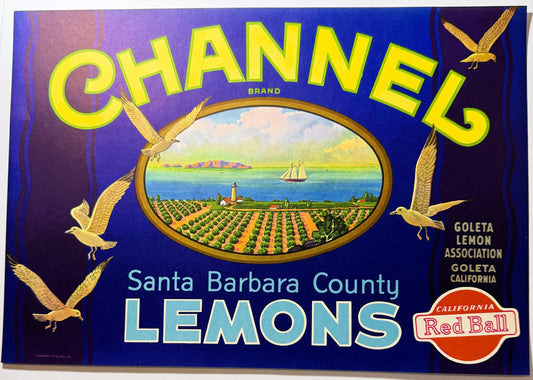
  • Grade mark, lower left: a red disc with a scalloped cartouche reading CALIFORNIA over Red Ball
  • Lower right: GROWN IN U.S.A. · SAN FERNANDO HEIGHTS LEMON ASS'N. · SAN FERNANDO, CALIFORNIA
  • Size: 12 1/2 x 9 inches
  • Made: color lithograph on paper, 1930s
  • Condition: new old stock — never applied to a crate; the reverse is blank paper

The picture is a small stage set. Two tall fan palms stand like curtains at either side. Between them sits a mission building in cream stucco, with red-tiled roofs, two red domes and a square bell tower, its arched walk half hidden behind flowering shrubs and a big agave. A dark sedan of the day is parked in the drive. To the right, the grove runs off in long green stripes toward low blue hills. Overhead, a white five-pointed star throws fine rays across a deep blue sky scattered with smaller stars, and the words EVENING STAR arch across the top in yellow capitals edged in red.

Every one of those colors went down in its own pass through the press, laid in register over the last. The lithography on these labels is unparalleled — no digital print gets that depth of ink — and museums and art institutes have hung them in gallery exhibitions for exactly that reason.


🔴 What "California Red Ball" Told the Buyer

The red ball in the corner is not decoration. It is a grade stamp. The California Fruit Growers Exchange — the growers' cooperative that marketed its best fruit as Sunkist — ran two quality marks. Sunkist went on fruit of perfect or near-perfect quality. California Red Ball marked the mid grade: fruit with satisfactory juice and sugar and decay held under two percent. Exchange inspectors visited the packing houses to check that what went into a box matched the mark on it, and there were penalties when it did not.

So a wholesaler in Cleveland pulling this crate off a rail car could read the whole story in one glance: the association's own brand across the top, and the Exchange's grade in the corner. The Exchange itself took the name Sunkist Growers in 1952.


🍋 The Company — From Pacific Packing to the Heights Association

The Evening Star name is older than the association that printed this label. About 1911 the Pacific Packing Company put up a lemon packing plant just south of Mission San Fernando. Two years later the Los Angeles Aqueduct opened in 1913 and brought Owens Valley water into the San Fernando Valley, and citrus planting there took off. In 1915 Pacific sold the plant to a new growers' concern, the San Fernando Heights Lemon Association, and four brand names came across with the sale: Silver Moon, Blue Moon, Evening Star and Southern Cross.

The association grew fast. In 1922 it put up a new building 80 by 172 feet at a cost of $24,000. In June 1925 the Van Nuys News reported a record price — over $14 a box — for its lemons sent to Cleveland. By September 1926 it had shipped 450 train loads, with 100 more on hand and 60,000 boxes still waiting to be picked. A three-story packing structure followed in 1936.

The 1930s were not all record prices. In August 1938 roughly 1,000 picketers, many of them not employees of the plant, descended on the association to demand higher pay — part of a decade of hard-fought labor trouble across California's citrus belt.


👩 The People on the Packing Line

Lemons were graded, wrapped and packed by hand — and the hands were overwhelmingly women's. The packing houses were one of the biggest employers of women in the area and a major source of work for the Latino families of San Fernando.

Luz Mendez Calvo was one of them. Born in 1896 in La Colorado, Sonora, she came north during the Mexican Revolution. A photograph held by California State University, Northridge, taken at San Fernando Heights around 1930, shows her at the line packing lemons into a Sunkist crate. She married Antonio Regalado Calvo of Alamos, Sonora, in 1926. While she worked in the packing houses, he took jobs in restaurants, hotels, pool halls and on WPA projects. Then the couple went into business feeding the packing crews: Luz cooked tacos, tamales and burritos in her kitchen, and Antonio — sometimes with the children — sold them to the workers on their lunch break. That lunch trade became Las Delicias Café, which settled at 1118 Pico Street in downtown San Fernando in 1946. Luz died in 1982.

Jacoba Llamas worked in the San Fernando Heights packing house too, alongside family and friends. Her great-grandson Anthony Llamas, a liaison at the López Adobe and the City of San Fernando, wrote in 2023 that his grandfather Daniel grew up working the ranches and fields of the Valley. Families like theirs did more than pack fruit. The picker communities, mostly Latino, moved out of labor camps and built some of the first suburban neighborhoods in Southern California.

Herbert S. Sykes, who managed the plant for some three decades, saw it through the long decline and credited mechanization, plant consolidation and changes in grading and packing for keeping it profitable as the groves shrank.


🎬 The Legend of the Packing-House Screen Test

This is the story San Fernando still tells. After World War II the packing houses could not find enough workers. According to a 1950 article, the Heights association had for a couple of years been contracting with Hollywood studios to film at the plant. When that got around, the place was besieged with applicants — young people who figured the surest road to a screen career ran past a lemon-wrapping table where a camera crew might be looking for a face. Whether anyone was ever actually discovered there is the part the story leaves open, which is exactly why it has lasted.

There is collector lore around the brand family as well. The story goes that Silver Moon, Evening Star and Blue Moon were the original trio, that Morning Sun later took Silver Moon's place, and that Blue Moon is the one that almost never surfaces. Southern Cross is the other hard one to find. And the building under the star looks like a stylized San Fernando Mission — Mission San Fernando Rey de España, founded in 1797, whose grounds sat just north of the packing house.


🏚️ How the Valley Changed — and Why the Labels Outlived It

At the start of World War II the San Fernando Valley had 11,000 acres of lemon, orange and grapefruit trees and ten packing houses. A quarter of that citrus went to supply vitamin C for United States armed forces and their allies. Then the war ended, veterans came home, and the orchards became subdivisions. The nearby San Fernando Lemon Association closed in 1948. The Heights plant was still running in 1950 with 80 workers in the house and 100 pickers in the field, but by 1956 regional citrus acreage had fallen from 11,000 to 6,000 acres and the working packing houses from eight to five. In May 1961 the closure of the Heights facility was reported.

The water that turned the Valley into lemon country is the same water that later let it fill with houses. The groves paid for the transformation and were paved over by it. When wooden crates gave way to printed cardboard cartons, the stacks of unused labels in packing-house storerooms stopped being supplies and started being history. That is the legacy this sheet carries: a paper record of a working landscape that no longer exists anywhere except on labels like this one.

Examples of Evening Star are kept by CSUN's San Fernando Valley History Digital Library, the Fine Arts Museums of San Francisco and the Digital Commonwealth archive.


🖼️ Display Ideas

  • 🌴 A California kitchen or breakfast nook — the cobalt, gold and red read well against white tile or Spanish-style plaster.
  • 🏡 A San Fernando Valley history wall — pair it with an old Valley map or a postcard of the mission.
  • 🌙 A celestial grouping — Evening Star next to a Morning Sun, Silver Moon or Southern Cross makes a set that explains itself.
  • 🎁 A gift with roots — for anyone whose family worked the Valley's groves or packing lines.

❓ Questions People Ask

Is this an original label or a reproduction?
Original — a 1930s lithograph, new old stock, never glued down, with a clean unprinted back.

What size is it?
It measures 12 1/2 inches wide by 9 inches tall.

What does "Red Ball" mean on a citrus label?
It was the California Fruit Growers Exchange's mid-grade quality mark. Sunkist marked the top grade; California Red Ball marked sound fruit of satisfactory juice and sugar with very little decay, and Exchange inspectors checked packing houses against it.

Is the building the San Fernando Mission?
It looks like it — a romanticized picture of the Valley's own mission, whose grounds lay just north of the plant.

Where did the Heights association pack its fruit?
In San Fernando, California, just south of the old mission. The growers bought the plant from Pacific Packing in 1915, and its closing was reported in May 1961.

What other brands did the association use?
Four celestial names came over from Pacific Packing — the two moons, the evening star and the southern cross — and Morning Sun was added later.

How should I frame it?
Use UV-filtering glass or acrylic and an acid-free mat, and hang it out of direct sun so the blues and reds stay strong.

Shipping

🚚 Shipping & Handling

  • Shipping costs and timing are calculated at checkout.
  • Items curated and shipped directly by me include U.S. shipping at no additional cost, professionally packed to ensure safe arrival of your artifact.

Items from Vetted Pro Collectors
Shipping for items offered by vetted Pro Collectors is determined at checkout. All Pro Collector listings are reviewed to ensure fair, reasonable shipping practices.

For full details, please refer to our Shipping Policy.

Returns & Exchange

Take your time — you've got a full six months. If a piece isn't right for you, send it back the way it reached you and we're good.

In the first 30 days your money goes straight back the way you paid. After that it's store credit, so you can put it toward something you'd rather have.

Return shipping we sort out between us, case by case. I don't make this difficult.

If something arrives damaged, or it isn't what I said it was, send me a photo within 48 hours and I'll make it right.

Email info@vintageantiquesgifts.com or call 802-356-9872 — that's me answering, not a call center.

The only things I can't take back are custom or special-order pieces and gift cards.

View full details
  • 5 stars: 1 (100%)
  • 4 stars: 0 (0%)
  • 3 stars: 0 (0%)
  • 2 stars: 0 (0%)
  • 1 star: 0 (0%)
n
n***n (3637)

Dig this authentic fruit crate label!

Preserving History: Authentic Objects Across Eras

— Curated by Travis Weigel