Skip to product information
1 of 3

Vintage and Antique Gifts

Antique 1930s La Reina Orange Crate Label 🍊 Rialto Orange Co San Bernardino California Spanish Señorita Fan Color Lithograph Western Litho American

Antique 1930s La Reina Orange Crate Label 🍊 Rialto Orange Co San Bernardino California Spanish Señorita Fan Color Lithograph Western Litho American

Regular price $9.00 USD
Regular price Sale price $9.00 USD
Sale Sold out
Shipping calculated at checkout.

Size: 11" x 10"

🚚 Free US Shipping — ships within one business day. International shipping calculated at checkout.

Quantity

Who Packed La Reina Oranges in Rialto? 👑 La Reina: A Spanish Queen Selling Oranges From a Town Founded by Kansas Methodists

Size: 11" x 10"

Rialto, California was started in 1887 by a band of Kansas Methodists who bought land from a water company. Fifty-odd years later its oranges went to market under a queen from a Spain that never stood in Rialto: a dark-eyed señorita with a tall comb, a rose at her ear and a black fan, posed beside palms and a red-tiled villa. This is her label — La Reina, "The Queen," packed by the Rialto Orange Co. of San Bernardino County, with the printing credited to Western Litho. Co. of Los Angeles. A 1930s original, never glued to a crate. Rialto once had seven packing houses. By 1966 the citrus was gone.

The Words Printed on It

  • The title: La Reina
  • The grown-in line: GROWN IN U.S.A.
  • The packer's block: RIALTO ORANGE CO. / RIALTO / SAN BERNARDINO CO. / CALIFORNIA
  • The printer's imprint, in microtype at the lower right margin: LITHO. IN U.S.A. – WESTERN LITHO. CO. LOS ANGELES

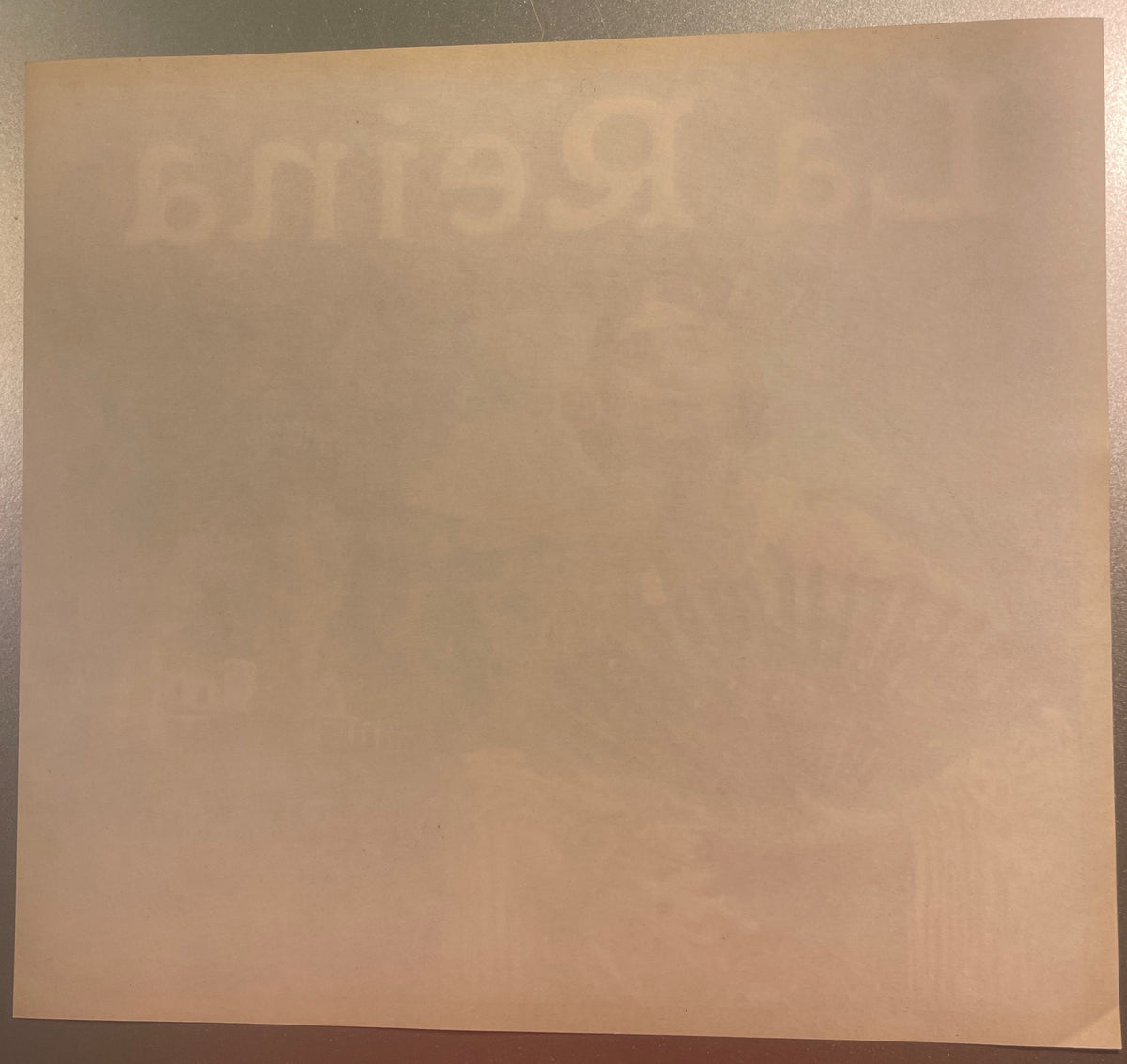
Size: approximately 11 x 10 inches  ·  Made of: paper, color lithograph  ·  Condition: unused new old stock, clean back with no glue

The Picture

La Reina, the queen, fills the left side: hair swept up under a high comb with a rose above one ear, long drop earrings, a folding fan held to her chest, and over her shoulders the fringed, rose-painted shawl Spain calls a mantón de Manila. Behind her an arched window frames a California that sells: mountains, two towering fan palms and a villa with a tile roof, a square tower and a columned porch.

Rialto: A Water Canal, a Kansas Colony and a Name From Venice

The Semi-Tropic Land and Water Company laid out Rialto in 1887, along with the neighboring townsites of Bloomington, Sansevaine and Fontana, and spent heavily on a six-mile concrete-lined canal to bring water down from Lytle Creek. The company went broke and was foreclosed. A later buyer, the Kansas Colony, failed too. But a group of Methodist settlers from Halstead, Kansas, who had arrived early and bought their land from the water company, kept it — and they really started the town. In 1888 the San Bernardino Daily Courier even reported that the University of Southern California was weighing a campus there. Rialto voted to incorporate in 1911, 135 to 72.

Nobody agrees where the name came from, and Rialto likes it that way. One story says it joins the Spanish words rio and alto, "high river," for the canal. The other legend holds that a settler's daughter named the town after the Rialto Bridge in Venice — itself named for the rivo alto, the high bank where Venice began.

The Orange Years

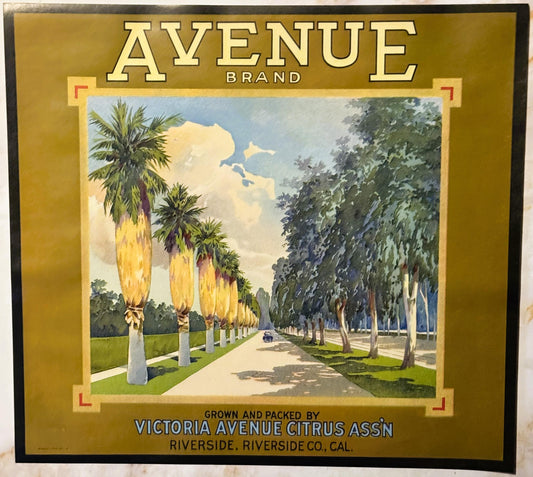
Rialto began as a fruit colony of lemon and orange groves, and at its height seven packing houses stood in town. How the navel orange got to California is one of the state's agricultural legends: in 1873 William Saunders of the U.S. Department of Agriculture passed two navel orange trees, a variety from Bahia, Brazil, along to Eliza Tibbets of Riverside. Navels turned out to suit Rialto's climate and soil, and local history records that Rialto's groves, unlike wind-sheltered ones, were kept clear of frost by the winds coming down from Cajon Pass. Most of the men worked in the citrus industry, and many of the women worked the packing house lines, grading and packing the fruit that went out under labels like this one. Other Rialto packers had their own brands; the Rialto Fruit Co. sold its fruit as Rialto Boy. Foothill Boulevard carried U.S. Route 66 through Rialto past the groves.

Then the valley changed almost overnight. Rialto's population was 3,156 in 1950 and 15,359 by 1956. As the Rialto Historical Society puts it, the growth between 1953 and 1966 was phenomenal: citrus disappeared, and Rialto became a residential community. In 1964 the Interstate took Route 66's traffic away from Foothill Boulevard as well. Today Rialto passes 100,000 people, is a hub of distribution warehouses and is home to Pyro Spectaculars, one of the country's big fireworks companies. The groves survive on paper, in labels like La Reina. Cal State San Bernardino's Pfau Library keeps one in its Collection of Citrus Labels. The Oakland Museum of California has a La Reina label from Rialto too, listed in its catalog as a señorita in full-color lithograph from Western Litho Co., L.A. And UCLA Library Special Collections (in its Collection of California Fruit Labels) and UC Riverside's citrus label collection both hold La Reina labels from the Rialto Orange Co.

Why a Spanish Queen? The Legend of "Ramona"

There were no señoritas in the Kansas colony. The queen on this label comes from a story. In 1884 the writer and activist Helen Hunt Jackson published Ramona, a novel meant to expose the mistreatment of California's Native people. Jackson had toured Southern California for The Century Magazine in 1881–82, where Antonio Coronel — a former mayor of Los Angeles and California state treasurer — and his wife performed a lovingly staged evening of old Californio life for her. The book became a runaway best seller, but not for the reason she hoped: readers fell in love with its sunny ranchos, missions and romance instead.

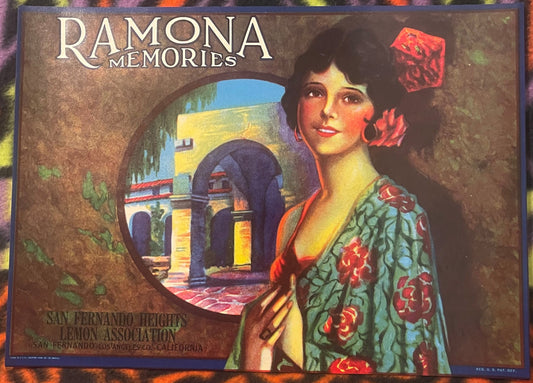
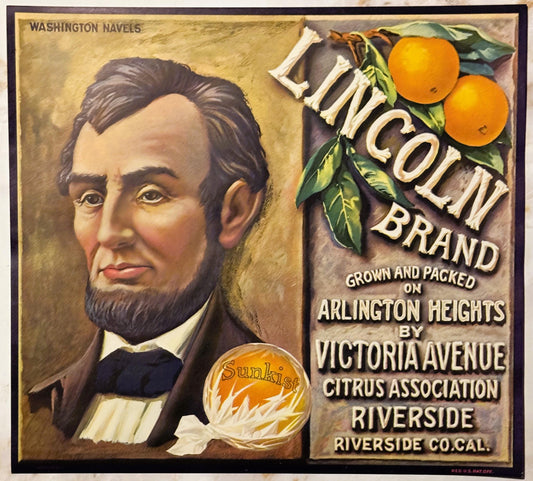
That legend shaped Southern California for decades. The writer Carey McWilliams later called it the region's "Spanish Fantasy Past," and he blamed it for a faux-Spanish Revival in art, advertising, architecture and even town planning. Railroads and land developers used the fantasy to lure settlers west, and citrus packers put it on their fruit: the San Fernando Heights Lemon Association used Ramona imagery on its labels. La Reina, with her mantón, fan and red-roofed villa among the palms, is that same dream, printed for the ends of Rialto orange boxes.

The Printer: Western Litho. Co., Los Angeles

The Western Lithograph Company traces back to a Los Angeles shop founded in 1899 by Anton Ernest Stoetzer, one of only two lithographic firms in the city by 1900. In 1906 William Gilbert and William Alvord Jones bought it and renamed it Gilbert-Jones-Rugg; Jones reportedly traded his share to Milton L. Davidson for a Montana ranch, and after Stoetzer died in 1909 Davidson brought back the Western Lithograph name. The September 10, 1910 issue of the Los Angeles Financier carried an advertisement presenting Western Lithograph as Gilbert-Jones-Rugg's successor. Designing and printing crate labels for California citrus growers was its main business from the start. California's other big label house, the Schmidt Lithograph Company, was started by Max Schmidt, a German immigrant who landed in San Francisco in 1871. Label historians note that Western favored one big dominant image, and that its labels, perhaps because the shop sat so near Hollywood, sometimes looked like movie posters. La Reina's single, film-star queen is a textbook example. Old-timers in the printing trade used to say a good lithographer "painted with ink." The firm now and then put a month and year into its tiny printer's line; one example reads "Western Litho Co., Los Angeles, Cal 11-16." Whatever follows LOS ANGELES on this sheet is too small to read. In 1953 Brown-Bigelow acquired the firm, about the time the citrus industry gave up wooden crates and paper labels for good.

Questions People Ask

How old is the La Reina orange crate label?
It is a 1930s label from the Rialto Orange Co.

Is it original?
Yes. It is an original color lithograph with the Western Litho. Co. Los Angeles imprint in the margin, and it was never used on a box.

What does "La Reina" mean?
"The Queen" in Spanish.

Where is Rialto, and is it still orange country?
Rialto is in San Bernardino County, west of San Bernardino. It had seven packing houses at the height of the citrus years, but the groves gave way to housing between 1953 and 1966.

How big is it?
Approximately 11 x 10 inches.

Who collects labels like this?
People who love citrus crate labels, Inland Empire and Route 66 history buffs, fans of California's Spanish Revival style, and anyone decorating a kitchen with genuine California color.

Shipping

🚚 Shipping & Handling

  • Shipping costs and timing are calculated at checkout.
  • Items curated and shipped directly by me include U.S. shipping at no additional cost, professionally packed to ensure safe arrival of your artifact.

Items from Vetted Pro Collectors
Shipping for items offered by vetted Pro Collectors is determined at checkout. All Pro Collector listings are reviewed to ensure fair, reasonable shipping practices.

For full details, please refer to our Shipping Policy.

Returns & Exchange

Take your time — you've got a full six months. If a piece isn't right for you, send it back the way it reached you and we're good.

In the first 30 days your money goes straight back the way you paid. After that it's store credit, so you can put it toward something you'd rather have.

Return shipping we sort out between us, case by case. I don't make this difficult.

If something arrives damaged, or it isn't what I said it was, send me a photo within 48 hours and I'll make it right.

Email info@vintageantiquesgifts.com or call 802-356-9872 — that's me answering, not a call center.

The only things I can't take back are custom or special-order pieces and gift cards.

View full details

Preserving History: Authentic Objects Across Eras

— Curated by Travis Weigel