Skip to product information
1 of 5

Vintage and Antique Gifts

Vintage Umatilla Belle Crate Label 🍊 Native American Beauty, Umatilla Florida Citrus Art

Regular price 8.00 USD
Regular price Sale price 8.00 USD
Sale Sold out
Shipping calculated at checkout.

Description

Ever wonder what made a wooden citrus crate worth a second look on a produce dock a thousand miles from the grove? 🍊

Long before refrigerated trucks, barcode scanners, or glossy produce packaging, a crate of Florida citrus had exactly one shot to catch a wholesale buyer's eye — the paper label glued to its end panel. Somewhere in a Lake County packing house, a grower's cooperative decided their fruit deserved a face as memorable as its flavor, and they gave her a name that still turns heads on collectors' tables today: the Umatilla Belle.

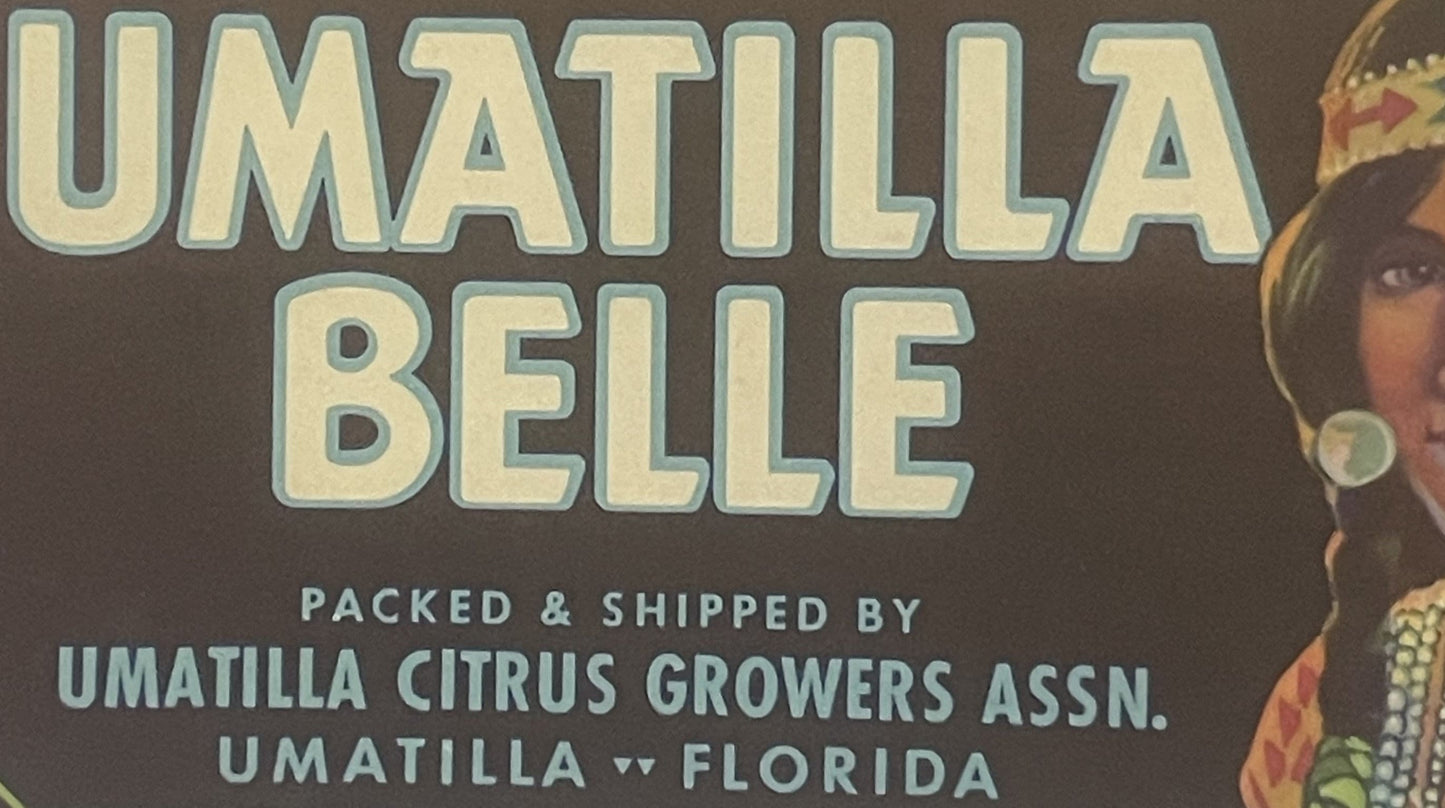
This is an original New Old Stock (NOS) citrus crate label produced for the Umatilla Citrus Growers Association of Umatilla, Florida, measuring 9" x 3.5" — the long, narrow strip shape built to run cleanly across the end board of a wooden citrus crate. The association's own company history dates the Umatilla Belle design to the 1930s, and this example has never been through a packing line — it's sat untouched exactly as it left the printer, never applied to a crate of fruit. The artwork centers on a young Native American woman rendered in the idealized, romanticized style so common to citrus and produce advertising of her day: dark hair parted at the center and falling loose past her shoulders in soft braids, a wide beaded headband worked in gold, red, and teal in a geometric arrow-and-diamond pattern, round pale jade disc earrings, and several strands of pale beaded necklaces layered at her throat. Her tan-and-gold garment carries its own beadwork motif of red and blue triangles across the shoulder. She's painted mid-smile, warm-eyed, set against a deep brown-black field bordered by a thin sage-green geometric frame. Across the LEFT half of the sheet, "UMATILLA BELLE" runs on two lines in tall cream lettering outlined in pale blue-teal, with the portrait occupying the right half, with "PACKED & SHIPPED BY UMATILLA CITRUS GROWERS ASSN. — UMATILLA, FLORIDA" set beneath it in smaller matching type.


🏭 The Umatilla Citrus Growers Association — A Century in the Grove Business

The growers who put their name and reputation behind this label organized in 1909, among them founding families whose surnames — Collins, Austin, Osborne, Kennedy — still turn up in Lake County's local records generations later. By 1914 the association had built its own packing house at the corner of what's now State Road 19 and West Ocala Street, right in the heart of town, and from there it shipped citrus north under a rotating cast of brand names for well over a hundred years.

That century wasn't an easy one. Florida's citrus industry has always lived at the mercy of the weather, and the state as a whole endured a punishing boom-and-bust rhythm of hard freezes — most famously the Great Freezes of 1894 and 1895, which wiped out entire groves across Central Florida almost overnight, and a second brutal run of freezes in the 1980s that permanently reshaped where citrus could even be grown in the state. The Umatilla association weathered every one of those. What it couldn't outlast was disease: citrus greening, first documented in Florida groves in 2005, spread relentlessly through the years that followed and eventually brought the operations of this century-old cooperative to a close — a quiet, hard-earned ending for an outfit that had already survived freezes, depressions, and market swings that had folded plenty of competitors long before.


🌊 Umatilla, Florida — "Land of Many Waters"

The town behind this label long predates its citrus fame. Nathan J. Trowell founded the settlement in 1856, and it was a fellow early resident, William A. Whitcomb, who suggested borrowing the name of an Oregon town for their new Florida community — a naming choice formally registered with the U.S. Land Office in Gainesville in 1876. Depending on which telling you favor, "Umatilla" is said to translate from its origins as either "laughing waters" or "land of many waters," and either fits the place perfectly: the region sits amid some 40 clear freshwater lakes within a two-mile radius, a landscape that drew citrus growers to its rich soil and mild microclimate just as it later drew lake-fishing tourists. Umatilla is still known locally today as a gateway to the Ocala National Forest just to its north.

Growth came with the rails. The St. Johns and Lake Eustis Line reached Umatilla from the river town of Astor in 1880, opening it to reliable shipping and setting the stage for the citrus economy that would define it. The town formally incorporated on November 8, 1904, by what local histories describe as a narrow vote among residents — and within a decade, groves pressed in close enough around town that locals took to calling this stretch of Lake County "the golden buckle of the citrus belt." At its peak, Lake County ranked as the second most productive citrus-growing county in the entire state of Florida, a remarkable standing for a town whose population never grew especially large.


👤 The People Who Kept the Association Running

A cooperative doesn't run for a hundred-plus years on brand names alone — it runs on the people who show up every packing season no matter what the weather or the market throws at them. Doris Mabry joined the Umatilla Citrus Growers Association in 1972 and went on to manage its day-to-day operations for decades, steering the co-op through killing freezes and financial hardship that would have folded a smaller outfit outright. On the association's board, John Westervelt served as president from 1965 all the way until his death in 2020 — more than half a century of stewardship over a single grower's cooperative — and Umatilla High School later named its football field in his honor, a small-town tribute that says a lot about how tightly this citrus association and its community were woven together.


🎨 A Town Full of "Indian" Brand Names — Local Color Worth Preserving

Umatilla, it turns out, wasn't content with just one citrus beauty. Records of Florida citrus labels turn up a whole small cluster of brands built around this one town's own Native-American-derived name — a genuinely local pattern rather than a single company's private idea. The Umatilla Fruit Company shipped fruit under a "Red Warrior" brand, and Umatilla Packers Inc. ran its own "Indian Warrior" label featuring a Native American brave front and center. Set against those two, "Umatilla Belle" reads almost like the missing third piece — the town's beauty answering its warriors, in exactly the kind of paired regional theming that early-20th-century citrus branding loved. It's a small detail worth passing along so it isn't lost to time: for a stretch of decades, this one modest Central Florida town put out an entire little family of Native-American-themed citrus brands, shipped from packing houses standing within a few miles of one another, each competing for the same wholesale buyers up and down the East Coast.

It's also worth noting, as period color rather than a claim about any one brand's intentions, that this kind of idealized "Indian princess" or "belle" imagery turns up constantly across early-20th-century American consumer advertising — on citrus, tobacco, butter, and dozens of other goods — as packers and manufacturers reached for a romanticized, exotic-feeling figure to make their product stand out at a glance on a crowded loading dock or grocer's shelf. Umatilla Belle sits squarely in that broader tradition of commercial art, even as her own label carries the specific, documented history of one Florida packing house behind her.


🍊 The Crate Label Era — and What Survives of It Today

Labels like this one belong to a genre of American commercial art that vanished almost overnight. For roughly seventy years, from the late 1800s into the mid-20th century, citrus growers across Florida and California competed as much on the strength of their crate art as on the fruit inside — bold, saturated lithographic color, confident hand-lettered typography, and a cast of idealized figures meant to be glimpsed for a second by a produce buyer before the crate was torn open and unpacked. When cardboard cartons replaced the wooden shipping crate in the decades after mid-century, that entire visual tradition simply stopped, and most of these labels were pulped, tossed, or lost along with the crates they'd been glued to.

What survived has since found real institutional homes. The University of South Florida Library's own citrus-label exhibit catalogs the Umatilla Belle brand by name, and the Florida Memory digital archive — maintained by the State Library and Archives of Florida — holds its own record of the label as well. Florida's Natural Growers, the modern citrus cooperative, keeps its own company history pages documenting brands like this one from the growers' associations that came before it, which is where the 1930s dating for this design comes directly from. A throwaway piece of packaging, meant to be glanced at once and discarded, has become one of the more accessible ways to own a genuine piece of Americana from the golden age of citrus marketing — full of the same bold color and confident lettering that once made a Florida packing house's shipment stand out on a loading dock a thousand miles from the grove.


🖼️ Display Ideas

  • 🍊 Frame it alongside other Florida citrus ephemera for a produce-stand or packing-house gallery wall
  • 🏡 Hang it in a kitchen, breakfast nook, or sunroom for a warm burst of color with real history behind it
  • 📚 Pair it with the "Red Warrior" or "Indian Warrior" siblings from the same town for a themed collection
  • 🖼️ Mat and frame it solo to let the lithographic color and lettering stand on their own
  • 🗂️ File it in an archival sleeve within a broader Florida-history or citrus-label collection
  • 🎁 Give it to a Florida native, citrus grower, or collector of early American advertising art

🎁 Who Collects These

Crate label collecting draws a genuinely varied crowd: Florida history enthusiasts tracking down every packing house their home county ever shipped under, vintage advertising and ephemera collectors chasing early commercial lithography, people building out collections of Native American imagery in period American advertising art, and citrus-industry researchers piecing together the family trees of grower cooperatives like Umatilla's. It's also a favorite pick for anyone furnishing a Florida room, a citrus-themed kitchen, or a wall of period agricultural and travel graphics, where a single label of this shape does more work than a much larger print would.

🪶 About the Headband — and the Shape of the Sheet

Two corrections worth making plainly, because they change what you are looking at.

The headband is beaded, not feathered. It is a wide cream-and-gold band worked with red double-headed arrows and teal triangles. There are no feathers anywhere on this label. The portrait also carries large round pale-jade disc earrings, several strands of pale beads, and a cream-tan garment with red triangles and a red-and-teal triangle motif on the shoulder over pale green fringe.

The sheet is an octagonal die-cut — a long horizontal strip with all four corners cut off at 45 degrees, roughly 2.55 : 1, framed by a single thin bright yellow-green rule that follows the octagonal outline. That is a distinctive format and it deserves saying.

What is printed, in full: UMATILLA / BELLE; PACKED & SHIPPED BY / UMATILLA CITRUS GROWERS ASSN.; and UMATILLA [a small printed chevron device] FLORIDA — the separator is a printed device, not a comma or a dash. There is no fruit word, no net weight, no size, no count and no grade line anywhere on the sheet; the word CITRUS occurs only inside the association's own name. A single line of very fine printing sits in the dark brown bottom border left of centre — it appears in the same position in two independent frames, so it is printed rather than a mark on one sheet, but it does not resolve at the resolution available and is left unread rather than guessed at.

Shipping

🚚 Shipping & Handling

  • Shipping costs and timing are calculated at checkout.
  • Items curated and shipped directly by me include U.S. shipping at no additional cost, professionally packed to ensure safe arrival of your artifact.

Items from Vetted Pro Collectors
Shipping for items offered by vetted Pro Collectors is determined at checkout. All Pro Collector listings are reviewed to ensure fair, reasonable shipping practices.

For full details, please refer to our Shipping Policy.

Returns & Exchange

Product Page Return Policy

  • 60-Day Returns – Items must be in original condition.
  • Refunds – Issued after inspection (excluding shipping costs).
  • Return Shipping – Customer is responsible unless item is damaged or incorrect.
  • Damaged/Incorrect Items – Contact us within 48 hours for a replacement or refund.
  • Easy Returns – Email [email protected] or call 802-356-9872 to initiate a return.

For full details, visit our Refund Policy.

View full details