Skip to product information
1 of 5

Vintage and Antique Gifts

Antique Imitation Pineapple Soda Cork Bottle Cap 🥤 Late 1930s–1940s

Antique Imitation Pineapple Soda Cork Bottle Cap 🥤 Late 1930s–1940s

Regular price $5.50 USD
Regular price Sale price $5.50 USD
Sale Sold out
Shipping calculated at checkout.

Size: 1 1/4"

🚚 Free US Shipping — ships within one business day. International shipping calculated at checkout.

Quantity

Remember Imitation Pineapple Soda? IMITATION, Printed as Big as the Fruit 🍍

Size: 1 1/4"

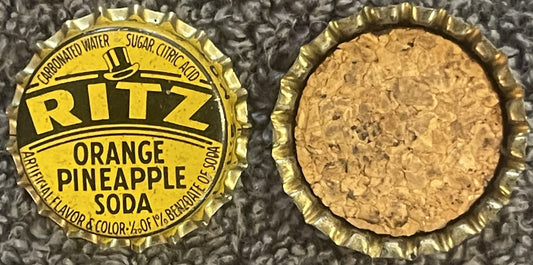
Look at the type on this cap. IMITATION runs across the top in letters every bit as tall and heavy as PINEAPPLE and SODA beneath it, and ARTIFICIALLY COLORED AND FLAVORED curves around the bottom edge. That is not decoration. It is the letter of American food law, which since 1938 has said that an imitation food must carry the word "imitation," in type as large and prominent as the rest, followed immediately by the name of the food it imitates, and that artificial flavoring and coloring must be declared.

The cap belongs to one of the most influential throwaway objects ever made. William Painter's crown cork was built to be used once and discarded, and Painter's advice about it sent a Crown Cork & Seal salesman named King C. Gillette off to invent the disposable razor blade. This cap was made to be pried off a bottle and tossed. It never was.


🔍 What You're Looking At

A late 1930s–1940s Imitation Pineapple Soda crown cap, New Old Stock and never used. The face is sunny yellow inside a black ring, lettered in black block capitals: IMITATION on the top line, PINEAPPLE across the middle, SODA below, and the artificial color and flavor declaration following the lower arc. The fluted skirt is silver-toned metal and still flares open. It has never been crimped onto the neck of a bottle.

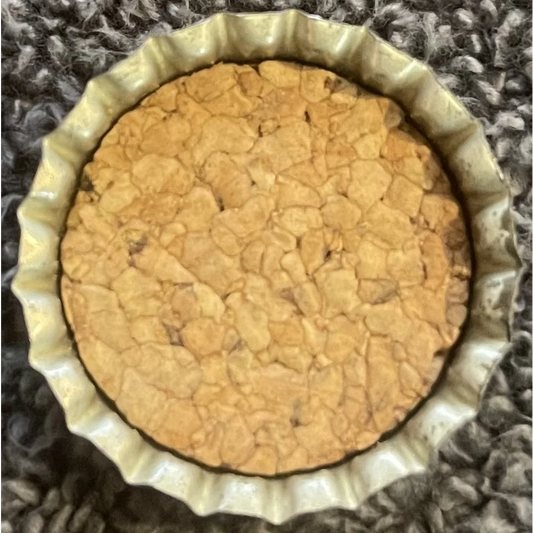
Turn it over and the inside is filled edge to edge with a pressed cork liner, small cork granules packed into a disc. On the outside of the skirt, stamped small between two flutes, is a crown outline around the number 10, with a tiny circled letter beside it.

No bottler's name and no town appear anywhere on it. The cap names its flavor, declares what the law asks it to declare, and stops there.


⚖️ The Law Printed on a Bottle Cap

In 1937 a liquid medicine called Elixir Sulfanilamide, dissolved in the toxic solvent diethylene glycol, killed more than 100 people. That disaster shaped the Federal Food, Drug, and Cosmetic Act, which President Franklin D. Roosevelt signed on June 25, 1938.

For food, the new act went well past the 1906 Pure Food and Drugs Act. It gave the government its first authority to set standards of identity for foods, required a label to bear a food's common or usual name, and in Section 403 spelled out what makes a food misbranded. Two of those clauses are sitting on this cap:

  • Section 403(c) — a food that is an imitation of another food is misbranded unless its label bears, in type of uniform size and prominence, "the word 'imitation' and, immediately thereafter, the name of the food imitated."
  • Section 403(k) — a food that bears or contains any artificial flavoring or artificial coloring is misbranded unless it bears labeling stating that fact.
  • The word mattered enough to reach the Supreme Court. In 1951, in 62 Cases of Jam v. United States, the justices considered "Delicious Brand Imitation Jam," a Colorado product with 25% fruit, well short of the federal jam standard. The Court held that calling it "imitation" satisfied the law; Justice Felix Frankfurter wrote that Congress did not give an esoteric meaning to the word. From then on, makers could sell a food that fell short of a standard, as long as they printed "imitation" on the label.

    Both clauses are still federal law, codified today at 21 U.S.C. 343. Hold the statute next to the cap and it reads like a compliance checklist the size of a bottle top: IMITATION, then PINEAPPLE SODA, in matching heavy letters, then the declaration of artificial color and flavor.


    👑 William Painter and the Crown Cork — Baltimore, Maryland

    William Painter was born on November 20, 1838, in Triadelphia, then a mill town in Montgomery County, Maryland, and moved to Baltimore in 1865 to begin a career as a foreman. On February 2, 1892, he was granted three patents for a new way to seal a bottle, among them U.S. Patent No. 468,226: a metal cap whose crimped flutes locked under the head of the bottle, lined with a thin cork disc and a special paper backing that sealed the bottle and kept the metal away from the drink.

    Painter did not stop at the cap. He invented and patented the machinery needed to manufacture it, started the Crown Cork & Seal Company of Baltimore that same year, and realized the cap could be levered off with a simple lifting device, the bottle cap opener. He died in July 1906, at 67. The crown he patented became the universal cap for carbonated drinks in glass bottles, and it still is.

    The crown kept changing after him. Its solid cork lining gave way to composite cork several years before Prohibition, the pressed-granule material you can see inside this cap. Beginning around 1960, crown liners took on plastic surfaces, cork was eventually replaced by PVC, and the flutes around the skirt were in time standardized at 21.


    🪒 The Salesman, the Dull Razor, and the Throwaway Idea

    King C. Gillette joined Crown Cork & Seal in 1891 and became a close friend of its founder. The story goes that Painter told him he was always inventing something, and that he ought to think of a product like the Crown Cork, "which, when once used, is thrown away, and the customer keeps coming back for more."

    As Gillette later told it, the answer came one morning at home in Brookline, Massachusetts, when he picked up his razor to shave and found the blade dull. He founded the American Safety Razor Company on September 28, 1901, renamed it the Gillette Safety Razor Company in July 1902, began production in 1903 with first sales of 51 razors and 168 blades, and was granted his patent in 1904. His cheap stamped carbon-steel blade, used until dull and then thrown out, turned a bottle cap's lesson into the razor-and-blades model that businesses still name and still copy.


    🌺 Why Pineapple? How Hawaii Sold a Flavor to America

    Pineapple spent the 1930s becoming a national taste, and advertising did much of the work. The Hawaiian Pineapple Co., whose president James D. Dole had bought the island of Lanai and developed the largest pineapple plantation in the world, sank into debt in the Great Depression and in October 1932 was reorganized and acquired by the sugar factor Castle & Cooke, which removed Dole from effective control.

    That same year the company made the scientific breakthrough needed to produce clarified pineapple juice. In March 1933, working with the New York advertising agency N.W. Ayer & Son, it launched a national campaign built around the new juice to establish the Dole name, and from 1935 Ayer used modern art to tie pineapple to a romantic image of Hawaii. Pineapple juice receipts grew from $1,000 in 1933 to $21.3 million in 1941, while Americans' yearly fruit juice consumption rose from half a pound per person in 1933 to eight and a half pounds in 1941.

    Pineapple went into the punch bowl too. In 1934 A.W. Leo, Tom Yeats and Ralph Harrison created Hawaiian Punch as a syrup topping for ice cream, blending orange, pineapple, passion fruit, guava and papaya. A soda that promised pineapple, even an imitation one, was selling a flavor the whole country had been taught to want.

    And pineapple soda was being bottled a long way from Hawaii. Down on the Gulf Coast, the Pailet brothers opened the Jefferson Bottling Company in Old Metairie, just outside New Orleans, in May 1920, and pineapple was on their flavor list right beside grape, orange, root beer and cream soda. In 1935 they renamed their root beer Big Shot, and you can still buy it today. When the business was sold in 1987, pineapple was still one of the flavors going out the door.


    🎁 Good For

    • 🥤 Bottle cap and sodiana collections — an unused cork-lined crown with bold two-color printing and a maker's crown stamp on the skirt.
    • 🍍 Tiki bars, tropical kitchens and yellow-and-black decor — the face reads clearly from across a shelf.
    • ⚖️ Food-law and advertising history — an everyday object that prints two clauses of federal law in its biggest type.
    • 🪒 Razor and shaving collectors — the product family that gave King C. Gillette his idea.
    • 🖼️ Shadow boxes — framed with period soda bottles, labels or a vintage opener.

    ❓ Questions People Ask

    Has this cap ever been on a bottle?

    No. It is New Old Stock. The fluted skirt still flares outward the way it left the press, and a cap that has sealed a bottle comes off bent and crimped.

    How old is it?

    It is a late 1930s–1940s crown, lined with the pressed composite cork that crowns carried before plastic-faced liners began arriving around 1960.

    Who made it, and whose soda did it seal?

    Neither name is printed. The face carries only the flavor and the required declarations, and the skirt carries a small crown outline around the number 10 with a tiny circled letter beside it.

    Why would a soda call itself "imitation"?

    Because federal law made it. Under Section 403(c) of the 1938 Food, Drug, and Cosmetic Act, a food imitating another has to say "imitation" right before the name of the food imitated, in type no smaller or weaker than the rest, and Section 403(k) requires artificial flavoring and coloring to be stated.

    What is the cork inside for?

    It is the seal. Painter's 1892 design pressed a thin cork disc against the lip of the bottle to hold in the carbonation and keep the drink off the metal. By this cap's day the lining was composite cork, granules pressed together, which is exactly what fills this one.

    What does King Gillette have to do with a bottle cap?

    Gillette sold crown corks for Painter's company. Painter urged him to invent something people would use once, throw away and buy again, and Gillette's answer was the disposable safety razor blade.

    Shipping

    🚚 Shipping & Handling

    • Shipping costs and timing are calculated at checkout.
    • Items curated and shipped directly by me include U.S. shipping at no additional cost, professionally packed to ensure safe arrival of your artifact.

    Items from Vetted Pro Collectors
    Shipping for items offered by vetted Pro Collectors is determined at checkout. All Pro Collector listings are reviewed to ensure fair, reasonable shipping practices.

    For full details, please refer to our Shipping Policy.

    Returns & Exchange

    Take your time — you've got a full six months. If a piece isn't right for you, send it back the way it reached you and we're good.

    In the first 30 days your money goes straight back the way you paid. After that it's store credit, so you can put it toward something you'd rather have.

    Return shipping we sort out between us, case by case. I don't make this difficult.

    If something arrives damaged, or it isn't what I said it was, send me a photo within 48 hours and I'll make it right.

    Email info@vintageantiquesgifts.com or call 802-356-9872 — that's me answering, not a call center.

    The only things I can't take back are custom or special-order pieces and gift cards.

    View full details
    • 5 stars: 2 (100%)
    • 4 stars: 0 (0%)
    • 3 stars: 0 (0%)
    • 2 stars: 0 (0%)
    • 1 star: 0 (0%)
    b
    burrresear

    Clean item; rapid delivery. Thanks.

    Pleasure is all ours. Thank you for your review and kind words!

    4
    40hotrod40

    Quality item! Fast shipping! Fun

    Pleasure is all ours. Thank you!

    Preserving History: Authentic Objects Across Eras

    — Curated by Travis Weigel