Skip to product information
1 of 5

Vintage and Antique Gifts

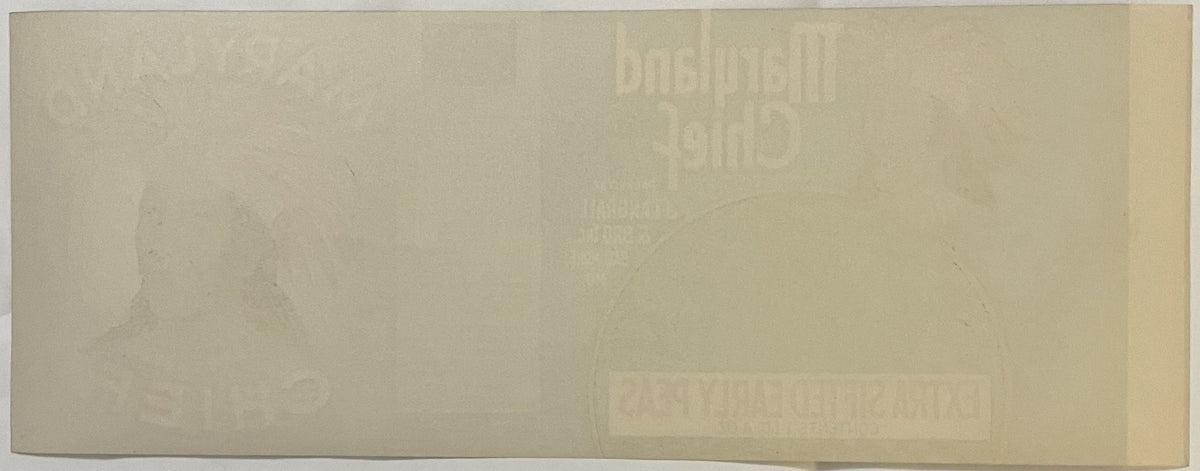
Antique 1930s-40s 🥫 Maryland Chief Peas Label NOS J. Langrall & Bro Baltimore

Antique 1930s-40s 🥫 Maryland Chief Peas Label NOS J. Langrall & Bro Baltimore

Regular price $6.00 USD
Regular price Sale price $6.00 USD
Sale Sold out
Shipping calculated at checkout.

Size: 11" x 4 1/2"

🚚 Free US Shipping — ships within one business day. International shipping calculated at checkout.

Quantity

How Does This Label Date Itself? 🥫 Antique 1930s-40s Maryland Chief Peas Label, J. Langrall & Bro., Baltimore, NOS

Size: 11" x 4 1/2"

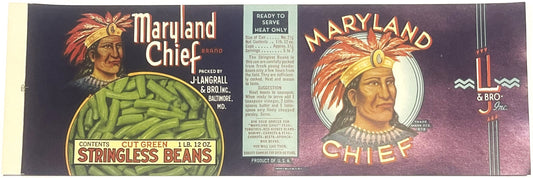
🥫 This label dates itself, and almost nobody notices. Beside the chief's shoulder it prints TRADE MARK REG. 1878. Down in the directions panel it prints QUALITY CANNERS FOR OVER 60 YEARS. Put the two together and the sheet is telling you it came off the press after 1938 — and the printer's name in the corner says before 1954, so this is a late-1930s or 1940s sheet — an original, unused Maryland Chief Brand Extra Sifted Early Peas can label from J. Langrall & Bro. Inc. of Baltimore, Maryland.

🧷 Details

Approx. 11" x 4 1/2" ~
NOS (New Old Stock) — original cannery stock, never pasted to a can, not a modern reprint
Lithographed color: midnight blue ground, gold and cream lettering, a mound of bright green peas
Printer's imprint at the lower right corner: Simpson & Doeller, Baltimore

🌽 What is printed on it

The wrap carries the chief in a red feathered headdress twice, once at each end, and a full serving panel between them: READY TO SERVE — HEAT ONLY, Size of Can No. 2, Sieve No. 2, Net Contents 1 lb. 4 oz., Cups Approx. 2½, Servings 4 to 5. Then the packer's own promise: “The Peas in this can are carefully packed from fresh young tender peas only a few hours from the field.”

Underneath is a recipe — to these Peas and liquor add small onion cut in tiny cubes, ¾ teaspoon salt, ⅛ teaspoon pepper and 1 teaspoon butter. Simmer over low heat. Be sure the Peas never boil. “Liquor” here is the canner's word for the packing liquid in the tin, nothing stronger; the warning not to boil is because boiled canned peas go gray and split.

And at the bottom, the rest of the line, in the voice of a company that expected you to buy the whole shelf: ASK YOUR GROCER FOR “MARYLAND CHIEF” SPINACH · TOMATOES · RED KIDNEY BEANS · STRINGLESS BEANS · HOMINY · CARROTS & PEAS · CARROTS · BEETS. YOU WILL LIKE THEM.

🫛 “Extra Sifted” and “Sieve No. 2” — what the grocer’s wife actually read

Canned peas are graded by the size of the circular opening they will pass through without being forced: sieve 1 is the tiniest, sieve 6 the largest and mealiest. Sifted means the sizes have been separated out; Extra Sifted means a tightly sorted, small, sweet pack. Early (or Early June) is the smooth-skinned Alaska-type pea, the first of the season. So Extra Sifted Early Peas, Sieve No. 2 is not marketing language — it is a precise spec, and in 1930s grocery shopping it was the difference between a good tin and a cheap one.

🏭 J. Langrall & Bro., and Baltimore’s cannery row

Two brothers, James and Leander Langrall, started packing oysters in Baltimore in 1878 — the same 1878 the chief carries on his shoulder. They spent their first season at 103 Boston Street, then settled on Aliceanna Street on the Fells Point waterfront, where Polk's 1887 directory lists “Langrall J & Bro (J and L Langrall), oyster packers” with their own wharf, and where the firm stayed into the 1970s. They ran canneries over on the Eastern Shore too, around Centreville; James died on the Chester River near them in August 1906, and the next year the old firm incorporated, with Leander as president. That is the “Inc.” on this label.

Maryland Chief went on Baltimore oysters as early as 1882, then on pears, tomatoes, peas and the whole list at the bottom of this wrap. Leander, who had been in canning since 1878, died in August 1937 — so he never saw a label that could truthfully say over 60 years.

Baltimore did not merely participate in canning; it invented much of it. Thomas Kensett, who had patented tin cans in New York, moved his oyster canning to Baltimore in 1849. By 1870 the city held more than a hundred packing houses, and by 1880 it was the canning center of the United States. A. K. Shriver, working in a Baltimore oyster and produce plant, invented the steam retort in 1874 — the giant pressure cooker that made mass canning safe and fast, and which every cannery on earth still uses in some form. A humble peas label from Aliceanna Street sits directly downstream of that.

🖨️ The printer in the corner

The tiny imprint at the bottom right reads Simpson & Doeller, Balto., Md. John Simpson started printing labels in Baltimore in 1886 and was in partnership with Henry Doeller by the late 1890s; from 1908 they worked out of a big plant on East Preston Street and advertised “Artistic Labels. Plain. Varnished. Embossed.” to canners for decades. In September 1954 the United States Printing & Lithograph Co. bought the business and closed the Preston Street presses, which is why a sheet carrying their own name predates 1954. Their work turns up in museum collections — The Henry Ford holds a Simpson & Doeller tomato label from the 1910s. Their old plant site is now on Maryland's environmental cleanup rolls; the company is gone, and the surviving evidence of what it could do is sheets exactly like this one.

🎨 Why the art is this good

Before television, the label WAS the advertising. A shopper met the brand for three seconds in a dim grocery, so canners paid lithographers for saturated color and portrait-grade artwork on a scrap of paper destined to be glued to a tin and burned. Most Maryland Chief labels went exactly that way. Unused sheets survive only because bundles of them were left in a cannery storeroom when a pack size or a design changed.

❓ Questions People Ask

Does the 1878 date mean the label is from 1878? No. 1878 is the year the Langralls started and the year the brand dates itself to — when a later owner registered the name in the 1970s, it gave the first use as September 1, 1878 — and it stayed on the label for the rest of the brand's life. The “over 60 years” line is what dates the sheet: after 1938, and before Simpson & Doeller sold out in 1954.

Is this a reprint? No — it is unused original cannery stock, printed on the soft, slightly absorbent label paper of the period, with the lithographer's imprint still in the corner.

What is the headdress portrait about? Native American figures were used as brand marks across American food packaging of this era; the chief is the Maryland Chief mark itself, dated to 1878 and carried on every product in the line.

🕰️ Where the chief went

The brand outlived the firm. In 1955 the company was offering a “Remindex” shopping-list disc for fifty cents and two Maryland Chief labels. In 1977 the State Department cabled the brand's owner, Charles G. Summers Jr., Inc. of New Freedom, Pennsylvania, about Taiwanese knock-offs of the Maryland Chief red kidney bean label turning up in Kuwait. The name later passed to Hanover Foods, which still listed Maryland Chief among its brands in 2003. A Baltimore oyster packer's chief, copied on the far side of the world a century on, is a pretty good run.

🏡 Good for framing in a kitchen, pantry or dining room, Baltimore and Maryland history collections, food-packaging and lithography collections, and anyone who would rather own the artwork than a picture of it.

Shipping

🚚 Shipping & Handling

  • Shipping costs and timing are calculated at checkout.
  • Items curated and shipped directly by me include U.S. shipping at no additional cost, professionally packed to ensure safe arrival of your artifact.

Items from Vetted Pro Collectors
Shipping for items offered by vetted Pro Collectors is determined at checkout. All Pro Collector listings are reviewed to ensure fair, reasonable shipping practices.

For full details, please refer to our Shipping Policy.

Returns & Exchange

Take your time — you've got a full six months. If a piece isn't right for you, send it back the way it reached you and we're good.

In the first 30 days your money goes straight back the way you paid. After that it's store credit, so you can put it toward something you'd rather have.

Return shipping we sort out between us, case by case. I don't make this difficult.

If something arrives damaged, or it isn't what I said it was, send me a photo within 48 hours and I'll make it right.

Email info@vintageantiquesgifts.com or call 802-356-9872 — that's me answering, not a call center.

The only things I can't take back are custom or special-order pieces and gift cards.

View full details
  • 5 stars: 1 (100%)
  • 4 stars: 0 (0%)
  • 3 stars: 0 (0%)
  • 2 stars: 0 (0%)
  • 1 star: 0 (0%)
s
s***b (4440)

Nice transaction,all good,would deal with again.AAA+++

Preserving History: Authentic Objects Across Eras

— Curated by Travis Weigel