Skip to product information
1 of 2

Vintage and Antique Gifts

Antique Bull Durham Tobacco Plug Tag 🐂 NOS American Tobacco Co Guarantee Durham NC American Made

Regular price 6.00 USD
Regular price Sale price 6.00 USD
Sale Sold out
Shipping calculated at checkout.

Description

Could Something the Size of a Quarter Hold a Hundred Years of American Commerce? 🐂

There are objects that survive by accident — shuffled to the back of a drawer, forgotten inside a tin box on a shelf, wrapped in a scrap of newspaper and set aside with a vague sense that they might come in handy someday. And then there are objects that survive because someone, somewhere, understood without quite being able to say why, that this particular thing mattered. This little Bull Durham tobacco plug tag is both of those things at once. It is small enough to sit in the center of your palm and leave room to spare. It is old enough to have been printed when the twentieth century was brand new. And it carries on its two modest faces — a circle of heavy cardboard no more than an inch and an eighth across — the full weight of an industry, a town, a brand identity, and a legal battle for authenticity that shaped how American companies thought about counterfeiting for generations. Hold it, and you are holding Durham, North Carolina. You are holding the tobacco fields, the auction warehouses, the factory floors, and the advertising genius of a company that turned a working bull into one of the most recognized brand images in the world.


🐂 What This Tag Is — The Object Itself

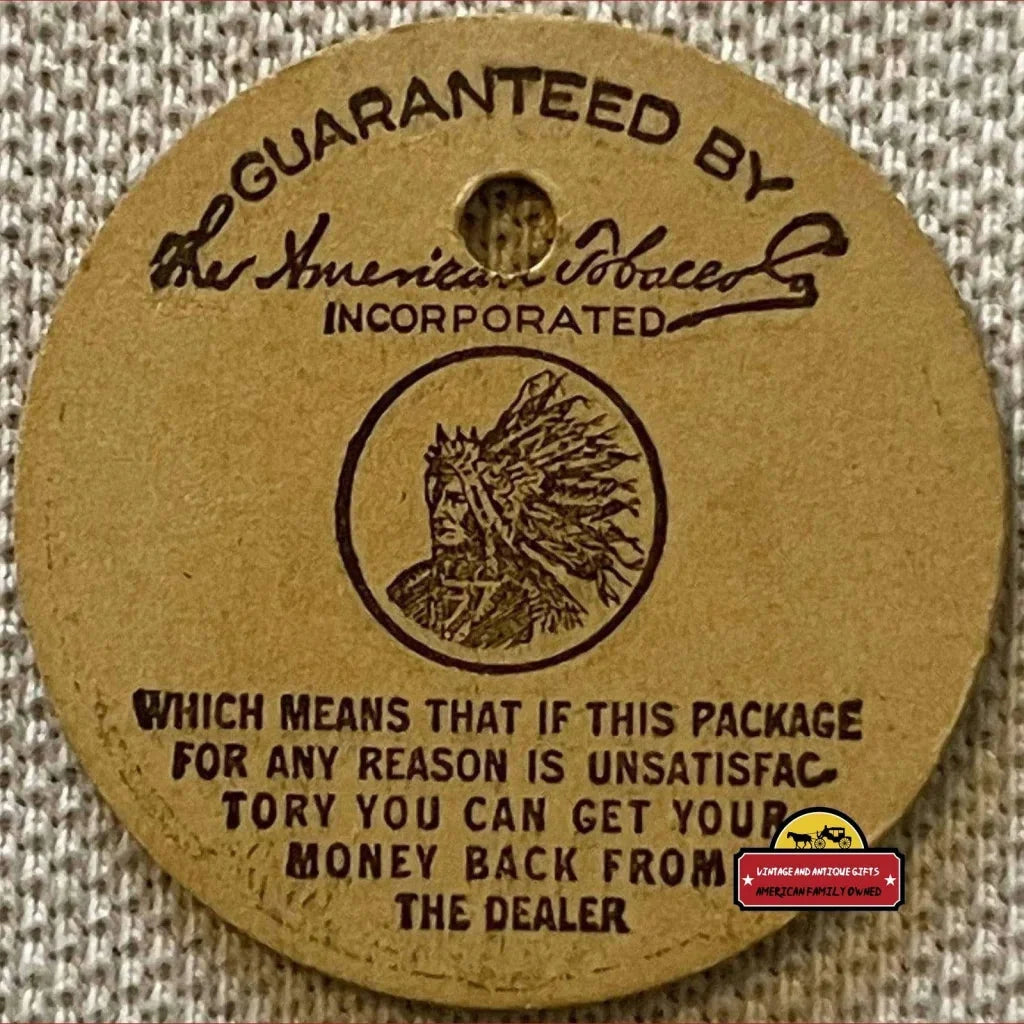
This is an original Bull Durham Tobacco plug tag, issued by the American Tobacco Company, Incorporated, dating to the early 1900s — New Old Stock, meaning it was printed, punched, and ready for use, but never tied to a pouch, never tucked into a package, never deployed in commerce. It waited instead, the way useful things do, in some forgotten corner of a warehouse or a stockroom or a family's back-room tin, outlasting the era that produced it with its ink still crisp and its cardboard still firm. The tag measures approximately 1 1/8 inches in diameter — a perfect small circle of heavyweight cardboard stock, factory-punched through at the top with a clean string hole, printed on both sides in sharp, dense ink that has refused to fade across more than a century of time.

The printing process is unmistakably of its period: engraved-style linework, the kind that required skilled craftsmen at the plate stage, the kind that gave commercial printing of the Gilded Age and early Progressive Era its particular muscular clarity. There is no smearing, no registration drift, no impression of haste. Someone cared about this tag. On one face stands the bull himself — broad-shouldered, firmly planted on a strip of grass, rendered in confident lines that give him weight and presence despite the miniature scale. Circling him in bold uppercase type runs the brand's foundational anti-counterfeiting declaration: NONE GENUINE WITHOUT THE BULL ON EACH PACKAGE. A decorative banner panel anchors the bottom of the circle, grounding the composition the way a good engraver would finish a certificate or a bond. Turn the tag over and you meet the guarantee side: the seal of the American Tobacco Company, Incorporated, centered on a portrait medallion of a Native American chief in full feathered headdress, with text beneath pledging a full refund from the dealer if the package proved unsatisfactory for any reason. That guarantee was not decorative — it was strategic, and understanding why takes you deep into the story of Bull Durham and the town that made it famous.


🏭 The American Tobacco Company and the Era That Made This Tag Necessary

The American Tobacco Company was, by the early years of the twentieth century, one of the most powerful commercial entities in the United States — a trust assembled by James Buchanan Duke with a combination of mechanical innovation, ruthless acquisition, and marketing genius that the era's business press simultaneously admired and feared. Duke's combine had absorbed dozens of competing tobacco firms, controlled an enormous share of domestic cigarette and plug production, and wielded distribution muscle that smaller operators could not match. Bull Durham itself had been acquired into this orbit after decades of independent operation under the Blackwell company in Durham, North Carolina, and the brand's integration into the American Tobacco portfolio only amplified both its reach and its vulnerability to imitation.

Because Bull Durham was famous — genuinely, nationally, internationally famous — it was counterfeited. This was not a minor nuisance. In an era before federal packaging standards and before mass-market consumer skepticism had fully matured, a convincing imitation could be sold across a wide territory before word got back to the manufacturer. The solution, which Bull Durham and its parent company pursued with real ingenuity, was to make the tag itself the authentication. The bull on each package was not merely a logo. It was a legal and commercial declaration: if you do not see this specific image, this specific mark, this specific guarantee seal with the portrait of the chief on the reverse, you do not have the genuine article. The plug tag existed as physical proof of origin, tied by a string to the genuine pouch, impossible to replicate cheaply enough to make counterfeiting worthwhile if the public had been trained to look for it. And American consumers were trained. The advertising campaigns for Bull Durham — among the most sustained and consistent in nineteenth and early twentieth century commercial history — hammered the bull image home year after year until it became, in the truest sense, a brand in the original meaning of that word: a mark burned into the public mind.


🌿 Durham, North Carolina — Bright Leaf Country and the Town the Tobacco Built

You cannot talk about Bull Durham without talking about Durham, North Carolina, and you cannot talk about Durham without talking about bright leaf tobacco — the specific varietal, cured in a particular way in that particular piedmont soil and climate, that gave the region's product its golden color, its mild smoke, and its distinctive sweetness that set it apart from darker, heavier tobaccos grown elsewhere. The story of how bright leaf became the signature crop of the North Carolina piedmont is woven through with accident and local knowledge in roughly equal parts. Farmers in the region had been growing tobacco for generations, but the bright leaf method — starving the plant of nitrogen, curing the leaf with charcoal heat in log barns — produced something so different from what had come before that it opened an entirely new market.

Durham itself was a railroad town before it was a tobacco town, but the two identities fused quickly and permanently. The North Carolina Railroad passed through in the early 1850s, and the depot at Durham's Station became a commercial node. When the Civil War ended and Union and Confederate troops were demobilized through the area, soldiers from both sides carried home memories — and, reportedly, small supplies — of the local smoking tobacco they had encountered during the campaign. The demand that followed lit a commercial fire that turned Durham from a crossroads into a city within a generation. Local legend holds that more than a few of those returning soldiers wrote back to Durham asking where they could buy more of that bright leaf tobacco they'd smoked during the last weeks of the war, and that those letters were the first market research the Blackwell company ever received. Whether or not the story is apocryphal, the effect was real: Bull Durham became a mail-order phenomenon before mail-order was even a recognized commercial category.

Lore passed down among tobacco collectors holds that the Bull Durham factory on the edge of downtown Durham was for a time the most visited industrial site in the American South — that visitors came specifically to see the massive painted bull on the factory wall, and that the company leaned into this tourism so deliberately that they kept the exterior freshly painted and the grounds presentable as a matter of brand policy. The great painted bull on Durham buildings and barns was itself a form of advertising infrastructure, and local stories credit it with being one of the earliest examples of what we would today call experiential marketing: you didn't just buy Bull Durham, you went to see where it came from, and you told people about it when you got home.


🖋️ The Plug Tag as Object, Artifact, and Legal Instrument

Within the specific world of tobacco ephemera collecting, plug tags occupy a place of particular affection and serious scholarship. They were produced by dozens of manufacturers across the tobacco-growing regions of the American South and border states, in an extraordinary variety of shapes — circles, ovals, diamonds, shields, animal silhouettes, portrait medallions. They were made of tin, of heavy paper stock, of lithographed cardboard, of embossed metal. They were sometimes gilded, sometimes lacquered, and almost always designed with a care and craft investment that seems surprising given how small and utilitarian their original function was. Collectors have assembled them by manufacturer, by shape, by imagery, by region, and by era, and the literature on tobacco plug tags — auction records, collector guides, specialist dealer catalogs — is richer than most outsiders to the hobby would expect.

This Bull Durham example sits at the intersection of several collecting categories simultaneously: it is tobacco ephemera, it is advertising ephemera, it is North Carolina history, and it is early American Tobacco Company material — a company whose corporate history is itself a significant chapter in the story of American antitrust law, business consolidation, and the Progressive Era reform movement. The Supreme Court's 1911 dissolution of the American Tobacco trust is one of the landmark decisions in antitrust jurisprudence, and any piece carrying the American Tobacco Company guarantee is, in that sense, a primary document of that history. This tag predates the dissolution. It was made when the trust was at or near its height. That context gives it a legal and historical valence that purely decorative tobacco items do not carry.

The NOS condition — never used, never tied to a pouch — means the string hole is clean, the cardboard is unbent, the ink retains the full sharpness of the original print run. Collectors who focus on condition are accustomed to searching for years for NOS examples of tags that are otherwise common in used form. This one shows none of that. It has come through more than a century in the condition in which it left the press.


🖼️ Display Ideas

  • 🪞 Float-mount in a shadow box alongside a period tobacco broadside or trade card to create a compact Bull Durham vignette — both sides of the tag can be displayed with a simple stand-off mount that shows the bull face forward and the guarantee seal angled behind it.
  • 📜 Frame with a period map of Durham County or the North Carolina piedmont tobacco region for a geo-specific display that connects the tag to its place of origin — a natural conversation piece for anyone with Carolina roots or Southern history interests.
  • 🏺 Display in a small apothecary jar or glass dome alongside other period tobacco ephemera — a clay pipe fragment, a period match safe, a trade card — for a curiosity-cabinet grouping that rewards close inspection.
  • 🖼️ Mat and frame under archival glass with a printed label giving the tag's context: the American Tobacco Company, the Durham origin, the antitrust history — turning the tiny object into a labeled museum piece suitable for a study, library, or home office with a historical theme.
  • 🎩 Incorporate into a vintage advertising gallery wall with other NOS or near-mint ephemera from the same era — trade cards, chromolithograph labels, patent medicine broadsheets — where its scale becomes a feature rather than a limitation, the eye drawn to it precisely because it is the smallest and most densely detailed piece in the arrangement.
  • 🐄 Pair with a framed print of the famous Bull Durham barn advertisement or a period photograph of the Durham factory for a two-piece display that tells the visual story of the brand across different scales and media.

🎁 Who Collects These

The audience for a piece like this is pleasingly broad, and it overlaps in ways that make Bull Durham material some of the most consistently sought tobacco ephemera in the market. Tobacco advertising collectors form the obvious core — people who have been assembling plug tags, tins, trade cards, posters, and store displays for decades and who recognize immediately that a NOS circular cardboard Bull Durham tag with this level of print clarity is not something that comes to market constantly. Alongside them are advertising and brand history collectors drawn specifically to the Bull Durham bull as an image — one of the most enduring and recognizable animal brand marks in American commercial history, in the same visual pantheon as Borden's Elsie or the Quaker Oats Quaker, and considerably older in continuous use than most of its contemporaries.

North Carolina history collectors and piedmont South enthusiasts form a passionate secondary audience — people who collect the material culture of the tobacco economy not as advertising objects but as regional history, as documents of how a specific place shaped itself around a specific crop and the industries that crop sustained. For this audience, the Durham, NC provenance is the primary draw, and the American Tobacco Company name on the guarantee seal carries the weight of an entire chapter in their home state's economic and social history. Then there are the antitrust and business history collectors — a smaller but intensely focused group who seek out primary materials from the great trust era of American capitalism, and for whom an American Tobacco Company guarantee tag made before the 1911 dissolution is a tangible connection to one of the defining legal battles of the Progressive period. And finally, there are the generalist vintage ephemera collectors who are simply drawn to things that are old, well-made, crisp in their printing, and quietly extraordinary in their survival — people who understand that this tag was not supposed to be here, a century and more later, and find in that survival its own kind of beauty.


❓ Frequently Asked Questions

What exactly does "NOS" mean for this tag, and why does it matter so much to collectors?

NOS stands for New Old Stock — a term that means the item was manufactured and prepared for sale or use but was never actually put into service. For this Bull Durham plug tag, that means it was printed, cut, and punched with its string hole at the factory, but it was never tied to a tobacco pouch or inserted into a package for retail sale. It went directly from production into storage — a drawer, a tin, a stockroom shelf — and stayed there for more than a century. The significance for collectors is both aesthetic and evidentiary. Evidentiary, NOS status is the strongest possible confirmation of original period production, because the object has never been modified, repurposed, or restored. What you see is what left the factory. For a piece this small and this old, NOS condition is genuinely uncommon, and collectors who specialize in tobacco plug tags understand that immediately.

What can you tell me about the bull image itself — is this the famous Bull Durham bull that appeared on barn signs and factory walls?

Yes, this is the same bull — the same foundational brand image that appeared on barn advertisements across the American South and Midwest, on the massive painted wall murals at the Durham factory, on trade cards, posters, tobacco pouches, and in newspaper advertisements for decades. The engraved-style rendering on this tag — broad-shouldered, standing broadside on a strip of grass, rendered with confident linework that gives him genuine physical presence at miniature scale — is consistent with the canonical Bull Durham brand illustration used across the company's printed materials in the late nineteenth and early twentieth centuries. The text circling him, NONE GENUINE WITHOUT THE BULL ON EACH PACKAGE, was the brand's primary anti-counterfeiting declaration, trained into consumers through repetition in advertising over many years. The bull on this tag is not a simplified or abbreviated version of the image — it is the full brand mark, compressed faithfully to the 1 1/8-inch diameter of the tag with the skill you would expect from a professional commercial engraver of the period.

What is the portrait on the guarantee side of the tag, and what was the cultural context of using a Native American chief image on a tobacco product?

The reverse of the tag carries the American Tobacco Company guarantee, with a central portrait medallion depicting a Native American chief in full feathered headdress. The use of Native American imagery on tobacco products was extremely common in the nineteenth and early twentieth centuries, rooted in a long-established visual association between Native American culture and tobacco that dated back to the earliest European contact with the Americas. Tobacco was understood by consumers of the period as a fundamentally indigenous product — something that had come to European and American commercial culture through Native peoples — and manufacturers leaned heavily on that association as a mark of authenticity and quality. Cigar store figures, brand names, trade cards, and packaging across the tobacco industry of this era are densely populated with Native American iconography. For collectors today, these images are understood as artifacts of their period's cultural attitudes — documented, studied, and collected as primary evidence of how commercial culture operated in that era, rather than endorsed as contemporary representations.

How do I know this tag is genuinely from the early 1900s and not a later reproduction?

Several characteristics of this tag are consistent with early 1900s commercial printing and inconsistent with later reproduction. The cardboard stock is heavyweight and period-appropriate in its weight, texture, and aging characteristics. The printing is engraved-style linework executed with a quality and density of ink coverage that is characteristic of professional commercial printing of the Gilded Age and early Progressive Era — not the screened or offset printing that became standard in later decades. The factory-punched string hole is clean and shows the mechanical characteristics of period production tooling. The ink has the particular quality of deep-press period printing: it has not faded to grey or brown but retains its dark sharpness, which is characteristic of high-quality period commercial inks on good cardboard stock. The American Tobacco Company, Incorporated, named on the guarantee side, was dissolved by Supreme Court order in 1911, providing a useful terminus for dating — material bearing that corporate name as an active issuing entity was produced before that dissolution. Taken together, these characteristics support an early 1900s date consistent with the seller's attribution.

What is the best way to store or preserve this tag once I have it?

For long-term preservation, the primary concerns for a piece of heavy cardboard ephemera like this are humidity, UV light exposure, and physical handling. Archival-quality storage is straightforward at this scale: a Mylar or polypropylene sleeve (acid-free, archival standard) provides clean, inert housing that protects against dust and handling without introducing any chemical interaction with the cardboard or ink. If you are displaying rather than storing, UV-filtering archival glass or acrylic in a frame will prevent the slow light-fading that is the primary enemy of period printing inks. Avoid direct sunlight entirely. For humidity, a stable interior environment — the same conditions comfortable for books and paper — is appropriate. The tag should not be mounted with pressure-sensitive tapes or adhesives of any kind; if matting for display, use acid-free mat board and archival corner mounts or hinging tape. Duke, ordered dissolved by the Supreme Court in 1911 under the Sherman Antitrust Act. The dissolution created a number of successor companies, and the Bull Durham brand passed through several corporate hands over the subsequent decades. The brand continued in production well into the twentieth century, though its cultural prominence declined as cigarette smoking displaced loose-leaf and plug tobacco as the dominant form. For collectors, material bearing the American Tobacco Company, Incorporated guarantee — as this tag does — is specifically pre-1911 in its corporate identity, which places it in the trust era and gives it historical significance beyond its value as a tobacco advertising piece. Later Bull Durham material exists and is also collected, but it carries different corporate markings and a different historical context. This tag belongs to the first chapter.

What makes a plug tag valuable versus common in today's collector market?

Within the tobacco plug tag collecting community, value is driven by several intersecting factors: brand recognition, material (tin commands a premium over paper or cardboard in some collecting circles, though exceptional paper examples are prized in their own right), condition, rarity of the specific design variant, and NOS versus used status. Bull Durham is among the most recognized brands in the category, which creates sustained demand from multiple collector audiences simultaneously — tobacco ephemera specialists, advertising collectors, North Carolina history collectors, and brand history enthusiasts all have reasons to want a Bull Durham tag. A circular cardboard example in NOS condition with crisp printing on both sides — bull face and guarantee seal intact — represents a combination of brand prestige, print quality, and preservation status that places it well above average in the category. The two-sided printing (most plug tags were single-sided or had a simpler reverse) and the specific anti-counterfeiting text add documentary interest that single-purpose decorative tags do not have. For a collector assembling a reference collection of American tobacco brand marks, this tag functions simultaneously as a decorative object and a primary historical document.

Shipping

🚚 Shipping & Handling

  • Shipping costs and timing are calculated at checkout.
  • Items curated and shipped directly by me include U.S. shipping at no additional cost, professionally packed to ensure safe arrival of your artifact.

Items from Vetted Pro Collectors
Shipping for items offered by vetted Pro Collectors is determined at checkout. All Pro Collector listings are reviewed to ensure fair, reasonable shipping practices.

For full details, please refer to our Shipping Policy.

Returns & Exchange

Product Page Return Policy

  • 60-Day Returns – Items must be in original condition.
  • Refunds – Issued after inspection (excluding shipping costs).
  • Return Shipping – Customer is responsible unless item is damaged or incorrect.
  • Damaged/Incorrect Items – Contact us within 48 hours for a replacement or refund.
  • Easy Returns – Email [email protected] or call 802-356-9872 to initiate a return.

For full details, visit our Refund Policy.

View full details