Skip to product information
1 of 2

Vintage and Antique Gifts

Vintage 1900s Quality 5 Cigar Label Gold Embossed Round Tobacco Advertising Token NOS Cigar Store Tobacciana 🚬

Vintage 1900s Quality 5 Cigar Label Gold Embossed Round Tobacco Advertising Token NOS Cigar Store Tobacciana 🚬

Regular price 13.00 USD
Regular price Sale price 13.00 USD
Sale Sold out
Shipping calculated at checkout.
Quantity

What Does a Five-Cent Cigar Tell You About the Man Who Smoked It? 🎩

There is a particular kind of object that stops people cold — not because it is large or loud, but because it is so completely, perfectly itself. You know the feeling. You are moving through a flea market or an estate sale, your eyes skimming over table after table of the familiar and the forgettable, and then something small and vivid and absolutely certain of itself reaches out and grabs you by the sleeve. That is exactly what this antique Quality 5¢ cigar token does. It did it a hundred years ago on the counter of a tobacco shop, and it does it today on a collector's display shelf, or in the center of your open palm where the weight of it — that satisfying, purposeful heft — tells you immediately that this was never a throwaway thing. It was always something worth keeping.

This is the golden age of the American cigar distilled into a disc the size of a pocket watch face. It is red as a fire engine, edged in warm gold, stamped with the kind of quiet confidence that the early tobacco trade carried like a second skin. When five cents bought you something worth bragging about, this token said so — proudly, clearly, without apology. That era is gone. This piece remains.


🔴 What Exactly Is This Object — and Why Does It Matter?

This is an antique embossed cigar token, produced during the American tobacco golden age, dating to the 1900s through the 1920s. It is classified as tobacciana — the beloved and increasingly competitive collecting category that gathers in cigar labels, tobacco tins, store displays, trade cards, advertising ephemera, and the small promotional and point-of-sale objects that the cigar industry produced in extraordinary quantity and extraordinary quality during the late nineteenth and early twentieth centuries. This particular piece measures approximately 4 inches by 2 inches — large enough to command presence, small enough to hold comfortably, sized exactly right for the countertop or display case placement it was originally designed for.

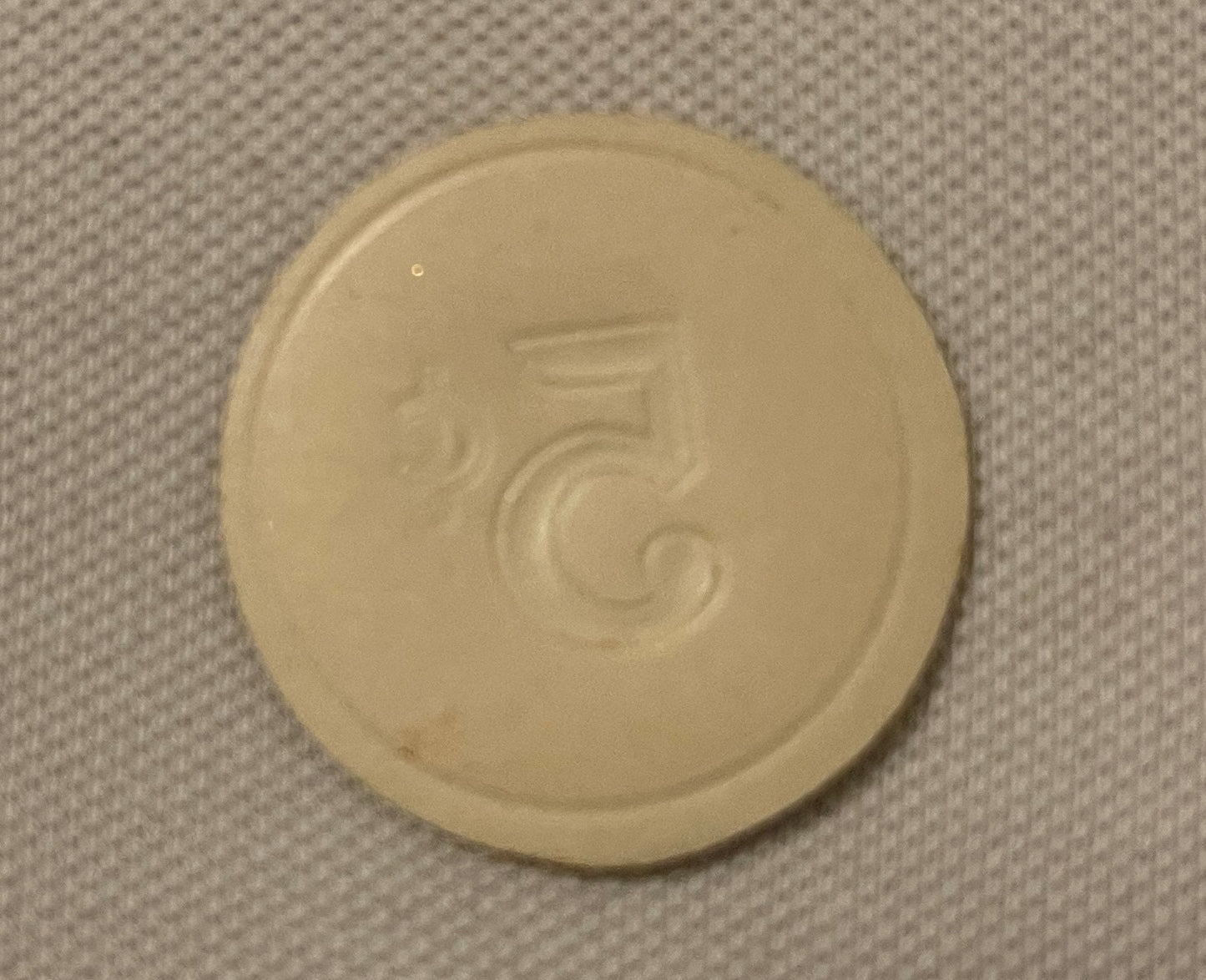
The face of this token is immediate and bold. A deep, saturated red ground fills the circle edge to edge — not a faded or dusty red, but the kind of red that was chosen by a designer who understood that a tobacco shop counter in 1910 was a competitive visual environment, and that your piece needed to own the space it occupied. Against that red ground, the word QUALITY arcs across the top in clean white capital lettering, and CIGAR completes the ring along the bottom. Dead center, a large white numeral 5 with its cent sign announces the price — not apologetically, but with the full confidence of a man who knows what his product is worth. The outer edge of the disc carries a warm gold-toned border that frames the entire composition like a coin meant to be kept rather than spent. The embossing on the "5¢" gives it a raised, tactile presence — you can feel it under your thumb, exactly the way the craftsmen who produced it intended you to feel it.

This piece is NOS — New Old Stock. That designation matters enormously to collectors and is worth understanding clearly. New Old Stock means this token was produced during the original era of manufacture — the 1900s to 1920s — but was never placed in active circulation or regular use. It survived in storage, in a warehouse lot, in an old shop's back room, in the kind of carefully forgotten places where the best tobacciana always hides. NOS condition means you are not looking at a reproduction, not looking at a later-issue piece, and not looking at something that has been cleaned, restored, or artificially enhanced. What you see is original production, original materials, original color, original embossing — exactly as it left the shop that made it, preserved by circumstance and now offered to you by intention.


🏭 The American Cigar Industry in Its Prime — A World This Token Came From

To hold this token correctly, you need to understand the world that produced it. The period from roughly 1880 through the 1920s is what historians of American commerce call the golden age of the hand-rolled cigar, and the numbers bear out that description in a way that is almost impossible to fully absorb today. At the peak of American cigar production in 1907, manufacturers in the United States produced approximately 8 billion cigars in a single year. Eight billion. The country had roughly 89 million people at the time. The cigar was not a luxury item reserved for special occasions — it was the ambient smell of American public life. Barbershops smelled of it. Train cars smelled of it. Offices and courtrooms and back rooms where decisions were made all carried that particular sweet, woody, slightly sharp fragrance that said, in the language of the era: here is a man conducting business.

The five-cent cigar occupied a specific and beloved position in that world. It was the everyday smoke — not the premium Havana that a banker might light after a formal dinner, but not a cheap roll of floor scraps either. The five-cent cigar was what a working man reached for at the end of a shift, what a shopkeeper offered a regular customer, what a traveling salesman tucked into his breast pocket before making calls. Vice President Thomas Marshall, frustrated during a Senate debate in 1917, famously said that what this country needed was a good five-cent cigar — and the line landed because everyone in that chamber, and everyone who read about it the next morning, knew exactly what a good five-cent cigar meant. It meant quality at an honest price. It meant the everyday pleasure that a working republic ought to be able to afford.

The token you are holding was produced to represent exactly that promise. The word QUALITY is not decoration — it is a declaration. In a market crowded with hundreds of competing brands, each with their own labels, their own colors, their own embossed seals and gold-printed guarantees, the cigar maker who put the word QUALITY front and center in white capital letters on a red ground was staking a very specific claim. He was saying: I do not need a fancy name, a famous portrait, an elaborate lithographed scene of Spanish plantations or aristocratic leisure. I need one word. And that word will be enough.


🗺️ Tobacciana Collecting in America — The Geography of the Trade

The American cigar industry was not evenly distributed across the country, and understanding its geography helps place a piece like this in its proper context. The great cigar-producing regions were concentrated in a handful of states where the right combination of leaf supply, immigrant labor traditions, and urban distribution networks came together. Pennsylvania — and in particular the Lancaster County region — was one of the most significant domestic leaf-growing areas in the country, supplying binders and wrappers to manufacturers across the eastern seaboard. Tampa, Florida, had become by the 1890s one of the most important hand-rolling centers in the Western Hemisphere, its Ybor City neighborhood home to thousands of skilled Cuban and Spanish rollers who had relocated from Key West and Havana following labor unrest and the disruptions of the Cuban independence movement.

But the cigar trade was also deeply local in a way that large modern industries rarely are. In virtually every mid-sized American city, there were small cigar manufacturers — sometimes one-room operations, sometimes modest factories with a dozen or two dozen rollers — producing house brands for local tobacco shops and hotel cigar stands. These small manufacturers needed display pieces, counter tokens, and point-of-sale advertising, and they ordered them from the printing and embossing trade suppliers who served the tobacco industry across the Midwest and East. A piece like this Quality 5¢ token could have originated in any one of dozens of cities — Cincinnati, Detroit, Philadelphia, Chicago, Baltimore — all of which had both thriving local cigar trades and the commercial printing infrastructure to produce the kind of bold, vivid, embossed point-of-sale material that the industry demanded.

Lore passed down among tobacciana collectors holds that the very best embossed cigar display pieces — the ones with the deepest color, the sharpest lettering, and the most satisfying heft — came from a handful of specialty shops that served the cigar trade almost exclusively, working in close collaboration with local manufacturers to produce counter displays that were essentially three-dimensional advertisements. Whether this specific token came from one of those specialist operations or from a broader commercial printer who handled tobacco accounts among many others, the quality of the embossing and the boldness of the color suggest a production source that took the work seriously.

Local legend among Pennsylvania tobacciana collectors holds that small-town cigar shops in Lancaster County would sometimes order custom-embossed tokens and counter pieces in quantities of just a few dozen, using them as much as conversation starters with regular customers as actual point-of-sale tools — a way of saying, without saying it, that this establishment cared enough about presentation to invest in something permanent and handsome rather than a paper card that would curl and yellow by spring. Whether or not this specific piece has Lancaster County origins, the spirit of that story lives in the object itself.


🎨 The Craft of Embossed Tobacciana — Why These Objects Survive

One of the reasons tobacciana from this period survives in such collectible condition — and why NOS pieces like this one turn up with such extraordinary color integrity — is the nature of the materials and processes used to produce them. The embossed disc format, using a heavy stock or composition base with die-stamped lettering and border work, was specifically chosen for durability. These were objects intended to sit on a cigar shop counter for years, to be handled daily by customers and staff, to resist the ambient humidity and tobacco smoke of a working shop environment. Manufacturers and their suppliers understood that a flimsy or easily damaged display piece was a poor advertisement — literally and figuratively. So they built for permanence.

The red color that makes this piece so visually immediate was produced using pigments that have proven remarkably stable over a century of storage. The gold border work, applied with similar intention and craft, has held its warm tone in the way that the very best period commercial printing always holds — not because of any special preservation treatment, but because quality materials applied with skill simply last. This is what NOS condition from this era looks like when it is found in the right circumstances: vivid, present, immediate. Not a relic. A survivor.


🖼️ Display Ideas for Your Quality 5¢ Cigar Token

  • 🏠 Framed shadow box display: Mount the token at center in a shadow box frame alongside a period cigar band or two from the same era — the combination of objects tells the complete story of early American tobacco culture and creates an instant focal point for a study, library, or home bar wall.
  • 🪵 Antique general store or apothecary vignette: Pair this piece with other early 1900s counter ephemera — a small tin, a glass apothecary jar, a vintage trade card — on a shelf or mantlepiece for that warm, layered general store aesthetic that never goes out of style.
  • 🎩 Gentleman's study or smoking room accent: This token was born in the world of the smoking room and the cigar stand. It belongs in that world today — on a side table alongside a period ashtray, a vintage lighter, or a collection of cigar bands under glass. It anchors the aesthetic without overwhelming it.
  • 🗂️ Tobacciana collector's display shelf: For the serious collector of tobacco advertising and ephemera, this piece works beautifully as a focal point in a dedicated display — its size and color give it natural prominence among smaller labels and tins, while its NOS condition and embossed detail invite closer inspection from fellow enthusiasts.
  • 🏛️ Local history or Americana cabinet: Collectors who focus on early American commercial history and trade ephemera will find this token a natural anchor for a broader display of the period — alongside currency, trade tokens, advertising cards, and other material culture of the 1900s–1920s commercial world.
  • 🎁 Gift display for the history lover: Presented in a small frame or display stand with a brief typed card explaining its era and significance, this piece becomes an immediate and personal gift — the kind that says "I found something real for you," which is increasingly rare and therefore increasingly valuable.

🎁 Who Collects These — and Why They Keep Looking

Tobacciana collecting is one of the oldest and most established categories in American antiques and ephemera collecting, with a community that spans from casual pickers who grab a beautiful piece when they encounter one, to deeply specialized collectors who focus exclusively on specific regions, manufacturers, or object types. The cigar token and counter display subset of that world attracts collectors for reasons that are both aesthetic and historical.

Aesthetically, pieces like this Quality 5¢ token represent the high-water mark of American commercial graphic design from a period when design was executed by hand, by craftsmen who understood both the printing process and the visual needs of the retail environment. The bold color, the clean typography, the satisfying weight and tactile quality of the embossing — these are not accidents of the era but achievements of it. Design historians and graphic arts collectors find in tobacciana some of the most compelling surviving examples of pre-digital American commercial art.

Historically, the cigar token connects collectors to a specific moment in American social and commercial life that has no true parallel today. The world in which a five-cent cigar was a meaningful daily pleasure, in which the tobacco shop was a social institution as important as the barbershop or the saloon, in which the embossed counter token was a serious investment in brand identity — that world is gone, and the objects it left behind are among the most vivid and immediate connections available to us. Collectors who focus on Americana, on the Gilded Age and Progressive Era, on the history of American commerce and labor and leisure, all find tobacciana deeply rewarding territory.

And then there are the collectors who simply love the object itself — who pick up this red and gold disc and feel immediately, without needing any further historical context, that this is a thing made with care and confidence and intention, by people who took what they were doing seriously. Those collectors are often the most enthusiastic of all, because they are responding to something that transcends category: genuine quality, recognized across a century.


❓ Collector FAQ — Your Questions About This Quality 5¢ Cigar Token, Answered

What does NOS mean, and how do I know this token is genuinely NOS from the 1900s–1920s?

NOS stands for New Old Stock — a designation that means the piece was manufactured during its original production era but was never placed into active everyday use or circulation. For this token, that means it was produced between approximately 1900 and 1920 and survived in storage or in old stock rather than being used until worn or discarded. The evidence for genuine NOS status in a piece like this is visible in the condition itself: the depth and saturation of the red color, the crispness of the gold border work, the sharpness of the embossed "5¢" detail, and the overall integrity of the disc are all consistent with a piece that was never subjected to the daily handling and environmental exposure of an active shop counter. Period manufacturing techniques, materials, and the specific character of the embossing work also allow experienced tobacciana collectors and dealers to date pieces of this type with confidence. This token presents exactly as a genuine NOS piece from the described period should present.

Is this a store token that could be redeemed for a cigar, or is it a display/advertising piece?

This is a wonderful and frequently asked question in tobacciana collecting, because the cigar industry produced both types of objects and they can look superficially similar to the newcomer. Based on its size — approximately 4 inches by 2 inches — and its bold, graphic presentation, this piece is best understood as a counter display or point-of-sale advertising token rather than a redemption token. Redemption tokens intended to be exchanged for cigars were typically produced at coin-like scales, small enough to be carried in a pocket and handled like currency. Display pieces like this one were sized and designed to be seen from across a counter, to catch the eye of a customer and communicate the brand and price quickly and vividly. The embossed detail, the bold color field, and the disc format are all characteristic of the display-piece tradition in early American tobacco advertising.

How do I care for and preserve this token without damaging it?

The best care for a piece like this is benign neglect combined with sensible storage and display. Do not attempt to clean the surface with any chemical cleaner, solvent, or abrasive — the color and embossing have survived a century in their current state, and any intervention risks doing more harm than the passage of time has done. If you are displaying the piece, keep it away from direct sunlight, which can fade pigments over time, and away from environments with extreme humidity fluctuations, which can stress the materials. A shadow box or display case with UV-protective glazing is ideal for pieces you want to display permanently. For storage, acid-free materials are always preferred. Beyond these common-sense measures, this piece is robust — it was made for a commercial environment and built to last, and it has proven that durability across more than a century.

What is the value trajectory for tobacciana like this, and is it a category worth collecting seriously?

Tobacciana as a collecting category has shown consistent strength over the past several decades, driven by several factors that show no sign of reversing. First, the supply of genuine period pieces in collectible condition is finite and diminishing — as pieces are absorbed into permanent collections, lost, or destroyed, the pool of available material contracts. Second, the collector base for Americana and early twentieth-century commercial ephemera has grown steadily as the generation that grew up surrounded by these objects in grandparents' homes and old shops has come into collecting age and disposable income. Third, pieces with strong visual presence — bold color, clear graphic design, tactile interest — consistently outperform plainer pieces in the same category, and this red-and-gold embossed token has all of those qualities in abundance. NOS condition is a meaningful premium in any ephemera category, and tobacciana is no exception.

Can this token be displayed alongside other antique advertising pieces, or does it work better as a standalone?

This piece works beautifully both ways, which is one of its great strengths as a display object. As a standalone, it has more than enough visual presence and historical weight to hold attention on its own — the color, the scale, the embossed detail, and the simple authority of "QUALITY 5¢ CIGAR" are sufficient to make a complete statement without supporting material. In a curated group display alongside other tobacciana — cigar bands, tin litho pieces, trade cards, tobacco tins — it functions as a natural focal point or anchor piece, its size and boldness giving the eye somewhere to land before exploring the surrounding material. It also works well in mixed Americana displays alongside non-tobacco advertising ephemera, early trade items, and other commercial objects of the 1900s–1920s period. The red and gold color palette is versatile enough to complement a wide range of period objects without competing aggressively.

How does this piece compare to other examples of embossed cigar tokens from the same era?

Embossed cigar display tokens and counter pieces from the 1900s–1920s period vary considerably in their survival condition, their graphic ambition, and the quality of their original production. What distinguishes this particular piece for collectors is the combination of NOS condition — meaning the color and embossing are presented without the fading and wear that characterize circulated or displayed examples — with a graphic design that is clean, immediate, and genuinely bold rather than fussy or overworked. The decision to use a single strong word — QUALITY — as the primary brand statement, combined with the centered numeral and the crisp white-on-red lettering, gives this piece a graphic confidence that reads as modern even at over a century's remove. Among tobacciana collectors who have handled many examples from this period, that combination of condition and design clarity is recognized as something worth seeking out.

Is this piece appropriate as a gift for someone who is not already a tobacciana collector?

Absolutely and enthusiastically yes. One of the things that makes a piece like this such a rewarding gift is precisely that it does not require any prior collecting knowledge to appreciate. The visual impact is immediate — bold, warm, vivid, and clearly old in the best possible sense. The tactile quality of the embossing gives it a presence in the hand that communicates craftsmanship without any explanation. And the story it carries — of the American cigar trade at its peak, of the five-cent cigar as a democratic pleasure, of the care that went into even the small display objects of that world — is a story that virtually anyone with an interest in American history, commercial art, or simply the well-made things of the past will find genuinely engaging. It is the kind of gift that prompts a question: "Where did you find this?" And that question is the beginning of a conversation worth having.

Shipping

🚚 Shipping & Handling

  • Shipping costs and timing are calculated at checkout.
  • Items curated and shipped directly by me include U.S. shipping at no additional cost, professionally packed to ensure safe arrival of your artifact.

Items from Vetted Pro Collectors
Shipping for items offered by vetted Pro Collectors is determined at checkout. All Pro Collector listings are reviewed to ensure fair, reasonable shipping practices.

For full details, please refer to our Shipping Policy.

Returns & Exchange

Take your time — you've got a full six months. If a piece isn't right for you, send it back the way it reached you and we're good.

In the first 30 days your money goes straight back the way you paid. After that it's store credit, so you can put it toward something you'd rather have.

Return shipping we sort out between us, case by case. I don't make this difficult.

If something arrives damaged, or it isn't what I said it was, send me a photo within 48 hours and I'll make it right.

Email info@vintageantiquesgifts.com or call 802-356-9872 — that's me answering, not a call center.

The only things I can't take back are custom or special-order pieces and gift cards.

View full details
  • 5 stars: 13 (100%)
  • 4 stars: 0 (0%)
  • 3 stars: 0 (0%)
  • 2 stars: 0 (0%)
  • 1 star: 0 (0%)
E
Etsy customer

This is the kind of Etsy experience I love. Very personal and very thankful for my purchase and a great thank you card with the kids signatures as well. Very Cool!

m
m***m (1074)

Perfect and as listed. Buy from these folks!!

r
r***e (2990)

To Travis & Kids ... Great Sellers ... Item as Advertised ... Fast Shipping ... Best to all of you !!!

k
k***e (15)

Small cigar label looks great

K
Karen

Nice piece and fast shipping

d
dianne

Perfect little embossed cigar label. and included some free gift labels, as well! Fast shipping. Thank you!

R
Richard

Perfect condition. It’s a nice addition to my cigar paraphernalia collection.

3
37thframephoto

VINTAGE LABELS

Thank You!

j
jpl742

Excellent transaction & very nice cigar label!!

Thank you so glad you liked it!!!

m
mdfoutz349mary

good description & fast delivery

Thank you!

g
geebiff

Great transaction,fast ship,very nice to deal with,A+++

Thank you!

w
wild*jacks*trading*post

Nice, nice. Nice stuff. Threw in feebies too. Got note and picture from their kids. Feel like one of the family. Theyll prob even have me over for holidays! (Like my steak medium well😉). Is there a higher grade than A+++ we can give these folks?

LOL!!! I am still laughing at this review. Funniest one ever! The kids are going to love reading this one. Our home is always open to you especially if you are bringing steaks ;)

We definitely look to build relationships with our customers. We not only love old memorabilia but also good old-fashioned customer service which is a lost art these days.

The kids love to learn about each item we send and see where it is going. I couldn't do it without them. Thanks for the laughs and amazing review!

L
Lillian

The 5 cent cigar label I purchased was shipped so quickly and well packaged. I’m so Happy with the quality and excellent condition of this item.