Skip to product information
1 of 4

Vintage and Antique Gifts

Antique Queen Seal 👑 Gold Embossed Chromolithograph Cigar Box Label | 1900s–1920s New Old Stock

Antique Queen Seal 👑 Gold Embossed Chromolithograph Cigar Box Label | 1900s–1920s New Old Stock

Regular price 5.50 USD
Regular price Sale price 5.50 USD
Sale Sold out
Shipping calculated at checkout.
Quantity

What Does a Crown Mean When It's Printed in Gold on a Cigar Box? 👑

There is a moment, when you hold something like this Queen Seal label in your hands, when the distance between then and now collapses entirely. You're holding a piece of paper — technically speaking — but what you're really holding is the full weight of an era when American commerce dressed itself in royal robes and meant it. When a tobacconist wanted to tell a customer that his cigars were worth trusting, he didn't write an advertisement. He commissioned a heraldic proclamation, printed it in chromolithographic inks with hand-applied gold embossing, and wrapped his product in something that looked like it had been issued by a European court. The Queen Seal label is exactly that. It is a miniature declaration of quality rendered in the visual language of monarchy, and it has survived more than a century in New Old Stock condition — never placed on a box, never folded into someone's trash, never smoked over or forgotten in a warehouse flood. It came off the press and waited. Now it's here.


✨ What You Are Looking At

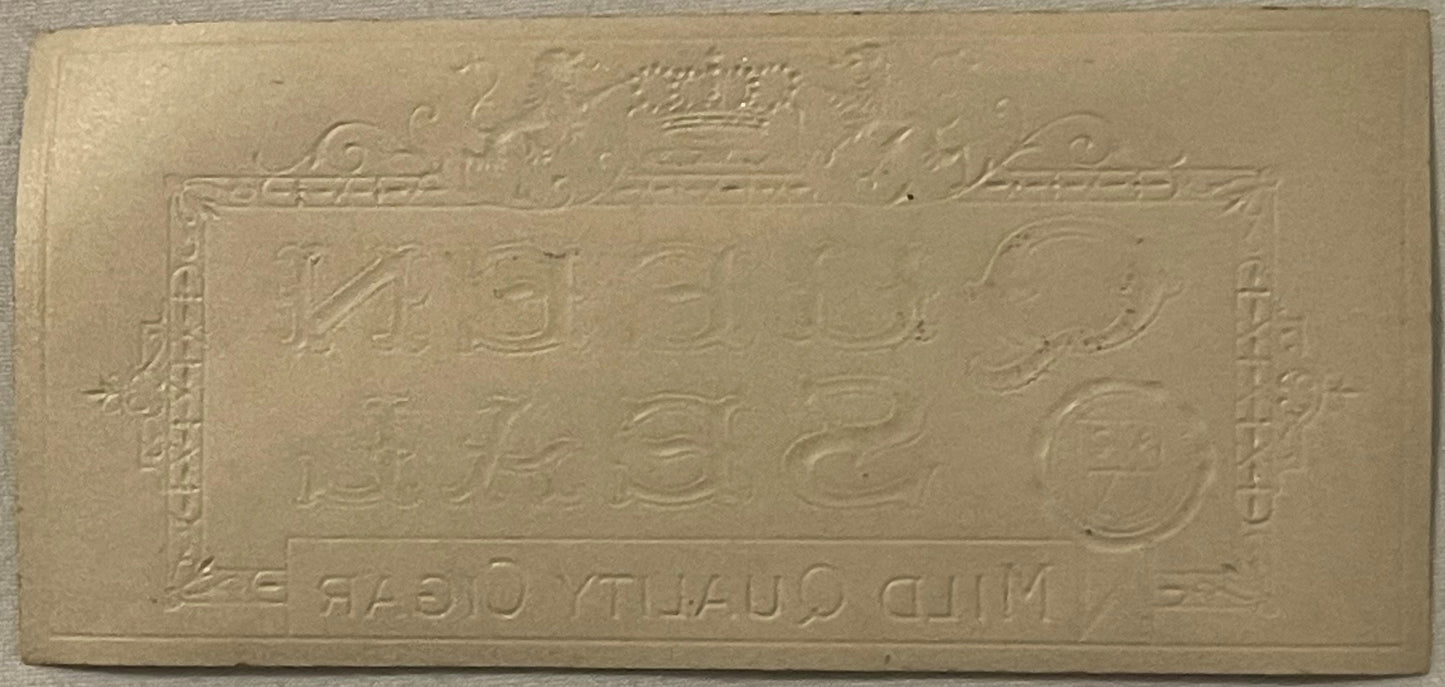
This is an original antique chromolithographed cigar box outer label, gold embossed, produced during the 1900s through the 1920s — the undisputed apex of American cigar label craft. It measures approximately 5.25 by 2.75 inches, which is the standard outer label format that was the established industry practice from the 1880s onward: a long horizontal band meant to wrap across the front face of a wooden cigar box, identifying the brand at a glance from across a tobacco shop counter.

Every fraction of that surface is in active service. The ground color is a soft blue-gray, cool and silvery — the precise kind of background a lithographer chose when he wanted gold to sing. And the gold here does sing. Two heraldic lions rear up on either side of a jeweled crown at the top of the composition, scrollwork curling around them in the tradition of a genuine coat of arms.

The brand name QUEEN SEAL dominates the center in bold, richly shadowed lettering across a warm gold panel framed in red and gold ornament. To the lower left, a round wax-seal emblem bearing a quartered shield sits ribboned like an award. Along the bottom, in quiet gold type: Mild Quality Cigar. The whole thing reads like something a monarch might hand down to a favored tobacconist — which, of course, was exactly the intended effect.

This example is New Old Stock: pristine, unplaced, and preserved precisely as it came off the press.


🏭 The American Cigar Label Industry — When Printing Was an Art Form

To understand what the Queen Seal label is, you have to understand what American lithography meant between roughly 1880 and 1930. Chromolithography — the process of printing in multiple layers of color, each requiring a separate stone or zinc plate and a separate press run — was the dominant commercial printing technology of its era, and the American cigar industry was its most extravagant patron.

At the industry's height, there were more than 70,000 registered cigar brands in the United States. Every single one of them needed labels. Inner labels, outer labels, end labels — each brand might commission dozens of variants for different box sizes and market tiers. The print shops that produced them, concentrated most heavily in New York, Cincinnati, and the Pennsylvania corridor, employed master lithographers who had trained in European apprenticeship traditions and brought genuine fine-art skill to commercial work.

The embossing — that raised, tactile gold surface that gives the Queen Seal label its dimensional quality — was applied through a secondary die-stamping process that required its own tooling and its own craftsmen. A label like this one passed through many hands and many press beds before it was finished. It was not a casual production.

The Mild Quality designation that runs along the Queen Seal label's base is not a throwaway line. In the cigar trade of the early twentieth century, "Mild" was a specific and respectable market position. The American cigar-buying public was sophisticated and hierarchical in its preferences. A mild cigar suited a mid-morning smoke, a social occasion, a man who wanted flavor without weight. Branding a cigar "Mild Quality" in restrained gold type — rather than making larger claims — was a signal of confidence. It said: we know our customer. The label's royal iconography amplified that confidence into something grander. You weren't just buying a mild cigar. You were buying the cigar endorsed, symbolically at least, by a crown.

👑 The Language of Royalty in American Tobacco Branding

Queen-themed cigar branding occupied a specific and fascinating corner of American commercial psychology. In the decades following the Victorian era, royal imagery carried enormous cachet in the American marketplace — an era when "Queen" in a brand name implied the feminine ideal of refinement, discernment, and gentle authority. It was aspirational language. It told the buyer that this product had been evaluated by an imaginary sovereign and found worthy. The Queen Seal brand pushed this iconography further than most, embedding not just a crown but a full heraldic apparatus — lions, scrollwork, a quartered shield, a wax seal — into a label barely larger than a playing card. The result is something that straddles the line between commercial art and genuine heraldry. The lions are not decorative squiggles. They are rampant in the proper heraldic tradition, facing outward, supporting the crown above them in the pose of a real coat of arms. Someone in the design chain — a lithographer, an art director, a brand owner with specific taste — knew exactly what he was doing when he commissioned this.

Lore passed down among cigar label collectors holds that the most elaborate outer labels were often produced as loss leaders by the lithography houses — printed in editions larger than any brand could actually use, then offered at favorable rates to encourage smaller manufacturers to adopt premium presentation for their products. Whether the Queen Seal label was produced under such an arrangement, or whether it was a fully custom commission from a specific manufacturer, is the kind of question that sends collectors deep into trade directories and tobacco industry journals. What the label itself tells us is that whoever put their name on the Queen Seal brand understood the persuasive power of beauty, and was willing to invest in it.

🖨️ The Craft of Gold Embossed Chromolithography

It is worth slowing down here and describing exactly what "gold embossed chromolithograph" means in physical terms, because the phrase has become so familiar in collector circles that it can slide past without registering its full significance. Chromolithography meant, in practice, that a skilled craftsman drew the design in reverse on a flat limestone or zinc plate, applied ink, pressed paper, and repeated this process — sometimes a dozen or more times for a single label — each time adding a new color layer with precise registration.

The layering built up a richness of color that no single-pass printing process could achieve, which is why chromolithographic labels have that jewel-like quality that reproduction simply cannot replicate. The gold embossing was an entirely separate operation: a metal die, precisely tooled to match the gold areas of the design, was pressed into the paper under significant pressure, simultaneously applying metallic foil and raising the surface in relief.

Run your finger across a label like this one and you can feel the crowns, the lettering, the ornamental borders standing slightly proud of the surface. That texture is not printed. It was pressed in by force. The New Old Stock condition of this label means that embossed surface is intact, uncrushed, exactly as the die left it.


🖼️ Display Ideas

  • 👑 Frame it solo in a deep shadow-box mount with a mat that echoes the label's blue-gray ground — the gold embossing reads beautifully under a single directional light source and makes an immediate conversation piece at any scale.
  • 🎨 Group it in a gallery wall of antique cigar labels — the Queen Seal's horizontal format and royal color palette pair especially well with other heraldic or crown-themed labels from the same era, creating a wall that functions as a survey of the lithographer's art.
  • 🥃 Incorporate it into a study or bar cart vignette — propped in a small easel stand alongside vintage tobacco tins, antique playing cards, or a cut-glass ashtray, it anchors a masculine-classic aesthetic with genuine historical weight.
  • 📚 Mount it in a collector's archive sleeve or archival mat board for flat storage and display — many serious ephemera collectors prefer to display their finest pieces at a slight angle in archival envelopes so both the front and the NOS back can be appreciated without handling the piece directly.
  • 🎁 Present it as a framed gift for a collector, a history enthusiast, or anyone with a passion for the Gilded Age and the Progressive Era — the label's regal imagery and immaculate condition make it a gift that looks and feels considered and rare.
  • 🏛️ Use it as a focal point in a Victorian or Edwardian period room — paired with appropriate furnishings, it belongs in the visual conversation with lithographed trade cards, chromolithographic prints, and other paper ephemera from the same decorative moment.

🎁 Who Collects These

Cigar box label collectors are a community with deep roots, and they know exactly what they are looking for. The serious collector — the one who has spent years building a reference library, who can date a label by its typography and lithographic style within a decade, who keeps their collection in archival sleeves in a temperature-stable room — comes to a label like the Queen Seal for very specific reasons. The NOS status matters enormously to this buyer. A label that was never placed on a box has never been exposed to the humidity, the tobacco oils, or the handling that aged a placed label. It is as close as you can get to the moment it left the press. The gold embossing is crisp. The blue-gray ground is clean. The chromolithographic color layers are vivid. For the condition-focused collector, this is precisely the point.

But the Queen Seal also draws buyers who are not primarily label collectors at all. Lovers of heraldic and royal imagery collect it for its iconographic program — the lions, the crown, the quartered shield — which would be at home in any collection of royal ephemera from the Edwardian period. Americana collectors who focus on the decorative arts of the 1900s–1920s find in these labels some of the finest surviving examples of everyday lithographic beauty from an era before offset printing flattened commercial art into uniformity.

Graphic designers and typographers seek out original labels precisely because the lettering on pieces like this one — that bold, shadowed, richly ornamented QUEEN SEAL logotype — represents a standard of hand-drawn commercial letterform that repays careful study. Antique shop decorators and interior designers collect them as ready-made period accents that cost a fraction of what a framed chromolithographic print of comparable quality would demand.

And increasingly, buyers simply respond to the label's beauty without needing a category to put it in — they see something this well-made and they want to own it, which is, when you think about it, exactly how these labels were always supposed to work.


❓ Frequently Asked Questions

What exactly is New Old Stock, and does it really matter for a paper label?

New Old Stock — NOS — means that this label was produced during its original manufacturing period, in this case the 1900s through the 1920s, and was never actually used for its intended commercial purpose. It was never glued to a cigar box, never handled by retail workers, never exposed to the tobacco oil vapor and ambient humidity of a humidor or a smoke shop. For paper ephemera, this distinction is significant. A placed label lived a hard life: the water-activated gum on its reverse was wetted, pressed, and dried; the label itself was handled repeatedly; it sat in proximity to cigars whose oils could migrate through wooden box walls. A NOS label bypassed all of that. The embossing is intact at its original relief. The ink layers are vivid and unoxidized. The paper is stable. Condition in paper collecting is not merely cosmetic — it affects the long-term stability of the piece, its visual impact on display, and its desirability among serious collectors. For the Queen Seal label, NOS status means you are getting the piece at its best.

How do I know this label is genuinely from the 1900s–1920s and not a later reproduction?

Several characteristics confirm period authenticity for chromolithographic cigar labels of this type. The paper stock itself — its weight, its texture, its aging characteristics — is consistent with period commercial printing stock rather than modern paper. The chromolithographic printing method, with its distinctive layered color depth and the slight imprecision of registration that is inherent to stone or plate lithography, is visually and texturally different from any later reproduction process. Most importantly, the gold embossing on a genuine period label is mechanically pressed into the paper fiber, creating actual surface relief that is felt as clearly as it is seen. Modern reproduction labels, if they exist at all for obscure period brands like Queen Seal, rely on foil stamping or digital simulation that does not replicate this quality. The 1900s–1920s dating is further supported by the label's typographic conventions, its ornamental vocabulary, and the specific format dimensions — 5.25 by 2.75 inches — which correspond to documented industry-standard outer label sizing of the period.

Is the gold embossing fragile? How should I handle and store this label?

The embossed surface of a period cigar label is more durable than it might appear, but it does respond to pressure. The gold foil and raised paper relief that make the embossing so beautiful are vulnerable to being flattened if the label is stacked under weight or pressed face-down against a hard surface. Best practice for handling is to hold the label by its edges, avoiding direct contact with the embossed areas.

For storage, an archival polyester sleeve (Mylar or equivalent) provides the ideal environment: it protects the surface from humidity, dust, and handling while keeping the label flat without pressing against it. For display, a UV-filtering glazing material — whether glass or acrylic — will protect the chromolithographic inks from light-related fading over time.

This is a horizontal rectangle — wider than it is tall — in the format that was standard for cigar box outer labels throughout the industry's peak decades. This format does not correspond to any standard modern frame size, which is typical of period paper ephemera. The most straightforward approach is to present it within a larger mat board cut to a standard frame size — 5x7, 8x10, or whatever proportion suits your display context — with the label centered in the opening.

A mat with an appropriately sized window can be cut by any framing shop, or sourced from archival framing suppliers. The label's horizontal orientation and its visual weight work well with a generous mat border, particularly in a mat color that echoes the label's blue-gray ground or its warm gold elements. Shadow-box framing — which creates a slight gap between the label and the glazing — is especially effective for embossed pieces, as it allows the dimensional quality of the gold work to read clearly without the glazing flattening it.

Can you tell me more about the heraldic imagery — what do the lions and the crown represent?

The heraldic vocabulary of the Queen Seal label is genuine rather than decorative pastiche, which is part of what makes it so compelling. Rampant lions — lions rearing on their hind legs with forepaws raised — are among the oldest and most recognizable charges in European heraldry, associated since the medieval period with strength, sovereignty, and royal authority.

They appear in the arms of England, Scotland, Norway, Sweden, Denmark, and numerous noble houses, which gave them an instantly legible meaning for the label's American audience: this is royal. This is endorsed by power. The crown they flank is jeweled in the lithographic rendering, which places it in the tradition of the imperial or royal crown rather than the simpler civic coronet — again, a deliberate choice of the highest possible heraldic register.

The quartered shield in the wax-seal emblem to the lower left echoes genuine armorial quartering, the practice by which noble families combined inherited arms from multiple lineages. Labels that were never placed on boxes — like this one — represent a fraction of overall surviving examples, since the commercial purpose of a label was to be used.

The combination of NOS status, gold embossing, a legible and visually strong brand identity, and the specific 1900s–1920s production window places the Queen Seal label in a category that serious collectors recognize as desirable. That said, no one can responsibly predict the future market for any category of antique. What can be said with confidence is that this label cannot be reproduced: it is an artifact of a specific industrial and artistic moment that ended, and the conditions that produced it no longer exist.

Scarcity and irreproducibility are the foundational requirements of lasting collector value, and this piece has both.

I want to give this as a gift — is it appropriate for someone who doesn't collect labels specifically?

Absolutely, and in fact some of the most satisfying homes for pieces like this are with people who simply respond to beautiful, well-made historical objects without needing a category to put them in. The Queen Seal label communicates its age, its craft, and its visual richness immediately — you don't need to know anything about cigar label lithography to recognize that this is something exceptional. For a recipient who loves the Gilded Age or the Edwardian period, who collects antiques of any kind, who has an affinity for royal or heraldic imagery, who appreciates fine printing and typography, or who simply has good taste and an eye for the rare and the beautiful, this label makes an immediate impression. It is small enough to fit in a gift envelope and significant enough to warrant a proper frame. It is the kind of gift that someone keeps for life — which, given that this one has already survived more than a hundred years, seems entirely appropriate.

Shipping

🚚 Shipping & Handling

  • Shipping costs and timing are calculated at checkout.
  • Items curated and shipped directly by me include U.S. shipping at no additional cost, professionally packed to ensure safe arrival of your artifact.

Items from Vetted Pro Collectors
Shipping for items offered by vetted Pro Collectors is determined at checkout. All Pro Collector listings are reviewed to ensure fair, reasonable shipping practices.

For full details, please refer to our Shipping Policy.

Returns & Exchange

Take your time — you've got a full six months. If a piece isn't right for you, send it back the way it reached you and we're good.

In the first 30 days your money goes straight back the way you paid. After that it's store credit, so you can put it toward something you'd rather have.

Return shipping we sort out between us, case by case. I don't make this difficult.

If something arrives damaged, or it isn't what I said it was, send me a photo within 48 hours and I'll make it right.

Email info@vintageantiquesgifts.com or call 802-356-9872 — that's me answering, not a call center.

The only things I can't take back are custom or special-order pieces and gift cards.

View full details
  • 5 stars: 1 (100%)
  • 4 stars: 0 (0%)
  • 3 stars: 0 (0%)
  • 2 stars: 0 (0%)
  • 1 star: 0 (0%)
m
miasmadness

cool, and fast shipping

We appreciate it. Hope to see you again soon!