Skip to product information
1 of 6

Vintage and Antique Gifts

Antique Big Wolf Cigar Label Strip Embossed Gold Foil High Grade Hand Made NOS Tobacco Ephemera Collector 🚬

Antique Big Wolf Cigar Label Strip Embossed Gold Foil High Grade Hand Made NOS Tobacco Ephemera Collector 🚬

Regular price 6.00 USD
Regular price Sale price 6.00 USD
Sale Sold out
Shipping calculated at checkout.
Quantity

Size: 10 x 1 inches

What Does a Piece of Paper Know That We've Forgotten? 🐺

There is a particular kind of quiet that settles over you when you hold something that has survived everything — the company that ordered it, the press that printed it, the cigars it was meant to crown, the warehouse that kept its secret for fifty years, and the decades of collectors who passed it along — and it arrives in your hands looking exactly as it did the morning it came off the stone. Not aged. Not faded. Not worn at the corners from a century of handling. Just present. Vivid. Ready, still, to do the job it was made to do. That is the feeling this label strip carries with it. It is not nostalgia exactly, though nostalgia is certainly part of it. It is something closer to the uncanny pleasure of continuity — the sense that beauty, when it is made with enough care and enough craft, simply refuses to expire.

Tobacco ephemera from the 1920s occupies a very specific corner of the collector world — one populated by people who understand that the most telling artifacts of an era are rarely the grand monuments. They are the small, workaday objects that were made to be used up and discarded, and that somehow weren't. A cigar label strip is exactly that kind of object. It was never meant to be framed. It was never meant to be archived. It was meant to be pasted to a wooden box and sold across a counter and forgotten. The ones that survived did so by accident — by a canceled order, a closed shop, a warehouse that outlasted its owners — and they carry that accidental permanence like a quiet miracle.


🐺 What This Is — The Object, the Brand, the People Behind It

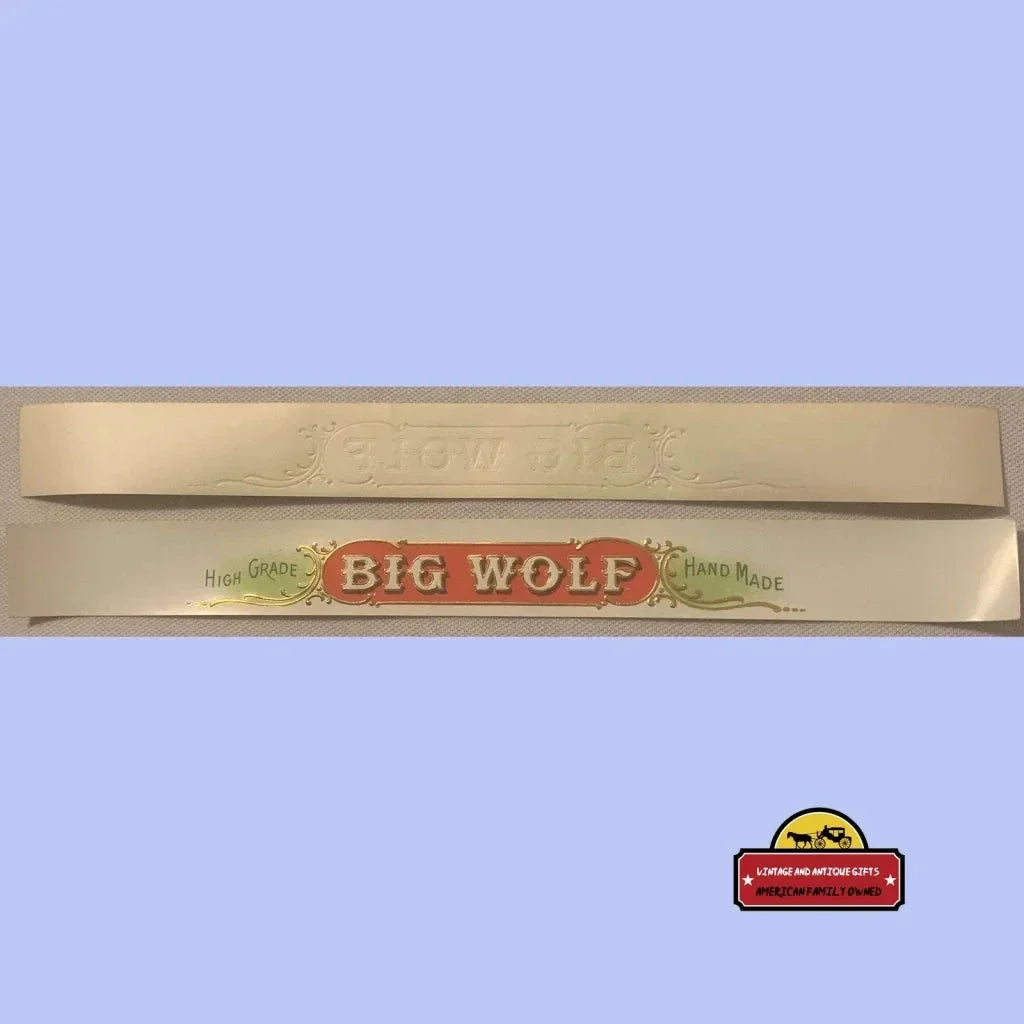
This is an original antique cigar label strip for the Big Wolf brand, produced for the James W. Smith Cigar Company and printed by Benjamin J. Kane of Philadelphia, Pennsylvania, in the 1920s. It is New Old Stock — NOS in collector language — meaning it was never placed on a box, never smoked over, never folded into a junk drawer, never subjected to the ordinary indignities of use. It came out of a warehouse find, a cache of unplaced label stock discovered by collectors in the 1970s and 1980s, and it left Kane's press in exactly the condition it presents today.

Physically, the strip measures ten inches long by one inch wide — the elegant band format designed to run across the outside of a cigar box and make its declaration of quality before a single lid was lifted. It is a format that required confidence: one long, narrow stage, and everything the brand needed to say had to live within it. The centerpiece is a bold oval cartouche in warm terra cotta red, and inside that oval the name BIG WOLF runs in large, confident serif lettering in cream and gold. Flanking the badge on both sides are intricate gold scrollwork flourishes — botanical filigree of the kind that a stone lithographer built up one color pass at a time, each layer registered by hand against everything that came before it. To the left of the cartouche: HIGH GRADE. To the right: HAND MADE. The label is also embossed, meaning the gold elements carry a subtle physical relief — you can feel the luxury before you fully read it.

Those two phrases — HIGH GRADE and HAND MADE — were not decorative filler in the 1920s. They were a promise spoken directly from a tobacconist's shelf to a buyer who knew the difference, who had opinions about leaf and wrapper and draw, who understood that not every five-cent cigar was the same five-cent cigar. Printing them on a label strip was a commitment, and having Benjamin J. Kane execute that commitment in embossed gold lithography was a statement about how seriously the James W. Smith Cigar Company took that promise.


🏙️ Philadelphia and the Golden Age of Cigar Label Printing

To understand what this label strip is, you have to understand where it came from — and Philadelphia in the early twentieth century was one of the great centers of the American lithographic trade. The city's printing houses occupied a world unto themselves: dense blocks of workshops where pressmen, stone grinders, color separators, and letterers worked in close collaboration, where the smell of ink and stone dust was as ordinary as coffee, and where the competition to secure a tobacco account was real and constant. Cigar manufacturers across the mid-Atlantic and beyond understood that their label was their brand — it was the only visual identity their product would ever have — and they trusted Philadelphia's lithographers to carry that identity with authority.

Benjamin J. Kane operated in this ecosystem as a known and respected trade printer. Kane's shop was the kind of establishment that a cigar company like James W. Smith would have selected not by chance but by reputation — by seeing Kane's work on a competitor's box, by knowing someone who knew the pressroom, by understanding that the quality of the stone work was consistent and the registration was reliable. Stone lithography of this period demanded a craftsman's patience: each color required its own stone, its own inking pass, its own careful alignment to the layers beneath it. The gold scrollwork on this label strip did not appear in a single moment. It accumulated, color by color, pass by pass, until the finished strip emerged with the depth and warmth that flat printing simply cannot achieve.

Collector lore holds that Kane's shop maintained unusually close relationships with several of the small-to-mid-size cigar houses operating in the Philadelphia-to-Delaware-Valley corridor in the 1910s and 1920s, and that a significant portion of the warehouse label stock discovered by collectors in the postwar decades could be traced back to a single print run that was never fully placed — an order completed in full but interrupted by the economic turbulence of Prohibition-era business closures, which hit tobacco suppliers and their ancillary trades in ways that are still not entirely documented. Whether this particular Big Wolf cache was part of that broader undistributed run is not confirmed, but among collectors of American cigar ephemera, the story circulates with the easy confidence of passed-down truth.


🍂 The James W. Smith Cigar Company — A Name Worth Knowing

The James W. Smith Cigar Company is not a household name today, which is precisely what makes a piece like this so valuable to the record. The American cigar industry of the early twentieth century was vast and decentralized — thousands of manufacturers, from the great Havana-style houses of Tampa and Key West to the smaller regional blenders who sourced Pennsylvania and Connecticut shade leaf and marketed to local loyalty. James W. Smith operated in this latter world: a company defined by its regional identity, its house brands, and its relationships with local retailers who kept their products on the counter because they knew the name and trusted the quality.

The Big Wolf brand name itself is worth pausing on. Wolf imagery in American commercial art of this period carried a specific register — it was aggressive but noble, wild but controlled, a symbol of something untamed that had been harnessed into product. It sat in a tradition of American brand naming that reached for animal power: the bull, the eagle, the bear, the wolf. Choosing BIG Wolf — not just Wolf, but Big Wolf — was a deliberate escalation, a brand voice that announced itself before the box was opened. Combined with HIGH GRADE and HAND MADE, the message was complete: this is serious tobacco, made by serious people, for buyers who know what they want.

Local legend among Philadelphia-area tobacco ephemera collectors holds that James W. Smith himself — if indeed there was a single individual at the founding, rather than a partnership operating under a proprietary name, which was common practice — was known to the Kane shop as a demanding client, one who specified his label colors personally and returned proofs more than once before approving a run. Whether apocryphal or accurate, the story is consistent with what the finished label demonstrates: this is not a generic house design. The terra cotta red of that oval cartouche, the specific weight of the serif lettering, the density of the gold scrollwork — these read as deliberate choices, not defaults.


📜 Stone Lithography, Embossing, and Why It Still Looks This Good

One of the most common questions asked about NOS cigar labels from this period — and this one invites it immediately — is how they can possibly look this vivid after a hundred years. The answer lives in the process. Stone lithography as practiced in commercial printing houses of the 1910s and 1920s used pigments that were ground and mixed for permanence, applied to limestone plates whose grain structure accepted and held ink with a fidelity that early photomechanical processes could not match. The resulting print has a density and a richness that is immediately legible to the eye, even when you cannot articulate exactly why it looks better than you expect it to.

The embossing on this strip adds another dimension, literally. Where the gold elements rise slightly from the surface of the paper, you are seeing the result of a die-press operation that followed the lithographic printing — a separate pass through a different kind of machine, one that drove the paper against a metal form to create physical relief. Embossing was not cheap. It required tooling, registration, and an additional step in production that added cost and time. That James W. Smith specified it, and that Kane's shop executed it, tells you something specific about the commercial ambitions behind this brand. You do not emboss a label for a cigar you are embarrassed about.

The NOS condition means all of this is fully intact. The embossed gold is as tactile as the day it left the die. The terra cotta red of the cartouche is warm and saturated. This is the label in its intended state — which is also, by a wonderful accident of history, its preserved state.


🖼️ Display Ideas

  • 🖼️ Frame it in a narrow float frame — the long horizontal format reads beautifully when mounted with breathing room on all sides, allowing the embossed gold to catch ambient light at different times of day.
  • 📚 Incorporate it into a curated tobacco ephemera grouping — pair with vintage cigar box labels, trade cards, or tobacco tins for a cohesive display that tells the story of American commercial printing in the early twentieth century.
  • 🏠 Use it as a focal accent in a study, home bar, or den — the terra cotta and gold palette is warm and masculine, and the wolf imagery gives it an immediate narrative presence that doesn't require explanation.
  • 🎨 Mount it in a shadow box with period cigar-related objects — a Victorian cigar cutter, a match safe, or a vintage ashtray from the same decade creates a three-dimensional still life with genuine historical coherence.
  • 🗂️ Archive it in a collector's flat file or archival sleeve — for the serious ephemera collector who prefers preservation to display, this piece stores flat and remains fully stable in acid-free conditions.
  • 🎁 Gift it as a named-piece presentation — framed with a small card noting the printer, the brand, and the decade, this makes an extraordinary and entirely singular gift for someone who collects American commercial art or Philadelphia history.

🎁 Who Collects These

Cigar label collecting has a long and serious tradition in American ephemera circles, and the community that pursues it is broader and more varied than you might expect. At the center are the dedicated tobacco ephemera collectors — people who have been accumulating cigar box labels, inner labels, band labels, and strip labels for decades, who know the major printing houses by name, who can date a label by its typographic conventions and color palette, and for whom a NOS strip in this condition from a named printer is an unambiguous acquisition.

Alongside them are the American commercial art collectors — people drawn to stone lithography as a medium, who understand that the cigar label industry produced some of the finest chromolithographic work in the country during its peak decades, and who collect it for the same reasons they might collect Victorian trade cards or early poster art: because the craft is extraordinary and the survival rate is low. Then there are the Philadelphia regional history enthusiasts — collectors and researchers for whom the Kane imprint is a piece of local printing history, a data point in the story of the city's commercial trades.

And then there is a whole category of collector who simply responds to the object: the wolf imagery people, the vintage branding enthusiasts, the interior designers who want something genuinely old and genuinely beautiful for a specific space. This label strip speaks to all of them at once, which is one of the things that makes it remarkable — it has multiple entry points and rewards every one of them.


❓ Frequently Asked Questions

What exactly does "New Old Stock" mean for a cigar label strip?

NOS — New Old Stock — means this label was manufactured, stored, and never used in its intended function. It was never pasted to a cigar box. It was never handled in a retail setting. It was never folded, creased, dampened with adhesive, or exposed to the smoke and light of a tobacconist's shop. It came out of a warehouse cache — a body of unplaced label stock discovered by collectors beginning in the 1970s and 1980s — in the condition it left the press. For ephemera collectors, NOS is the gold standard precisely because it means you are seeing the object as it was intended to be seen, not as it survived use. The colors are at full saturation. The embossing is fully intact. The paper is clean. This is the label as designed, as printed, as Benjamin J. Kane's pressmen passed it for release.

Is the embossed gold printing still raised and tactile, or has it flattened over time?

The embossing is fully intact and physically present. Because this strip was stored flat and unplaced — never subjected to the friction of box assembly, the pressure of stacking, or the humidity fluctuations of retail storage — the die-pressed relief has not been compressed or abraded. You can feel the gold scrollwork with a fingertip, which is exactly the tactile experience the original printer designed for. Embossing was an additional production cost that manufacturers specified because it read as luxury at the point of sale — the buyer's hand confirmed what the eye had already suggested. A century later, that sensory quality is entirely preserved.

How do I know this is genuinely from the 1920s and not a later reproduction?

Several factors confirm the period authenticity of this label. The stone lithography process used here — with its specific ink density, color layering, and the slight texture visible under magnification — is characteristic of pre-photomechanical commercial printing and is not replicated in later production. The typography, the design conventions of the cartouche format, and the specific color palette (that terra cotta red, those cream and gold letterforms) are all consistent with 1920s American cigar label production. The paper stock, the embossing technique, and the printer's identity — Benjamin J. Kane of Philadelphia — are all traceable to this period. Additionally, the provenance as warehouse-cache NOS is well-established in the collector community for this class of material; these caches have been documented and the label stock has been in collector hands for decades, which is itself a form of authentication chain.

Who was Benjamin J. Kane, and why does the printer's identity matter?

Benjamin J. Kane was a Philadelphia commercial lithographer operating in the early twentieth century, working within the city's robust trade printing community at a time when Philadelphia was one of the major centers of American chromolithographic production. The printer's identity matters for several reasons. First, it provides geographic and temporal anchoring — Kane's Philadelphia operation places this label within a specific regional printing tradition. Second, for serious ephemera collectors, known-printer provenance adds to a piece's research value and collectibility; it is a named object, not an anonymous one. Third, it speaks to the quality standard the James W. Smith Cigar Company was reaching for: you selected your printer based on reputation, and commissioning embossed, multi-color stone lithography from a recognized Philadelphia house was a deliberate quality statement. The Kane imprint makes this label part of a traceable story, not just a beautiful object.

What is the best way to store or preserve this label strip if I'm not displaying it?

For archival storage, flat is always correct for paper ephemera of this type. An acid-free archival sleeve or folder, stored horizontally in a flat file or document box away from direct light, humidity fluctuations, and heat sources, will maintain this label indefinitely in its current condition. The paper stock used in commercial label printing of this era is generally more stable than newsprint or lower-grade trade papers, but all paper benefits from controlled, stable storage conditions. If you are adding this to an existing ephemera collection, it is worth noting that the embossed surface should not be stored face-to-face with another embossed piece without an interleaving sheet, as registration of embossed elements against each other over time can cause subtle impression transfer. A single sheet of acid-free tissue between pieces is sufficient protection.

Is the Big Wolf brand name documented elsewhere, or is this one of the rarer obscure house brands?

Big Wolf sits in the category that ephemera collectors often find most interesting: a regional house brand with a strong visual identity and a name that communicates its personality immediately, but without the broad distribution or advertising record of the major national brands. That relative obscurity is, paradoxically, part of its value to collectors. The major national cigar brands of the 1920s are well-documented and their label stock, while beautiful, is comparatively abundant. A named regional brand like Big Wolf — with a specific printer credit, a specific company association, and a NOS survival story — represents the kind of piece that serious tobacco ephemera collections are built around: something with a distinct personality, a traceable origin, and a lower survival rate than the high-volume brands. Lore passed down among collectors holds that wolf-themed cigar brands of this era are among the more actively sought animal-imagery labels, a subcategory that has its own dedicated following within the broader cigar label community.

Can this label strip be framed without damaging it, and what framing approach works best for a piece this narrow?

This label strip frames beautifully and is ideally suited to float-mount presentation, which is the approach most recommended for paper ephemera of this scale and format. Float mounting — attaching the label to a backing mat so that all four edges are visible and the piece appears to hover slightly above the background — preserves the full visual field of the strip, including the edges, without any portion being concealed beneath an overmat. For a piece ten inches long and one inch wide, a horizontal float in a narrow-profile frame with a generous mat border (three to four inches on all sides) gives the label breathing room and allows the embossed gold to catch light from multiple angles. UV-filtering glazing is worth specifying if the frame will hang in a room with significant natural light exposure. The piece should be attached to its backing using reversible conservation methods — small paper hinges or corner pockets — rather than any permanent adhesive, so that future reframing does not require contact with the label's surface. A local framer with experience in paper ephemera will be familiar with all of these considerations.

Shipping

🚚 Shipping & Handling

  • Shipping costs and timing are calculated at checkout.
  • Items curated and shipped directly by me include U.S. shipping at no additional cost, professionally packed to ensure safe arrival of your artifact.

Items from Vetted Pro Collectors
Shipping for items offered by vetted Pro Collectors is determined at checkout. All Pro Collector listings are reviewed to ensure fair, reasonable shipping practices.

For full details, please refer to our Shipping Policy.

Returns & Exchange

Take your time — you've got a full six months. If a piece isn't right for you, send it back the way it reached you and we're good.

In the first 30 days your money goes straight back the way you paid. After that it's store credit, so you can put it toward something you'd rather have.

Return shipping we sort out between us, case by case. I don't make this difficult.

If something arrives damaged, or it isn't what I said it was, send me a photo within 48 hours and I'll make it right.

Email info@vintageantiquesgifts.com or call 802-356-9872 — that's me answering, not a call center.

The only things I can't take back are custom or special-order pieces and gift cards.

View full details
  • 5 stars: 1 (100%)
  • 4 stars: 0 (0%)
  • 3 stars: 0 (0%)
  • 2 stars: 0 (0%)
  • 1 star: 0 (0%)
b
bskousen830

As promised thanks best seller ever! Thanks for the note Charlee

Thank you so much for your feedback! We really appreciate it as it helps us so much being so new. Charlee is going to love reading this when she wakes up. She told me yesterday she wanted to learn how to do all of this and didn't know how to. I am like be patient little one you got plenty of time to learn if you want. Thanks again and we hope we get to send more notes to you in the future! Travis and the Kids