Skip to product information
1 of 6

Vintage and Antique Gifts

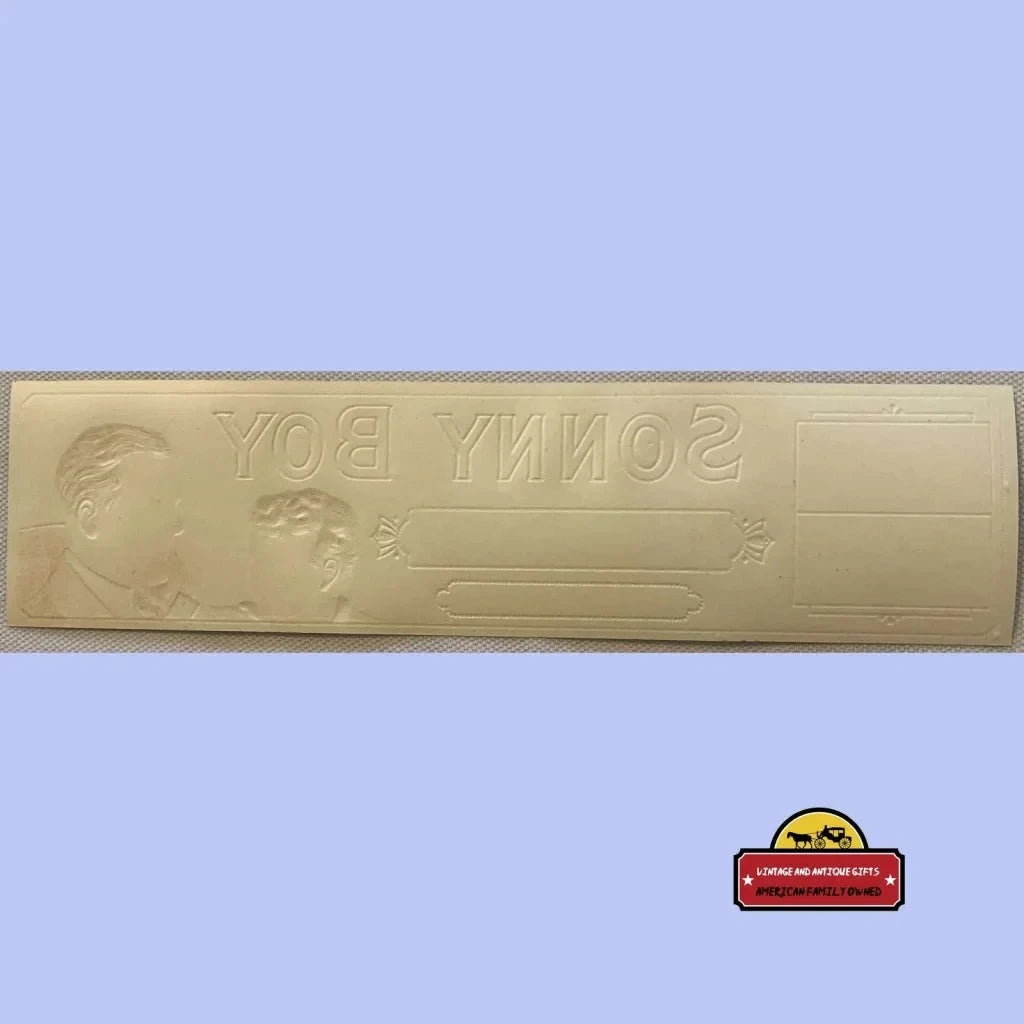
Vintage 1910s-1930s Sonny Boy 🎸 NOS Chromolithograph Cigar Box Label Embossed Cellophane Collectible

Vintage 1910s-1930s Sonny Boy 🎸 NOS Chromolithograph Cigar Box Label Embossed Cellophane Collectible

Regular price 6.00 USD
Regular price Sale price 6.00 USD
Sale Sold out
Shipping calculated at checkout.
Quantity

Size: 8.5 x 2.12 inches

What Does a Five-Cent Cigar Know About Art? 🎨 More Than You'd Think.

There is a particular kind of object that historians almost missed entirely — not because it was rare when it was made, but because it was considered too ordinary to save. Counter ephemera. Trade goods. The paper that wrapped the product, not the product itself. The Sonny Boy Quality Cigar label is exactly that kind of survivor, and every collector who has held one understands immediately why these pieces command the attention they do today. This isn't decoration rescued from a parlor or a museum gallery. It's commercial art pressed into service on the front lines of American retail — designed to work, designed to persuade, and designed to do all of that before a single word passed between the tobacconist and the man reaching into his vest pocket for a nickel. That it is beautiful is almost beside the point. That it survived at all, in this condition, is the story worth telling.

Warm, vivid, and bursting with the confident color vocabulary of an era that never questioned whether a cigar label could carry genuine artistic ambition, the Sonny Boy label has the kind of presence that stops a collector mid-scroll and doesn't let go. This is the piece you frame. This is the piece that anchors a corner of the study or the reading room and quietly announces to anyone who enters that the person who hung it there knows something about American commercial history that most people have simply never been told.


🔍 What This Is — The Object, the Process, the Moment

This is a New Old Stock (NOS) chromolithograph cigar box label, produced in the style and timeframe consistent with the broad 1900s–1930s window of American cigar label printing, almost certainly originating from a Pennsylvania factory operation — the heartland of the American chromolithography trade. "New Old Stock" is a term collectors use with a particular reverence: it means this label was never applied to a box. It never sat in a tobacconist's back room gathering humidity. It was never faded by gas lamp or fluorescent tube. It came out of old stock exactly as it left the press, and it has waited — patiently, in the way only paper goods can wait — for exactly the right moment to be seen again.

The label is embossed, which is worth dwelling on. Embossing was not an afterthought in the chromolithography trade. It was a statement — a tactile argument that the printer and the brand behind the label were willing to spend the extra time, extra passes through the press, and the extra mechanical attention required to give the paper a three-dimensional quality that the eye could see from a distance and the fingers could confirm up close. When a customer reached across the counter and touched a box bearing an embossed label, he wasn't just reading a brand name. He was receiving physical information about quality, care, and seriousness of purpose. The embossing on this Sonny Boy label is consistent with that premium-tier production sensibility.

The face of the label reads SONNY BOY in bold red lettering with a warm gold shadow outline — the kind of typography that commands a shelf from three feet away without ever raising its voice. Centered beneath the name, a teal and gold cartouche carries the declaration QUALITY CIGAR, and below that, in a clean oval banner, the single word CELLOPHANED. That word is a dating clue all on its own. Cellophane wrapping was a genuine selling point in the early decades of the twentieth century — novel enough, modern enough, and reassuring enough about freshness and cleanliness that it belonged on the label as a mark of distinction. To the right of the text, a chromolithographed portrait element anchors the composition, rendered with the kind of careful color layering that required skilled pressmen and patient registration work across multiple stone or plate passes. The overall palette — reds, golds, teals, warm skin tones — is the full chromolithographic vocabulary of the period, deployed with confidence.


🏭 The Pennsylvania Printing Trade and the Golden Age of the Cigar Label

To understand why this label exists at all — why it was made this beautifully, by this many hands, for a product that cost five cents — you have to understand what Pennsylvania meant to the American printing industry in the late nineteenth and early twentieth centuries. The Commonwealth was home to some of the most technically advanced chromolithography operations in the country. Philadelphia alone had a cluster of firms that competed ferociously for the tobacco trade's label contracts, and that competition drove standards upward decade by decade. Printers understood that a cigar brand lived or died by its visual identity, because in an era before radio advertising and decades before television, the label on the box was the brand. There was no other medium. The label was the entire marketing budget, expressed in ink and paper and embossing dies.

The mechanics of chromolithography — the process that produced this label — were formidable. A single chromolithograph of this complexity might require ten, fifteen, or even more separate passes through the press, each depositing a different color layer, each requiring the paper to be registered with precision so that the final image resolved into the seamless, rich illustration the designer had intended. The stone or metal plates had to be prepared by hand. The colors had to be mixed to match the original artist's gouache or watercolor reference painting. The pressmen had to monitor humidity, pressure, and ink consistency across every sheet of a print run that might number in the tens of thousands. These were craftsmen in the fullest sense, working in a tradition that traced its roots to the European lithography houses of the early nineteenth century and had been transplanted, refined, and made distinctly American in the decades following the Civil War.

Lore passed down among collectors of tobacco ephemera holds that the most skilled chromolithography pressmen in the Pennsylvania trade were known to their colleagues simply by their initials — not out of modesty, but because the print shops ran multiple shifts and the foremen tracked quality by pressman code rather than name. Whether or not a particular pressman's mark survives on surviving press records is uncertain, but the tradition of craft pride embedded in that system shows up clearly in the output: labels that were never intended to be framed, made with standards that would have justified framing them from the beginning.


🍂 The Cigar Trade, the "Sonny Boy" Name, and What It Meant on a Label

The American cigar trade in the early twentieth century was one of the most densely branded consumer markets in the country's history. Hundreds of brand names competed for counter space, and the naming conventions of the era reveal something genuine about the culture that produced them. "Sonny Boy" as a brand name carries warmth and familiarity — an appeal to the domestic, the affectionate, the American home. It's a name that suggests a gift, a celebration, a small everyday luxury that a man might share with a friend or tuck into a breast pocket as a quiet comfort against the working day. The branding strategy embedded in a name like Sonny Boy was sophisticated even if it appeared simple: it associated the product with goodwill, with family feeling, and with the kind of uncomplicated pleasure that five cents could legitimately purchase in an era when five cents was still real money.

The addition of "CELLOPHANED" on the label is a particularly evocative historical marker. Cellophane — a transparent cellulose film — was developed in the early twentieth century and became commercially available in the United States during the 1920s. Its adoption by the tobacco trade was rapid, because it solved a genuine problem: keeping cigars fresh and protected from the air without the weight and opacity of tin or wooden packaging. When a cigar brand advertised that its product was cellophane-wrapped, it was making an argument about modernity and quality simultaneously. It was telling the buyer that the brand had invested in new technology on the buyer's behalf. That this selling point appeared directly on the box label — declared in its own clean oval banner — tells us something about how significant that guarantee of freshness was to the consumer of the period. Local legend in the tobacco trade holds that some shopkeepers would actually hold cellophane-wrapped cigars up to the window light as a demonstration for customers uncertain about freshness, making the transparency of the wrapping a part of the sales ritual itself.

The "Quality Cigar" designation framed within the teal and gold cartouche is similarly intentional. In an unregulated market where quality claims were the currency of competition rather than the product of formal certification, placing the word "quality" inside a decorative frame — literally enclosing it in gold — was a visual argument for the claim's seriousness. The cartouche borrowed from a vocabulary of heraldry and officialdom that consumers recognized as a signifier of authority. It was commercial semiotics, practiced instinctively by designers who may never have used that term but understood its logic completely.


📜 NOS Condition and Why It Changes Everything

Collectors who have worked in tobacco ephemera for any length of time know that the condition gradient in cigar labels is steep and unforgiving. A label that was actually applied to a box — exposed to the adhesive, the handling, the humidity of a tobacconist's environment, and then whatever decades of attic or basement storage followed — is a genuinely different object from one that came out of old printer's stock untouched. The colors in an applied label fade. The embossing flattens. The edges curl or split. The paper darkens. All of that is perfectly acceptable in a used example and tells its own honest story about life in the trade. But NOS is something else: it is the label as the printer intended it to be seen, with the chromolithograph colors still carrying their full saturation, the embossing still reading with crisp dimensionality, and the paper surface still holding the texture it had the day it left the press.

That this Sonny Boy label has survived in NOS condition — coming out of old stock exactly as it left the press, never applied, never exposed to the back-room environment of a working tobacconist — is the kind of preservation outcome that collectors spend years hoping for and rarely encounter as reliably as they'd like. The piece is not just historically interesting. In this condition, it is visually complete: the object as it was designed to be, seen as the designer intended it to be seen.


🖼️ Display Ideas

  • 🖼️ Frame it with archival materials — a UV-protective glass or acrylic front, acid-free matting in cream or deep forest green, and a simple dark walnut or gilt frame will let the chromolithograph colors read exactly as they were designed to read, without competing for attention.
  • 📚 Build a vignette with period tobacciana — pair the framed label with a vintage cigar cutter, a solid brass ashtray, and a small stack of period tobacco trade catalogs for a reading room or study corner that feels genuinely curated rather than merely decorated.
  • 🗂️ Archival portfolio display — collectors who work with paper ephemera often display unframed NOS pieces in archival polyester sleeves within a standing portfolio or shallow display drawer, allowing the piece to be handled and examined without risk while remaining visible.
  • 🏛️ Themed gallery wall — group the Sonny Boy label with other period chromolithograph advertising labels, trade cards, or sheet music covers from the same era for a wall installation that reads as a coherent survey of American commercial art from the early twentieth century.
  • 🎁 Gift presentation framed — this label, properly framed, makes an exceptional gift for collectors of Americana, tobacco memorabilia, printing history, or commercial art — the kind of object that arrives looking like a find and leaves the recipient genuinely impressed by the thought behind it.
  • 🔬 Flat archival storage for study — for the collector who prioritizes preservation and examination over display, housing the label flat in an archival clamshell box or between acid-free boards keeps the embossing crisp and the paper stable for the long term, protecting an already exceptional survivor.

🎁 Who Collects These

The community of collectors drawn to cigar box labels and tobacco ephemera is broader and more varied than most people outside it would guess. At one end of the spectrum are dedicated tobacciana specialists — collectors who focus exclusively on the material culture of the American tobacco trade and who can place a label like this Sonny Boy piece within a detailed taxonomy of brands, printers, eras, and regional production traditions. These are the scholars of the field, and they pursue NOS examples with particular determination because the condition represents the label in its definitive state.

Chromolithography collectors form another distinct constituency. For these collectors, the subject matter of the label is almost secondary to the printing process itself — they're building collections that document the full range of chromolithographic production in America, from trade cards and seed packets to cigar labels and theatrical posters, and a well-preserved embossed example like this one fills a specific gap in that record. Advertising art collectors overlap with both groups, drawn by the graphic design vocabulary of the period — the typography, the color relationships, the compositional conventions — and by the broader history of American visual persuasion that these pieces represent.

Beyond those specialist communities, Americana collectors with a general interest in the material culture of everyday life in the early twentieth century find cigar labels genuinely compelling. These are objects that appeared in ordinary spaces — barbershops, general stores, tobacconists, hotel lobbies — and carried the visual sophistication of fine printing into environments where no one necessarily expected to encounter it. They're democratic luxury, in a sense: art that worked for a living and never called itself art. Interior designers and stylists working with vintage or period-specific aesthetics have discovered chromolithograph labels as display objects in recent years, drawn by the richness of the color palettes and the authenticity of the period graphic vocabulary. And gift buyers — people looking for something genuinely unusual and genuinely old for the collector in their life — round out the audience. A framed NOS cigar label is the kind of gift that arrives with a story already attached to it, which is precisely what makes it memorable.


❓ Frequently Asked Questions

What exactly does "NOS" mean, and how does it affect the value and display of this label?

NOS stands for New Old Stock — a term used across antiques and collectibles to describe items that were produced in a historical period but were never placed into actual use or circulation. For this Sonny Boy cigar label, NOS means it was never applied to a cigar box, never handled in a working tobacconist's environment, and never exposed to the moisture, adhesive, handling wear, or light fading that would have come with active use. It came directly from old printer's or distributor's stock, kept in the same condition it was in the day it left the press. In practical terms for display, this means the chromolithograph colors retain their full original saturation, the embossing reads with crisp, precise dimensionality, and the paper surface is stable and intact. For value purposes, NOS condition represents the ceiling of the condition gradient for paper ephemera of this type — it is the object as designed, uncompromised by its history of use.

What is chromolithography, and why does the process matter for a piece like this?

Chromolithography is a color printing process developed in the nineteenth century that produces images by printing multiple layers of color ink from separate stones or plates, one color at a time, building up the final full-color image through careful registration and layering. Unlike later photomechanical reproduction processes, chromolithography was a highly skilled craft operation: artists prepared the color separations by hand, pressmen monitored each pass through the press with close attention, and the quality of the final result depended directly on the skill and experience of the people doing the work. A complex chromolithograph like the Sonny Boy label might have required a dozen or more separate printing passes to achieve the depth and richness of color visible in the finished piece. The process matters because it explains both the visual quality of the label — the luminosity, the tonal range, the fine detail — and the labor investment embedded in it. These were not cheap objects to produce, even when they were inexpensive to purchase. The craft is visible in the result, and that visibility is part of what collectors respond to.

What does the word "CELLOPHANED" on the label tell us about when this was made?

Cellophane was developed in the early twentieth century and became commercially available in the United States during the 1920s, when it was adopted rapidly by food and tobacco producers as a modern, hygienic wrapping material. Its novelty in those early decades was genuine — it was a new technology that solved real problems of freshness and product visibility — and that novelty made it a selling point worth advertising directly on the label. The presence of "CELLOPHANED" in its own dedicated oval banner on this label places it comfortably within the period when cellophane wrapping was still a distinction rather than an expectation. By the mid-twentieth century, cellophane was standard enough across consumer goods that calling it out specifically had lost much of its marketing impact. This label almost certainly dates from the window when that callout still carried meaning — broadly consistent with the 1920s through 1930s portion of the documented 1900s–1930s production range, though earlier production is also possible.

How should I store or display this label to protect it long-term?

For display, the most protective approach combines UV-filtering glazing — either museum glass or UV-protective acrylic — with acid-free matting and a stable backing board. This combination protects the paper from both light fading and acid migration from non-archival materials, which are the two primary threats to chromolithograph longevity in displayed conditions. For storage without display, flat housing in acid-free tissue between rigid acid-free boards, or in an archival polyester sleeve, keeps the embossing from flattening under pressure and the paper from picking up humidity from its environment. The single most important rule for either approach is to keep the label away from direct sunlight and from fluctuating humidity — chromolithograph inks and embossed paper are both vulnerable to moisture cycling over time. Treated with reasonable care, a NOS label in this condition has every reason to remain exactly as it is for generations.

Is this the kind of piece a beginning collector can work with, or is it more appropriate for an advanced collection?

Honestly, this is an excellent entry point. Cigar box labels and tobacco ephemera are one of the more accessible areas of American paper collectibles — they are historically rich, visually compelling, available across a wide range of price points, and supported by an active and knowledgeable collector community that has published extensively on dating, attribution, and condition standards. A NOS chromolithograph label in this condition is the kind of piece a beginning collector can display immediately and learn from over time, while also being the kind of piece an advanced collection is genuinely glad to include. The specific combination of embossing, NOS condition, the cellophane dating marker, and the full chromolithographic color palette gives this label multiple layers of interest that reward closer examination as a collector's knowledge deepens. It's a piece that grows with you.

Were cigar labels like this produced in large quantities, and does that affect their collectibility?

Yes — cigar labels were produced in print runs that often numbered in the tens of thousands or more, because the economics of the chromolithography trade favored scale. The setup costs for a complex chromolithograph were substantial, and spreading those costs across a large print run made the per-unit price manageable for the cigar manufacturers ordering them. That high original production volume is part of why surviving examples exist at all. However, the survival rate for NOS examples is genuinely much lower than the original print run figures might suggest, because the vast majority of printed labels were applied to boxes, used in commerce, and ultimately discarded or destroyed. Labels that remained in stock — never applied, never used — survived only through the particular accidents of storage, business closure, and the random preservation decisions of people who may or may not have recognized their significance. The collectibility of a NOS example like this one is driven less by original scarcity and more by survival condition: the printing was common; the survival in this state is not.

What makes the embossing on this label technically significant?

Embossing in commercial label printing was a premium production step that required either a separate pass through a dedicated embossing press or a combination die that applied both ink and relief impression simultaneously. Either approach added time, mechanical complexity, and cost to the production process — costs that the printer passed on to the brand ordering the labels, and that the brand accepted because the tactile result was worth the investment.

An embossed label communicated quality before the buyer consciously processed the brand name or the text, because the raised surface registered in the fingertips as something more substantial than flat-printed paper. In a retail environment where competing cigar brands occupied the same counter space, that immediate tactile differentiation was a genuine competitive asset.

For collectors today, the embossing matters because it is one of the features most vulnerable to damage over time — applied labels lose their embossing relief to moisture and pressure, and even stored labels can flatten if they are stacked under weight without proper interleaving. The fact that this label's embossing remains intact and legible in NOS condition is a direct result of its preservation history and is among the most significant aspects of its current condition.

Shipping

🚚 Shipping & Handling

  • Shipping costs and timing are calculated at checkout.
  • Items curated and shipped directly by me include U.S. shipping at no additional cost, professionally packed to ensure safe arrival of your artifact.

Items from Vetted Pro Collectors
Shipping for items offered by vetted Pro Collectors is determined at checkout. All Pro Collector listings are reviewed to ensure fair, reasonable shipping practices.

For full details, please refer to our Shipping Policy.

Returns & Exchange

Take your time — you've got a full six months. If a piece isn't right for you, send it back the way it reached you and we're good.

In the first 30 days your money goes straight back the way you paid. After that it's store credit, so you can put it toward something you'd rather have.

Return shipping we sort out between us, case by case. I don't make this difficult.

If something arrives damaged, or it isn't what I said it was, send me a photo within 48 hours and I'll make it right.

Email info@vintageantiquesgifts.com or call 802-356-9872 — that's me answering, not a call center.

The only things I can't take back are custom or special-order pieces and gift cards.

View full details
  • 5 stars: 1 (100%)
  • 4 stars: 0 (0%)
  • 3 stars: 0 (0%)
  • 2 stars: 0 (0%)
  • 1 star: 0 (0%)
B
Butch (New York, US)
Fantastic

Items arrived with-in a few days. Perfect condition and I couldn't b happier! I have grandkids your kids age and they love grampies collection. Looks like I'm your new regular customer!