Skip to product information
1 of 8

Vintage and Antique Gifts

Antique West Shore Railroad Bond Certificate 🚂 $1000 Due A.D. 2361, 1930s-1960s Orange

Antique West Shore Railroad Bond Certificate 🚂 $1000 Due A.D. 2361, 1930s-1960s Orange

Regular price 7.00 USD
Regular price Sale price 7.00 USD
Sale Sold out
Shipping calculated at checkout.
Quantity

🚂 Principal due January 1, A.D. 2361. Not a typo and not a collector's legend — it is engraved into the document twice, once in the decorative panel down the left border of the face and again in bold display type on the reverse docket. The West Shore Railroad Company put its name to a thousand-dollar obligation maturing more than three centuries after everyone who signed it would be gone, and had one of the country's finest security printers engrave it so it would still be legible when the day came.

🧾 What this document actually is

It names itself, in its own engraved banner: First Mortgage Guaranteed Bond. The docket on the reverse says it again in bold display type — Guaranteed 4 Per Cent First Mortgage Registered Bond, $1000. This is a bond: a debt obligation of the railroad, guaranteed by the New York Central and Hudson River Railroad Company. It is not a share of stock and not an equity holding, and that distinction is the whole reason a maturity in the year 2361 is even possible.

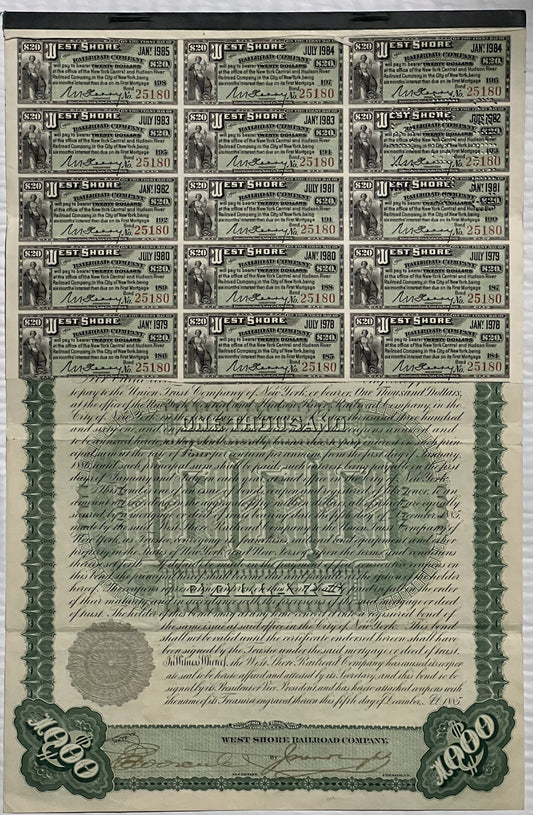
Across the top of the face: UNITED STATES OF AMERICA, with the West Shore Railroad Company wordmark in shaded display lettering beside it and, in small engraved capitals, the ceiling on the whole issue — "Issue limited to $50,000,000." A scalloped guilloché rosette at the upper right carries $1000. Beneath the title banner runs the terms line: "Interest payable semi-annually on the first days of January and July, at the rate of four per centum per annum." Then the body in fine engraved script with the blanks completed in period pen — "For Value Received, the West Shore Railroad Company promises to pay to ______ or assigns, ONE THOUSAND DOLLARS at the office of the New York Central and Hudson River Railroad Company in the City of New York" — secured by a mortgage or deed of trust dated the fifth day of December, 1885, made to the Union Trust Company of New York as Trustee and covering the railroad's franchises, equipment and property in the States of New York and New Jersey. The signature lines read VICE PRESIDENT and SECRETARY, signed in ink with the date written in by hand. Serial number and completed dates vary piece to piece.

🎟️ Why there is no coupon sheet — and why that is correct

Anyone who knows railroad bonds looks for the coupons first. The answer is printed on the document itself: this issue was made "Coupon and Registered" — the same debt in two forms. The coupon form carried a sheet of dated interest tickets that the bearer clipped and cashed twice a year. The registered form, which is what this is, worked the other way round: the holder's name was written onto the face in ink and entered on the company's books, and the semi-annual interest was paid straight to that holder of record — mailed to the name on the register instead of clipped from a sheet. No coupons were ever printed for it. Nothing here is missing; this is simply the other half of the issue.

In place of a coupon sheet the registered form carries something a coupon bond never has. The face states the bond is "transferable only on the books of said West Shore Railroad Company at said office by the registered owner in person or by attorney, upon surrender hereof," and the back carries the mechanism that did it: a full transfer and assignment panel"For Value Received ______ hereby sell, assign and transfer unto ______ ... the within bond issued by the West Shore Railroad Company" — with a witness line, a printed box for documentary stamps, and space for a bank's SIGNATURE GUARANTEED endorsement.

🖋️ The paper trail on the back

Stock and bond certificates carry financial writings, markings, stamps, hole punches and staples as part of the life of the instrument, and a registered bond that actually changed hands shows every step of it. On the example photographed the assignment is completed and dated in ink and witnessed; the transfer is guaranteed by three separate institutions stamping and signing beside one another; there is a documentary-stamp waiver notation; and punch-cancellation holes run across the face and through the engraved vignette where the bond was taken out of circulation at settlement.

None of that is damage. Endorsements and signatures, transfer-agent and registrar stamps, revenue or documentary tax stamps, punch or cut cancellations at redemption — that is the paper trail of a financial instrument doing its job: bought, held, assigned and finally retired. Three institutions put their name to one transfer on this sheet. It is a layer of history a blank certificate can never have. Expect the ordinary period handling that goes with it — soft folds, light toning, edge wear.

🦅 The engraving

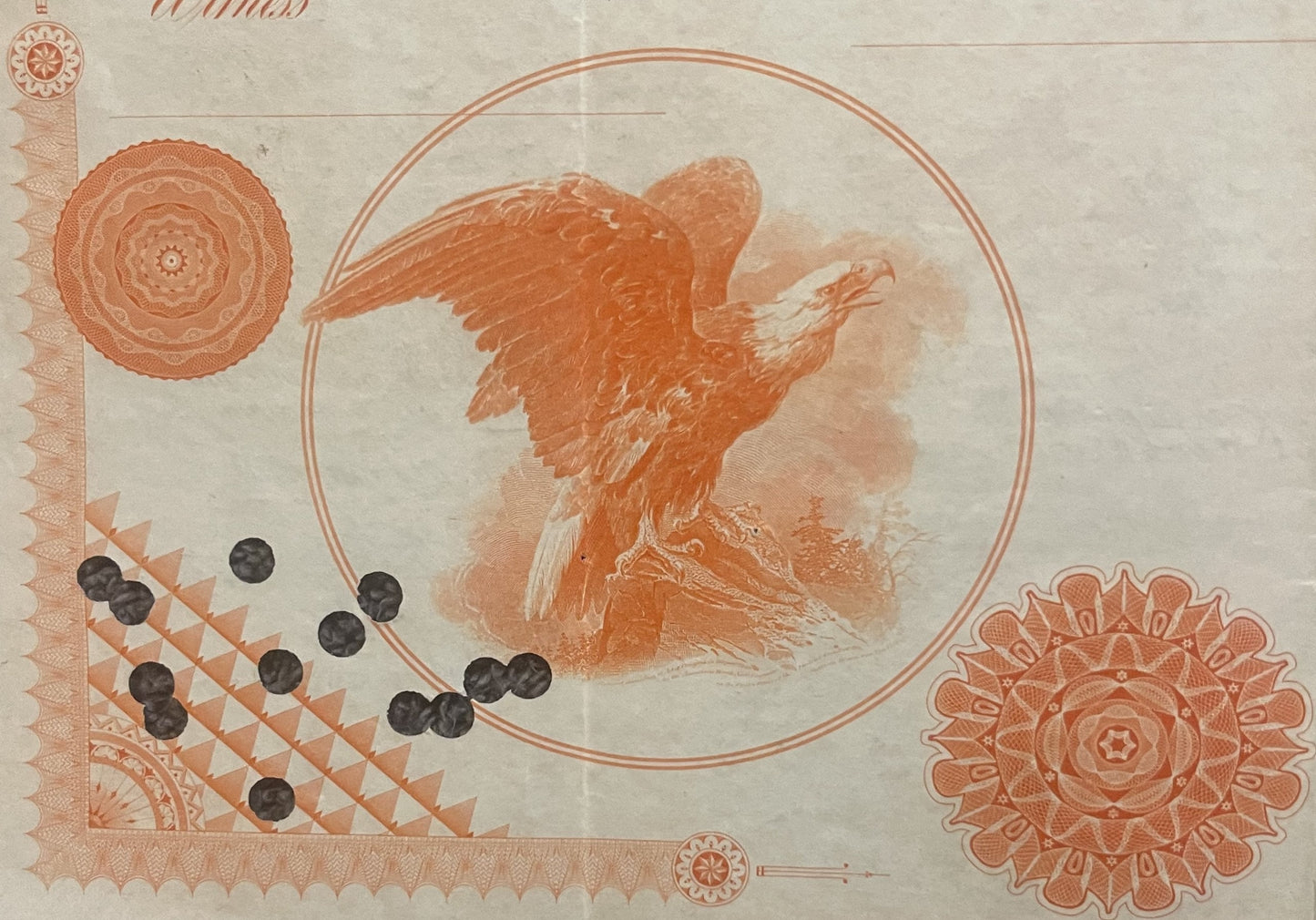
The main vignette across the lower face is a Hudson River scene engraved in black: highlands rising across the water, a sailboat and a larger sailing vessel out on the river, a multi-stacked steamboat lying at a pier with dockside buildings behind it, and a steam train running along the near shore with smoke trailing behind it. It is a picture of exactly what this railroad was — rails and river traffic competing for the same valley. At the left of the face an interlaced WS monogram shield sits wreathed in engraved lilies above the panel reading PRINCIPAL DUE January 1. A.D. 2361 and the serial number. The reverse carries a second vignette in orange: a bald eagle with wings spread on a rocky outcrop inside a double-ruled circle, flanked by large guilloché rosettes of the kind designed specifically to be miserable to counterfeit. The corporate seal is embossed into the paper at the lower left of the face, and the printer's imprint at the foot reads AMERICAN BANK NOTE COMPANY, NEW YORK.

🗓️ Where a date like 2361 comes from

The number is not arbitrary. The New York Central bought the New York, West Shore and Buffalo Railway on November 24, 1885, renamed it the West Shore Railroad, and leased the whole operation for 475 years effective January 1, 1886. Do the arithmetic: 1886 plus 475 lands exactly on 2361. The maturity date on this bond is not Gilded Age showmanship — it is the last day of the lease, written into the paper. The lease itself settled a real railroad war: the West Shore had been built in the 1880s to run up the west bank of the Hudson and undercut the Central's own main line on the opposite shore, and the Central ended it the way the Central usually ended things, by buying the upstart outright and locking it into a lease long enough that nobody would ever have to think about it again.

📅 About the decade, and about the piece you receive

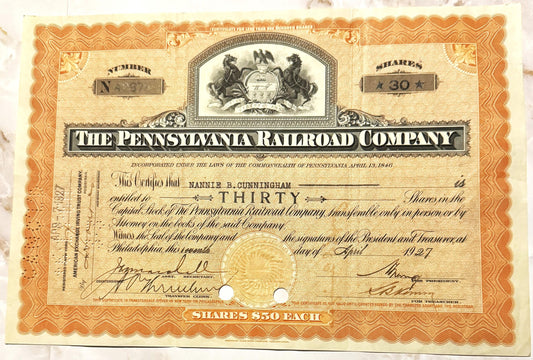
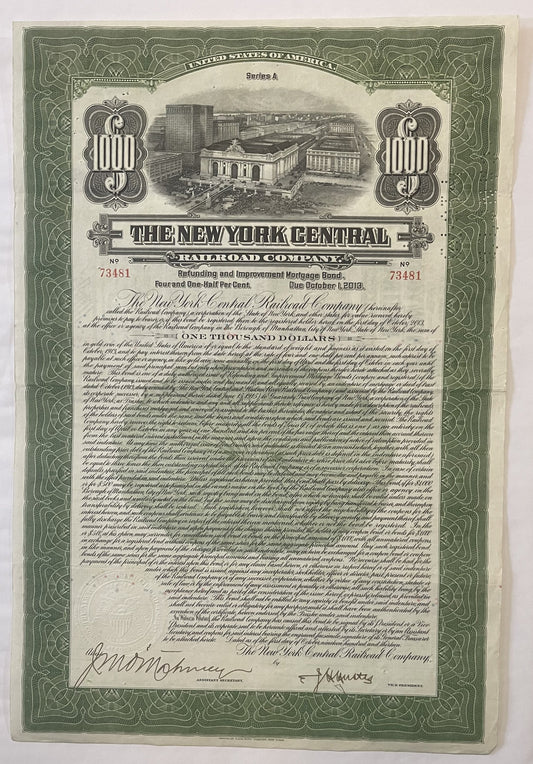
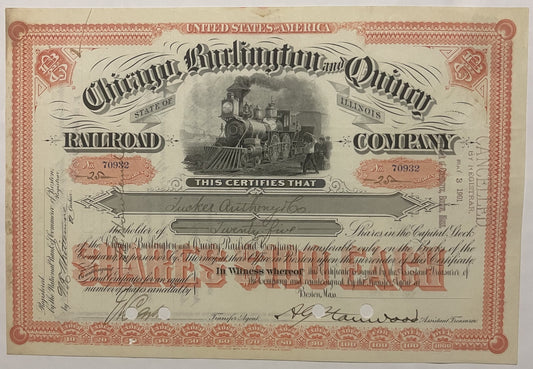
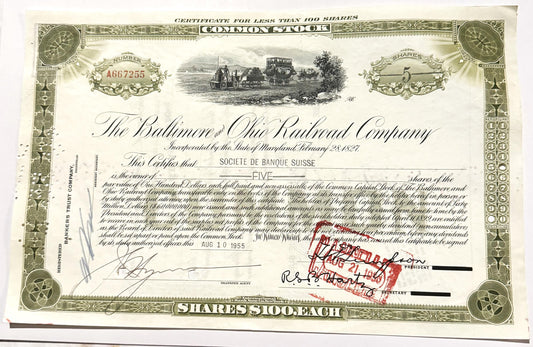
This offering covers West Shore bonds across the 1930s through the 1960s. Because each one is an individual period document, treat the photographs as an example of the type rather than a portrait of one specific sheet: the serial number, the completed dates, the officers' manuscript signatures, the endorsement and guarantee stamps on the assignment panel and the placement of any punch cancellation all vary from piece to piece. In the owner's own long-standing words:

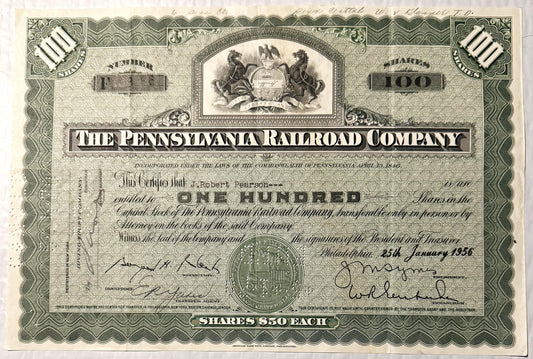
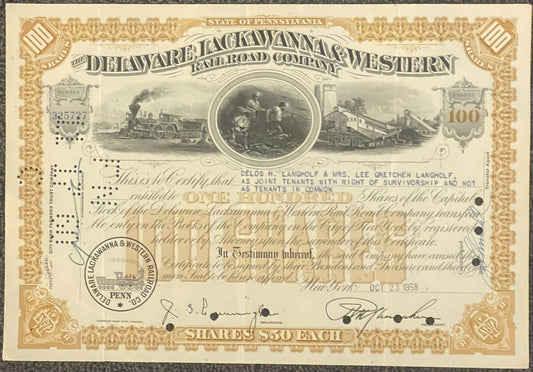
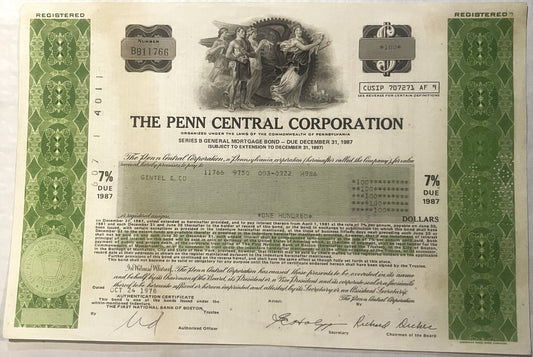
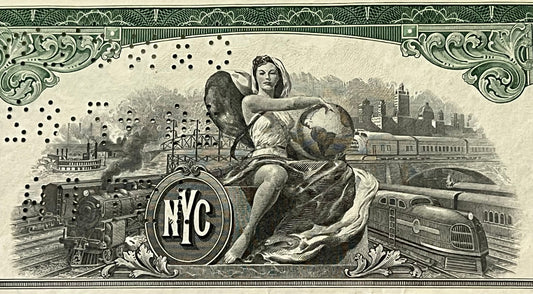
14" x 9 1/2" ~ Picture is of a 1940s all look the same except some of the later have a small Penn Central label to denote the ownership change. Some of these decades are very uncommon.

The NYC bought the New York, West Shore and Buffalo Railway on November 24, 1885, and renamed it the West Shore Railroad, leasing it for 475 years from January 1, 1886. What makes this bond really neat is the principal and interest owed all came due on 2361 and you were just to show up to their office to collect.

West Shore has a long and storied history provided service from New York City via Weehawken, New Jersey to Albany and Buffalo. This line became part of Penn Central in 1968 and passed to Conrail in 1976 after Penn Central's 1970 bankruptcy. It is now under the control of the huge conglomerate CSX.

My pictures seriously can't do it justice!

Imagine hanging this vintage historic collectible on your wall as home decor in any room! Stock certificates are another thing that is limited in supply and once they are gone into museums and collections, they will be hard to get. They are such historic documents with so much history behind them. The first stock certificate was issued in 1606 by the Dutch East India Company. 407 years of history later the Walt Disney Company issued one of the last paper stock certificates from a major corporation in 2013.

These had to be done on heavy paper stock, almost like a dollar bill but stiffer and more durable, which makes them stay vibrant and new looking for a long time. The other very unique thing about stock and bond certificates is they have all kinds of interesting signatures, and you honestly never know whom you will find. Almost all stocks are signed by the company President and Secretary. Some collectors research the other signatures and historic significance, and it adds so much provenance and value to an already valuable item. I have never done this as I can barely read my own signature let alone one from over 100 years ago and with the time it would take to do thousands of certificates my mother and I decided years ago not to bother.

Shipping

🚚 Shipping & Handling

  • Shipping costs and timing are calculated at checkout.
  • Items curated and shipped directly by me include U.S. shipping at no additional cost, professionally packed to ensure safe arrival of your artifact.

Items from Vetted Pro Collectors
Shipping for items offered by vetted Pro Collectors is determined at checkout. All Pro Collector listings are reviewed to ensure fair, reasonable shipping practices.

For full details, please refer to our Shipping Policy.

Returns & Exchange

Take your time — you've got a full six months. If a piece isn't right for you, send it back the way it reached you and we're good.

In the first 30 days your money goes straight back the way you paid. After that it's store credit, so you can put it toward something you'd rather have.

Return shipping we sort out between us, case by case. I don't make this difficult.

If something arrives damaged, or it isn't what I said it was, send me a photo within 48 hours and I'll make it right.

Email info@vintageantiquesgifts.com or call 802-356-9872 — that's me answering, not a call center.

The only things I can't take back are custom or special-order pieces and gift cards.

View full details
  • 5 stars: 2 (100%)
  • 4 stars: 0 (0%)
  • 3 stars: 0 (0%)
  • 2 stars: 0 (0%)
  • 1 star: 0 (0%)
J
James

Great product and packaged well. Recommend this seller.

a
a***a (391)

Hi my friend I received my vintage 1970s railroad stock certificate in great condition and right on time as always I so appreciate your great service I thank you so much keep up your good work and your family work stay safe and healthy to you and your family 👍