Skip to product information
1 of 5

Vintage and Antique Gifts

Vintage "Old Kentucky General" Bourbon Whisky Label 🥃 Bottled-in-Bond Gold Foil General Distillers Louisville KY American Made

Regular price 10.00 USD
Regular price Sale price 10.00 USD
Sale Sold out
Shipping calculated at checkout.

Description

When a Label Was a Promise — Do You Remember When Bourbon Had Something to Prove? 🥃

There is a particular kind of thrill that runs through a collector's hands the moment they pick up a piece of printed ephemera that has survived nearly a century completely intact. The ink still deep, the gold foil still catching light the way it did when it left the press, the paper still carrying that satisfying thickness of a label made to last. That thrill is exactly what you get with this extraordinary antique embossed gold foil bottle label from Old Kentucky General Kentucky Straight Bourbon Whisky — and once you understand the world this label was born into, you will never look at a printed paper rectangle quite the same way again. This is not decoration. This was documentation. This was defiance. This was America getting back on its feet and telling the world it still knew how to make honest whiskey.

This label arrived in my hands as part of a larger collection of pre-war distillery paper, and it stopped me cold. I have handled a lot of labels from this period. This one is something else. The weight of the history embedded in those four words — Under U.S. Government Supervision — hits differently when you know what it meant to a drinker in 1935 or 1940. It meant the dark years were over. It meant the thing in your hand was real.


🔍 What This Actually Is — The Object, the Brand, the Company, the Era

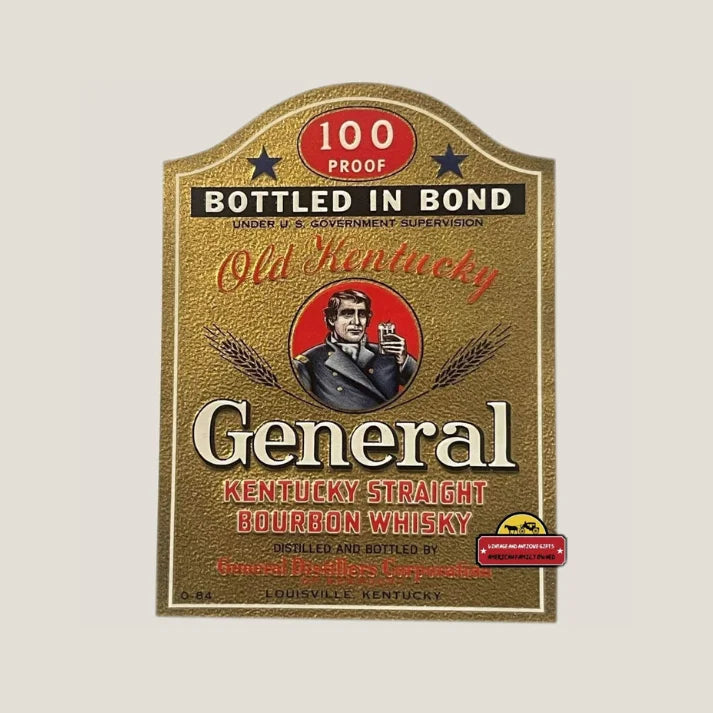
What you are looking at is a genuine New Old Stock (NOS) antique bottle label — never applied to a bottle, never soaked, never steamed, never crinkled by the wet pressure of glass and adhesive. It is original 1930s–1940s production paper ephemera, printed for General Distillers Corporation of Louisville, Kentucky, intended for use on their Old Kentucky General Kentucky Straight Bourbon Whisky. The label carries a 100 Proof designation and the full Bottled-in-Bond certification, meaning every bottle it ever dressed contained whiskey distilled in a single season by a single distillery, aged a minimum of four years in a federally bonded warehouse, and bottled at exactly one hundred proof — all under the watchful eyes of resident U.S. government agents who lived, literally, inside the warehouse. That is not marketing language. That is federal law — the Bottled-in-Bond Act of 1897, still in force, still the gold standard.

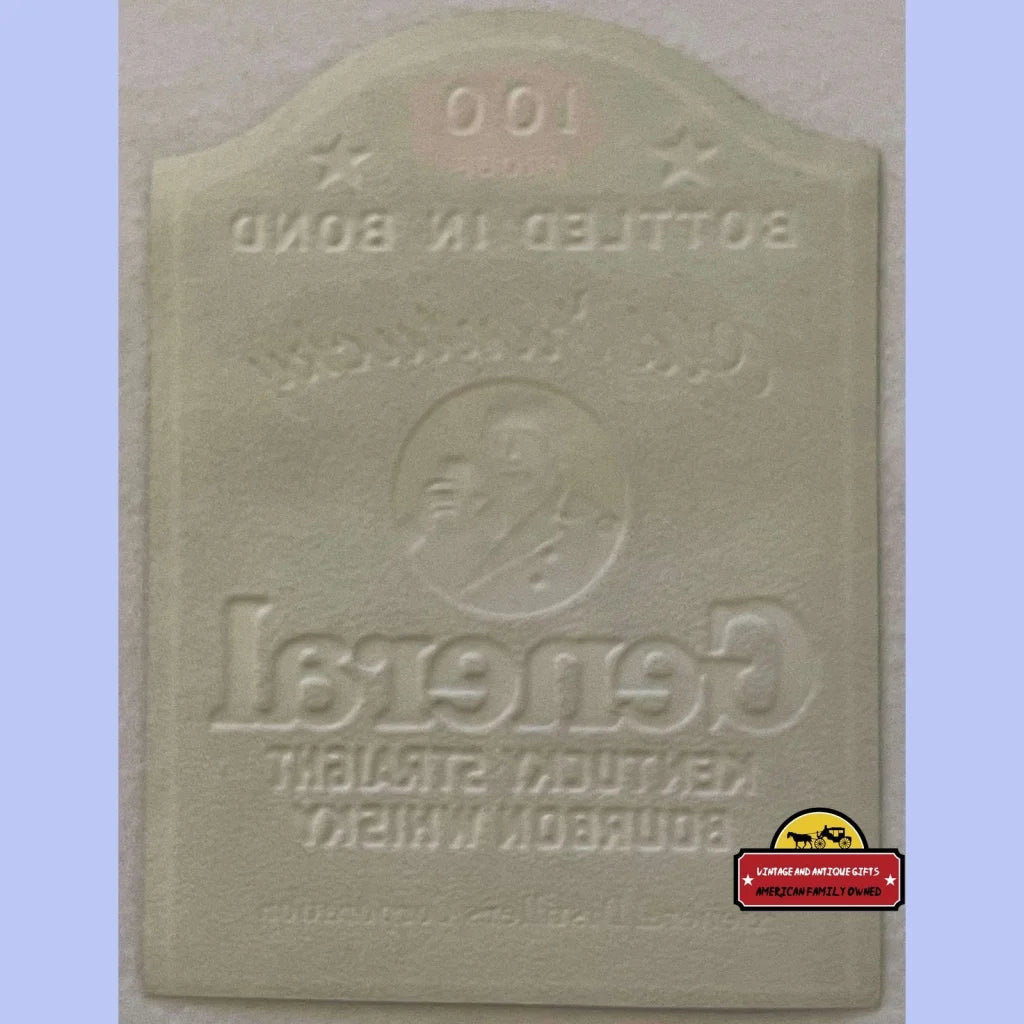
The label's silhouette is a classic tombstone arch — rounded at the crown, square at the shoulders — a shape beloved by label designers of the era because it commanded authority on the shelf without shouting. A slim cream border frames the design and steps inward to create a contained visual field. At the very top, a bold red oval badge announces 100 PROOF in thick serif numerals, flanked on either side by deep navy blue five-pointed stars that echo the iconography of federal certification and American patriotism without being heavy-handed about it. Below that sits a solid black banner carrying BOTTLED IN BOND in white serif type, with the subtext Under U.S. Government Supervision — phrasing that was, in this period, the single most powerful claim a bourbon brand could make. Sweeping below that banner in elegant flowing red script are the words Old Kentucky, and beneath the script sits the label's centerpiece: a detailed circular medallion portrait of a uniformed general, rendered with the kind of fine-line engraving-style printing that was the hallmark of prestige label work in pre-war America. The gold foil — embossed, not flat-printed — gives the entire composition a weight and luminosity that photographs struggle to fully capture. In hand, under a single lamp, this label glows.

The paper is heavy stock, consistent with NOS label sheets of the period. Because this label was never applied, the reverse gum is intact and the edges are sharp. This survived because someone, somewhere, understood its value and kept it safe. Louisville, Kentucky had been the undisputed capital of American bourbon production before Prohibition, and after repeal it fought hard to reclaim that crown. The problem was immediate and serious: aged bourbon takes time. You cannot rush a four-year minimum. Companies that wanted to sell legal Bottled-in-Bond bourbon in 1935 had to have started aging barrels in 1931 — while Prohibition was technically still the law. Some companies did exactly that, obtaining medicinal or sacramental permits. Others scrambled to acquire existing aged stocks. The early post-Prohibition years were a fascinating tangle of acquisitions, mergers, leased warehouses, and brand launches, with companies racing to put legitimate, government-certified whiskey on shelves that had been empty — or worse — for over a decade.

General Distillers Corporation was among the companies navigating that landscape from Louisville, producing the Old Kentucky General brand with the full Bottled-in-Bond credential displayed on this label. The name itself is a statement of intent: General — both the military rank evoked by the portrait medallion on the label, and the corporate confidence of a company presenting itself as an authority in its field. Louisville in the 1930s was a city rebuilding its identity around bourbon, and brands like Old Kentucky General were part of that rebuilding. They carried names that spoke of heritage, of the old Kentucky tradition, of a whiskey culture that predated the Volstead Act and would outlast it.

Local legend among Kentucky whiskey paper collectors holds that the general depicted in the central medallion on the Old Kentucky General label was a composite figure — neither a specific historical general nor a purely invented mascot, but a deliberate visual reference to the long tradition of Kentucky military and political figures who were also known bourbon men. Lore passed down among Louisville distillery history enthusiasts suggests that General Distillers' design team specifically chose a bearded, uniformed figure to evoke the post-Civil War era of Kentucky bourbon's first golden age — a period when bourbon from the Bluegrass State was winning medals at international expositions and being served in the finest hotels from New York to San Francisco. Whether or not the specific model for the medallion portrait has ever been definitively identified, the visual intent is clear: this is a whiskey with history, with rank, with standing.


🌆 Louisville, Kentucky — The City That Made Bourbon American

To fully appreciate this label, you have to feel the city it came from. Louisville, Kentucky sits at the falls of the Ohio River — the only natural impediment to river navigation between Pittsburgh and the Gulf of Mexico — and that geography made it a commercial crossroads from the earliest days of American settlement. By the mid-1800s, Louisville was home to dozens of rectifying houses and distilleries, and the city's Whiskey Row on West Main Street was one of the most economically significant commercial corridors in the American South. The cast-iron-fronted warehouses that lined those blocks stored, blended, and shipped bourbon whiskey to every corner of a thirsty country. Barrel after barrel moving by river, by rail, by wagon — Louisville bourbon was everywhere.

Prohibition did not just slow Louisville's whiskey economy. It devastated it. The great warehouse complexes sat idle or were repurposed. Distillery workers scattered. The institutional knowledge of master distillers — the specific mash bills, the yeast strains, the warehouse rotation patterns — was, in some cases, simply lost, passed down only in memory or in handwritten notes tucked into family bibles. When repeal came, Louisville did not just flip a switch and resume. It rebuilt from fragments, from aging records, from old brand registrations, from the recollections of men who had worked the warehouses before the law took their livelihoods away.

The labels produced in this rebuilding era — the late 1930s and 1940s — are physical artifacts of that recovery. Every element of a label like this one was chosen to communicate trustworthiness, heritage, and government-certified authenticity to a public that had spent thirteen years drinking whatever they could find, quality be damned. The gold foil, the tombstone arch, the bold 100 Proof badge, the Bottled-in-Bond banner — these were not decorative choices. They were reassurances. They were a city's promise to the American consumer that honest bourbon was back.

Local bar lore in Louisville holds that in the years just after repeal, regulars at the old bourbon bars along Bardstown Road would ask specifically for Bottled-in-Bond whiskeys — not out of snobbery, but out of caution. The government seal meant you knew what you were drinking. In a decade that had seen wood alcohol passed off as spirits, the Bottled-in-Bond designation on a label like this one was, genuinely, a matter of public health as much as quality assurance.


📜 The Bottled-in-Bond Act — The Most Important Four Words in American Whiskey History

The phrase Bottled in Bond is printed on this label with the same confidence other brands reserved for prize medals or presidential seals — because, in the American whiskey world, that is exactly what it was. The Bottled-in-Bond Act of 1897 was the first federal consumer protection law for a food or beverage product in United States history, passed specifically because the American whiskey market had been overrun with rectified and adulterated spirits that bore no reliable relationship to actual aged bourbon. Distillers who were making the real thing lobbied for the law. They wanted a way to put the government's credibility behind their product — and they got it.

The requirements were specific and unforgiving. The whiskey had to be the product of one distillery, one distiller, one distillation season. It had to be aged at least four years in a federally bonded warehouse — a warehouse where government agents held one key and the distiller held the other, so that nothing could be added, removed, or altered without federal knowledge. It had to be bottled at exactly 100 proof — no more, no less. And it had to carry the distillery's registration number on the label, along with the state of distillation, so that any bottle could be traced back to its exact origin. No coloring. No flavoring. No blending across seasons. Honest whiskey, made honest, stored honest, bottled honest.

When you read Under U.S. Government Supervision on this label, you are reading the result of that entire regulatory architecture. The government agent who supervised the bonded warehouse where this bourbon was aged had a physical presence in that building. He was not a signature on a form filed in Washington. He was a man with a key, walking the rickhouse, logging the barrels. That human weight is embedded in the language of this label, and it gives this piece of paper a gravity that purely decorative vintage labels simply do not have.


🖼️ Display Ideas — Showing This Label the Way It Deserves to Be Seen

  • 🪵 Rustic bar cart or bourbon station centerpiece: Float this label in a simple black or walnut frame alongside a poured glass at cocktail hour — the gold foil catches candlelight and lamplight in a way that makes every gathering feel like a step back into a warmer, more intentional era of American drinking.
  • 🖼️ Gallery wall with other pre-war Kentucky distillery paper: Pair with other 1930s–1940s bourbon labels, whiskey tax strips, or distillery receipts in matching frames for a cohesive Prohibition-era and post-repeal Americana wall installation that tells a complete story.
  • 🏠 Study, library, or home office: Framed under UV-protective glass and mounted alongside a small explanatory card about the Bottled-in-Bond Act, this label becomes a genuine conversation piece and an educational artifact — the kind of thing that prompts a half-hour story every time a guest notices it.
  • 🎩 Antique display case with related ephemera: Lay flat in an archival display case alongside a period bourbon advertisement, a 1930s Louisville city directory page showing the distillery district, or a vintage Louisville travel brochure — creating a curated snapshot of the city and its signature industry at a pivotal moment.
  • 🍾 Restaurant, bar, or tasting room wall art: For bourbon bars, whiskey-forward restaurants, or spirits tasting rooms, an authentically framed pre-war Bottled-in-Bond label like this one delivers immediate credibility and historical atmosphere that no reproduction print can match.
  • 🎁 Archival presentation as a collector's gift: Presented in archival Mylar with a backing board and a brief typed provenance card, this label makes a remarkable gift for the serious bourbon historian, whiskey collector, or Kentucky heritage enthusiast in your life — something genuinely old, genuinely rare, and genuinely beautiful.

🎁 Who Collects These — and Why This One Belongs in Serious Company

Vintage bourbon and whiskey label collecting has grown substantially over the past two decades as the broader interest in American whiskey history has expanded alongside the craft bourbon renaissance. Collectors come to this material from several directions, and this label speaks to all of them.

Bourbon historians and whiskey heritage collectors seek pre-war Bottled-in-Bond labels specifically because they represent the post-Prohibition rebuilding of American distilling — a pivotal and underrepresented chapter in the country's economic and cultural history. A label from a company like General Distillers Corporation, operating in Louisville in the late 1930s, is primary source material for understanding how the industry reconstituted itself after repeal.

Advertising art and graphic ephemera collectors are drawn to the design quality of pre-war label printing. The combination of embossed gold foil, fine-line engraving-style illustration, bold color blocking, and elegant script typography on this label represents a high-water mark in American commercial printing — work that required skilled craftsmen operating precision equipment, producing results that modern observers consistently find more beautiful and characterful than what followed in the postwar lithography era.

Louisville and Kentucky regional collectors seek out material connected to the city's distilling history as part of a broader project of preserving the commercial and industrial heritage of one of America's most historically significant manufacturing cities. General Distillers Corporation and the Old Kentucky General brand are part of that story, and a NOS label in this condition is an exceptional find.

Home bar and bourbon lifestyle enthusiasts — the growing audience of people who have fallen in love with the bourbon world through distillery tours, tasting clubs, and the explosion of premium American whiskey — increasingly want objects that connect their present-day appreciation to the deep history of the tradition. A genuine 1930s–1940s Bottled-in-Bond label, framed and displayed, does exactly that. It is not nostalgia for nostalgia's sake. It is a real piece of the history they love.

Americana and advertising art collectors operating at the higher end of vintage paper ephemera recognize that NOS condition pre-war whiskey labels — particularly those with embossed metallic elements intact — are increasingly difficult to source. The NOS status of this label, with its unapplied, ungummed-reverse condition, puts it in a category above the vast majority of surviving examples from this period.


❓ Frequently Asked Questions — What Collectors Ask About This Label

Is this label actually from the 1930s–1940s, and how can I be confident of that?

Yes. The dating is supported by several converging lines of evidence. General Distillers Corporation operated under that specific corporate name during the post-Prohibition rebuilding era, placing this label in the period between repeal (1933) and the post-World War II industry consolidations of the late 1940s. The printing style — tombstone arch silhouette, embossed gold foil, fine-line engraved-style medallion portrait, combination of red script and bold serif blocking — is entirely consistent with prestige bourbon label design of the 1930s and 1940s and inconsistent with what came after. The paper weight, gum formulation, and ink character are all period-appropriate. The specific combination of 100 Proof and full Bottled-in-Bond designation with the Under U.S. Government Supervision subtext language is characteristic of this precise era. Taken together, the physical evidence confidently places this label in the 1930s–1940s window stated.

What does "NOS" mean and why does it matter so much for a label like this?

NOS stands for New Old Stock — meaning this label was produced in its era but was never used for its original purpose. It was never applied to a bottle, never soaked in water for adhesion, never subjected to the steam and moisture of a bottling line, never stored on a damp shelf or behind a bar. The practical result is a label that has survived with its paper integrity, ink depth, and — critically for this piece — its embossed gold foil completely intact. NOS labels avoid all of those indignities. For a collector or for a framing display, the difference between a NOS label and an applied-and-removed label is the difference between a primary source and a photocopy of one. This is the real, uncompromised original.

What exactly is embossed gold foil, and does the embossing survive well at this age?

Embossed gold foil on a label of this period was achieved through a hot-stamping or foil-embossing process in which a heated die pressed a metallic foil film into the surface of the paper, simultaneously transferring the metallic layer and creating a raised relief impression. On this label, the gold foil areas — framing elements, the central medallion surround, and select typographic highlights — carry both the metallic reflectivity and the dimensional raised quality that were the hallmarks of premium label production. At nearly a century old, embossed foil can be vulnerable to cracking, flaking, or oxidation if the label has been rolled, folded, exposed to humidity, or subjected to temperature extremes. The fact that this label was stored flat and undisturbed in NOS condition means the foil has survived in remarkable shape, retaining both its gold tone and its embossed dimensionality. In direct light, it is visually spectacular. This is not a foil print that has gone dull or crazed — it glows the way it was designed to.

How should I store or frame this label to preserve it long-term?

For archival storage before framing, keep the label flat in an acid-free Mylar sleeve with an acid-free backing board, stored away from direct light, heat, and humidity fluctuation. For display, the single most important choice is UV-protective glazing — either UV-filtering glass or museum-quality acrylic — which will prevent the ink colors and gold foil from fading under ambient and artificial light exposure. Mount the label using acid-free corners or archival photo corners rather than adhesive, so it can be repositioned or re-housed without any contact with adhesive materials. A mat with acid-free properties between the label and the glazing will prevent contact and allow a small air gap. Many collectors of pre-war paper ephemera prefer floating-mount presentation — where the label appears to hover within the frame space — to show its full silhouette, including the tombstone arch outline, without cropping.

Is the Old Kentucky General brand or General Distillers Corporation documented in whiskey reference literature?

General Distillers Corporation and its brands occupy a documented place in the broader history of Louisville's post-Prohibition distilling industry, though like many mid-tier producers of the era they appear more frequently in trade publications, licensing records, and period advertising than in the major retrospective whiskey histories, which tend to focus on brands that survived into the modern era. This is, in fact, part of what makes labels from companies like General Distillers historically valuable — they document the full breadth of the Louisville whiskey industry at a pivotal moment, not just the names that happened to survive consolidation and market shifts. For serious researchers, period issues of trade publications like Wines & Vines, Kentucky state distillery licensing records from the late 1930s, and Louisville city directories of the era provide documentary context for the company's operations.

Can you tell me more about the portrait medallion at the center of the label?

The central medallion features a circular portrait of a uniformed general figure, rendered in the fine-line illustration style that was the signature of high-quality pre-war label engraving. The figure wears what appears to be a formal military dress uniform with visible insignia, and the portrait is framed by the circular medallion border in a style closely related to the portrait medallions used on currency, bond certificates, and other official documents of the era — a deliberate visual echo that reinforced the Bottled-in-Bond government-certification theme of the label as a whole. As noted in the collector lore surrounding this brand, the specific identity of the general depicted has never been definitively established in public record. The figure appears bearded, consistent with the aesthetic of Civil War-era military portraiture, and lore among Louisville paper collectors holds that the design was intentionally evocative rather than specifically biographical — meant to conjure the authority and heritage of the old Kentucky bourbon tradition rather than to commemorate a single historical figure. The medallion is, by any measure, the finest piece of illustration work on the label, and in NOS condition its detail is fully legible.

Is this the kind of piece that appreciates in value over time, or is it purely a display and collecting item?

Pre-war Kentucky bourbon ephemera in NOS condition has shown consistent collector interest, and as the pool of surviving uncompromised examples narrows with each passing decade, genuinely pristine pieces become more notable within the collecting community. The specific factors that drive long-term interest in a piece like this — Bottled-in-Bond designation, Louisville provenance, embossed metallic elements, documented pre-war corporate origin, NOS condition — are all positive indicators within the paper ephemera and Americana collecting world. That said, I always encourage collectors to acquire pieces first and foremost because they love them, because they tell a story worth preserving, and because they deserve to be displayed and appreciated rather than filed away as a pure financial instrument. This label is extraordinary to look at, rich with documented history, and connected to one of the most significant chapters in American food and beverage culture. Those are the reasons to own it.

Shipping

🚚 Shipping & Handling

  • Shipping costs and timing are calculated at checkout.
  • Items curated and shipped directly by me include U.S. shipping at no additional cost, professionally packed to ensure safe arrival of your artifact.

Items from Vetted Pro Collectors
Shipping for items offered by vetted Pro Collectors is determined at checkout. All Pro Collector listings are reviewed to ensure fair, reasonable shipping practices.

For full details, please refer to our Shipping Policy.

Returns & Exchange

Product Page Return Policy

  • 60-Day Returns – Items must be in original condition.
  • Refunds – Issued after inspection (excluding shipping costs).
  • Return Shipping – Customer is responsible unless item is damaged or incorrect.
  • Damaged/Incorrect Items – Contact us within 48 hours for a replacement or refund.
  • Easy Returns – Email [email protected] or call 802-356-9872 to initiate a return.

For full details, visit our Refund Policy.

View full details