Skip to product information
1 of 3

Vintage and Antique Gifts

Antique Brick's Banquet Hall Mince Meat Label 🥧 Edgar Brick & Sons, Crosswicks NJ, Early 20th Century

Antique Brick's Banquet Hall Mince Meat Label 🥧 Edgar Brick & Sons, Crosswicks NJ, Early 20th Century

Regular price 9.00 USD
Regular price Sale price 9.00 USD
Sale Sold out
Shipping calculated at checkout.
Quantity

Brick's Banquet Hall Mince Meat: Beef, Brandy and a Crosswicks Company That Is Gone

Beef and brandy, printed right in the recipe on this label. It is the old mincemeat that has all but left American kitchens: meat and liquor in the same pie filling. Edgar Brick started making it in a village general store in Crosswicks, New Jersey, in 1874. His firm became the largest mincemeat maker in the United States during World War II, stopped making mincemeat in 1968 and closed in 1979. Its factory, two farmhouses moved and joined together in 1879, was listed among New Jersey's endangered historic places in 2017. The company is gone. Its labels are what remain of it.

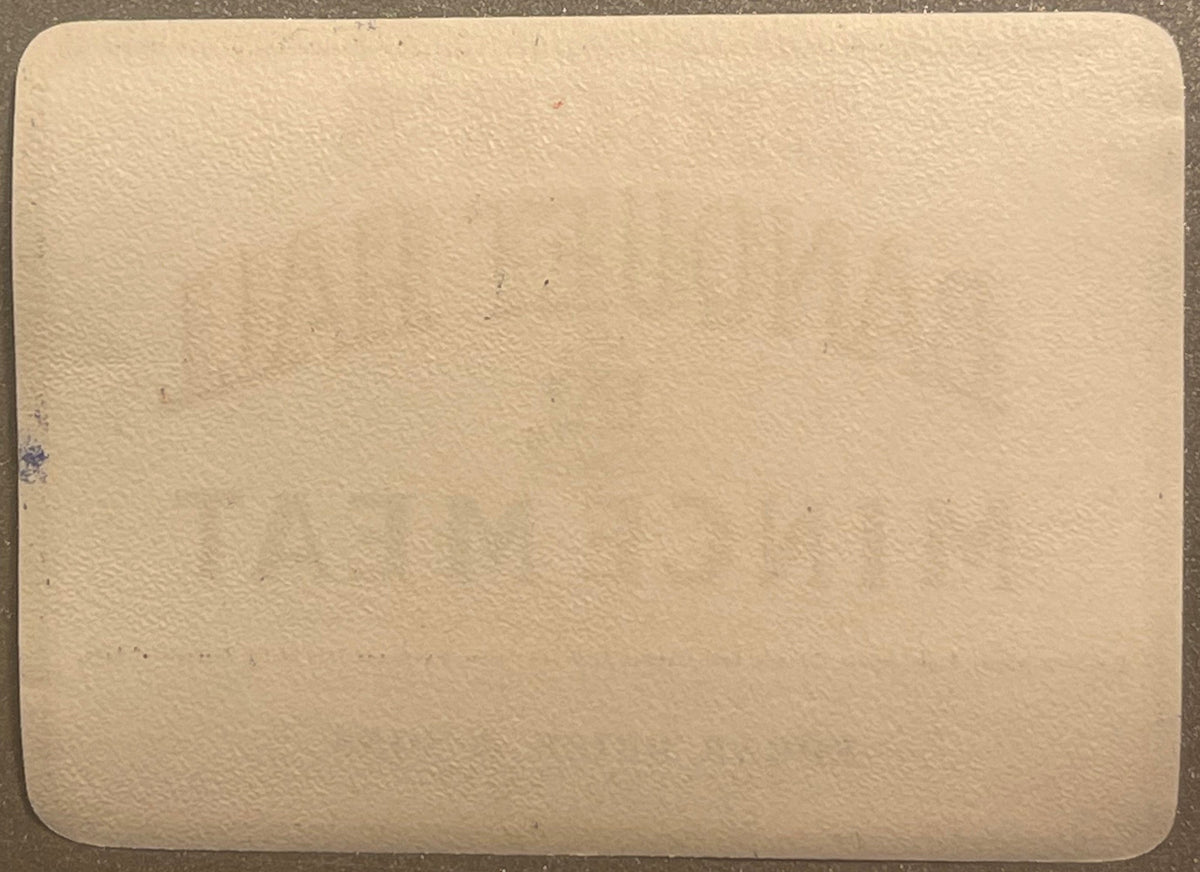
This is an unused antique label for Brick's Banquet Hall Mince Meat, 1910s-1930s, new old stock, 3 1/2" x 2 1/2". It was never applied: the back is plain paper with the front printing faintly showing through.

What the Label Shows

BRICK'S arches across the top in red letters outlined in gold, over BANQUET HALL in tall red capitals shadowed in navy. At the center is a heraldic crest: a gold lion above a blue shield with gold bands and a small red-and-white inner shield, set over a gold ribbon scroll. Below it, MINCE MEAT runs across in navy capitals, and under that, in red, the company's boast: CONSISTENTLY SUPERIOR SINCE 1874.

The small print is the recipe itself: "Combines Apples, Sugar, Raisins, Currants, Beef, Candied Peels, Salt, Spices, Brandy and 1/10 of 1% Benzoate of Soda." Then comes the cook's instruction in red, ADD QUARTER CUP WATER PER POUND MINCE MEAT USED, and the size, NET WEIGHT 5 LBS. The maker's line closes it: EDGAR BRICK & SONS, MANUFACTURERS, CROSSWICKS, N. J. A heavy blue border with rounded corners and a thin gold inner rule frames the cream sheet.

Edgar Brick & Sons of Crosswicks

Edgar Brick and his wife, Susan, moved to Crosswicks in the 1850s and opened a general store on Main Street. Among the things he sold was mincemeat made in Philadelphia. He was dissatisfied with it, and in 1874 he began making his own. The first year he sold 76 pounds. After five years of rising sales he needed a bigger building, and in 1879 the factory was created by moving two local farmhouses onto the property and joining them together.

By the turn of the twentieth century Edgar Brick & Sons was the largest mincemeat manufacturer in New Jersey. When Edgar died in 1920, his three sons, Arthur, Josiah and Charles, took the company over, and Brick family members stayed involved in running the business from then on. At its peak during World War II the factory employed 40 workers and produced three million pounds of mincemeat a year, the largest mincemeat manufacturer in the United States.

The family's mark on the village reached past the factory door. Members of the Brick family were instrumental in bringing electricity to Crosswicks, establishing a mill and an ice plant along Crosswicks Creek, and forming the Chesterfield Township Historical Society.

How the Mincemeat Stopped

Mincemeat consumption began to decline in the 1960s. In 1968 the company stopped making mincemeat entirely and turned to producing alcoholic beverages, and in 1979 it closed. A uniform company bought the building in 1980. In 2017 the old factory was listed as one of New Jersey's endangered historic places, threatened by demolition by neglect, and Chesterfield Township has deemed it a safety hazard. A firm that once shipped three million pounds a year survives mostly on paper like this.

The Old Mincemeat: Beef in the Pie

Mince pie reaches back to medieval England. The 1390 English cookbook The Forme of Cury has a recipe for "tartes of flesshe," meat pies that may be its forerunner. Settlers carried mince pie to the New England colonies, where it was the habit to put cider and molasses on pies. Through the nineteenth century recipes increasingly left the meat out, yet Americans kept eating meat-filled mince pies for decades. This label is that older tradition in print: beef sits in the middle of the recipe, between the currants and the candied peels.

Mince pie also carries one of the best-known Christmas legends in the English-speaking world: that Oliver Cromwell banned it. Food historians call that a myth. Parliament's 1647 ordinance abolished the festivals of Christmas, Easter and Whitsun, but it banned no food, and mince pie is still traditionally served at Christmas in much of the English-speaking world.

Brandy and Prohibition

Brandy in a food product became a legal question once Prohibition took effect in 1920. A court case in 1922 ruled that culinary products could contain liquor, mincemeat included. Canned mincemeat was reported at alcohol levels as high as 14 percent, although a great deal of the alcohol cooked off in the baking.

A Brick's Banquet Hall label printed under Prohibition carries a federal Prohibition permit number and a line stating its alcohol by volume. This label names brandy in its recipe and carries neither of those lines. No year of printing appears anywhere on it; 1874 is the year Edgar Brick began making mincemeat.

The Food Laws Written Into the Fine Print

"1/10 of 1% Benzoate of Soda" is a small line with a loud history. In the early years of the 1906 Pure Food and Drug Act, the safety of benzoate of soda as a food preservative caused a huge uproar. Harvey Wiley of the Bureau of Chemistry, whose human trials of food additives had drawn national attention, was strongly opposed to it. At President Theodore Roosevelt's request, Secretary of Agriculture James Wilson appointed a Referee Board of scientists, headed by Ira Remsen of Johns Hopkins University, to repeat Wiley's trials. The board exonerated benzoate of soda, which infuriated Wiley.

The line NET WEIGHT 5 LBS. belongs to the same era of reform. The Gould Amendment, signed by President William H. Taft on March 3, 1913, required the contents of a food package to be plainly and conspicuously marked on the outside in terms of weight, measure or numerical count.

Crosswicks, New Jersey

Crosswicks takes its name from the Lenape "Crossweeksung," meaning "house of separation." A mostly Quaker group settled there in 1677, making it the oldest of Chesterfield Township's three villages. In 1773 the Chesterfield Friends began a brick meeting house modeled on the Buckingham Meeting House in Bucks County, Pennsylvania, and finished it on the eve of the Revolutionary War in 1776. Throughout the war it housed troops from both sides, with the understanding that the soldiers keep the meeting free for Sunday worship.

On June 23, 1778, five days before the Battle of Monmouth, American forces under Generals Philemon Dickinson and William Maxwell fought at the bridge over Crosswicks Creek to delay the march of British troops under General Henry Clinton. The meeting house was hit by three cannonballs. One struck the brick wall and left an imprint; that ball was saved and later mortared into the wall at the spot where it hit. A century later the Bricks built a mincemeat business in the same village.

For the Collector and the Kitchen Wall

This label was printed for a five-pound container of mincemeat and never went on one. Framed, its red and navy lettering and gold lion crest read clearly from across a room, and it belongs in a kitchen, a dining room or a holiday baker's corner. It is a natural gift for someone with Burlington County or New Jersey roots, a collector of food labels, or anyone who loves the history of Prohibition and American food law. The company that printed it has been closed since 1979 and its factory is crumbling; once these old labels are gone into collections, they will be very difficult to acquire.

Questions People Ask

Is this label unused?

Yes. It is antique new old stock and was never applied to a container.

How big is it?

3 1/2" x 2 1/2".

When was it printed?

1910s-1930s. The label carries no printed year; the 1874 in CONSISTENTLY SUPERIOR SINCE 1874 is the year Edgar Brick began making mincemeat.

Did mincemeat really contain beef and brandy?

This one did. Beef and brandy both appear in the recipe printed on the label, alongside the fruit, candied peels and spices.

Who made Brick's Banquet Hall Mince Meat?

Edgar Brick & Sons, Manufacturers, of Crosswicks, New Jersey, as the label prints. Edgar Brick founded the business in 1874, and his sons Arthur, Josiah and Charles ran it after his death in 1920.

What happened to the company?

It stopped making mincemeat in 1968, turned to alcoholic beverages, and closed in 1979. The factory building still stands in Crosswicks and was listed as endangered in 2017.

Where is Crosswicks?

Crosswicks is an unincorporated community in Chesterfield Township, Burlington County, New Jersey.

Shipping

🚚 Shipping & Handling

  • Shipping costs and timing are calculated at checkout.
  • Items curated and shipped directly by me include U.S. shipping at no additional cost, professionally packed to ensure safe arrival of your artifact.

Items from Vetted Pro Collectors
Shipping for items offered by vetted Pro Collectors is determined at checkout. All Pro Collector listings are reviewed to ensure fair, reasonable shipping practices.

For full details, please refer to our Shipping Policy.

Returns & Exchange

Take your time — you've got a full six months. If a piece isn't right for you, send it back the way it reached you and we're good.

In the first 30 days your money goes straight back the way you paid. After that it's store credit, so you can put it toward something you'd rather have.

Return shipping we sort out between us, case by case. I don't make this difficult.

If something arrives damaged, or it isn't what I said it was, send me a photo within 48 hours and I'll make it right.

Email info@vintageantiquesgifts.com or call 802-356-9872 — that's me answering, not a call center.

The only things I can't take back are custom or special-order pieces and gift cards.

View full details