Skip to product information
1 of 2

Vintage and Antique Gifts

Vintage OK Oklawaha River Citrus League Label 🍊 Florida Crate Art, 1930s-1940s

Vintage OK Oklawaha River Citrus League Label 🍊 Florida Crate Art, 1930s-1940s

Regular price 5.50 USD
Regular price Sale price 5.50 USD
Sale Sold out
Shipping calculated at checkout.
Quantity

🍊 Can You Still Picture a Steamboat Loaded with Oranges, Threading Its Way Up a Cypress River?

There was a stretch of Central Florida, not so very long ago in the grand scheme of things, where the fastest way to move a crate of oranges to market wasn't a highway — it was a river. The Ocklawaha wound its way north through cypress and palm, and paddlewheel steamboats worked that water hauling citrus out to the wider world. Every crate that left a Central Florida packinghouse needed something to set it apart from a hundred other crates stacked in the same railcar or the same dockside warehouse — and that's exactly what this little round label was built to do. Two bold letters, O and K, blazing in red and gold against a field of deep navy blue, announcing a promise before a single orange was ever cut open: finer flavored fruit, graded high, guaranteed good all the way through. Holding one of these today is about as close as you can get to holding a piece of that river-and-rail citrus world firsthand.

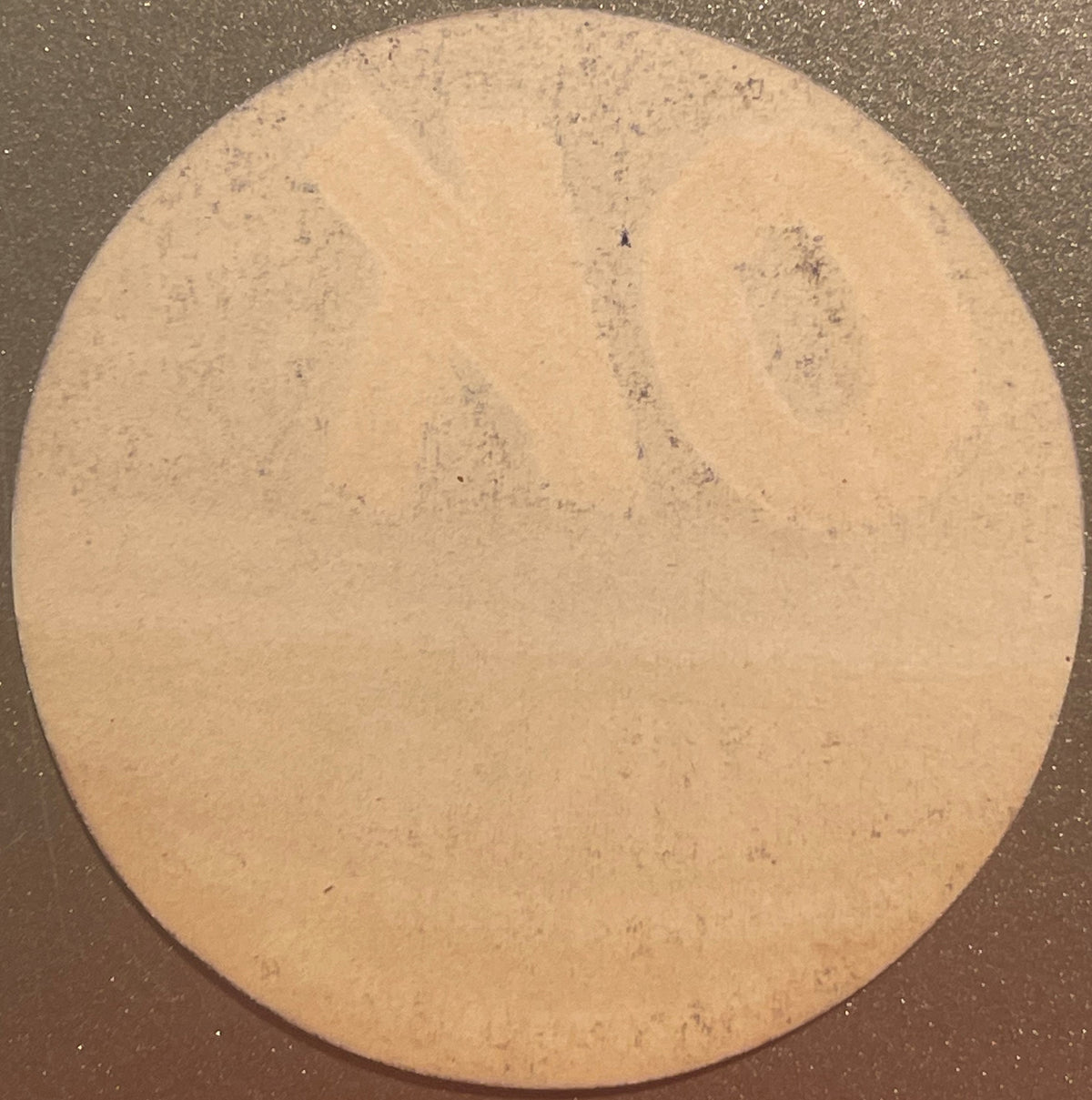
This is an original Florida citrus crate label for the Oklawaha River Citrus League, marketed under the brand name OK and promising "Finer Flavored Fruits." It carries the full verbatim wording: OK · OKLAWAHA RIVER CITRUS LEAGUE · FINER FLAVORED FRUITS · It's what's under the skin that counts! · OKLAWAHA RIVER CITRUS LEAGUE · HIGH INTERNAL GRADE. The label is circular, measuring approximately 3 inches across, and it is offered here as New Old Stock (NOS) — original, unused stock that never made it onto a shipping crate in its working lifetime. Stylistically, with its bold condensed sans-serif lettering, flat lithographic color separations, and idealized painted grove-and-river scene, this label belongs to the golden run of Florida citrus label design that spanned the 1930s–1940s.

The artwork itself rewards a close look. A giant red-and-gold "O" and "K," each outlined in white and shadowed for dimension, dominate the top half of the label against that deep navy-blue field — and if you look carefully, the letters of "OKLAWAHA," "RIVER," and "CITRUS LEAGUE" are spiraled right into the shapes of the O and the K themselves, a clever typographic trick that turns the whole monogram into a tiny word-puzzle. A small white star sits inside the O. Below the lettering, a hand-lettered script banner reads "It's what's under the skin that counts!" stretched across a pale sky, and beneath that unfolds a painted panorama: neat rows of citrus trees receding to a vanishing point, a curving river lined with palm trees cutting through the grove, and green fields stretching to the horizon. Along the bottom curve of the label, in bold yellow block letters on black, runs "OKLAWAHA RIVER CITRUS LEAGUE — HIGH INTERNAL GRADE." It's a striking, confident piece of commercial art — built to be read across a warehouse floor.


🍊 What "OK" and "High Internal Grade" Actually Meant

This label wasn't just decoration — it was making a real argument, and a distinctly Floridian one. Florida citrus has notably thinner skin than California citrus, and that single fact shaped the whole industry: the overwhelming majority of Florida's orange crop has historically gone toward juicing, while California's crop has leaned toward table fruit sold on looks. That meant Florida growers couldn't win by having the prettiest, thickest-skinned fruit on the shelf — they had to sell on what was inside. Florida grading standards leaned heavily on a fruit's sugar-to-acid ratio, sometimes called the Brix/acid ratio, with juice-grade fruit historically expected to hit a ratio of at least 10-to-1 before it was considered properly mature. That's the real substance behind "High Internal Grade" and "It's what's under the skin that counts!" — this wasn't just a catchy slogan, it was a grower's creed built directly on the actual science of what made Florida citrus worth shipping a thousand miles north.

Even the color choices on a label like this one carried meaning within the trade. In this era, the background color scheme on a citrus crate label often signaled the grade of fruit packed inside — blue commonly marked grade A, red signified grade B, and yellow or green indicated a mixed lot. Whether or not every buyer down the line consciously registered it, that navy-blue field this OK label is built on wasn't a random design choice — it was doing quiet work for the grower, telegraphing quality to a produce buyer scanning a hundred crates at once.


🌊 The River, the League, and the Lake County Citrus Belt

The Ocklawaha (spelled "Oklawaha" on this label, the older period spelling) is one of Florida's principal rivers and the largest tributary of the St. Johns River, its headwaters rising out of Central Florida's Green Swamp and threading through the Harris chain of lakes — Griffin, Eustis, Harris, Dora, and Apopka. That geography plants the Oklawaha River Citrus League squarely in the heart of Florida's original citrus country: Lake County and Marion County, the district around Leesburg, Eustis, and Weirsdale.

This wasn't just any citrus district — it was arguably where Florida's whole commercial citrus story began. Leesburg, sitting at the head of the Ocklawaha, emerged as early as 1860 as the very first citrus center of the state, a bustling shipping town where oranges were hauled in by horse, wagon, or boat from as far as fifty or sixty miles away, packed locally, and shipped out to markets across the country by steamboat. Weirsdale, a little further south along the river near Ocala, has remained tied to citrus for generations, with growers working the land there to this day. The Oklawaha River Citrus League took its name, and almost certainly its membership, from growers scattered across exactly this corridor — a cooperative marketing brand meant to give a whole community of river-and-lake growers one strong, unified voice in a crowded national marketplace. The precise founding date and roster of the League itself have faded from the record the way so much small-town cooperative history does — but the label survives as solid physical proof that it once mattered enough to commission its own striking artwork and stake its name on a promise of quality.


🚢 Steamboats, Freezes, and the Grit Behind the Label

Lore passed down among Florida label collectors holds that the growers who packed fruit along the Ocklawaha corridor were fiercely proud people — proud enough of their groves to put that pride directly into ink and imagery for every wholesaler, grocer, and fruit-stand owner in the country to see. "It's what's under the skin that counts!" reads today like clever ad copy, but the old-timers' version of the story is that it was closer to a philosophy — the kind of line a grower only commits to print when he genuinely believes his fruit beats the competition and wants the whole nation to know it.

That pride was hard-won. By the 1870s Florida's young citrus industry was already booming and desperate for better transportation, and steamboats laden with crated citrus were a common sight working the Ocklawaha and the state's other inland waterways — a direct answer to the problem of getting fruit out of remote groves and onto northbound trains and ships. But this same district also absorbed one of the most brutal blows in American agricultural history: the Great Freeze of 1894–95, when the temperature in Central Florida dropped 62 degrees in less than a day. Lake County alone lost 99 percent of its citrus trees. The December freeze killed the fruit on the trees; the follow-up freeze in February killed the trees themselves, salting the earth for a generation of growers who had to replant from nothing. The citrus boom that rebuilt through the 1920s and 1930s — the very era this label comes from — was quite literally grown back from that devastation, grove by grove, by families who refused to let a single hard freeze be the end of the story.


🎨 The Golden Era of Citrus Crate Art — and Why It Vanished

The whole idea of dressing up a humble wooden fruit crate with a brilliant lithographed label traveled east from California, where growers first realized that a bright, memorable image stuck to the end of a crate could turn an anonymous box of fruit into a recognizable, trusted brand. Florida growers picked up the practice fast, and by the early 1900s the state had its own flourishing crate label industry, with unnamed commercial artists cranking out gorgeous, colorful designs — sunrises, groves, rivers, monograms, mascots — for every grower and shipper who wanted to stand out on a crowded dock. The period from roughly 1900 through 1939 is often remembered as the true golden era of this art form, and Florida citrus labels stayed prominent all the way through 1950.

The end came fast once it started. When World War II arrived, so much of the citrus crop was routed directly to feed the military that the whole economic engine behind flashy crate advertising began to sputter. Postwar improvements in packing and printing made the old individually-lithographed labels feel increasingly old-fashioned, and by the mid-1950s the wooden shipping crate itself — the very thing these labels were designed to decorate — had been almost entirely replaced by pre-printed cardboard boxes. The last of the true label era is generally dated to 1956, after which this entire beautiful, colorful chapter of American commercial art simply closed. Every surviving label from a brand like the Oklawaha River Citrus League is a direct physical artifact of that closed chapter — printed, stored, and never used, then quietly outlived by the very industry that made it.


📦 A Small Piece of Florida That Outlasted the Boxes It Was Meant For

What makes labels like this one so treasured today is exactly the fact that they were never meant to survive on their own. A crate label's whole job was to get glued to a wooden box, ride a train or a boat north, and get torn off and thrown away at the grocer's dock. The labels that exist today in collections — including examples of the Oklawaha River Citrus League brand documented in the State Archives of Florida's official catalog of Florida crate labels — survived mostly because they were never used at all: leftover printer's stock, tucked away in a packinghouse drawer and forgotten, then rediscovered generations later by collectors who recognized them for what they are — genuine folk art, and genuine local history, from a Florida that largely doesn't exist in this form anymore. That's exactly the category this piece falls into: original, unused stock from that world, never mounted to a crate, never shipped, never thrown away.


🖼️ Display Ideas

  • 🍊 Frame it alone in a small round or shadow-box frame to let that bold OK monogram be the star of a kitchen or breakfast-nook wall
  • 🌊 Pair it with a map or print of the Ocklawaha or St. Johns River for a Central Florida history corner
  • 🏡 Group it with other Florida citrus ephemera — postcards, old grove photos, packing-house tins — for a themed gallery wall
  • 🛋️ Set it into a curio tray or small display easel on a bookshelf as a rotating conversation piece
  • 🎁 Gift it to a Florida transplant, Leesburg or Ocala native, or citrus-industry retiree who'll recognize the river name instantly
  • 📖 Slip it into a scrapbook or archival sleeve alongside other Florida crate labels for a growing themed collection

🎁 Who Collects These

Citrus crate label collecting draws a genuinely broad crowd — vintage advertising and ephemera collectors chasing strong graphic design, Florida history buffs building out a picture of the state's early agricultural economy, and folks with a personal or family tie to the old Central Florida citrus belt who want a tangible piece of that world on their wall. Steamboat and river-history enthusiasts gravitate toward Ocklawaha-branded pieces specifically, since the river itself carried a whole transportation story long before highways existed. Kitchen and farmhouse-style decorators love the bold, saturated color palette these labels bring — navy, red, gold, and green read beautifully in a breakfast room or sunroom. And serious paper-ephemera collectors value labels like this one simply because so few survived at all; every era-correct, unused example still in circulation represents one small, lucky escape from the trash bin of a packing house that closed its doors decades ago.


❓ FAQ

What exactly is this label made of, and how was it produced?

It's a color lithograph — a printing process capable of laying down flat, vivid, separated colors, which is exactly the technique that gave Golden Era citrus labels their bold, poster-like look. The navy blue, red, yellow, green, light blue, and white on this piece are all classic hallmarks of that lithographic printing style.

Was this label actually used on a shipping crate?

No — this is New Old Stock (NOS), meaning it's original, unused printed stock from the period rather than a label that was ever mounted to a crate and shipped. That's part of why it survives in the shape it's in today, since most labels that actually made it out into the shipping world were torn off and discarded at their destination.

What does "Oklawaha" mean, and why is it spelled differently from "Ocklawaha"?

Both spellings refer to the same Central Florida river. "Oklawaha" was a commonly used period spelling; the more modern standard spelling is "Ocklawaha." The river is a major tributary of the St. Johns River, rising out of Central Florida's chain of lakes in Lake County.

What does "High Internal Grade" and "It's what's under the skin that counts" actually mean?

It's a real grading claim, not just a slogan. Florida citrus was historically judged heavily on internal maturity — specifically its sugar-to-acid ratio — rather than external appearance, since Florida fruit's thin skin meant most of it was destined for juicing rather than the produce stand. This label is making a direct pitch to that internal-quality standard.

How old is this label?

Stylistically — the bold condensed lettering, the flat lithographic color work, the idealized painted grove-and-river scene — this label is consistent with the 1930s–1940s era of Florida citrus crate label production, the heart of the format's golden run before wartime shortages and the shift to cardboard packaging brought the whole art form to a close by the mid-1950s.

What size is the label?

It measures approximately 3 inches across — a small, circular format, well suited to framing individually or grouping with other citrus ephemera.

Is the Oklawaha River Citrus League still an active organization?

The League is documented as a genuine Florida citrus brand of its era, tied to the Ocklawaha River citrus district in Lake and Marion Counties. Like most small regional citrus marketing cooperatives of the period, detailed records of its day-to-day operations have largely faded from public record — but this label stands as authentic, tangible proof that it once marketed real Florida fruit under a proud, distinctive name.

Shipping

🚚 Shipping & Handling

  • Shipping costs and timing are calculated at checkout.
  • Items curated and shipped directly by me include U.S. shipping at no additional cost, professionally packed to ensure safe arrival of your artifact.

Items from Vetted Pro Collectors
Shipping for items offered by vetted Pro Collectors is determined at checkout. All Pro Collector listings are reviewed to ensure fair, reasonable shipping practices.

For full details, please refer to our Shipping Policy.

Returns & Exchange

Take your time — you've got a full six months. If a piece isn't right for you, send it back the way it reached you and we're good.

In the first 30 days your money goes straight back the way you paid. After that it's store credit, so you can put it toward something you'd rather have.

Return shipping we sort out between us, case by case. I don't make this difficult.

If something arrives damaged, or it isn't what I said it was, send me a photo within 48 hours and I'll make it right.

Email info@vintageantiquesgifts.com or call 802-356-9872 — that's me answering, not a call center.

The only things I can't take back are custom or special-order pieces and gift cards.

View full details
  • 5 stars: 1 (100%)
  • 4 stars: 0 (0%)
  • 3 stars: 0 (0%)
  • 2 stars: 0 (0%)
  • 1 star: 0 (0%)
D
Drew Swaggerty

Arrived in great condition, would purchase from seller again.

Hello Drew! Your stellar 5-star rating is the light of our day! We're so thrilled that you're loving the 'Oklawaha River Crate Label'. Embrace the essence of the 1930s with us! ️ We're always here to dust off and send your way hidden historical gems! Thank you for being a valued member of our vintage family!