Skip to product information
1 of 4

Vintage and Antique Gifts

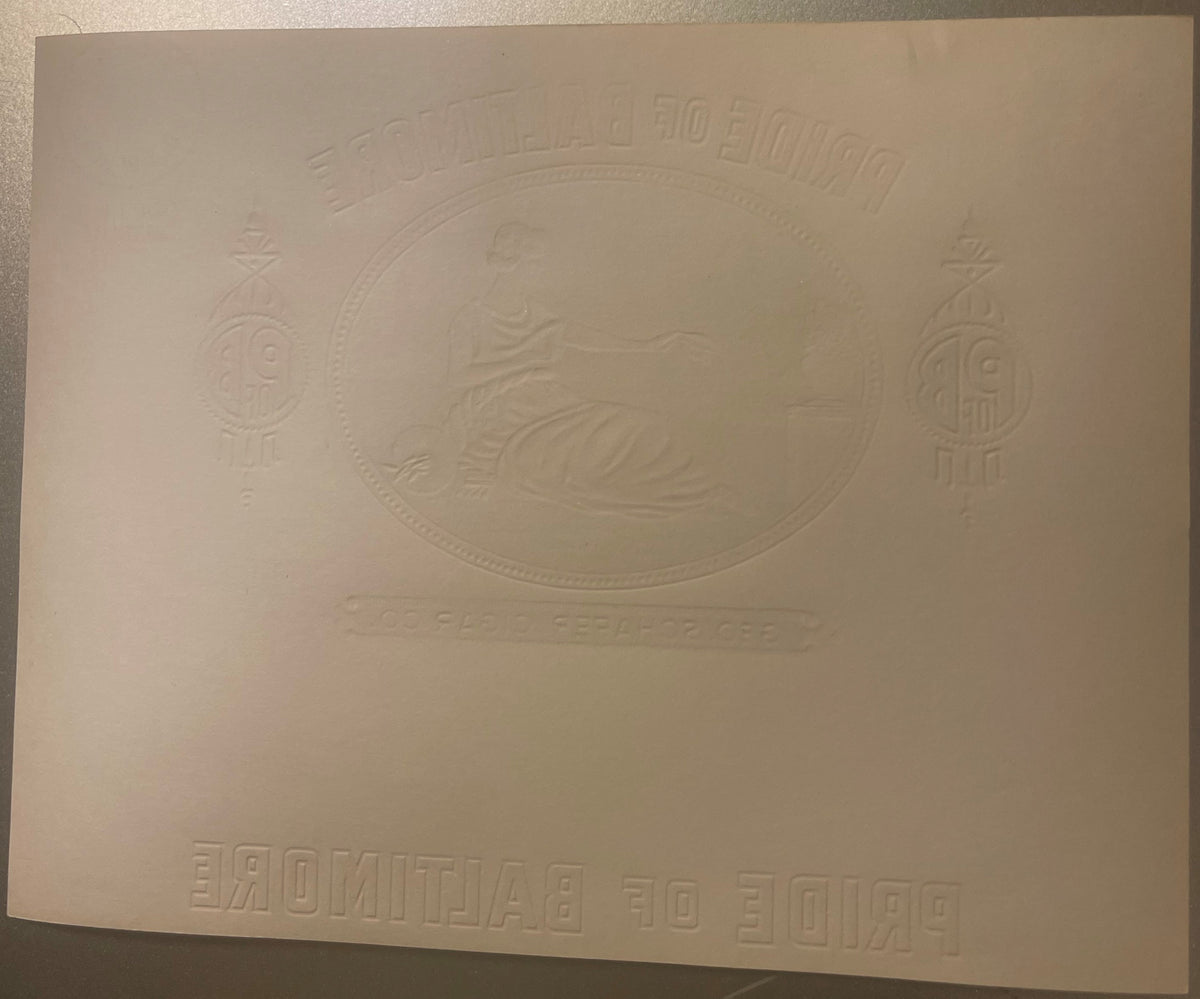
Antique Pride of Baltimore 🏛️ Geo. Schafer Cigar Co. Embossed Gold Foil Lithograph Label 1900s–1920s

Antique Pride of Baltimore 🏛️ Geo. Schafer Cigar Co. Embossed Gold Foil Lithograph Label 1900s–1920s

Regular price 7.00 USD
Regular price Sale price 7.00 USD
Sale Sold out
Shipping calculated at checkout.
Quantity

🏛️ Do You Remember When Baltimore Was Famous for More Than Baseball?

There is a particular kind of pride that a city earns — not through a single moment, but through generations of craft, commerce, and character. Baltimore earned hers on the waterfront, in the canneries, in the iron foundries, and yes, in the long, fragrant rows of rolling tables in its cigar factories. At its industrial peak, this city was producing hundreds of millions of cigars every single year, and the men and women who built those brands wanted the world to know exactly where they came from. They put it right on the label. Pride of Baltimore. You can't get more direct than that.

This piece is a genuine artifact of that era — a beautiful, surviving reminder that American manufacturing once celebrated itself with art this gorgeous, and that Baltimore was a city confident enough in its own identity to name a cigar brand after the feeling of belonging to it.


🎨 What You Are Looking At

This is an antique Pride of Baltimore cigar box label, produced by the George Schafer Cigar Company of Baltimore, Maryland. It is a large-format piece — approximately 8½ inches by 6½ inches — printed as an embossed lithograph with genuine gold foil work throughout. It is New Old Stock (NOS), meaning this label was printed, stored, and never applied to a box. It survived the way the best things do: quietly, in a drawer or a warehouse somewhere, waiting for someone who understood what it was.

The printing process itself is worth pausing on. Embossed lithography with gold foil was among the most labor-intensive and technically demanding commercial printing techniques of its era. The image was built up from multiple stone or plate passes — each color laid down separately, in precise registration — and the embossing was pressed in afterward to give the gold-worked areas a raised, tactile dimension that you can feel with your fingertips. Most companies at the time used real gold flakes in their embossing process, and the depth and warmth of the gold on this label reflects exactly that. Modern printing cannot replicate it. Offset lithography and digital printing simply do not produce this quality of surface. What you are looking at is the work of craftsmen operating at the absolute top of their profession, in an era when commercial art was taken seriously as art.

The label's central image is a seated woman in classical dress — white draped top, vivid red skirt spreading dramatically across the grass — reclining in a garden setting with a flower urn beside her. She reaches forward with one arm, poised and composed, the image of civic elegance. Behind her rises a cityscape: tall trees, a formal promenade, and a tower rising against a blue sky — almost certainly a nod to the Baltimore skyline as it was recognized and romanticized in the early twentieth century. Flanking the central oval on both sides are ornate P of B torch emblems worked in gold, each featuring the monogram of the brand. The text reads in embossed gold and red: PRIDE OF BALTIMORE — GEO. SCHAFER CIGAR CO. — and on the outer label, the period details that collectors love: 6¢ — HOLE-IN-HEAD — DON'T-BITE — JUST-LITE.

That slogan is worth its own paragraph. "Hole-in-Head / Don't-Bite / Just-Lite" is one of the more charming pieces of vintage American tobacco advertising copy you will ever encounter. Punchy, practical, a little cheeky — it speaks directly to the working man who was the brand's customer, with the humor and directness that characterized so much great mid-century American vernacular advertising. The 6¢ price point places this firmly in the category of the everyday cigar, the one you lit up after lunch or on the front steps in the evening, not the celebratory smoke for special occasions. This was Baltimore's workingman's cigar, and it was proud of it.


🏭 The George Schafer Cigar Company — Baltimore's Own

The George Schafer Cigar Company is a documented part of Baltimore's industrial heritage. The Baltimore Museum of Industry holds a Geo. Schafer Cigar Co. Pride of Baltimore cigar box in its permanent collection — which is itself a significant marker of historical legitimacy. Objects don't end up in an industry museum's collection by accident; they get there because curators recognized them as representative of something real and important about how a city worked and what it made.

A related Schafer box — a book-form novelty cigar container titled The Book of Contentment — is documented as a 1940 edition, which gives us at least one firm date placing the brand in active production around the middle of the twentieth century. And the Schafer name continued: a newspaper record from The Cumberland News in Cumberland, Maryland, dated December 19, 1974, references the name Schafer-Pfaff Cigars, suggesting the firm had evolved, partnered, or carried forward under a combined name well into the latter half of the century. That is a remarkably long run for an independent regional cigar brand — evidence of a company that built genuine loyalty among its customers and held onto it across generations.

The founding date of the Schafer operation is not documented in the surviving records I've been able to locate, and I will not invent one. What I can tell you is that the label style — the classical figurative imagery, the torch emblems, the embossed gold foil — is consistent with the printing and graphic conventions of the early decades of the twentieth century. The seller has long placed this label in the 1900s–1920s range based on the visual evidence of the printing craft and the style of the artwork, and that attribution carries the weight of someone who has handled hundreds of labels from this era.

Lore passed down among collectors of Baltimore ephemera holds that the Schafer operation was one of the tighter-run family cigar shops in the city — the kind of place where the tobacco was blended on-site, the rollers were known by name, and the owner considered the label art a point of personal pride. Whether George Schafer himself selected the classical imagery of the seated woman and the tower, or whether he handed the brief to a lithographer and trusted their eye, no one now living can say for certain. But the care in the execution suggests someone cared very much about what this label communicated: dignity, civic identity, and quality.


🌆 Baltimore and the Cigar Trade — A History Worth Knowing

To understand this label properly, you need to understand what Baltimore was in the American cigar industry. This was not a minor regional footnote. In 1922, Baltimore had 132 registered cigar factories producing approximately 350 million cigars annually. That number is almost impossible to hold in your mind — 350 million individual hand-touched products, each one rolled, banded, boxed, and labeled, flowing out of a single mid-Atlantic city into the national market.

Baltimore's position in the trade had deep roots. The city was home to the first local Cigar Makers' Union in the United States, founded in Baltimore in 1851. That is not a trivial distinction. It means that Baltimore's cigar workers were organized, skilled, and aware of their own value before the rest of the country had caught up — and it created a culture of craft and labor pride that shaped the industry for decades. When George Schafer was running his operation, he was operating inside a tradition that was already seventy or eighty years old, with its own customs, its own standards, and its own fierce local loyalties.

The city had everything the trade needed: access to imported Havana leaf through its port, a dense working-class population with the manual skill to roll cigars at production scale, a thriving printing and lithography industry to produce the elaborate label art that brands competed on, and a consuming public that bought their local brand the way they rooted for the local ball club. Brand identity in the cigar trade was hyperlocal in a way that is hard to appreciate today. A Baltimore man smoked a Baltimore cigar. The Pride of Baltimore name was not marketing poetry — it was a genuine statement of origin and allegiance.

Local legend has it that during Baltimore's great cigar-making decades, the smell of curing and rolling tobacco would drift through entire neighborhoods on warm evenings — that you could navigate certain parts of the city by the scent alone, following the tobacco smell to the factory district the way a sailor follows a lighthouse. Whether or not that image has been romanticized in the telling, it captures something true about how deeply embedded the trade was in the physical life of the city.


✍️ The Artists Who Made These — and Why They Matter

This is the part of the story that moves me most, and I want to make sure it doesn't get lost.

The artists who painted the original artwork for cigar labels — the figurative illustrators, the ornamental designers, the lettering specialists who created compositions like this one — were, by almost any measure, extraordinarily talented commercial artists. The seated woman at the center of this label is a beautifully rendered figure: the foreshortening of her outstretched arm, the layering of warm and cool color in her drapery, the softness of her expression, the distant cityscape behind her rendered in atmospheric perspective. This is accomplished work. Someone who knew how to paint did this.

And yet most of them will never be known. They worked on assignment, in studios attached to the great lithography houses, and the finished prints went out under the brand name — not the artist's name. Many were highly trained European-immigrant artists who came to America with classical skills and found their market in commercial work. Many were desperate for steady income in an era when fine-art careers were precarious. They were paid by the job, received no residuals or royalties, and their names were not put on the work. The label was the brand's art, not theirs.

Collectors and museum curators have begun, in recent decades, to give these artists their due — recognizing cigar label lithography as a legitimate and significant chapter in American graphic art history. Museums and art institutes have mounted exhibitions dedicated to the genre. Scholars have written about it. And the market has responded: fine original cigar labels, particularly large-format embossed examples like this one, have moved steadily from curiosity to collectible to sought-after Americana.

The supply is genuinely finite. NOS labels like this one survived because they were printed in quantities and stored, but the stores are not infinite, and once they are framed and hanging on walls in private collections and galleries, they don't come back to market easily. What exists now is, more or less, what there will ever be.


🖼️ Display Ideas

  • 🏠 Frame it for the home office or den — the large format and warm color palette make this an immediate conversation piece in any room with dark wood furniture or leather seating.
  • 🍺 Pair it in a Baltimore-themed gallery wall — alongside vintage Orioles or Colts ephemera, old Chesapeake Bay charts, or other Maryland industrial advertising for a deeply local statement.
  • 🎁 Gift it to the Baltimore native or transplant who has everything — this is the piece they didn't know existed and will never stop talking about.
  • 🏛️ Shadowbox with period objects — a vintage cigar band, a period match safe, an old city directory page — to create a curated display that tells the whole story of the trade.
  • 🍽️ Hang it in a restaurant, bar, or hospitality space — Baltimore-themed hospitality venues, cigar lounges, and cocktail bars look for exactly this kind of authentic local ephemera, and original pieces like this carry an authority that reproduction signage never can.
  • 📚 Display it as part of a lithography or printing history collection — alongside other embossed labels from the era, this piece demonstrates the full range of what American commercial lithography achieved at its creative and technical peak.

🎁 Who Collects These

Vintage cigar label collectors are a diverse and passionate group, and this particular piece draws from several overlapping communities. Baltimore and Maryland locals — whether they grew up in the city or moved there and fell in love with its history — respond to the Pride of Baltimore brand with an immediate and personal recognition. This is their city's story, and they want it on their walls.

🗂️ Antique advertising collectors who focus on pre-war and mid-century American commercial art prize embossed gold foil lithographs as among the most technically impressive surviving examples of the printer's art. These are not prints in the modern sense — they are layered, textured objects that have to be seen in person to be fully appreciated.

🖼️ Folk art and Americana collectors are drawn to the figurative imagery — the classical woman, the civic pride, the confident vernacular lettering — as authentic examples of how American commercial culture expressed its values and aspirations in graphic form.

🏭 Industrial history enthusiasts, particularly those focused on Maryland and the mid-Atlantic, see the Geo. Schafer Cigar Co. label as a primary document — the kind of artifact that makes a personal collection feel like a genuine archive.

🎨 Interior designers and decorators working in vintage, eclectic, or historically informed styles have discovered that original antique labels, properly framed, carry a warmth and depth of color that contemporary reproduction art simply doesn't replicate. The clients who know what they're looking at — and there are more of them than you'd think — will immediately recognize this as the real thing.

And then there are the people who simply grew up with a grandfather who smoked a 6¢ cigar on the back porch after dinner, who remember the blue-gray smoke drifting out over the garden on summer evenings. For them, this label is not an antique. It is a memory made tangible.


❓ Collector Questions — Answered Honestly

Is this an original label, or a reproduction?

This is an original, antique embossed lithograph label — New Old Stock (NOS), meaning it was printed during the original production run of the Pride of Baltimore brand and was never applied to a box. It was stored rather than used, which is how it survived in the condition you see it. It is not a reproduction, a reprint, or a facsimile. The embossing is genuine — you can feel the raised gold-foil areas with your fingertip — and the paper stock is the heavy, substantial stock that the original printers used to support the embossing process. Reproductions of cigar labels do exist in the broader marketplace, and the easiest way to tell the difference is the embossing: genuine period embossing has a depth and irregularity that modern flat-printing facsimiles cannot replicate.

What exactly is embossed gold foil lithography, and why does it matter?

Lithography is a printing process in which an image is drawn on a flat stone or metal plate with a grease-based medium, and ink is applied to transfer that image to paper. For multi-color work, each color required a separate plate and a separate press pass, with the paper carefully aligned each time. The embossing step came after the color printing: a die pressed areas of the paper upward from behind, creating a raised three-dimensional surface. Gold foil — in this era often incorporating actual gold — was then applied to those raised areas, giving the finished label its characteristic warmth and depth. The result is an object that is as much sculpture as print: it catches light differently depending on the angle, and the gold has a richness that four-color process printing on flat paper cannot approach. This is why cigar label collectors and museum curators regard the finest examples of this technique as legitimate works of graphic art, not merely packaging.

The seller notes a slight ripple in the upper left corner — what should I know about that?

This is something worth being straightforward about, because the seller mentions it honestly and I respect that: every example of this label he has encountered carries a slight ripple in the upper left corner, and he believes it happened to the entire find — meaning it is a consistent characteristic of this particular group of NOS labels, not a random individual flaw. The seller's own assessment is that you would very likely not notice it once the label is framed behind glass. I'd encourage you to look at the photos carefully and make your own judgment. What I can tell you is that this kind of paper movement is entirely typical of large-format lithograph labels that have been stored flat for a long period, and that standard dry mounting or float framing techniques handle it routinely. It does not affect the visual integrity of the printed and embossed design area.

How should I frame or display this label?

Because this is an embossed piece — meaning the surface has genuine three-dimensional texture — the framing approach matters. A standard flat dry-mount will technically work, but it will compress the embossing and reduce the tactile dimension that makes the label special. The better approach is a float mount or a frame with a mat that keeps the glazing slightly above the surface of the label, allowing the embossing to read fully. UV-protective glazing is worth the investment for a piece of this age and rarity. A dark wood frame in walnut or ebony tones complements the gold and red palette beautifully. Standard frame sizes in the 10×13 or 11×14 range will accommodate the approximately 8½ × 6½ inch label with a clean mat border.

Is the George Schafer Cigar Company historically significant, or just a small local operation?

By any reasonable measure, it is both — and those two things are not in conflict. The Baltimore Museum of Industry holds a Pride of Baltimore Geo. Schafer Cigar Co. box in its permanent collection, which is institutional recognition of the brand's place in Baltimore's manufacturing history. The firm's name appears in a Maryland newspaper as late as 1974, suggesting a run of at least several decades as an active local brand. In the context of Baltimore's cigar industry — which in 1922 alone comprised 132 registered factories producing 350 million cigars — the Schafer operation was one of many competing regional houses, which is itself historically significant: it was a participant in a major American urban manufacturing industry at full flood. Labels like this one are primary documents of that industry, and the fact that the Baltimore Museum of Industry curated a Schafer box reflects exactly that understanding.

The price on the label is 6¢ — does that help date the piece?

It offers useful context, though I'll be careful not to overstate the precision. A 6¢ price point was consistent with the mass-market, everyday-smoker segment of the cigar trade — the working-class cigar that a man might smoke daily. Price points in the cigar trade shifted across the decades in response to tobacco costs, labor costs, and tax structures, and while 6¢ is broadly consistent with the mid-twentieth century positioning of an inexpensive everyday brand, it is not a precise dating tool on its own. What the price does confirm is the brand's market positioning: this was not a luxury or specialty cigar. It was Baltimore's everyday smoke, made for and sold to the city's working population, and the label's confident civic pride — "Pride of Baltimore," full stop — reflects exactly that democratic, neighborhood-level brand identity.

Are these labels becoming harder to find?

Yes — and this is not sales language, it is simply the reality of how the NOS supply of antique cigar labels works. These labels survived in quantity because commercial printers produced them in runs and the unused stock was stored. But those stores are finite, and as collectors, museums, galleries, and interior designers have increasingly recognized the artistic and historical value of fine embossed lithograph labels, the available supply has moved steadily into frames and collections. Once a label of this quality is properly framed and installed in a collection, it very rarely comes back to market. The supply of this specific label — for a documented Baltimore brand, in this format and with this quality of embossing — is not being replenished. What exists now is the whole story.

Shipping

🚚 Shipping & Handling

  • Shipping costs and timing are calculated at checkout.
  • Items curated and shipped directly by me include U.S. shipping at no additional cost, professionally packed to ensure safe arrival of your artifact.

Items from Vetted Pro Collectors
Shipping for items offered by vetted Pro Collectors is determined at checkout. All Pro Collector listings are reviewed to ensure fair, reasonable shipping practices.

For full details, please refer to our Shipping Policy.

Returns & Exchange

Take your time — you've got a full six months. If a piece isn't right for you, send it back the way it reached you and we're good.

In the first 30 days your money goes straight back the way you paid. After that it's store credit, so you can put it toward something you'd rather have.

Return shipping we sort out between us, case by case. I don't make this difficult.

If something arrives damaged, or it isn't what I said it was, send me a photo within 48 hours and I'll make it right.

Email info@vintageantiquesgifts.com or call 802-356-9872 — that's me answering, not a call center.

The only things I can't take back are custom or special-order pieces and gift cards.

View full details