Skip to product information
1 of 3

Vintage and Antique Gifts

Vintage 1950s Red Lion Brand 🦁 Lithograph Crate Label — Red Lion Packing Co., Exeter, California

Vintage 1950s Red Lion Brand 🦁 Lithograph Crate Label — Red Lion Packing Co., Exeter, California

Regular price 7.00 USD
Regular price Sale price 7.00 USD
Sale Sold out
Shipping calculated at checkout.
Quantity

What Does a Roaring Red Lion Tell You About California's Golden Age of Fruit? 🦁

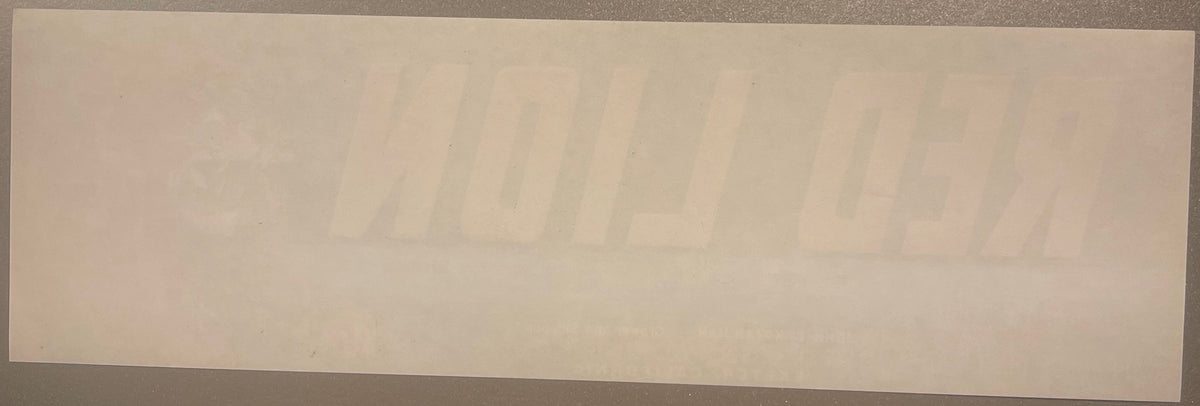
Some pieces of paper survive against all odds — tucked away in warehouse corners, forgotten in storage rooms, outlasting the wooden crates they were meant to dress, the packing houses that printed them by the thousands, and entire industries that rose and fell in a single human lifetime. This Red Lion Brand lithograph crate label is exactly that kind of survivor. Bold, fierce, and unapologetically dramatic, it carries a roaring lion rendered in deep reds and burning oranges against a rich purple field — a piece of commercial art so vivid and confident it practically dares you to look away. My photographs genuinely do not do it justice. You have to hold this thing in your hands to feel the full weight of what California's golden age of fruit shipping looked like when it was dressed to impress.

This is new old stock (NOS) — an unused label that never made it onto a crate, never rode a rail car east, never sat in a buyer's warehouse in Louisville or Chicago. It came straight from inventory into the collector market, which is the only reason a piece of lithographed paper this vivid survives in the state it does. It is an excellent early example of American commercial art and the storied California crate-label tradition at its height.

The label reads exactly as printed: RED LION BRAND — NET WEIGHT 27 LBS. — PRODUCE OF U.S.A. — JOHN C. KAZANJIAN, Grower and Shipper — RED LION PACKING CO, EXETER, CALIFORNIA. It measures approximately 13" × 4" — the elongated rectangular format of the classic grape lug-box label, designed for the flatter, shallower crates used for fragile produce like table grapes. The printing method is lithography, the same labor-intensive, color-layered process that made California crate labels the envy of commercial printers worldwide. The color palette alone — red, orange, yellow, blue, purple, white — required multiple press passes and the kind of precise registration that separated the great lithography shops from the ordinary ones. Museums and art institutes maintain galleries dedicated to this tradition, and for good reason: the craft has never quite been replicated.


🦁 The Red Lion and the Man Behind It — John C. Kazanjian of Exeter

Here is something that surprises a lot of buyers when they first encounter this label: Red Lion Packing Co. was not a large corporate entity. Court records are unambiguous on this point. John C. Kazanjian was an individual doing business as Red Lion Packing Company — a sole proprietor, a DBA, one man running his own operation under a trade name that projected far more ferocity than any single-owner packing house had any right to project. There is something deeply American about that. You pick a roaring lion. You stamp it on your boxes. You ship your grapes across the country and let the label do the selling.

The label names him plainly: Grower and Shipper. That dual designation matters. Kazanjian did not merely pack fruit grown by others — he grew it himself and moved it himself, controlling the chain from vine to railcar. Records confirm he grew grapes and operated a packing house at Exeter, and that the Red Lion Packing Co. evolved into a fruit-dehydrating operation — drying grapes into raisins, following the San Joaquin Valley's shift toward the dehydrated fruit trade that made California famous in American pantries from coast to coast.

The surname Kazanjian is Armenian, and it fits perfectly into one of the most fascinating and underappreciated chapters of California agricultural history. Armenian immigrants and their American-born children became among the most consequential figures in the San Joaquin Valley's grape and raisin industries, arriving in significant numbers in the late nineteenth and early twentieth centuries, often settling in Fresno and Tulare counties, where the soil and climate matched what they already knew about growing. The Kazanjian family's presence in Exeter as growers and shippers was part of that broader pattern — a diaspora community that planted itself in California's valley floor and shaped an industry. Their personal biography, the precise arc of immigration and settlement, has not been independently documented in surviving records — but the name itself tells a story that collectors of California agricultural ephemera will immediately recognize.

Lore passed down among collectors of San Joaquin Valley labels holds that many of the Armenian grower-shippers of this era chose bold, powerful mascots for their brand names — lions, eagles, crowns — as a deliberate statement of permanence and pride. Whether Kazanjian chose the lion for that reason or simply because it was the most striking image a lithographer could put on a grape crate, the result is a label that commands a room.


⚖️ The 1948 Federal Court Case — Red Lion Goes National

One of the most remarkable pieces of documented history attached to this label is a U.S. District Court case from 1948: Joseph Denunzio Fruit Co. v. Crane, 79 F. Supp. 117 (S.D. Cal. 1948). The case reads like a map of how California produce actually moved across America in the mid-twentieth century. Four parties are named: Raymond M. Crane, doing business as Associated Fruit Distributors of California in Los Angeles; John C. Kazanjian, doing business as Red Lion Packing Company in Exeter, California; A. B. Rains, Jr, a food broker in Louisville, Kentucky; and the Joseph Denunzio Fruit Company, a Kentucky corporation with principal offices in Louisville.

The dispute centered on principal-and-agent questions between the Los Angeles distributor and the Kentucky buyer — but what it reveals incidentally is that Kazanjian's Exeter packing house was plugged directly into a national distribution network that stretched from the San Joaquin Valley through Los Angeles brokers out to the American Midwest and South. Red Lion grapes were not a local product. They were moving east, under that roaring lion label, to buyers who had never set foot in Tulare County and never would. The court case, dry as its legal language is, captures the scale of ambition behind a small Exeter packing house in the late 1940s — and it places the active life of this label squarely in the 1940s to 1950s, a dating confirmed by multiple collector and ephemera sources, with several pointing to around 1950 as the heart of the label's use.


🌄 Exeter, California — The Heart of the Citrus Belt and the Grape Country Beyond It

Exeter sits in Tulare County in the eastern San Joaquin Valley, tucked against the foothills of the Sierra Nevada at an elevation that gives its winters just enough chill and its summers just enough heat to coax extraordinary sweetness out of citrus and grapes alike. The citrus boom that put Tulare County on the national agricultural map started in the 1880s and ran through the 1940s — and it was citrus cooperatives that gave Exeter much of its economic identity. The Exeter Citrus Association was formed in October 1925 as a cooperative for picking, packing, and selling citrus fruit, and its operations became emblematic of the organized, cooperative model that California growers pioneered.

But citrus was never the whole story. The San Joaquin Valley's table-grape and raisin trade ran parallel to the citrus industry for decades, and it was in that parallel world that Kazanjian's Red Lion operation lived. Exeter in the 1940s was a small, tight-knit agricultural town where everyone knew which families farmed which acreage, which packing houses were moving product and which were struggling, and which label on a crate signaled quality to a buyer three thousand miles away. Old-timers from the region recall the packing-house culture of those decades as something close to a community heartbeat — the seasonal rhythms of harvest, the smell of fresh-packed fruit, the stacks of labeled crates waiting for the rail connection that would scatter them across the country.

Local legend in the San Joaquin Valley grape country holds that a grower's label was his handshake with the distant buyer — the one piece of his identity that traveled with his product when he couldn't. A bad label, dull and forgettable, was a liability. A great label — a roaring red lion on a purple field, bold enough to be spotted across a warehouse floor — was a competitive advantage. Kazanjian understood that, or he hired someone who did.


🖨️ The Art of the Lithograph — Why These Labels Were Made to Last Forever (Even Though No One Expected Them To)

The lithographic crate label tradition that produced this piece was never meant to create collectibles. It was industrial commercial art, produced in enormous runs, glued to wooden crates, and discarded the moment the crate was emptied. The miracle of the surviving NOS warehouse stock — labels like this one that never made it onto a crate — is that it preserved, entirely by accident, some of the most accomplished color printing that American industry ever produced.

The dominant California crate-label lithographers of the era were serious industrial operations. Schmidt Lithograph Company of San Francisco, to cite the most celebrated example, was founded in 1872 by German immigrant Max Schmidt, incorporated in 1899 as Mutual Label & Lithographing Company, and renamed Schmidt Lithograph when its landmark new building opened in 1907 — a name it carried for the next six decades. Schmidt and its competitors brought European chromolithography craft traditions to the California produce industry, building color separations by hand, running sheets through the press once for each color, achieving a depth and vibrancy that modern offset printing still struggles to match at the same scale.

The printer of this specific label is named on the label itself. The bottom-left margin carries LITHO. IN U. S. A.—WESTERN LITHO. CO, LOS ANGELES, which makes this sheet the work of Western Lithograph Company of Los Angeles, one of the large houses serving the California crate-label trade. A short two- or three-character code follows the imprint; that is a plate or form number, not a year, and it does not date the label. What was never in question is the quality of the result: multiple colors, crisp registration, and a lion that roars off the paper with genuine graphic authority.

For fragile produce like grapes — where a standard square crate would bruise the fruit — packers used a flatter, more elongated lug box. The label format followed the box: shorter in height, wider in proportion, the long horizontal rectangle that became the signature shape of the grape-country label. At approximately 13" × 4", the Red Lion label is textbook lug-box format, designed to wrap around the narrow end of a grape crate and announce itself in a packed railcar or produce warehouse with maximum visual impact.

Collectors who follow the crate-label market closely note that labels from Tulare County grape and raisin operations — especially those from smaller, family-run packing houses like Kazanjian's — surface far less frequently than citrus labels from the same region. The citrus cooperatives ran larger print volumes; the grape operators often printed shorter runs tailored to a single season's pack. That arithmetic works in a collector's favor today.


🕰️ A Word on Rarity and What "NOS" Really Means

New old stock in the crate-label world entered the collector market primarily through two routes: warehouse cleanouts when packing houses closed, and the occasional discovery of storeroom inventory tucked away and forgotten for decades. Once a packing house shuttered — and most of the small independent operators of the 1940s and 1950s did eventually close as the industry consolidated — whatever labels remained unused were either discarded or, if a sharp-eyed dealer got there first, preserved. The supply is genuinely finite. No one is printing new Red Lion Brand grape labels. The Exeter packing house is gone. The crates are gone. What remains is what survived, and what survived is now dispersed into collections and galleries where it tends to stay.

Museums and art institutes with collections dedicated to California crate labels understand this. Once the available supply is absorbed into collections and display, these pieces become genuinely difficult to acquire. A label like this one — vivid, graphic, tied to a documented company and a real named individual, from a specific town with a specific place in California agricultural history — represents the kind of depth that serious collectors and institutional curators look for when they look at this category at all.


🖼️ Display Ideas

  • 🖼️ Frame it simply and hang it large. A clean black or dark walnut frame with a wide mat pulls out the purple background and lets the lion command the wall — works beautifully in a kitchen, dining room, home bar, or any room that wants a genuine conversation piece rather than a reproduction.
  • 🗺️ Build a California agricultural map display. Pair it with a vintage Tulare County or San Joaquin Valley map and one or two other Exeter or Tulare County labels for a geographically anchored wall grouping that tells a regional story.
  • 🍷 Wine room or tasting room centerpiece. The grape connection is direct — a roaring lion from a California grape packing house is natural, thematic decor for a wine cellar, tasting room, or any space dedicated to wine culture.
  • 📚 Home office or library accent. Framed behind a desk or in a reading room alongside other pieces of American commercial ephemera, it reads as serious collector taste rather than decoration — the kind of thing that prompts guests to ask questions.
  • 🏪 Restaurant or specialty food business display. A framed crate label in a farm-to-table restaurant, specialty grocer, or food-focused retail space connects the space to the authentic visual language of American produce history in a way no reproduction ever can.
  • 🎁 Collector's archive display. Housed in an archival sleeve within a flat file or display portfolio alongside documentation of the 1948 court case and Exeter's agricultural history — a research-backed presentation piece for the serious collector who wants the story as much as the object.

🎁 Who Collects These

California crate-label collectors are a genuinely diverse group, and the Red Lion Brand draws from several overlapping communities. California agricultural history enthusiasts — especially those with roots in or affection for Tulare County, the San Joaquin Valley, or the grape and raisin industries — respond to the specificity of a named grower, a named town, a documented legal history. Armenian-American heritage collectors find personal resonance in the Kazanjian name and its place in the San Joaquin Valley's immigrant farming story. Graphic design and commercial art collectors prize the lithographic process itself — the color depth, the illustration quality, the craft of an era before digital reproduction flattened everything into the same visual register.

Beyond those specialist communities, the Red Lion label appeals to anyone drawn to powerful animal imagery in vintage Americana — the roaring lion is not a subtle design choice, and it reads beautifully in a modern interior that wants one strong vintage graphic rather than a cluttered wall of decoration. Increasingly, interior designers sourcing authentic American antiques and vintage advertising for residential and hospitality projects treat crate labels as a legitimate and historically grounded alternative to mass-produced vintage-look prints. This one earns that treatment.


❓ Frequently Asked Questions

Q: What fruit or produce did the Red Lion Brand label go on?
A: The 27-lb. net weight and the elongated 13" × 4" lug-box format are consistent with table grapes, and records confirm that John C. Kazanjian was a grape grower and shipper who also operated a fruit-dehydrating (raisin-drying) operation. The lug-box format was standard for fragile produce like grapes that required a shallower, flatter crate than citrus or other hardier fruit.

Q: Who exactly was "Red Lion Packing Co." — was it a big company?
A: No — and this surprises a lot of people. Court records from a 1948 U.S. District Court case confirm that Red Lion Packing Co. was the trade name of John C. Kazanjian personally — a sole proprietor doing business under that name, not a large incorporated firm. The label's own text names him as "Grower and Shipper," meaning he farmed the grapes, packed them, and moved them to market himself, plugged into a national distribution network that reached buyers in Kentucky and beyond.

Q: Is this an original label or a reproduction?
A: This is an original vintage lithograph label — new old stock (NOS), meaning it was printed in the 1940s–1950s era and never used on a crate. It is not a modern reproduction or a digital print of a vintage label. The paper, the ink, and the lithographic printing process are all period-authentic.

Q: Who printed it — was it Schmidt Lithograph or Western Lithograph Co.?
A: Honestly, the printer is undetermined. Until a maker's mark or union bug in the label's margin is positively identified, the lithographer's name remains an open question — and I'd rather tell you that honestly than assert something I can't confirm. What's not in question is the quality of the printing itself.

Q: How do I frame and preserve a vintage crate label?
A: The standard collector approach is archival (acid-free) mat board and UV-filtering glazing — either UV-filtering glass or acrylic — to protect the paper and inks from light degradation over time. For storage rather than display, an archival polyester sleeve in a flat file is ideal. Avoid direct sunlight and high-humidity environments. A framer experienced with paper ephemera will know the right materials.

Q: Is Exeter, California still an agricultural area?
A: Yes, though the industry has changed significantly. Tulare County remains one of California's most productive agricultural counties, but the small independent packing houses of the mid-twentieth century — operations like Kazanjian's Red Lion — have largely been replaced by large-scale corporate agriculture and cooperative consolidation. The Exeter Citrus Association, formed in 1925, was emblematic of the cooperative model that eventually reshaped the industry. The era that produced this label — the independent grower-shipper, the personally named label, the sole proprietor sending his brand across the country on a wooden crate — is genuinely gone, which is exactly what makes surviving artifacts from it worth preserving.

Q: Why do so many crate labels survive unused when they were meant to be glued onto crates?
A: Labels were printed in large runs at the start of a season, and packing operations rarely used every label printed. When a season ended, surplus labels went back into storage — sometimes for years, sometimes for decades. When packing houses eventually closed, that warehouse stock either got discarded or, if a dealer arrived in time, entered the collector market as NOS. The finite nature of that surviving inventory is what makes original vintage labels genuinely collectible: no new stock is being produced, and every label that enters a collection tends to stay there.

📋 What Is Printed On This Label

Every line of type on the sheet, transcribed from the label itself rather than paraphrased:

  • RED LION
  • BRAND
  • NET WEIGHT 27 LBS.
  • PRODUCE OF U.S.A.
  • JOHN C. KAZANJIAN - Grower and Shipper
  • RED LION PACKING CO.
  • EXETER, CALIFORNIA
  • LITHO. IN U. S. A.-WESTERN LITHO. CO., LOS ANGELES (+ short plate/form code)

Printer: the lithographer is named on the sheet — LITHO. IN U. S. A.-WESTERN LITHO. CO., LOS ANGELES, set in microtype in the margin.

The printer's mark is in the margin, and it is legible. The bottom-left margin of this sheet carries LITHO. IN U. S. A.—WESTERN LITHO. CO., LOS ANGELES, set in small pale type on the blue band, followed by a short two- or three-character code. Western Lithograph Company of Los Angeles printed it. The trailing code is a plate or form number, not a year, and is not a date for this label.

No fruit is named in type. The sheet prints PRODUCE OF U.S.A. and NET WEIGHT 27 LBS. — the standard California grape lug weight — but the word grape appears nowhere on it.

Shipping

🚚 Shipping & Handling

  • Shipping costs and timing are calculated at checkout.
  • Items curated and shipped directly by me include U.S. shipping at no additional cost, professionally packed to ensure safe arrival of your artifact.

Items from Vetted Pro Collectors
Shipping for items offered by vetted Pro Collectors is determined at checkout. All Pro Collector listings are reviewed to ensure fair, reasonable shipping practices.

For full details, please refer to our Shipping Policy.

Returns & Exchange

Take your time — you've got a full six months. If a piece isn't right for you, send it back the way it reached you and we're good.

In the first 30 days your money goes straight back the way you paid. After that it's store credit, so you can put it toward something you'd rather have.

Return shipping we sort out between us, case by case. I don't make this difficult.

If something arrives damaged, or it isn't what I said it was, send me a photo within 48 hours and I'll make it right.

Email info@vintageantiquesgifts.com or call 802-356-9872 — that's me answering, not a call center.

The only things I can't take back are custom or special-order pieces and gift cards.

View full details